Showing posts with label Aaron Sorkin. Show all posts

Thursday, December 9, 2021

BEING THE RICARDOS

 Nicole Kidman     Javier Bardem     J. K. Simmons     Jake Lacey
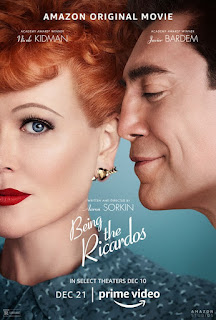
Nina Arianda     Alia Shawkat     Tony Hale


            I was not a big fan of the Lucy/Desi shows, so I didn’t see Being the Ricardos with much nostalgia.  But for those who did love them, the film is likely to be a big hit.  A few viewers in the screening audience laughed out loud on cue with the radio audience, suggesting they were having fond looks down memory lane.

            I will say that the film is informative in that I was not aware of the significant roles Lucille Ball and Desi Arnaz had had in their productions, from the script to the sets to the executive decisions.  I had read about Arnaz’ revolutionary role in the creation of television as it’s seen today, but the film shows the painstaking efforts of the couple—each with different ideas—in executive decisions.  The stunned looks on the named executives’ faces foretell the significance and revolutionary nature of Desi’s and Lucy’s contributions.

            It’s also educational for the viewer to be given a peek behind the scenes and witness the haggling and sometimes brutal struggles that take place among writers, producers, actors, and sponsors in putting on a show.  When we see the finished product, usually little of the blood, sweat, and tears that went into the project are apparent.

            Something is puzzling to me, though.  It’s not uncommon for actors to disappear into their characters so much so that the viewer becomes unaware of the actor.  Recent case in point is Jared Leto as a Gucci son in House of Gucci and Benedict Cumberbatch as an American rancher in The Power of the Dog.   And there are countless examples of such through time, with Meryl Streep being one of the paragons of this kind of shape shifting.  However, I did not see that convincing transformation in Nicole Kidman as Lucy and Javier Bardem as Desi.  I was always aware of the actors and had difficulty putting the characters in their place.  The reason this is puzzling is that both Kidman and Bardem are top-notch actors.  It wasn’t as if they weren’t portraying their characters accurately, it was that that “something” that makes the actor disappear was not evident.

            One explanation could lie at the writer/director Aaron Sorkin’s feet.  This is his “creation” in a sense, so perhaps he was not as attuned to subtleties and nuances that he could have exploited.  His scripts can sometimes border on the glib, where the writing is more about the craft than about human drama, especially when it is delivered rapid-fire like stand-up comedy.  Other times, I wondered why some dialog was even inserted, such as when writer Frawley (Simmons) asks Desi whether he was scared when the Cuban militia came for his family, which constitutes a “Duh!” moment.

            Another somewhat minor—although annoying--issue with the film is sound production.  So often, music and sound effects drown out the dialog, even when sound effects are not necessarily needed (for example, the rain at one point).  Javier Bardem’s English is excellent, and I have never had difficulty understanding him in a movie, but apparently here, he was advised to affect a stronger Spanish accent than even Desi actually had, resulting in my not comprehending all of what he said.  (I never had trouble understanding Desi in sound clips.)

            Being the Ricardos will be primarily for die-hard fans who are nostalgic and for those who like to watch behind-the-scenes filmmakers hash out the fine points of scenes, plots, and characters. 


Being the Ricardos is for the fans of Lucy and Desi primarily and for a look at the influence two actors had on television production.  


Grade:  C+                            By Donna R. Copeland


Wednesday, December 27, 2017

MOLLY'S GAME

Jessica Chastain     Idris Elba     Kevin Costner     Michael Cera
Jeremy Strong     Chris O’Dowd      Bill Camp     Brian d’Arcy


     This is one of the few, or only, major films showing a female character who is strong, cheeky, brilliant, daring, and successful, and who chooses an honorable path regardless of the consequences.  Often, we see a film showing men in that position, but not women. 
     Molly Bloom (cunningly played by Chastain) is a cheeky woman brought up by her sports-obsessed father (Costner) to compete to the death on a ski slope; he’d had great success with her older brothers.  When she was 12 years old, after major surgery for scoliosis and doctors’ recommendation not to ski again, she went on to compete in the Olympics as part of the U.S. team.  Bad luck came in the form of a small piece of pine embedded in the ice slope, which ended her skiing career forever.
      Nevermind.  This is a woman of many talents and formidable determination.  She’s set to go to law school, but against her father’s wishes, she chooses to move to Los Angeles from Colorado and find “temporary employment” as a waitress in a nightclub and as an office assistant, just for a break.  Her employment as office assistant turns into a 24-hour a day job for Dean Keith (Strong) who runs a gambling casino in the Cobra Lounge.  Molly is nothing but smart, and quickly learns everything she can about poker; moreover, she draws up spreadsheets (something Dean has never heard of) showing the bets, wins, losses, and financial information. 
     When Dean sees how much she is making as his assistant, he tries to stiff her (as will another character later on, both planning to do an age-old con on a woman), but she is already ahead of him and opens her own place of business.  Keep in mind that all along, Molly takes great effort to see that her business is legal and above board.  She is circumspect in not indulging in many of the activities men in her position have a history of doing. 
     However, the money is so good, and she takes a few risks in cutting corners.  But she is back on track toward her goal of enrolling in Harvard Law School when she is arrested by the FBI.  This brings her in contact with Charlie Jaffey (Elba), a high-priced, circumspect lawyer who doesn’t regard her as rich enough or ethical enough to warrant his law practice.
Their interactions and conversations are quintessential Aaron Sorkin—fast-paced, erudite, and funny.  Molly has to convince him to take her on as a client with drawbacks that are against his standards of practice as well as money.  That’s when the film takes on the elements of a thriller and an inspiring life story.
     Chastain brings her considerable talent to this role, most likely reinforced by the nature of the character’s challenges and struggles.  It’s another victory of brains and ethical grounding winning out over masculine pride and ego, including those of a psychologist-father, who took many years to understand how much grit she had and how much like him she was.  Chastain tackles the role as she always has in grasping all the elements that make up her complicated character.  Idris Elba is just as much master of his role, and the two of them make an excellent pair in shaping the action.
     This film should be an inspiration to women aspiring to achieve success and to men who want to understand these women in a non-stereotypical manner.

A refreshing and different take on a crime thriller.

Grade:  A                                    By Donna R. Copeland

Tuesday, October 13, 2015

STEVE JOBS

Michael Fassbender     Kate Winslet     Seth Rogen     Jeff Daniels     Makenzie Moss

          Living/working with a genius is no easy task, as is made very clear in the film Steve Jobs.  Aaron Sorkin wrote the screenplay based on Walter Isaacson’s book with the same title.  From the way the dialog is written in the film, it clearly reflects Sorkin’s style of rapid-fire conversation and arguments that speed by too fast to give them any thought.  In fact, that is much of the film, with Steve (Fassbender) having no-holds-barred repetitive arguments with his closest associate, Joanna (Winslet), his daughter Lisa and her mother Chrisann, his creative partner Wozniak (Rogen), board chair Sculley (Daniels), and many, many others.  Sorkin’s mark is also in snappy one-liners:  “The very nature of people is something to be overcome.”  “Things don’t become so because you say so.”  And the best, spoken by the grown-up Lisa about the new iMac “looking like the inside of Judy Jetson’s Easy Bake Oven.”
          From the beginning, we get the impression that for Jobs, it’s all about him.  He has a maddening way of responding to an assertion with an argument a few degrees off the topic.  To his credit, however, he apparently developed some insight into himself and made some positive changes across time.
          The film covers only the period of time when he and his team are launching the first Macintosh product (1984) up to the introduction of the iMac (1998).  In between, Steve was fired by his board and started new companies, but then rejoined Apple later.  Time is marked by switching back and forth between three product launches and Jobs’ relationship with his daughter, whom he initially denied until he saw an aspect of himself in her (her facility with a computer at age 5).  This back-and-forth between personal and professional at the nerve-wracking times of launches was not a good choice on the part of the filmmakers; it’s too frenetic.
          Fassbender seamlessly captures the character he plays, and I was most impressed with his skill in showing Jobs at his most sensitive, when someone (usually Joanna, but also Sculley) gives him a perspective on himself that he is ripe for or touches him emotionally, as when his young daughter Lisa (Moss) spontaneously gives him a hug.  He grows silent, withdraws into himself, and almost—but not quite—sheds a tear.  Other times, when someone is railing against him, his face is completely impassive. 
          Winslet is critical in helping carry this film and we admire her art and skill, as well as her character Joanna (a composite of three women), who was probably key in holding Jobs together and keeping him grounded.  She was just what he needed in smarts, friendship, emotional support, and basic values, which he sometimes seemed to lack.  Jeff Daniels and Seth Rogen in supporting roles epitomize the professional struggles Jobs had with his colleagues, and clearly illustrate the ambivalence that was characteristic of all of his relationships shown in the film.
          I found the film very interesting.  Despite having some motivation to read Isaacson’s well-received book, a New York Times best seller, I actually never did.  Hopefully, the film is a good rendition of it, showing a truly remarkable man who played a significant role in bringing so many people to the technological age we’re in, but who had his share of human faults.  Amazon says he “revolutionized six industries:  personal computers, animated movies, music, phones, tablet computing, and digital publishing.”  Wow!

A tale of Apple well told.

Grade:  B+                        By Donna R. Copeland