Showing posts with label George MacKay. Show all posts

Tuesday, December 7, 2021

WOLF

 George MacKay     Lily Rose Depp     Paddy Considine     Marten McCann     Terry Notary
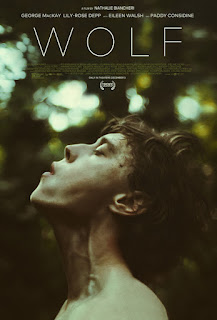

            Wolf implies that “species identification disorder” is common, when in fact “species dysphoria” is a very rare condition.  I found this movie misleading and distasteful in so many ways.  First of all, the “hospital” staff treat the humans like animals, expecting them to become human, e.g., shaming them into compliance.  The filmmakers appear to know nothing about proven behavioral principles and therapy.  Progressive approximation is a common technique used by certified psychologists, whereas shame used by The Zookeeper (Considine) gets one nowhere or into something worse.  When the “patients” began to rebel at one point, my thought was that if you treat humans like animals, they will begin to show animalistic behavior.

            That is also shown in individuals, such as Jacob (MacKay) who is demonstrably tender-hearted, but when The Zookeeper in particular treats him more and more like an animal, he becomes ferocious.

            Jacob’s and the other residents’ parents have brought them for therapy, and have high hopes that they will get better.  But we don’t see any of them getting better, only worse, which shows the staffs’ techniques are wrong.  It may be that the filmmaker’s (writer/director Nathalie Biancheri) intention is to show the abuse and ill intentions for all to see, but there is no indication of that in the film.  Appropriate ways of treating people with mental disorders is never apparent.

            In contrast with the staff, when Jacob and his new-found friend “Wildcat” (Depp) confide in one another, they become more human in their sympathy, empathy, and attitude toward their peers.  Mackay’s performance is noteworthy, especially when we see him moving in the forest; he must have studied the movement of wolves enough so that his form looks convincingly feral.

            One comment made by an inmate suggests that the staff uses technology (like an iPad game) to connect them with their human side.  (Staff apparently don’t read today’s claims about technology possibly turning us into automatons.)  Other ludicrous interventions include a hopping dance with forced smiles (not emotionally based), shocks delivered to the abdomen, and placing disobedients gagged and chained into a cage.


There is nothing to redeem this psychological disaster of a movie.


Grade:  F                              By Donna R. Copeland 

Tuesday, December 24, 2019

1917

George MacKay    Dean-Charles Chapman     Andrew Scott
Mark Strong     Richard Madden     Colin Firth     Benedict Cumberbatch


     Be prepared to run for all you’re worth with the characters over all kinds of terrain strewn with friendly and enemy soldiers and feel continuing tension for almost the entire film of 1917.  Director and writer (with Krysty Wison-Cairns) Sam Mendes and his cinematographer Roger Deakins made an excellent call in filming the entire adventure in essentially one continuous take.  With the immediacy of the story, it pulls the viewer right into the screen, and you are there.  
     In France in the first World War, two young Lance Corporals, Tom (Chapman) and Will (MacKay) are sent on a mission to Colonel MacKenzie (Cumberbatch) with the urgent message to cancel a military charge where, unbeknownst to MacKenzie, a trap has been set by the Nazis.  Will and Tom will have to cross a no-man’s land of dead bodies and through enemy lines to get by all kinds of dangers along the way, and they have only a few hours to make it.  The charge is given with a special incentive:  Tom’s brother is one of the 1600 men in MacKenzie’s company who will be killed if MacKenzie proceeds with the attack.
     Along with the script and direction, cinematography and music (Thomas Newman) are paired so seamlessly with the story they serve as sensory enhancements, intensifying the whole experience.  There are breathtaking scenes such as one at sunset when a soldier is sneaking through the sculpted forms of the remains of a bombed-out building, which Deakins has constructed to look like a morbidly colorful abstract painting.  The whole scene is heightened by the fear of being shot.  In this case, the music has unworldly sounds that give expression to the tension and fear.  Other times, there are sharp contrasts between the horrors encountered along the way and snow-white cherry blossoms wafting in the breeze or come upon in a host of trees felled by the Germans.  
     Another feat in this film is the production design (Dennis Gassner) and the creation of miles of military encampments, abandoned encampments complete with rats, and a bombed out building where a young woman and an abandoned child are sheltered with one candle burning brightly.  And much later on, we witness a contrast with a camp of British soldiers listening to one of their own singing the popular American folk song, “Wayfaring Stranger.”  
     The paradox of 1917 is in its graphic description of the horrors of war coupled with the visual and lyrical beauty in which the story is presented.  A late bloomer this year, 1917 may be at the top of more than one list in the upcoming award season.

Heroics are paramount in 1917, but the visual and musical enhancements and the brief, tender moments, altogether, earn it a place on the “must see” list.

Grade:  A                                    By Donna R. Copeland