Showing posts with label Glenn Close. Show all posts

Thursday, December 16, 2021

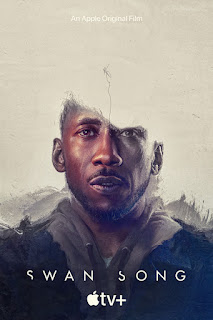
SWAN SONG

 Mahershala Ali     Naomie Harris     Glenn Close     
Awkwafina     Adam Beach     Lee Shorten


            This bit of sci-fi poses some interesting moral and ethical questions about the extent to which one could/should make a valiant attempt to spare his family grief and suffering.  Cameron’s (Ali) wife Poppy (Harris)—normally a vivacious, perky kind of woman—had undergone a severe reaction when her twin brother was killed, and if he could protect her from the potential for that to happen a second time, he is seriously considering participating in a medical experiment as a solution.

            Cameron, a commercial artist given to presenting his spontaneous drawings of those he meets to them, has been experiencing the effects of a brain disorder for some time, but hasn’t had the courage to tell Poppy.  They have a young son and another child on the way, comprising a most happy family.  When his disease worsens, Cameron is presented with a most unusual option.

            Arralabs is experimenting in making molecular copies of terminally ill patients—not just their bodies and physical appearance but all their memories from the time they were born, as well as their unconscious mind—as a way of preserving family relationships and avoiding grief after a major loss.  It boggles the mind to think about, and as you see how the process works there is definitely an eeriness about it.  You see the clone being developed in the lab, and indeed he looks exactly like Cameron.  

            The process goes on for a number of weeks for a full transition to be completed, so Cameron has some time to prepare—and even back out—although after a certain point dropping out won’t be possible.  The clone’s memories of the transformation will be erased, after which, he will be Cameron.  Cameron must then bear his own fate alone, albeit on Arralabs’ extensive well-kept, scenic grounds in the Pacific northwest.  

            Dr. Scott (Close, embodying the ideal doctor—warm, direct, sympathetic, informative) has given Cameron a detailed description of what to expect and the terms of the contract.   Whenever he has doubts, she informs him of his options, and although she makes it clear all of this is his own choice, she encourages him to stick with the plan for the sake of his family.

            Swan Song, written and directed by Benjamin Cleary, skillfully and realistically portrays the kinds of dilemmas and considerations that one would encounter in considering such a proposal at this.  He depicts research hospitals and staff as caring and informative—just as one would hope to—and does—find in good research centers.  And he shows (thoughtfully enacted by Ali) the degree of ambivalence the research subject will undergo in making such a momentous decision.  The Lab has arranged for Cameron to see his clone interacting with his family at home, so he must deal with all the emotions that brings up for him.

            As a futuristic solution to the problem of loss and grief, I appreciate this slant on how things could be at some point in the future.  The world is changing at a rapid pace, so it is within the realm of possibilities that such a system could be an option.  (I’m avoiding, of course, how much it would cost and who would pay for it.)


This adventure into the sci-fi world of human replication offers an intriguing new idea for managing loss and grief.


Grade:  B                              By Donna R. Copeland

Wednesday, November 11, 2020

HILLBILLY ELEGY

Owen Asztalos     Gabriel Basso     Amy Adams     Glenn Close     Freida Pinto     Haley Bennett


     After a ride touring the horrors of addiction combined with credulousness, Ron Howard has made me feel as if I’d been there.  One watches this like a child in the drama, pulled in, but helpless to do anything about what is going on onscreen.  

     The main character, J.D. (Asztalos as the younger and Ballo as the older) is looking back on his life as a small boy growing up in the hills of Kentucky into a family strong on loyalty and responsibility toward one another, but susceptible to addictions.  Based on the memoir of the real J.D. Vance, it is indeed an elegy to the people who brought him up—some of whom have passed on.  It shows how strong family connections can be—especially if family has been its primary value—when this has been drilled into a child throughout.  The film likewise shows the sense of guilt that is a strain running through it.

     Young J.D. lives with his mother Bev (Adams) and older sister Lindsay (Bennett), with Grandma (Close) ever present.  He’s a bit clumsy, and this can trigger a crisis with his mother who is usually on a fine edge.  Susceptible to stress, she might take out after anyone, with no thought of the consequences.  Earlier in life, J.D. has been able to count on Grandma to rescue him from his mother’s rages, and later, his older sister Lindsay (read parent-child), who has become Bev’s primary responsibility.

     Through all this, with some luck and some of his Grandma’s guidance, J.D. has managed to make it to law school.  It’s a completely different world than he’s been used to (Uh…what fork do I use among three on the table?!), and he has some sense about the cloistered world of the Ivy League and how he doesn’t fit in.

     Luck often plays a role in success stories, and here one piece of luck is in J.D.’s romantic relationship with Usha (Pinto), a woman of Indian descent who has all the empathy and good sense lacking in his early life.  Intuitively, he grasps how different and how healing she can be, worrying that his troubles will drive her off.  As you watch this film, their interactions will serve as flight into reasonableness away from the cacophony of J.D.’s circumstances. 

     Ron Howard has established himself as a film director who can empathize with all kinds of people with major problems (e.g., A Beautiful Mind, Cinderella Man) and here he sheds light on not only the ethos of “hillbilly” families, but also the plague of addiction that has hit them so hard—opioids.  They are vulnerable because without the essential skills of parenting, open communication, and reasoning, families are unable to cope with the thrill of the moment, peer pressure, and economic need that prey upon them.  It’s a tale that needs to be told dramatically to get the point across.

     Glenn Close is her usual wonder to behold, almost unrecognizable here as a wizened old woman who has done the best she can, considering her life story. She conveys crusty warmth and encouragement, somehow getting through to the hapless J.D.  Because of the role she plays—despite how well she does it—Amy Adams is not so sympathetic, although seeing her in the grip of addiction makes one more empathic with those currently in its throes.  Gabriel Basso, Freida Pinto, and Haley Bennett round out a well-chosen cast to tell this poignant story.


Hard to watch, but a beautifully composed film that is eloquent in its depiction of the effect of drugs on an entire family through generations.


Grade:  A                                    By Donna R. Copeland


Sunday, September 23, 2018

THE WIFE

Glenn Close     Jonathan Pryce     Christian Slater     Max Irons     Elizabeth McGovern


     How many young wives have made the bargain of being a dutiful, adoring wife to their husbands with the tacit agreement that his career is top priority?  Countless, I would say, with most never realizing the long-term consequences of that bargain.  That’s Joan in the ‘50’s as a wide-eyed English student at Smith College taking a writing course from erudite Professor Castleman.  He praises her work—and asks her to babysit for him and his wife.  During that time, she is introduced to a female writer of some note—but not really famous—who advises her not to write, because publishers (who, at that time, are men) will not take women’s writing seriously.  Her books will end up only on university alumni shelves.
     It isn’t long before Joan and Joe are having an affair, and his divorce and their marriage come soon after.  But friction between them surfaces after she reads one of his manuscripts, which has been rejected by a publisher.  She critiques it honestly (and innocently), suggesting that the characters are “wooden” and the dialog “stilted”, and he goes into a narcissistic rage.  (Through the years, temper tantrums will continue to be one of his preferred methods for getting her to give into him.)  She responds by belittling herself and offering to “fix” the manuscript.  She is waiting tables at the time, and when she overhears men discounting writers who are women/Jewish, she runs home for “their” manuscript, gives it to the critical men, and sure enough, they agree to publish it.  Is there any mention of attaching her name as a co-author? No!  This is the fifties…
     The film opens on the cozy relationship between Joe Castleman (Pryce) and his wife Joan (Close), who have been married for years and have a daughter who’s pregnant with their first grandchild and a son, surly David (Irons), an aspiring writer. (Oedipal issues abound in the story, and are accounted for toward the end.)  Soon, jumping-on-the-bed rejoicing comes after an early morning call from Sweden informing Joe that he has won the Nobel Prize for literature. We get an “all is (almost) right with the world” vibe from the couple, and they head for Sweden along with their son David, who seems to be wishing he were anywhere else.  Clearly, Joan must constantly intervene in the men’s quarrels—which will make sense later on in the story.
     The rest of the film juxtaposes the luxurious Nobel surroundings and people with the Castleman family drama, one that realistically portrays the struggles families must undergo across time as new experiences and new events alter individuals in significant ways.  Everyone must adjust—some do so successfully, some not so admirably.  
     The Wife is based on a novel by Meg Wolitzer (screenplay by Jane Anderson) and skillfully directed by Bjorn Runge.  Although I usually don’t like films going back and forth in time, that arrangement works here in giving us some information in the present, then explaining it by showing past events.  The contrast between the Castleman couple’s coming together in the fifties and their experiences forty years later shows the turn of events that makes it seem topsy-turvy—but not if you pay attention to transitions.
     Humor, gut-wrenching interactions among characters, and apprehensions of all kinds keep the plot forging on while we sit transfixed, wondering how it will all turn out.  All this is beautifully dramatized by the actors.  Glenn Close is exemplary in her role as a woman of substance:  a delight, and a creative contributor, facilitator, arbiter, planner, and negotiator.  She is deserving of a major award.  As her foil, Jonathan Pryce is more than convincing as a self-obsessed dependent tyrant who has little insight in himself.  Max Irons is talented in portraying a range of characters, from FBI rogue agent (TV’s “Condor”) to disenchanted son with mountains of resentment; and Christian Slater is up to his usual portrayal of a formidable persona.

A family story outside the norm for “housewives.”

Grade:  A                                    By Donna R. Copeland


Wednesday, February 22, 2017

THE GIRL WITH ALL THE GIFTS

Gemma Arterton     Glenn Close     Sennia Nanua     Paddy Considine


      Yes, she has many gifts, including that of cunning.  Melanie (Nanua) is a survivor of a fatal fungus infection that has spread around the world, but she is immune to the disease, along with a group of other children.  Unlike most of the zombies with the fungus, these children can think, reason, and care about other people.  The kids have all been gathered up by Dr. Caroline Caldwell (Close) for her research; she is sure she can create a vaccine that will save everyone.  The problem is that she is deficient in ethics and grandiose in ambition, so has no qualms about using the children’s bodies for the vaccine.  The children are sent to school, but they are bound up in wheelchairs and staff has been instructed never to touch them or even consider them as human beings.  They’re referred to as ‘it’ and ‘thing.’
      One of the teachers has a problem with this, especially regarding Melanie, whom she regards as a very special child who needs support and encouragement more than containment.  Melanie, in turn worships Miss Justineau (Arterton).  She is a very bright, polite, and creative student whom Miss Justineau comes to trust. 
     Through a series of events, the two end up being rescued by Dr. Caldwell and her Sergeant, Parks, and two other soldiers from mobs of zombies that have stormed the military base and are attacking anyone alive for a tasty meal.  Caldwell is still determined to complete her work with Melanie’s brain and spine, so is doing everything she can to protect her.  The group escapes in an armored truck, but must make their way to a point of safety, picking up supplies judiciously along the way.
     Melanie is a big help numerous times, since she can go out in the open (the zombies won’t eat one of their own) for supplies and for reconnaissance.  The situation comes to a climax when swarms of children like Melanie descend on the group, and Dr. Caldwell feels forced to take matters into her own hands and harvest what she needs from Melanie.  This situation gives the film more depth in its ethical dilemma of how much one member of society can be pressured or forced to sacrifice him-herself for the good of humankind. 
     There is plenty of suspense in this thriller directed by Colm McCarthy, based on the screenwriter Mike Carey’s novel.  Sennia Nanua as the always sharp, well-socialized Melanie, is a joy to watch, especially at the end, when she makes a cogent argument using sound logic.  Glenn Close, known for her eerie, sinister female roles, comes through perfectly as the gentle-tongued older woman with seething ambition.  Paddy Considine and Gemma Arterton are also perfect in their support roles of basically normal, thoughtful people interested in giving their jobs their best.

An updated zombie movie with an interresting twist at the end.

Grade:  B+                                    By Donna R. Copeland