Showing posts with label Mahershala Ali. Show all posts

Thursday, December 16, 2021

SWAN SONG

 Mahershala Ali     Naomie Harris     Glenn Close     
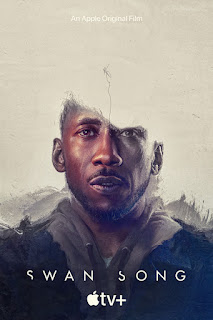
Awkwafina     Adam Beach     Lee Shorten


            This bit of sci-fi poses some interesting moral and ethical questions about the extent to which one could/should make a valiant attempt to spare his family grief and suffering.  Cameron’s (Ali) wife Poppy (Harris)—normally a vivacious, perky kind of woman—had undergone a severe reaction when her twin brother was killed, and if he could protect her from the potential for that to happen a second time, he is seriously considering participating in a medical experiment as a solution.

            Cameron, a commercial artist given to presenting his spontaneous drawings of those he meets to them, has been experiencing the effects of a brain disorder for some time, but hasn’t had the courage to tell Poppy.  They have a young son and another child on the way, comprising a most happy family.  When his disease worsens, Cameron is presented with a most unusual option.

            Arralabs is experimenting in making molecular copies of terminally ill patients—not just their bodies and physical appearance but all their memories from the time they were born, as well as their unconscious mind—as a way of preserving family relationships and avoiding grief after a major loss.  It boggles the mind to think about, and as you see how the process works there is definitely an eeriness about it.  You see the clone being developed in the lab, and indeed he looks exactly like Cameron.  

            The process goes on for a number of weeks for a full transition to be completed, so Cameron has some time to prepare—and even back out—although after a certain point dropping out won’t be possible.  The clone’s memories of the transformation will be erased, after which, he will be Cameron.  Cameron must then bear his own fate alone, albeit on Arralabs’ extensive well-kept, scenic grounds in the Pacific northwest.  

            Dr. Scott (Close, embodying the ideal doctor—warm, direct, sympathetic, informative) has given Cameron a detailed description of what to expect and the terms of the contract.   Whenever he has doubts, she informs him of his options, and although she makes it clear all of this is his own choice, she encourages him to stick with the plan for the sake of his family.

            Swan Song, written and directed by Benjamin Cleary, skillfully and realistically portrays the kinds of dilemmas and considerations that one would encounter in considering such a proposal at this.  He depicts research hospitals and staff as caring and informative—just as one would hope to—and does—find in good research centers.  And he shows (thoughtfully enacted by Ali) the degree of ambivalence the research subject will undergo in making such a momentous decision.  The Lab has arranged for Cameron to see his clone interacting with his family at home, so he must deal with all the emotions that brings up for him.

            As a futuristic solution to the problem of loss and grief, I appreciate this slant on how things could be at some point in the future.  The world is changing at a rapid pace, so it is within the realm of possibilities that such a system could be an option.  (I’m avoiding, of course, how much it would cost and who would pay for it.)


This adventure into the sci-fi world of human replication offers an intriguing new idea for managing loss and grief.


Grade:  B                              By Donna R. Copeland

Thursday, November 15, 2018

GREEN BOOK

Viggo Mortensen     Mahershala Ali     Linda Cardellini     Don Stark     Sebastian Maniscalco


     It’s fascinating to see how filmmakers are able to turn stereotypes on their heads so shrewdly and wittily, which can be funny, heartbreaking, or insidious.  Here, the director (Peter Farrelly) and writers (Nick Vallelonga, Brian Hayes Currie, and Farrelly) have woven a tale based on a true story showing how a slightly condescending African-American who is wealthy, mannerly, and educated can somehow bond with a white working class man, a bouncer at the Copacabana in New York, with clear hostilities toward minorities.  In their concert tour, they confront southerners with major prejudices, field workers gawking at a black man in a suit being driven by a white man who has to fix the car, and self-contradicting southern traditionalists who invite a black artist to perform for them, but will not allow him to use their bathroom or eat in their dining room.
     Part of the delight of Green Book (referring to a guidebook used by blacks designating restaurants and motels/hotels in the south that would accept them as patrons) is observing how, with the right provocative experiences many can change, even though some will be impervious. And that is the lofty goal of Dr. Don Shirley (Ali), to change the world and make it a better place.  He succeeds beautifully and heartwarmingly with his driver Tony (Mortensen)—as he himself is transformed in the process. And we hope that he leaves change in his wake as he protests with dignity the injustices he encounters on the road.  
     Another delight is seeing the different perspectives of the two men crashing into one another, usually in the car on the road.  They have pointed conflicts that are only settled by Don being Tony’s boss.  Yet, Tony gets his jabs in from time to time.  Tony is proud of his life-long designation of “Tony Lip”, which came from his reputation at an early age of being a good bullsh*ter. When Don labels it as simply lying, Tony is offended.  He sees it as getting people to do what he wants them to.  And both learn from the conversation as Tony ponders what Don has said and Don along the way sees how Tony’s bulls*ting gets them out of jams.  It expresses in an exquisite way the truth in both their views.
     Another beauty of this film is to see the two actors, Mortensen and Ali, at work. They are masters at conveying subtle signs of all kinds of thoughts and emotions.  They have perfect chemistry with one another and will always praise the other’s skills.  They’re not just being polite; both approach their roles in a perfectionist way, wanting most of all to convey accuracy and authenticity.  Ali’s piano playing is a wonder to see, and I was curious to know if he could actually play that well.  It turns out that he had a coach and sometimes double, but the rendition on the screen looks like it is all Ali.
     This is a very different Farrelly film from his past collaborations with his brother Bobby (e.g., There’s Something about Mary, Dumb and Dumber, Shallow Hal) in its being more than a comedy, something of a character study, and taking a political point of view with regard to race and class.  He should be proud of the venture in its depth of commentary and essential substance, along with the comedy.  At its most eloquent, Don agonizes, “I’m not black enough, not white enough, not enough of a man—so who am I?”  Stereotypes limit us; diversity frees us.  That’s the message of this film, which won the audience award at the Toronto International Film Festival.
     Despite the two-hour run time, I didn’t want the story to end; I wanted to stay with these people.

A wonderful film that moves you, prompts you to ponder, and makes you laugh.

Grade:  A                                    By Donna R. Copeland

Thursday, November 3, 2016

MOONLIGHT

Mahershala Ali     Alex Hibbert     Ashton Sanders     Trevante Rhodes     Naomie Harris     Janelle Monae     Andre Holland


           This is an artfully rendered film in which the viewer participates by filling in details that are omitted from the storyline, which proceeds from the main character’s childhood to adulthood.  Little/Black/Chiron is the character named differently, depending on his age and the section of the movie.  (The three very fine actors are Alex Hibbert, Ashton Sanders, and Trevante Rhodes.)  Little is picked on as a child because he’s not “hard”; he gets bullied and teased for being a “faggot”, and rarely stands up for himself.  His only friend Kevin (Jadon Piner, Andre Holland, Jharrel Jerome) tries to help him by telling him to fight back, but even in high school, he remains passive.  He’s a boy/man of few words, although the considerable turbulence inside shows on his face to an astute observer.
            When a kind-hearted drug dealer Juan (Ali) finds Little in a “drug hole”, he makes an effort to befriend him, find out where he lives, and who his parents are.  But Little is mostly mute, and it takes Juan’s girlfriend Teresa (Monae) to draw him out enough to find out where he lives.  When Juan takes him home, much is gradually revealed, and we begin to sort out the relationships in the community and why Little’s life is so hard.  We see Juan taking him under his wing, realizing he needs a father figure (which shows up later when Chiron adopts the appearance and occupation of this most important man in his life).
            The switching of actors (three for Chiron and three for Kevin) makes following the story a bit difficult, especially since Chiron says so little, but the actors are so skilled it doesn’t take long to sort it out.  The pace of the film and Chiron’s reticence is skillful in eliciting our empathy, and will hopefully have the effect of helping more of us understand and have sympathy for those caught up in the drug culture in poorer neighborhoods and the trials that gay people undergo even at a young age.  This is a picture of a segment of society that few of us have seen so tenderly portrayed.
            Co-writer with Terell McCraney, director Barry Jenkins has created a portrait of a boy and his milieu that is evocative while being so quiet, eloquent while making the main character Chiron so mute, and heartwarming in its highlights of kindnesses shown toward Chiron.  Its style and form seem groundbreaking to me.
             
An Impressionist painting of a gay child growing up in a black drug culture that elicits our empathy and sympathy.


Grade:  A                                    By Donna R. Copeland