Showing posts with label Guillermo del Toro. Show all posts

Wednesday, December 15, 2021

NIGHTMARE ALLEY

Rooney Mara     Bradley Cooper     Cate Blanchett     Willem Dafoe     Mary Steenburgen

Toni Collette     Ron Perlman     Tim Blake Nelson     Richard Jenkins     David Strathairn
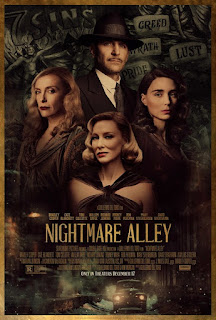
            It’s a nightmare all right.  It starts out with arson by a shady-looking character, and we follow him as he wanders around and ends up at a circus, where he manages to get hired.  Stan Carlisle (Cooper) is smart and a bit of a charmer, and quickly makes friends with the showrunner (Dafoe) and the fortune teller Pete (Strathairn) and his roommate Zeena (Collette), a reader of Tarot cards.  When he learns fast from Pete and begins to offer tips on improving Molly’s (Mara) electrical act, it becomes clear that he has worked in the circus before, and that he doesn’t mind conning people.

            But like all good sociopaths, he draws viewers into his web and we become fascinated with/question more and more of his actions.  Del Toro’s mastery in weaving stories that develop slowly across time, sustain glued-to-the-screen interest with spikes of anxiety and tension is clearly working in Nightmare Alley.  All the characters have potential to be a story unto themselves, but somehow Del Toro and his team integrate all of them into a coherent whole.  He co-wrote the screenplay with Kim Morgan and William Lindsay Graham who wrote the novel on which it is based.

            The filmmakers make the most of their cast headed up by Bradley Cooper who embodies a corrupt phoenix that keeps rising after destruction.  Conning is his game, and it is only the goons [Molly’s protector Bruno (Perlman), a wealthy stooge’s bodyguard, and a psychologist] who recognize his threat.  This role could be a high mark in his career.  Cate Blanchett as a psychologist caught up in his web is icily intriguing as a gorgeous blonde fellow schemer, and as always cinches her role, which I will take issue with below (the role; not the actress).  Rooney Mara pulls off a rather naïve ingenue who eventually picks up on the straits she is in, in an entirely convincing way.  Toni Collette, David Strathairn, and Richard Jenkins are highlights in their portrayals of quirky characters who gradually become endearing in a strange way.

            I found the production to be very entertaining and living up to the filmmakers’ reputation for making a good horror movie that gets into the psychology of human beings and all the myriad of characters that can and do emerge.  Speaking of psychology, I hope that viewers realize that the psychologist portrayed here committed any number of infractions that would revoke her license, let alone try her for crimes.  But as usual, filmmakers seldom consult with professionals in the profession they are portraying.  I got a chuckle out of Dr. Ritter’s sign:  Dr. Lilith Ritter, Psychologist, Ph.D.  It’s Dr. Ritter who earned the Ph.D., which should come with her name, not tacked on at the end.

            Crafts I especially liked about Nightmare Alley are the production design by Tamara Deverell and the cinematography by Dan Laustsen.  Both contributed so much to the mood and subject of the film.


Nightmare Alley has Guillermo del Toro’s mark of provocative storytelling that always includes observations about human nature and ethics.


Grade:  B+                            By Donna R. Copeland


Thursday, December 7, 2017

THE SHAPE OF WATER

Sally Hawkins     Michael Shannon     Richard Jenkins     
Doug Jones     Michael Stuhlbarg     Octavia Spencer     Nick Searcy


     The playful, loving nature of Sally Hawkins’ Elisa perfectly captures the nature of this film and Guillermo del Toro’s creativity and imagination.  She’s a complex character—as is the plot—and continually surprises us with her thinking and actions.  She is mute, but not deaf, and is one of the two housecleaners at a research facility, the other being Zelda (Spencer), who knows sign language and assumes a maternal stance toward her.  Elisa’s neighbor, Giles (Jenkins), a rather fussy, inhibited man who doesn’t seem to know that she does not like key lime pie, and goes ahead and orders it for her, despite her protests.  He knows sign language as well, and is able to express his appreciation to her for looking out for him.
     The research facility is an odd one, with Dr. Robert Hoffstetler (Stuhlberg) in charge, and he has invited Strickland (Shannon) to come to the lab to study a strange creature Strickland found in the Amazon Jungle.  Elisa is immediately fascinated with “Amphibian Man”, and sneaks a peak at it as often as she dares.  Then she gets bolder when she finds that he appreciates a boiled egg she has brought to him.  She teaches him sign language, which he rapidly acquires, and they begin to communicate.
     The story takes on more adventure and drama when we learn of the varying motivations among all parties to study the creature (Jones).  Strickland, a speculator wants to make dough and please the five-star General Hoyt (Searcy); Hoffstetler, a scientist (and more, which we don’t find out until later) has interests beyond the scientific; and Elisa, a good-hearted maid with strong moral principles, simply wants to protect it.
    Del Toro inserts quirky mannerisms for the characters and plot twists and turns to entertain us with while he is telling his story, which turns out to be a bit of a thriller.  For instance, take Strickland—not minding that the women are cleaning the men’s room—he proceeds to wash his hands before he pees, and expounds on his thoughts about washing before or after relieving himself.  Mystery is introduced when he leaves behind a trace of blood on the lavatory.  Elisa loves movies and dancing, and proceeds to tap-dance along her way when she is alone.  Giles makes odd pronouncements such as, “Corn Flakes were invented to keep people from masturbating.”  Zelda has a demanding husband, who doesn’t seem to do much of anything, which she endures with patience; but she’s good-hearted like Elisa, so they make very fine friends.
     All this is bound together with the flowing score of diverse but script-meaningful songs by the musically elite Alexandre Desplat and artistic camerawork of Dan Laustsen. 
    Del Toro likes to play with magic in his films, and he is like a magician himself in putting together in The Shape of Water all of the many elements of filmmaking to give us excitement, creativity, full-bodied characters, and visual displays that we can see as a true work of art.
     Bravo! Guillermo del Toro! 

Weird meanderings of a beautifully told story with an unexpected ending.

Grade:  A                                                Donna R. Copeland

Monday, March 16, 2015

FILM REVIEW OF LOST RIVER AND A CONVERSATION HOUR WITH RYAN GOSLING AND GUILLERMO DEL TORO

-->

-->
Review

            “Broken pieces trying to make a whole” is how writer/director Ryan Gosling describes his new film, Lost River.  He follows a single-parent family in their struggle to survive against many odds.  Billy (Christina Hendricks) has two sons, a four year-old, and teenaged Bones (Iain De Caestecker), who works long hours gathering scrap metal and whatever else he can sell from empty buildings in town to help them survive.  Much of the town was abandoned following a major flood (which has a story behind it), but a few people stubbornly hold onto their homes.  Billy is one of these, but she is behind on her payments, and the bank manager, Dave (Ben Mendelsohn) who owns a bordello, wants her to start working there.  Her older son is clearly against this, and is trying to make enough money selling scraps to support the family, but standing in his way is the town Bully (Matt Smith), who claims he owns the town and doesn’t want anyone “stealing” from him.  He has no qualms about killing and maiming those who defy his orders, so now, Bones’ life is in danger.
            After the flood, residents believe their town was cursed, and one named Belladonna (Barbara Steele) became mute.  Her granddaughter, called Rat (Saoirse Ronan), takes care of her, and is Bones’ best friend.  She shares a historical video with Bones that reveals significant parts of the town’s history, and he goes looking for a city buried beneath the river.  There, he finds something that will be of critical value later.  Simultaneously, there are intrigues taking place at the Bordello, where the Cat (Eva Mendes) and Billy entertain club patrons with weird, titillating acts featuring sadistic pleasures (lots of “blood”) and Dave sexually harasses Billy. 
            As the flaming houses, decaying buildings, and tangled forests float by on the screen, with the melodic but haunting score of Johnny Jewel, the viewer is struck by the visual beauty amidst human poverty and suffering, and the cruelty of some.  Cinematographer Benoit Debie’s work enhances all these effects. 
            Gosling’s underlying points seem to relate to current events such as the growing importance of family in a self-serving world and the increasing disparity between a few mega-wealthy people and everyone else.  But families through the centuries have survived almost impossible odds; maybe that’s where humanity’s hope lies.

Grade:  B                       

Conversation Hour at SXSW Film Festival, 2015

           Del Toro (always an entertainment) praised Gosling’s new film and directorial debut, Lost River, as “weird, a fairy tale, and magical—one in which anything is possible.”  Briefly, it is meant as a fairy tale in which a single parent has to fight for survival after their town is abandoned following a catastrophe.  One day, the teenage son in the family finds a mysterious city hidden under the water of the river.  This leads them on a surprising journey that will test the limits of their love for one another.
           The history of Lost River is that it was three years in the making.  Gosling first approached del Toro with his ideas, often expressed simply in pictures, which he had taken after Detroit was abandoned following the crash of the U.S automobile industry.  del Toro emphasized that the finished product differed little from how it was mapped out in the beginning, and told Gosling, “I’ll direct it if you don.” 
           Gosling was intent on tapping into the feeling of Detroit in a fairy tale format.  Gosling, as a child in Canada, used to look at Detroit as the American Dream, and now it had come to this.  Paired with those images, the film is partially based on Gosling’s personal life, growing up in a single-parent family; his mother was beautiful, but bothered by the catcalls she got simply walking down the street, so saw men primarily as predators.  
             Lost River was difficult to shoot because of the need to enhance the fairy-tale effect, so Gosling engaged the talented Benoit Debie, who only shoots on film (not digital), and the two of them kept the lighting low, using only hints of color.  The intent was always to make it as mysterious and magical, without going over the edge.  The music by Johnny Jewel added to the magical tone using romantic melodies with dark, threatening undertones
           In casting, Gosling talked lovingly about the actors, having recruited the main characters from his friendships.  His style is to write the characters and then allow the actors to fill them in.  He spoke of Barbara Steele (Belladonna) as representing the mystery of the story, lending a powerful presence.  He required people auditioning for the role of Dave, the bordello owner, to do an audition online on an open site by having them read a Robert Frost poem and perform a dance as if they were dancing with someone else.  Ben Mendelsohn nailed the part, making a big production of the dance, and increasing its dramatic effect by periodically dancing off-screen.  There are fairy-tale like names for characters, such as Dr. Fucking Who, who longs to be the king of a place where there are no subjects and Rat, a hoarder who lives like a rat and has a rat for a friend.  Then there is the talented four year-old whom Gosling sees as a future “Marlon Brando.”   Because Franky actually didn’t like cameras, the crew had to film him out of his sight by, for instance, hiding themselves and their cameras behind bushes.
           The current residents of Detroit coincidentally got into the picture because Gosling had the choice of keeping them off the set—which seemed impossible—or using them in the scenes.  He decided they added an authenticity to the production by integrating reality into the fantasy. 
           Lost River is meant to be viewed as magical realism, as when a work of art has magical, unrealistic elements in an otherwise realistic world, such as a fairy tale, for example.  Gosling intentionally inserted those elements into his film to capture better what he had observed as changes Detroit went through after it was almost abandoned by the auto industry.  The story, color, and tone of the work is in the tradition of Terrence Malick (Tree of Life and To the Wonder) and Nicolas Winding Rifn (Only God Forgives).

By Donna R. Copeland