Showing posts with label Patrick Wilson. Show all posts

Thursday, February 3, 2022

MOONFALL

Halle Berry     Patrick Wilson     John Bradley     Michael Pena

Donald Sutherland     Charlie Plummer 
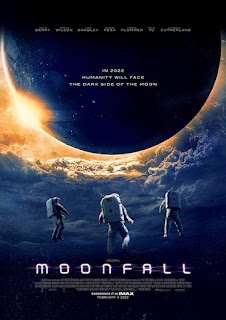

            This movie is a disaster—but not in the way the filmmakers intended.  It’s the disaster.  The thinly drawn characters, the inane/stereotypical dialog and awkward dreamed-up situations make it hard to sit through.  Special effects are about the only aspect of Moonfall that have a chance to entertain.

            The story starts in such a hodge-podge, it’s difficult to discern the plot and sort out the characters.  People and technical information are thrown out rapid-fire in the first few minutes so that it takes some time to get oriented.  Finally, we begin to see that something major is happening with the moon that if not stopped will endanger the earth.  Institutions such as NASA and the military are portrayed as run by self-serving fools.  For instance, there is the military solution considered of nuking the moon, with no regard to fall-out danger to the earth.

            The main characters include Brian Harper (Wilson), a disgraced astronaut who is blamed for his friend-colleague’s death, his ex-wife Jo (Berry) who is now married to a general in the military and who is made the leader of NASA where she is employed by the current chief as he is running out the door, and hapless janitor KC Houseman (Bradley) impersonating a scientist-astronaut and claiming to understand a complexity in the universe that has stumped the real scientists.  In the movie, he is proven to be right.  The upshot is that these three are going to revisit the moon, discover what is wrong and make things all right on earth.

            In the process of the tale, discounted characters turn out to be heroes, government departments and authorities are portrayed as incompetent fools, and somehow miraculous things just happen in order to carry the story along or save the characters.  Tender parent-child scenes are thrown in liberally sometimes during the height of emergencies, and conflicts get resolved somehow, even between ex-spouses.

            Most of these shortcomings can be attributed to the director Roland Emmereich, whose past films have many of the same elements (e.g., Stargate, The Day after Tomorrow, The Patriot, and Independence Day) discussed above and for which he has been criticized.  What Roger Ebert said about Stargate could be said about Moonfall: “Stargate” is the kind of movie where a soldier can be transported to “the other side of the known universe” in a whirlpool of bizarre special effects, step into a temple on an alien planet, and say, “What a rush!”  https://www.rogerebert.com/reviews/stargate-1994.

            Cinematography (Robby Baumgartner) and special/visual effects are about the only aspects of Moonfall worth your time.  Not only are they entertaining, but the viewer can appreciate them as works of art and technology.  The scenes in space are breath-taking and convincingly take you to another world.


The telling of the story is hard to bear, but cinematography and special effects might be worth your time.


Grade:  D                              By Donna R. Copeland


Thursday, June 3, 2021

THE CONJURING: THE DEVIL MADE ME DO IT

 Vera Farmiga     Patrick Wilson     Ruairi O’Connor     John Noble


Those who have followed the Conjuring series of films are familiar with the husband-wife duo of a demonologist (Wilson), Ed, and his psychic wife,Lorraine,  (Farmiga) who set up their equipment on site wherever there are clues or trouble.  In this instance, there is trouble in the Glatzel family where young David seems to be possessed.  It’s one of those cases where a child is happy and well-adjusted, jumping happily on a newly found waterbed, when he is suddenly seizing and thrashing around and developing demonic qualities.  A priest has been called in for an exorcism, but when it doesn’t seem to be working, Arne (O’Connor), the beau of David’s sister Debbie, whom he adores, speaks to the devil, asking it to transfer the curse to Arne.  

This transfer complicates everything, and Lorraine and Ed go to all kinds of eerie settings in search of clues, which include a rat-infested area under the Glatzel’s house where a witch totem is found, the home of a retired priest who studied Satanists and knows about this particular totem, and a mortuary where the dead body of a cursed young woman is revivified.  

All during these searches, other significant events are occurring; namely, Ed’s heart attack, Lorraine’s near-death experiences, and Arne’s imprisonment and trial for murder.

This is over the top for me personally, but the audience in the screening I attended applauded afterward.  To each his/her own, and for horror fans, it may be that this movie might be just the ticket to thrill and chill.

Vera Farmiga (Bates Motel, Up in the Air) and Patrick Wilson (Fargo, Angels in America) are accomplished actors who elevate what could be a ho-hum story into an engaging tale.  Their supporting actors (Ruairi O’Connor, John Noble, Sarah Catherine Hook, and Julian Hilliard) are commendable and forceful in portraying their roles.

But I think this film suffers from what many do nowadays, those in which filmmakers are re-treading the same plot over and over again.  There is only so much they can do, other than pulling in more and more over-the-top scenes to grab and jolt the audience.  It would be so much more preferable to me for them to create new plots for current issues, rather than drawing on something like a 1973 Exorcist film, something long outdated.


An updated Conjuring tale may not necessarily be the best choice for a movie.


Grade:  D+                By Donna R. Copeland

Tuesday, June 25, 2019

ANNABELLE COMES HOME

Vera Farmiga     McKenna Grace     Patrick Wilson
Madison Iseman     Katie Sarife     Michael Cumino


     There is really not much to be said about this version of Annabelle, so much of it is seeing people walking around the house in a scared state.  There are a few real, jolting scares along the way, but mostly there are just weird incidents.   Most of the action is only during the last half-hour.   
     The film starts with Lorraine and Ed Warren (Farmiga and Wilson) coming home at night with Annabelle in the back seat, when they have to take a detour and their car breaks down.  Ed knows how to fix it, but they are by a cemetery, and we become apprehensive when “ghosts” appear from time to time.  But the Warrens make it home just fine, and the priest is there to exorcise the demon inside Annabelle and bless the house.  She is secured in a locked cabinet to “contain the evil.”
     Soon, the Warrens have to leave again, and have engaged their usual babysitter Mary Ellen (Iseman) to look after their daughter Judy (Grace).  After a newspaper lauding the Warrens for their work in the occult, Judy is getting teased at school, and Mary Ellen’s friend(?) Daniela (Sarife) seems to have an uncommon interest in the Warrens and their house. Mary Ellen has let her know she is not invited to come over, but she barges in anyway, and invites herself to stay.  She soon manipulates Mary Ellen and Judy to go out skating while she has free run of the house.
     Now, the Warren’s have a workroom in the house with a sign on it clearly warning of danger and forbidding anyone to enter.  Daniela is not one to follow rules (plus we learn that her father has died and she has a burning interest in contacting him; hence, her curiosity about the Warrens and their house).  You can guess what follows.  Daniela snoops, and havoc ensues.
     In addition to there being long periods of nothing happening, as with many horror movies, we have to watch people doing stupid things.  First off, why would the knowledgeable Warrens leave a high school student in their landmine of a house to babysit their daughter? Why wouldn’t the responsible Mary Ellen call the Warrens at the first sign of weird goings on?  Why wouldn’t she as an asthmatic not keep her inhaler with her constantly?  
     Another problem I have with the film is depicting Daniela as someone you are eventually supposed to feel sorry for, aftert she has committed all kinds of infractions that make us thoroughly dislike her.  And seeing Lorraine Warren let her off the hook after all the pain and fear she has caused, also does not make sense.
     It seems that a young Lothario is inserted just to spice things up.  He’s Bob (Cimino), the naïve nerd with a crush on Mary Ellen—stoked by Daniela—who comes to serenade her, egged on by the pizza deliveryman.  He also gets terrorized, but this insertion is just another sub-plot that makes no sense, and is probably included for purely fan-pandering reasons.
     The young actors (we really don’t see Farmiga and Wilson much at all) are probably the only strong points of this film.  McKenna Grace, Madison Iseman, Katie Sarife, and Michael Cimino (as lovesick Bob) fill their roles nicely; it’s just the script by writer-director Gary Dauberman that lets the production down.  Well, that and he and the producers thinking they can milk the Annabelle story so many times (seven, I think!).
     Unless the viewer is a never-say-die fan of theAnnabelle movies—regardless of their content—I would recommend staying away from Annabelle Comes Home.

One more time—the 7th—to see the infamous Annabelle doll do its damage.  Still Interested?

Grade:  D+                                    Donna R. Copeland

Thursday, December 20, 2018

AQUAMAN

Jason Momoa     Amber Heard     Willem Dafoe     Patrick Wilson     Nicole Kidman     Dolph Lundgren     
Ttmuera Morrison     Tainu and Tamor Kirkwood

     This is a spectacle—not in a good way.  It’s a series of showy special effects glorifying fighting and wars, although the filmmakers attempted to relate it to some kind of mythology.  The grandeur of the sights and conversations, however, are regrettably punctuated by modern idioms such as, “or screw you!”, or f-words, or corny comeback jokes that jerk you back to reality a la Hollywood.
     The story from DC Comics rests on who will be king of Atlantis, the underwater kingdom—the legitimate son or the illegitimate “half-breed.”  Earlier, the princess of Atlantis, Atlanna (Kidman) got into a storm that deposited her into a lighthouse off the coast of Maine, where she was rescued and revived by the lighthouse keeper (Morrison).  They fell in love and had a child, Arthur (Kirkwood as the child, Momoa as the grown-up), the half-breed.  The bad part is that she was betrothed to the son of the King of Atlantis, and what she did was treason.  They were coming for her, so to save her child and his father, she returned home and was thought to have been killed at some point.
     We see Arthur after that as an odd child who gets teased by his classmates; however, when he shows he has special powers at the aquarium, they back off.  
     When Arthur is a young man, he gets pulled into the struggle for a new king of Atlantis. (Keep in mind, he neverwantsthe job, but is drawn into it, presumably by destiny.)  The legitimate son (also the son of the queen) has already been installed as King Orm (Wilson), but not everyone is happy with his rule, which continues his father’s belief that land and sea are two separate realms that he wishes to rule over as “Oceanmaster.”  
     Despite his reluctance, Arthur is pulled into the struggle, but he will be aided by Vulko (Dafoe), Atlanna’s trusted advisor who has been charged with his instruction in military arts.  He will also be aided by the daughter of one of the underwater kings, King Nereus, Mera (Heard), who is betrothed to King Orm.  Yes, it gets complicated if one is not already familiar with DC Comics.
     Many, many battles with spectacular feats will ensue until your brain is numb.  And the script is so thin it is of little use to the actors and holds no surprises for the viewer.

The amazing feats of Aquaman in his struggle for leadership of land and sea.
      
 Grade:  D                           By Donna R. Copeland


Wednesday, February 1, 2017

THE FOUNDER

Michael Keaton     Laura Dern     Nick Offerman     John Carroll Lynch     Patrick Wilson     Linda Cardellini


       Such an ironic title, as one finds out by the end of this dramatization of Ray Kroc (Keaton), the known founder of the McDonald hamburger franchise.  This film is noteworthy in telling the story of how that came to be and the people involved, of which most of us were doubtless unaware.
          Kroc starts out as a door-to-door salesman and schemer of investment projects, many of which were groundless for potential.  His weary wife (Dern) has become skeptical of his harebrained schemes, and simply wants to continue their comfortable golfing country club life with friends.  Kroc is currently trying to sell a milkshake maker that is supposed to speed up the process considerably, but we see doors shut in his face over and over.  Then he gets a message that a restaurant in California wants to order 6-8, so drives pell-mell from St. Louis to the one and only McDonald’s Drive-in owned by brothers Dick (Offerman) and Mac (Lynch) McDonald. 
          This is in the 1950s, when all the drive-ins had curb-hops who took your order and brought your food on a tray that attached to your car.  Ray eats most of his meals at drive-ins, and we see him get annoyed when his order gets mixed up in one way or another.  One of the funniest moments in the film is the screenwriter’s (Robert D. Siegel) portrayal of Ray’s first visit to McDonald’s (with golden arches), where he has to get out of his car, wait in line, place his order, and receive it in a paper bag and cup.  Befuddled, he finally realizes that he must eat it in his car or on a park bench.  When he finds the hamburger is delicious, he immediately goes to talk to the owners.  But he has more in mind than simply their order of the milkshake machines; he wants a tour of their business, which they readily do, showing that speed and natural ingredients are secrets to their success.
         Ray immediately asserts himself by offering numerous suggestions for increasing their business, most of which the brothers decline to accept.  After much pressure, though, they finally give in to the idea of franchising McDonald’s.  They had tried this before, but gave it up because quality control could not be maintained.  Ray counters their objections by offering to play that role, and assuring the McDonalds that he would oversee operations at all the franchises.  The McDonald’s produce a contract that stipulates that all changes in the franchises must be approved by them.
            The McDonalds continue to deny almost all of Ray’s suggestions, and in frustration, he begins to ignore them and do with the franchises whatever he pleases.  Of course, this all comes to a head and we hear the end of the plus/minus story. 
         Siegel’s screenplay continues his fine writing skill (The Blind Side, Turbo, The Wrestler) in presenting a script that avoids the potential for being boring (business, sales) by focusing on the personality of the lead and its subtle transformations across time, and the story’s relevance for contemporary times.  Keaton’s realization of Ray’s character is marked by a combination of charisma, self-interest, and willingness to slight the ethics of his behavior.  It’s a little akin to his Birdman role, without the imagination shown in that film, but Keaton’s performance is just as good. 
         Director John Lee Hancock (The Blind Side, Saving Mr. Banks) knows just how to bring the screenplay to life and show how the film is a part of American corporate history as well as McDonald’s specifically.  It moves at a good pace, always keeping our interest and fascination with the subject and the characters high.
          Kroc is to be credited with the commercialization of the hamburger business, much to the McDonalds brothers’ dismay.  He converted it into a real estate business (Franchise Realty Corporation) by buying all the properties on which the franchises were located, introduced “unnatural” powdered ingredients for milkshakes, and expanded the business beyond U.S. borders.  I don’t know, but I imagine there are similar stories to tell about many of our U.S. corporations.

“Fortune favors the bold” – Ray Kroc quote.

Grade:  A                                    By Donna R. Copeland