Showing posts with label Willem Dafoe. Show all posts

Wednesday, April 20, 2022

THE NORTHMAN

 Alexander Skarsgard     Nicole Kidman     Claes Bang     Ethan Hawke

Anya Taylor Joy     Willem Dafoe     Bjork     Gustav Lindt


            Oh, those Vikings!  They’re a brutal lot, and Director Robert Eggers with his co-writer Sjon (a poet and novelist as well as screenwriter) have presented us with an extraordinary drama that gets into all kinds of substantive issues of the ages—war (of course!); vengeance; family belonging, loyalty, and entanglements (including incestual); romance; and more—all against the backdrop of sweeping countryside vistas, blood, and gore.

            We get a brief picture of a happy royal family—King Aurvandil (Hawke), Queen Gudrun (Kidman), and Prince Amleth (Oscar Novak the younger, Skarsgard as the older), maybe with some raising of eyebrows, but with the King making his wife and son mindful of the burden of royalty.  He starts training Amleth bigtime in warrior ways, which includes dog-type faceoffs, and making him promise he will avenge his father’s death if it comes to that.  We’re told that honor is above all the highest virtue.

            The tale goes on, pitching the viewer into the 895 A.D. Vikings world through not only the plot, but also expert cinematography (James Blaschke), production design (Craig Lathrop), music (Robin Carolan, Sebastian Gainsborough), and special effects (too many to mention) as well.  The plot transports you along making you feel as if you are there, thanks to that and all the crafts supporting it.

            Quotable quotes are sprinkled about liberally, such as, “You have the strength to break men’s bones; I have the cunning to break men’s minds” and “My earth magic will stoke the flames of your sword”, both spoken by the fetching Olga to Amleth.  Still, some metaphorical references are humorous such as the cleverly inserted “kiss my butt” action.

            The most gripping part comes when Prince Amleth is confronted with elements of the prophecy told to him as a child that at some point, he will have to make a choice between the protection of loved ones and honoring a promise.  

            This is not only a visually beautiful film, it taps into fundamental beliefs we all have about family, war, and conscience, elevating it above your regular adventure film by allowing us to experience some of those real dilemmas that many people must face even now as in the past.  Some are publicly heroic, but some are simply the everyday experience of a reality a person did not plan to encounter.

            This is an exquisitely conceived film that tells a story for the ages.


If you like adventure with intelligence and cleverness and can stand the gore, go to this movie.  You will be rewarded.


Grade:  A                              By Donna R. Copeland

Thursday, December 16, 2021

SPIDER-MAN: NO WAY HOME

 Tom Holland     Zendaya     Benedict Cumberbatch     Jon Favreau     Marisa Tomei

Jacob Batalon     Alfred Molina     Willem Dafoe     J. K. Simmons     Jamie Foxx


This edition is most remarkable for cleverly integrating past Spider-Man movies and their characters into Spider-Man:  No Way Home.  If a viewer has not seen or can’t remember the past versions, it is easy enough to follow the plot.  However, a much richer experience will be had by those who have kept up with all the versions through the years and recognize all the past characters referenced and the actors who play them.  

The story opens with the chaos caused when Spider-Man’s identity is revealed to be Peter Parker (Holland).  The star broadcaster J. Jonah James (Simmons) at the Daily Fix has seen to that.  The item surfaced when the criminal illusionist Mysterio in his dying breath revealed the identity of Spider-Man, who had just killed him in the previous Spider-Man:  Far From Home (2019).  But now, Mysterio is being made a hero, and Spider-Man  as the presumed villain has to deal with the public rancor that ensues, along with monsters that are suddenly showing up mysteriously on earth.

Peter has sought the help of Dr. Strange (Cumberbatch), who condescendingly agrees to help, but is super-annoyed when Peter keeps interrupting the spell with conditions he thinks of while the spell is being produced.  This has consequences, the extent of which Peter only realizes later, making this something of a coming-of-age story.  It’s going to come home to Peter that gifts he has received come with responsibilities, and the process of learning that is repeated throughout this story line. 

Production of this version of Spider-Man directed by John Watts is engaging in its special effects and script by Chris McKenna and Erik Sommers, based on the Marvel comic by Stan Lee and Steve Ditka.  The cast realizes the action by numerous talented actors:  Tom Holland, Zendaya, Benedict Cumberbatch, Marisa Tomei, Alfred Molina, Willem Dafoe, Jamie Foxx, J. K. Simmons, and others.  All are top-notch.  

Like many films nowadays, judicious editing could have improved the production and reduced it a half-hour to a two-hour limit.  The story bogs down in the middle when one super-human sequence follows another, with technological aspects of filming taking precedence over story and characters.  I’m compelled to reiterate my usual irritation with these movies inevitably ending with a fist fight between two characters followed by tender, emotional scenes meant to pull on the heartstrings.  I like the latter, but why the fist fights when the characters have access to all kinds of technological tools?


With such a clever script, this is probably a true gem for Spider-Man and Marvel Comics fans.  For others, it can be mostly entertaining, except for the length.


Grade:  B                              By Donna R. Copeland

Wednesday, December 15, 2021

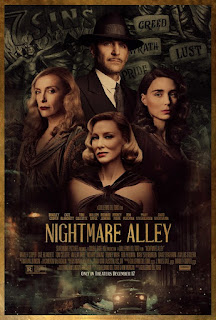
NIGHTMARE ALLEY

Rooney Mara     Bradley Cooper     Cate Blanchett     Willem Dafoe     Mary Steenburgen

Toni Collette     Ron Perlman     Tim Blake Nelson     Richard Jenkins     David Strathairn

            It’s a nightmare all right.  It starts out with arson by a shady-looking character, and we follow him as he wanders around and ends up at a circus, where he manages to get hired.  Stan Carlisle (Cooper) is smart and a bit of a charmer, and quickly makes friends with the showrunner (Dafoe) and the fortune teller Pete (Strathairn) and his roommate Zeena (Collette), a reader of Tarot cards.  When he learns fast from Pete and begins to offer tips on improving Molly’s (Mara) electrical act, it becomes clear that he has worked in the circus before, and that he doesn’t mind conning people.

            But like all good sociopaths, he draws viewers into his web and we become fascinated with/question more and more of his actions.  Del Toro’s mastery in weaving stories that develop slowly across time, sustain glued-to-the-screen interest with spikes of anxiety and tension is clearly working in Nightmare Alley.  All the characters have potential to be a story unto themselves, but somehow Del Toro and his team integrate all of them into a coherent whole.  He co-wrote the screenplay with Kim Morgan and William Lindsay Graham who wrote the novel on which it is based.

            The filmmakers make the most of their cast headed up by Bradley Cooper who embodies a corrupt phoenix that keeps rising after destruction.  Conning is his game, and it is only the goons [Molly’s protector Bruno (Perlman), a wealthy stooge’s bodyguard, and a psychologist] who recognize his threat.  This role could be a high mark in his career.  Cate Blanchett as a psychologist caught up in his web is icily intriguing as a gorgeous blonde fellow schemer, and as always cinches her role, which I will take issue with below (the role; not the actress).  Rooney Mara pulls off a rather naïve ingenue who eventually picks up on the straits she is in, in an entirely convincing way.  Toni Collette, David Strathairn, and Richard Jenkins are highlights in their portrayals of quirky characters who gradually become endearing in a strange way.

            I found the production to be very entertaining and living up to the filmmakers’ reputation for making a good horror movie that gets into the psychology of human beings and all the myriad of characters that can and do emerge.  Speaking of psychology, I hope that viewers realize that the psychologist portrayed here committed any number of infractions that would revoke her license, let alone try her for crimes.  But as usual, filmmakers seldom consult with professionals in the profession they are portraying.  I got a chuckle out of Dr. Ritter’s sign:  Dr. Lilith Ritter, Psychologist, Ph.D.  It’s Dr. Ritter who earned the Ph.D., which should come with her name, not tacked on at the end.

            Crafts I especially liked about Nightmare Alley are the production design by Tamara Deverell and the cinematography by Dan Laustsen.  Both contributed so much to the mood and subject of the film.


Nightmare Alley has Guillermo del Toro’s mark of provocative storytelling that always includes observations about human nature and ethics.


Grade:  B+                            By Donna R. Copeland


Thursday, September 9, 2021

THE CARD COUNTER

 Oscar Isaac     Willem Dafoe     Tye Sheridan     Tiffany Haddish


            I have heard that counting and keeping track of cards in games can help you win; and William Tell (Isaac) demonstrates this both in a simple card trick and in a fascinating story with themes of punishment and expiation—and their limits.  Writer/director Paul Schrader is a master of nuance and suspense, with engaging characters, richly metaphorical settings (Ashley Fenton), music complementary to the script (Robert Levon Been, Giancarlo Vulcano), and provocative cinematography (Alexander Dynan).

            Tell is a card shark who likes to keep a low profile after stints in the military and prison.  He has developed a systematic lifestyle that reflects his approach to cards—astute observation, discipline, the compulsive need to hide, and a solitary existence.  He meets a woman who calls herself La Linda (Hadish) and once she learns how good he is, wants to “back” him (finding wealthy clients interested in betting on him).  She appears to be the sole lightness in his life, but he still holds her at bay.

            After one of his games, he is passed a note from a bystander wanting him to give him a call, which he does.  This is Cirk (Sheridan), the son of an old acquaintance in the military.  Cirk has a proposal that seems not to interest Tell as much as the young man’s life story, which relates to the theme of punishment/expiation.  Tell has some ideas about how he can expiate himself of some of his past for which he was punished, but for which he has not forgiven himself.

            As with his previous film, First Reformed, in which a pastor is trying to work through PTSD after a war experience, Schrader poses circumstances that force the viewer to contemplate psychological stressors, current issues like war, and—above all—personal responsibility for actions in the past.  That is, it’s about war and about its after-effects and how those involved deal with them.  First Reformed deals with one person’s struggle; The Card Counter deals with the second generation’s struggle as well.

            The lead actors are supremely fitted to their roles.  Isaac’s ability to convince us of the depth of Tell’s story is key to the well written plot.  Tiffany Hadish provides (needed) respite from the gruesome details of Tell’s and Cirk’s accounts.  And she once again proves her acting abilities.  Tye Sheridan pulls off the hard-to-engage teenager with a singular passion and not much ambition.  Tiffany Hadish has evolved from her comedy roots in Like a Boss and Girls Trip to being a serious pivotal character in this film.  Willem Dafoe expertly shows us a jaded, exploitative figure who has no qualms about exploiting others under his control in the most weaseled of ways, even to the end.

            The psychological authenticity of Paul Schrader’s films always amazes me.  He is clearly attuned to personal transformations with myriad motivations that are not always clear, even to the person, much less those observing him/her.  The arc of transformation is similar in this film to that in First Reformed.   It involves something like “original” to something that is an outgrowth of itself after encountering real-life experiences.

            There are small wry touches of inspiration and humor that might go unnoticed, such as William (Bill) saying to Cirk, “You live like this?” (a messy room) and Cirk saying to Bill, “You live like this?” (a compulsively neat room).  Or La Linda taking Bill out  to a “city on fire”, which means walking through a labyrinth of bright lights, possibly as a metaphor for the potential of card winnings—dreams—and then, reality.


An intricately “wired” account of the psychological transformation of individuals as a consequence of their experiences.


Grade:  A                  By Donna R. Copeland

Thursday, June 11, 2020

TOMMASO

Willem Dafoe     Christina Chiriac     Anna Ferrara


     Scenes from a man’s life.  The Italian writer/director Abel Ferrara has written an apparent partial autobiographical account of his life—seemingly (my interpretation) as expiation for things in his past about which he has/is experiencing guilt. The story moves rather slowly across events, with forays into past events and, presumably, symbolic and metaphorical fantasies that encompass external as well as internal experiences.  The main character masterfully delivered by Willem Dafoe is a filmmaker with a younger wife and small child.  We get an insightful cross-section of significant elements and happenings in his life, with the fantasies serving to illustrate unconscious factors underlying his actions.
     We learn that Tommaso (Dafoe) is a recovering addict living in Italy with his wife Nikki (Chiriac) and daughter Deedee (Ferrara) in an apartment that must be entered through a series of locked doors/gates/elevator, suggesting from the outset preoccupations with security and control.  Indeed, these do become issues across time for Tommaso.
     The movie shows pictures of their daily life, the enjoyment and delight Tommaso gets in taking care of his daughter, the intense relationship between mother and child, the different versions Tommaso and Nikki have of what married life should be, significant events in their early lives that contributed to their adult personalities, and Tomasso’s internal experiences of all of this. The film becomes even more striking in the fact that Ferrara’s real wife and daughter play their characters, filmed in Ferrara’s and Chiriac’s actual apartment.
     The complex character presented as Tommaso has Dafoe at his finest, capturing all the subtleties and self-doubts of Ferrara as he sees himself.  He is a recovering drug addict, religiously attending AA meetings, having a keen interest in those around him, dealing with the most disturbing information he witnesses on one occasion, taking on an overbearing role in his marriage, and still finding the time and wherewithal to deal with a loud drunk out on the street disturbing the neighborhood peace. The latter ends up with a warm chat and a handshake as Tommaso sends the man on his way.
     The production clearly fits in the category of an art film in its pace and the inclusion of metaphor and symbolism.  It could be criticized as being a bit too long, but this is a minor criticism. Seldom do we witness such a film with the writer’s openness and keen insight into his own character.  It is helped immeasurably by this and by Dafoe’s, Chiriac’s, and Deedee Ferrara’s perceptive representations.

A moving depiction of the inner and outer experiences of a man and his family.

Grade:  A-                                    By Donna R. Copeland


Thursday, October 31, 2019

MOTHERLESS BROOKLYN

Edward Norton     Willem Dafoe     Gugu Mbitha-Raw     Bruce Willis     Alec Baldwin
Dallas Roberts     Leslie Mann     Bobby Cannavale     Michael Kenneth Williams     Cherry Jones


     Picture New York City in the 1950’s with a gumshoe detective following clues to weed out the killer of his life-long mentor.  Or at least picture one of the detective films you’ve seen—or heard on the radio—from that time (e.g., Mr. Keen, Tracer of lost personsDragnet), with the smokiness of the rooms, the seediness of the neighborhoods, and the persistence of a committed private detective.  That’s the movie Edward Norton has written (based on Jonathan Lethen’s novel), produced, directed, and starred in, in Motherless Brooklyn.  Norton and his cinematographer Dick Pope capture this period’s mood and effluence of city corruption that ends up being a crime thriller, complete with car chases, goons, and the pressure of rescuing an endangered damsel.
     The extra intriguing twist to this story is that the main character Lionel Essrog (what a name!), played spot on by Norton, has Tourette’s Syndrome (a disorder involving involuntary tics and utterances).  It’s not really relevant or essential to the story, but adds a touch of color.  Lionel works in a private detective agency headed by his lifelong mentor Frank Minna (Willis).  From the time Frank took pity on and rescued Lionel from bullies in a boy’s home, he has continued to protect him.
     But Frank is also mysterious about jobs he’s working on, giving Lionel and the others only sketchy details about it, but explicit instructions about how to keep an eye out and what to do if…  The movie begins with just such a job, during which Frank is killed.  What ensues is Lionel following the slim clues he’s been given or picked up to find the killer.
     This leads him into major city politics and Frank’s role in it; Moses Randolph (Baldwin), who seems to be in charge of major city “improvements”; a homeless man (Dafoe); activist    Gabby Horowitz (Jones); and a mysterious “black woman” Laura Rose (Mbitha-Raw).
     The novel—and consequently the film—seem to be at least loosely based on true historical events in the 1950’s, documented in a 2018 film, Citizen Jane:  Battle for the City, when Robert Moses, a city planner, began to dismantle city neighborhoods to construct freeways and bridges through them without regard for the people affected.  That is what is happening in this film, but it’s put into a drama that is exciting and will pull at the heartstrings.  
     This is a fun movie for those who can get into period dramas from not too long ago and follow leads and cues the detective Lionel chases—all while explaining his “brain problem.”  The cast is superb (what a juxtaposition of Baldwin’s Moses Randolph and his “Saturday Night Live” Trump impersonations), with Norton capturing the Tourette-plagued Lionel, Mbitha-Raw as an attractive, accomplished woman with a dark history, Willem Dafoe as the mysterious homeless man with a significant background, Bobby Cannavale as a compromised man, and Leslie Mann, Michael K. Williams, and Cherry Jones all providing star-quality performances.

A cloak and dagger story harking back to the 1950s with the added twist of a detective with Tourette’s, but possessing a formidable memory.

Grade:  B                                                By Donna R. Copeland

Thursday, December 20, 2018

AQUAMAN

Jason Momoa     Amber Heard     Willem Dafoe     Patrick Wilson     Nicole Kidman     Dolph Lundgren     
Ttmuera Morrison     Tainu and Tamor Kirkwood

     This is a spectacle—not in a good way.  It’s a series of showy special effects glorifying fighting and wars, although the filmmakers attempted to relate it to some kind of mythology.  The grandeur of the sights and conversations, however, are regrettably punctuated by modern idioms such as, “or screw you!”, or f-words, or corny comeback jokes that jerk you back to reality a la Hollywood.
     The story from DC Comics rests on who will be king of Atlantis, the underwater kingdom—the legitimate son or the illegitimate “half-breed.”  Earlier, the princess of Atlantis, Atlanna (Kidman) got into a storm that deposited her into a lighthouse off the coast of Maine, where she was rescued and revived by the lighthouse keeper (Morrison).  They fell in love and had a child, Arthur (Kirkwood as the child, Momoa as the grown-up), the half-breed.  The bad part is that she was betrothed to the son of the King of Atlantis, and what she did was treason.  They were coming for her, so to save her child and his father, she returned home and was thought to have been killed at some point.
     We see Arthur after that as an odd child who gets teased by his classmates; however, when he shows he has special powers at the aquarium, they back off.  
     When Arthur is a young man, he gets pulled into the struggle for a new king of Atlantis. (Keep in mind, he neverwantsthe job, but is drawn into it, presumably by destiny.)  The legitimate son (also the son of the queen) has already been installed as King Orm (Wilson), but not everyone is happy with his rule, which continues his father’s belief that land and sea are two separate realms that he wishes to rule over as “Oceanmaster.”  
     Despite his reluctance, Arthur is pulled into the struggle, but he will be aided by Vulko (Dafoe), Atlanna’s trusted advisor who has been charged with his instruction in military arts.  He will also be aided by the daughter of one of the underwater kings, King Nereus, Mera (Heard), who is betrothed to King Orm.  Yes, it gets complicated if one is not already familiar with DC Comics.
     Many, many battles with spectacular feats will ensue until your brain is numb.  And the script is so thin it is of little use to the actors and holds no surprises for the viewer.

The amazing feats of Aquaman in his struggle for leadership of land and sea.
      
 Grade:  D                           By Donna R. Copeland


Saturday, December 8, 2018

VOX LUX

Natalie Portman     Jude Law     Willem Dafoe     Jennifer Ehle     Raffey Cassidy     Stacy Martin


     “Don’t let your kids grow up to be rock stars” could be the theme of this film. Natalie Portman is her usual stunning self in this glittering picture written and directed by Brady Corbet (previously an actor in Martha, Marcy, May, Marlene, Clouds of Sils Maria, and Force Majeure), and now venturing into directing.  The picture starts with a tragic scene in a school in which Celeste (Raffey Cassidy as the younger and Portman as the grown-up) is shot, injuring her spine.  She is a talented, thoughtful young Christian, and to cope with the tragedy, composes a song with her sister Eleanor (Martin), which offers encouragement and solace to all those involved.  
     Celeste undergoes rigorous rehabilitation, and during this time, the song has become a hit not just in their hometown, but across the nation as well, all of which results in bids from people wanting to be Celeste’s manager, one of which is “The Manager” played by Jude Law.  A publicist played by Jennifer Ehle is engaged as well.  
     A bit of sibling rivalry between Celeste and Eleanor runs through the story, but for named reasons, Celeste becomes the star and Eleanor goes with her as her older sister/caretaker, but who remains active in writing songs.  She also becomes a kind of foster mother later for Celeste’s daughter Albertine (Cassidy again in this role).  Plausible family dynamics are woven into the story of Celeste’s rise to fame, enriching the plot.  But while Corbet pays attention to this important aspect, the main thrust of the story is Celeste’s meteoric rise in popularity, her physical/psychological/social vulnerabilities, and the penultimate outcome. Penultimate, because the ending leaves you guessing.
     Natalie Portman gives her all to this performance, as she did in Black Swan, a role which is similar to this one in its story of a talented young woman being exploited by people in the entertainment business.  Both films are left open-ended as to the ultimate outcome.  Here, we see the arc of a rock star’s fame, the erosion of her values and central core, and the question as to whether her family (sister and daughter) can buffer her from the consequences of the path she has chosen.
     A curious omission in this film is the absence of the mother.  She is nowhere to be seen in the film, and her absence is not explained.  This is unfortunate in that her absence could potentially account for some of Celeste’s journey and her relationship with her sister.  But we are given no information.
     The film contains large gaps in time, requiring the viewer to fill in information [e.g., we’re not told about Celeste’s pregnancy; we see her daughter for the first time after she has grown up in the last half of the film (Cassidy in this role too, which is a nice touch)].  The narration delivered with gravitas by Willem Dafoe that occurs periodically helps a great deal in this respect and in making psychological/philosophical sense of Celeste and events in her life.
     Significant assets to the film include the luscious, probing cinematography of Lol Crowley and the score supplied by Scott Walker, with songs by Sia, which are the ones Celeste sings onstage.  The finale is something to see in music and cinematography, and in peak emotionality.  A grande finale indeed, after you’ve thought that disaster was just around the corner.

A rock star born, launched, and riding the peaks and valleys of fame.

Grade:  A-                                    By Donna R. Copeland

Wednesday, November 21, 2018

AT ETERNITY'S GATE

Willem Dafoe     Rupert Friend     Oscar Isaac     Mathieu Amalric     Madds Mikkelsen


     This artistic, painterly film created by painter/director, Julian Schnabel (The Diving Bell and the Butterfly, Before Night Falls, Basquiat), reverberates in its portrayal of the essence of Vincent van Gogh and his internal experiences and stated intentions to bring nature and life to people through his art.  In defending his approach to Paul Gauguin, who is critical and lectures him about how he should paint, he retorts that he goes outdoors to paint because ‘the essence of nature is beauty.”  He is always trying to capture that beauty, thinking that he and others can always learn from it.
     As shown in the film, van Gogh leads a tortured life, always questioning himself and his brother Theo about whether his art is really good.  Despite his brother's reassurance, others are frank in telling him it is not; “It’s ugly”, declares a priest.  Beyond these doubts, van Gogh worries about his sanity, saying that people tell him later what he has done, but he doesn’t remember.  Moreover, he confides to his brother that he has hallucinations.  Townspeople find him strange, and he admits that he is always alone, sometimes not talking to anyone else for days.
     Vincent’s nurturing brother, Theo, pays Paul Gauguin, a friend of Vincent’s to go to Arles, France, and stay with him, thinking that Gauguin will be a positive influence on him.  And apparently he is, and it proves to be a productive time for both artists; but after some months, Paul tells Vincent he must return to Paris to attend to his own career.  This sends Vincent into such a tailspin, he cuts off his ear.  The event, along with his alcoholism and at times irrational behavior, results in psychiatric hospitalizations, which seem to be helpful.  But he continues his prolific painting throughout his confinements.
     The care with which At Eternity’s Gate was made is truly impressive, such as Schnabel teaching Willem Dafoe, the star, how to paint so he could give an authentic representation, Dafoe soaking up everything he could learn about van Gogh (e.g., running through the fields, with cinematographer Benoit Delhomme tracking him), and capturing his mood swings, social awkwardness, and sincerity.
     Dafoe—always a good actor (most notably in The Florida Project last year)—probably gives his best performance to date in conveying with subtlety and grace the intricacy, shading, contradictions, and volatility of an artistic personality, all the while conveying the absolute sincerity characteristic of van Gogh.  Its authenticity comes through to me in my past experience in working with people who were in a psychiatric inpatient service.
     Oscar Isaac’s optimistic presence as Paul Gauguin gives a welcome air of freshness to the production, and his performance is right on.  Mathieu Amalric as the psychiatrist-friend who is the most helpful to Vincent conveys just the right amount of empathy and astute inquiry.  
     This film is noteworthy in its artistic approach [most frames are teeming with artistic touches, such as blurring or pulsating the image (Benoit Delhomme, cinematographer) to the beat of the music by Tatiana Lisorkaia], its emotional and social valence, and historical elucidation.  It will not appeal to everyone, but will certainly be a hit with the art house crowd.

A film that captures the agonies of van Gogh’s life, along with the regret we all feel that he never received the validation he so deserved while he was alive.

Grade:  B+                                    By Donna R. Copeland

Thursday, November 9, 2017

MURDER ON THE ORIENT EXPRESS

Kenneth Branagh     Penelope Cruz     Willem Dafoe     Judi Dench     Johnny Depp     Michelle Pfeiffer
Daisy Ridley     Leslie Odom, Jr.     Josh Gad     Derek Jacobi     Olivia Colman


            Murder on the Orient Express should be an exciting, engaging, production of a beloved author’s work (Agatha Christie).  Kenneth Branagh, more acclaimed as an actor than a director, fills both roles here, but is not exemplary in either, and perhaps the script (Michael Green) bears some of the responsibility.  A good detective story subtly plants clues, explicates the detective’s reasoning process, and guides the reader along in the story.  But the story here comes across as too convoluted to make sense.  I found a number of problems in this production, foremost being Branagh as Poirot, a role stamped in my mind as a David Suchet character.  Although Branagh attempts to convey the preciseness and impressive deductive abilities of Poirot, these simply do not come across clearly; they’re too English (rather than Belgian), and rather than a neat mustache, Branagh sports what looks like a gray rag across his upper lip. 
            Many of the first scenes on the inside of the train are hazy, dark and difficult to discern what is taking place, despite the work of talented production designer, Jim Clay, and cinematographer, Haris Zambarloukos. 
            The fault cannot be in the stars; the cast for this film being a large group of highly accomplished actors, including Branagh, along with Penelope Cruz, Michelle Pfeiffer, Judi Dench, Derek Jacobi, Willem Dafoe, Leslie Odom, Jr., Josh Gad, Daisy Ridley, and Olivia Colman.  Johnny Depp is on the screen only briefly, but plays his role well.
            The plot adheres loosely to the novel, in which a group of passengers board the Orient Express in Istanbul bound for numerous European stations along the way; but the train derails in a storm, and the passengers are stranded until repairs can be made.  During this time, a murder is committed, and with Poirot on board, he is called upon to solve the case, despite his being on holiday.  Earlier, he had been approached by the victim, asking for his protection, because the man was convinced that someone was out to kill him.  The man wants to prevent a murder (his) before it happens.  Poirot refuses for reasons he states very clearly.  When the murder does take place, Poirot must solve the crime, which is the only intriguing part of this film, but delivered in a way that is hard to follow with the flurry of names and historical events.

This film seems to be a big miss for an Agatha Christie story.

Grade:  D+                                    By Donna R. Copeland

Thursday, October 19, 2017

THE FLORIDA PROJECT

Willem Dafoe     Brooklynn Prince     Valeria Cotto     Bria Vinaite     Christopher Rivera


            When we see the name of the purple-colored motel in the opening scenes—Futureland Motel—it is a portent that we’re not likely to think about until about half-way through the film.  This was specifically the intent of the filmmakers (primarily, Sean Baker, writer/director/editor), with The Florida Project (“Florida” evoking scenes of pastel frolics and “Project” evoking associations with housing projects) being a commentary on the sorely deficient social services in this country, making the term “Futureland” a kind of ironic statement at best and a dire prediction at worst.  Significantly, the Futureland Motel doesn’t really jive with the saccharine, colorful fantasyland that is Disney, which lies just beyond the reach of the Futureland Motel residents who live on the fringes of society.  (See Sean Baker’s comments about the film below*)
            But first, we will meet the children at the motel who live in a world of their own, full of their own fantasies gleaned from the marginal adults around them and their own creative imaginations.  Foremost among these is Moonee (Prince), a natural leader and as feisty a young child as you’ll ever meet.  She can swear with the best of sailors, thanks to her mother’s modeling.  But she is endlessly creative in exploring the world around her, absorbing like a sponge everything she sees and hears.  She is like the smartest street kid in New York City. 
            Moonee is appealing and very attractive to other children who meet her.  There is Scooty Rivera), whose mother works at a nearby restaurant and charitably hands out food to Moonee, knowing that she and her mother are living on the edge.  There is Jancey (Cotto), who gets acquainted with Moonee under adverse circumstances, but her grandmother, like many of the characters in this film, are tolerant and want to be helpful, so allows Jancey and Moonee to become friends. 
            Overseeing the motel as the management—although he must answer to its owner—is Bobby (Dafoe), about the only competent adult in the picture, and even he is not sure at times what to do.  But at least he has some sense about how children should be protected, and he exerts his authority as best he can.  I loved the scenes where you expect he will be cross with the children, but indulges their games and plays along with them instead, a real departure from the characters Dafoe usually plays in expert fashion.
            This is really a film about children, specifically, Moonee, who is growing up without the help and structure she needs to be successful in life, but is nevertheless very smart, perceptive, and world-wise.  I see the film as asking the question about what will happen to her (and others in her situation) ultimately.  Baker doesn’t hand it to us on a silver platter, so to speak, but poses the question that our socially conscious selves must answer.
          This film is hard to watch, primarily because we’re seeing/listening mostly to children’s interactions for most of the scenes.  But it’s also hard to witness the woeful efforts of Moonee’s mother Halley (Vinaite) to parent; psychologically, she is about the same age as Moonee.  So while she is great at acting out their imaginary fantasies in play, she is indiscriminate in what she teaches and models. 
            Brooklynn Prince’s performance shows an apparently innate talent for acting; this is her first film.  Her lines come out sounding like they come straight from her, rather than from the script co-written by Baker and Chris Bergoch.  It’s also a reflection on the fine casting and direction, in that, except for Dafoe, like Prince, this is the first film for all the main actors—Vinaite, Cotto, and Rivera.
            What starts out to be a mundane experience of following children around turns into a socially provocative film of importance to considerations about contemporary American life.

Children on the loose near (not at) Disney World.

Grade:  A                                    By Donna R. Copeland

*Baker:  …We wanted to make audiences laugh, have fun with these kids and spend the summer with them, but also use this platform to shed a light on what I think is a very important topic.
"Housing is a fundamental human right, and I think the first step toward change is awareness, so if we can get more people to be aware of this national situation," Baker continues. "I hope this movie inspires people to get involved —donation, education, support, advocacy. … Audiences are asking what [the ending] means, and that's important because it has people discussing the ending, which means they're actually discussing the topic." http://www.hollywoodreporter.com/news/florida-project-ending-director-sean-baker-explains-meaning-how-he-did-it-1047215

Thursday, February 16, 2017

THE GREAT WALL

Matt Damon     Willem Dafoe     Tian Jing     Pedro Pascal     Andy Lau     Hanyu Zhang


     Visually striking with some impressive special effects, The Great Wall could be a lesson in our current times as to how effective walls are for countries.  The Tao Tei are vicious monsters known for invading China every sixty years, and that time has come again.  They are fearsome dinosaur-like (allosaurus) beasts with huge heads and pointed teeth.  They come in droves—thousands at a time—and can climb walls and leap into the air.  They’re even smart enough to figure out how to get inside the wall and attack from there.  The Chinese have their own special weapons, including balls of black powder that explode on impact or near fire.  They can send out female warriors anchored by ropes on narrow protruding fingers high up on the wall to fight in the air.  They can send out comets of fire to light on the invading troops. 
     Unfortunately, the story and the dialog among characters tend toward the unimaginative and ordinary.  Basically, two scruffy men hoping to beg, borrow, or steal the rare black powder, are captured by Chinese militia and taken prisoner.  William (Damon) is experienced in warfare all over the world and looks at the situation they’re in with the intent of finding an intelligent escape.  His friend Tovar (Pascal) is not as smart or sensible, and when they encounter another prisoner who has been there 25 years after he was caught trying to steal black powder, they devise a plan of escape.  The Chinese will not allow any of them to leave the compound so as to prevent any knowledge of their secret weapons getting out.  William and Tovar were supposed to be killed, but after they proved their mettle in a surprise attack by the Tao Tei, they were spared.
     Then, there is a complication.  Commander Lin (Jing) and William have developed an awkward relationship that is part competitive, part respectful and part mistrust.  In their brief encounters, she does get through to him on the importance of trust (xin ren), which influences his usually mercenary intentions.  In demonstrating to the Chinese his military skill and getting their respect, he becomes more invested in protecting them and, potentially, the whole world, because military strategist Wang (Lau) has said that China would be only the first country to fall prey to the Tao Tei.
     Tovar is incredulous and scornful of William, and thus begins a real schism between them that has been simmering for a long time.  The rest of the story plays out much as one would expect, with harrowing scenes, intrigue among the three rogues, and Chinese cunning.
     Damon is up to his award-winning reputation, but I was disappointed in Dafoe’s character not being more sinister, which he does so well.  That has more to do with direction, most likely, than to him personally.  Pascal is convincing as a rascal, and pulls off some of the few acerbic comedy scenes. 
     At a time when the Chinese and the U.S. are launching a major collaboration in filmmaking, this film may be a harbinger of success, but maybe not.  Director Yimou Zhang (House of Flying Daggers, filming of the opening and closing of the Beijing 2008 Olympic Games), a respected filmmaker, must have had to incorporate the input of many writers and producers, which sometimes has a blunting effect on creativity.  At any rate, The Great Wall will probably not be an A-list movie, but for those who like action more than dialog and story, it may satisfy.

Special effects over story for this film.

Grade:  C                        By Donna R. Copeland