Showing posts with label Rachel McAdams. Show all posts

Wednesday, May 4, 2022

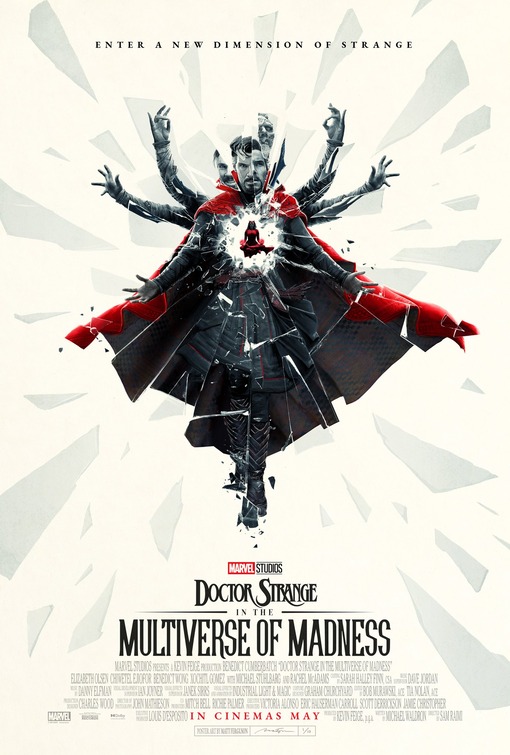
DOCTOR STRANGE IN THE MULTIVERSE OF MADNESS

 Benedict Cumberbatch     Elizabeth Olsen     Chiwetel Ejiofor     Benedict Wong
Xochitl Gomez     Michael Stuhlberg     Rachel McAdams     Patrick Stewart


            The strange wonders shown in this continuing saga of the Marvel universe(s) are a testament to the talent in filmmaking we’ve come to expect from Marvel, with a fine blending of story (Michael Waldron, Stan Lee, Steve Ditko), cast (Benedict Cumberbatch, Elizabeth Olsen, Benedict Wong, Xochitl Gomez, et al.), music (Danny Elfman), stunning  special effects and cinematography (John Mathieson).  All of these efforts are woven together into a spell-binding whole by director Sam Raimi.  Visually and emotionally, its powers draw the viewer into another colorful, fascinating, and sometimes terrifying world.

            One must carefully attend to the plot because of all the complexities involved in multiple universes with characters appearing in more than one, often with subtle differences among their different manifestations.  

            The hubris of Doctor Strange Cumberbatch), so evident in the previous (2018) story, is short-lived in this one.  Although starting out with his usual confidence in trying to incapacitate a huge octopus-like monster creating havoc on city streets and intent on capturing one small girl, Strange finds himself in need of assistance. He gets no small number of come-uppances from Wanda/Scarlet Witch (Olsen), a girl named America Chavez who is able to transverse universes at will, and others including the Doctor Strange in another universe.  Eventually, he is brought before the Illuminati summoned by Karl Mordo (Ejiofor) to sit in judgment of him.

            But throughout, there are major struggles with Scarlet Witch who appears to be power hungry, wanting to maintain her control in all the universes using Darkhold forces.  To do that, she is after America to steal the girl’s powers against the wishes and efforts of Dr. Strange who feels duty bound to protect America, who first appeared to him in a dream, although later she informs him that he was actually in another universe.

            As in the previous Doctor Strange, human conflicts are dramatically brought into the drama.  Significant here are the pull of motherhood on a woman, humans’ need for power and control, the duty of the strong to protect the weak, the wisdom of cooperation vs. going it alone, and the challenge of maintaining human relationships and managing grief and loss.

            Marvel movies are noteworthy for their broad-based appeal to young and old, fans of variable genres, and for their many historical, mythological, and literary references.  That they are based on comic books—usually considered light reading—must bring a smile to many.  Those who grew up on and have loved comic books might well say, “I could have told you so.”

            For those who love fantasy/action/adventure films that keep you on the edge of your seat, this is very likely to appeal.  In addition to the high drama and glittering visual display, it has human themes and moral conundrums worthy of post-theater discussion.


A mind-blowing experience traveling across multiple universes all of which have humans, some of whom appear in more than one, albeit with differing characteristics.


Grade:  A                              By Donna R. Copeland


Thursday, May 10, 2018

DISOBEDIENCE

Rachel Weisz     Rachel McAdams     Alessandro Nivola


            Disobedience versus free will is the issue in this production of Chilean filmmaker Sebastian Lelio, following upon his hit last year, A Fantastic Woman(Best Foreign Language Film at the Academy Awards).  Ronit Krushka (Weisz) is returning to Israel after the death of her father, but with a significant back-story.  We see her interactions with the hometown people rather awkward, beginning with her adoptive brother, David Kuperman (Nivola), who is in line to take the place of her father as the Rabbi.  She apparently left town abruptly years before, never to be heard from again, until she learns of her father’s death.  She seems to have had the reputation of a “wild child”, but the origin of this story is never explicated.
            Her visit creates consternation in the town, and it’s clear no one seems to know what to make of her.  They know she has made a life for herself in New York as a photographer, and all kinds of fantasies stem from that slight piece. We learn that she, David, and a woman named Esti (McAdams) were very close friends in their youth, and then she is surprised when she is told that David and Esti were married.
            As in A Fantastic Woman, director Sebastian Lilio is skillful in doling out little pieces of information along the way that help make sense of what is happening in the drama.  That is, we learn more about the relationships among the three main characters, the role the esteemed Rabbi Kuperman played, and the source of the ambivalence Ronit has for him.
            What plays out is a kind of feminine rebellion against patriarchy, and Lilio knows just how to notch up the tension in the viewer so that fundamental principles come to the fore.  And he throws in a little confusion for good measure. The esteemed rabbi went to great lengths to emphasize how humans are free to choose between angels and the desires of the beasts.  In that light, two characters have to weigh their options in leaving or staying.  Says one, “It’s easier to leave, isn’t it”, and the reply is, “No, it isn’t.”  
            The rewarding part in all this is that a main character develops understanding based on what he hears and observes and is able to alter behavior accordingly.  No easy job, considering the stakes.
            The actors are superb.  Rachel Weisz is able to conjure up all the mysteriousness of a character while keeping her genuine and real.  McAdams is a perfect foil in her limited but keen perception, and the ability to show her character’s increasing realizations. As the male in this drama, Alessandro Nivola exemplifies the male in such a conflict who is able to glean the truth and comport himself accordingly.
            Lilio’s account is very slow in building up to the essential elements and excitement of the story, and although the reward is well worth waiting for, perhaps too much time is spent on introducing the Ronit character and the explosive potential she embodies.

An intriguing kind of rebellion against the patriarchy in a traditional Jewish culture.

Grade:  B+                                    By Donna R. Copeland

Thursday, February 22, 2018

GAME NIGHT

Rachel McAdams     Jason Bateman     Jesse Plemons     Kyle Chandler


     This is a silly movie, and if you’re in a silly mood and easily go along with most comedies you see, you might like it.  It comes across first as a TV sit-com, then moves into what is supposed to be a thriller, then finally devolves into the absurd.  I think the writer Mark Perez intended for the script to move smoothly between couples’ conversations, comedy, and life-threatening chills.  But the conversations come across as hackneyed, the comedy not funny (unless you like the kind that is catty, mean, or demeaning), and the thriller parts become anti-climactic “gotcha” moments.  And the insertion of serious talks about such things as having a baby, and infidelity in the midst of a crisis is disjointedly unreal.  Perhaps some will see Game Night as a spoof on mystery/horror films, but I imagine most of these people will find most of the elements in the plot contrived.
     The main couple, Annie (McAdams) and Max (Bateman), are nuts about gaming and have an entertaining competitiveness with each other and when playing with their friends.  The film weaves in stories about all their relationships that are funny but have a sharp edge of discomfort and go on for too long.  Much of the interaction among all the couples is trying to one-up each other (which some laugh at, but I find not very funny).  One of the “serious” but intended comical elements is Max’s brother Brooks (Chandler) coming to visit.  We’re told about the psychological issues between the two, which are, indeed, played out before us.  We meet an egotistical “Hollywood” type who comes in flaunting his wealth and lording it over his brother.  He takes over every scene he’s in and all are enthralled and impressed with him, much to the chagrin of Max, who puts up only mild resistance.
     One of Brooks’ ostentations is to invite Annie’s and Max’s friends to his house/mansion the next week, which is intended to be the game of all games.  But there will be surprise after surprise (unless the viewer guesses each beforehand) intended to give the viewer a “what’s real? and “what’s the game”? kind of reaction.
     McAdams and Bateman do well with the material they have to work with, and come across as people one would like to know more about beyond the clichés.  But the real star is Jesse Plemons playing the nerd-like neighbor Gary, who is a lonely policeman longing to be included in the games his neighbors play.  Too bad the filmmakers didn’t end the film with his coup de grace.  That would have given their film a meaning we could hold onto. 
Game Night has some things going for it, but mostly it is a waste of time.

Gaming can be fun…until it gets mixed up in major crime.

Grade:  D+                                    By Donna R. Copeland

Wednesday, November 2, 2016

DOCTOR STRANGE

Benedict Cumberbatch   Chiwetel Ejiofor   Rachel McAdams   Benedict Wong   Mads Mikkelsen   Tilda Swinton   Benjamin Bratt


     Spectacular special effects makes this comic book story come alive in a special way, perhaps because it captures a child’s imagination and puts it on the screen.  We see it as a child with a vivid imagination may in reading a comic book.  Its exciting and mystically fascinating tale conjures up mythology and the spirit world with heroes and villains, and throws out paradoxes for us to consider.  (Must we sometimes commune with the dark side in order to achieve good?  Must we have death in order to have life?) 
     The film has numerous comical lines and jokes (e.g., a mystical reference that is actually a wi-fi password), but perhaps the biggest one is its riff on doctors who have a reputation for their arrogance, ambition, and stubbornness.  The star, Dr. Stephen Strange (Cumberbatch), is certainly supposed to shed this in his pursuit of shamanic knowledge, but part of the spoof is its tenacity on the heroic doctor. 
     Dr. Strange is at the height of his career as an esteemed neurosurgeon in New York; he can choose his patients (accepting only those that will pad his reputation), be dismissive and over-rule the staff, and is essentially the king of his realm.  His residence is fashionable with a stunning view of the city, and his car the most expensive and sportiest.  But lo, he roars out one evening to attend a lecture honoring him, when…Don’t text and drive folks! 
     Yes, he is pulled out of a ravine, but has lost the use of his golden hands, which throws him into an existential crisis and angry depression, for he is empty inside without his career.  He brushes off his one friend Christine (McAdams), a colleague trying to help him, and in desperation heads for Kamar-Taj, a healing place in Kathmandu, Nepal, where he hopes for a miracle.  His physical therapist had told him about a “hopeless” patient who had regained his physical abilities after its help.  “It will be costly”, the healed man (Bratt) informs him, but of course this was not a monetary reference. 
     Once he finds the place, Strange blusters in, completely unaware of a different universe and way of being.  While there, he will make discoveries he had never imagined in his empirically anchored life, and it will change him forever in no way that he ever anticipated.  He certainly becomes a nicer person, but that is only part of it.  He will strive to become a real hero with dimensions far beyond his previous accomplishments.
     Scott Derrickson, writer (with others) and director and his filmmaking team (Ben Davis, cinematography; Michael Giacchino, music; Charles Wood, production design; Ray Chan, art; and all the special effects group) have crafted an entertaining film with visual, musical, and literary qualities that should appeal to children and adults alike, one that contains rich material for thought and discussion after viewing. 
   Casting is perfect, with Cumberbatch as one who is equally skilled in portraying narcissism, extraordinary intelligence, and charity all in the same character.  Mikkelsen seems equally talented in portraying all different types of characters, with the one here being the epitome of evil.  A real coup with this film is casting Tilda Swinton as the “Ancient One”—we’re as surprised as Strange is that “he” is a “she.”  Swinton can play any exotic character a writer can come up with, elevating it with her own imagination.
      I was a little sorry at the end of this film to see that it was extended for 15-20 minutes too long, and that there was the now popular teaser for a sequel.  If only the filmmakers/investors could learn from their main characters!

This is a finely crafted action film with artistic merit.

Grade:  A-                                By Donna R. Copeland


Wednesday, November 4, 2015

EVERY THING WILL BE FINE

James Franco   Rachel McAdams   Charlotte Gainsbourg   Marie-Josee Croze


       “How are you?”  “Fine”  “How was your day?”  “Fine.”  This is how Every Thing will be Fine begins.  And it moves at a slow pace, omitting critical information (like who the characters are) for most of the film.  It is only in the last 20 minutes or so the viewer knows who people are and the story starts fitting together.  It’s divided up into three segments separated by years of time, and in each section Tomas is with a different woman.  It’s up to you to figure out the connections, and we never learn how they take place, except for the second one.
        The story begins with a scene of Tomas (Franco), a writer, scribbling on a pad when he awakens.  He emerges from a hut on a landscape blanketed with snow, chats with a small group outside briefly, letting you know he is not entirely satisfied with his progress, bums a cigarette, gets in his car and takes off.  When Sara (McAdams) calls on the phone, he appears unsettled and lights his cigarette.  In a flash, a sled with two boys comes sliding down a hill in front of the car.  He realizes he has hit something, but reacts slowly, and this is another scene in which it’s difficult to figure out what has happened.  Nothing is shown of the boy under the car, and when Tomas comes around to the front, he sees a tiny figure sitting on the ground.
       Tomas talks gently with him, reassuring him that everything will be OK and carries him on his shoulders up to the house to his mother, Kate (Gainsbourg).  We don’t hear much of what is said, but she screams and runs to the car.  The police show up, question Tomas, and reassure him it was an accident and he need not feel guilty.
       Tomas cannot take that advice, apparently, because that and his dissolving relationship with Sara spirals him down into destructive behavior.  We get glimpses of that, his conflicted relationship with an aging father, and strange periodic meetings with Kate, to whom he apologizes over and over and says that if there is ever anything he can do to call on him.  Kate’s grief is better shown in the film.  She sobs, goes to church, and tends to her son Christopher.  Tomas, on the other hand, becomes even more reticent, not even telling Sara what happened at first. 
    Every Thing will be Fine, directed by Wim Wenders with a script written by Bjorn Olaf Johannessen, has a number of problems, some of which are mentioned above.  The segment on Tomas’ father seems like a needless digression.  And I find it hard to believe that a parent would allow her children to slide down a trail that ends up on the road.  But the main problem is the lack of explanatory transitions between the three women in Tomas’ life. 
       Perhaps they are really intended to mark the progress of Tomas’ psychological status.  In the first, with Sara, he is majorly depressed even before he hits the children because of writer’s bloc and his relationship being in trouble.  Sara is shown to be very attentive to him, so it’s not entirely clear why he leaves her (and we find out it was he who left).  In the time period with Kate, he is recovering from self-destructive behaviors, and is attentive to her when she calls him to come over late at night.  He feels awkward, but allows her to put a pillow on his lap and go to sleep, and then departs early in the morning.  (They wanted to make sure Christopher did not awaken and see him there.  It’s not clear why.)  It’s also unclear whether they develop a relationship or not.  Several years transpire, and suddenly Tomas is picking up a little girl from school, and they obviously have a close connection.  Turns out she is the daughter of his current love, Ann (Croze).  In this section, he has become successful in his writing, seems well put together and calm, and is clearly devoted to Mina.
       What the film does do well is its demonstration that grief and guilt following the death of a child have a radiating effect on the immediate family, on the one responsible and on his relationships.  Another interesting phenomenon is Christopher’s almost instant transference toward Tomas during the brief interval when he carries him to the house.  Subsequently, Christopher will draw a picture of that, will read all of Tomas’ published novels, and eventually want to connect with him.  We see no father around, which may also help explain his being drawn to Tomas.
       The scenes of how Tomas deals with Christopher’s attachment to him much later on are some of the best in the film.  It shows Tomas as having made significant progress psychologically. 
       I’m unsure about where to place the responsibility for the drawbacks of Every Thing will be Fine; certainly much of it has to do with the script, its obfuscation and excruciating pace.  But certainly these tasks are also under the purview of director Wenders and the editor (Toni Froschammer). 
       On the other hand, the actors live up to their reputations.  Franco pulls off the successful, made-it older man just as well as the troubled younger man.  McAdams is only on screen for brief segments, but she is also good at portraying a supportive, concerned partner as well as an enraged rejected one years later.  Gainsbourg’s forté is her ability to portray odd, mysterious characters whom the viewer always remembers. 
       Last but not least, Alexandre Desplat’s music enhances the film throughout, as you would expect it would.

Everyhing will be fine, but it’s a long slog getting there.

Grade:  C+                                    By Donna R. Copeland

Friday, October 30, 2015

SPOTLIGHT

Mark Ruffalo   Rachel McAdams   Michael Keaton     Liev Schreiber   Stanley Tucci   Billy Crudup   John Slattery


          Shining a spotlight on wrongdoing is a big scoop for a newspaper, but it also holds huge risks.  The small team at the Boston Spotlight was charged with investigating the involvement of Catholic priests in the abuse of children in the 1970’s, just when newspapers were beginning to founder and a new editor had come aboard.  And Marty Baron (Schreiber) was an astute editor, insisting on pursuing the story even when the staff was a bit reluctant—except for one, Michael Rezendes (Ruffalo), one of the newer reporters. 
        Tom McCarthy, director, and co-writer with Josh Singer, has once again shown his considerable talent in telling an important story with grace, compassion, and thoughtfulness (as in The Station Agent, Win Win, and The Visitor) without indulging in hero worship or lurid descriptions.  That is, he avoided focusing it as a major newspaper scoop, and kept the attention on the (in)humanity of the issue.  Based on a true story, for which the Spotlight received the Pulitzer Prize for Public Service in 2003, McCarthy’s film is a docudrama about the newspaper’s honorable pursuit of the truth.  In their efforts, they encountered formidable resistance from a shocking number of respected leaders in the Boston community.
         The reluctance of so many to admit culpability—based on a myriad of reasons even as simple as “It just didn’t capture my attention” to “Yes I did it, but it wasn’t wrong”–is entirely understandable in some cases, but reprehensible in others.  The film does a fine job in distinguishing these from one another.  One sign of a story well told is if audience members ask themselves, “What would I have done?” and have to think about it for a while. 
   In addition to the drama, McCarthy knows how to choose musicians and cinematographers who will enhance the drama.  Howard Shore’s music swells or lilts at just the right places to reinforce the drama.  Similarly, cinematographer Masanobu Takayanagi is skilled in capturing mood and emotion in the drama and employing the camera as a visual guide.
     Now, back to the actors.  Mark Ruffalo gives probably one of his most memorable performances here, although he is noteworthy in many films (e.g., Foxcatcher, The Kids are all Right, The Avengers series, and television’s The Normal Heart).  As Mike in this film, he shows him as a team player, an eager beaver but with values, and more importantly one of the few who really champions and wants to protect children.  (I was dismayed to see how little regard for children so many, even mothers, had, as well as the absence of any impulse to protect younger children coming up.)  Michael Keaton and Rachel McAdams are noteworthy as well, especially in their “naturalness” in playing their roles.   He in his cool editor role who resists being regarded above his staff and she in her obviously caring but crack reporter role. 
       Actually, the whole ensemble is outstanding.  Liev Schreiber plays a boss that we would all like to have in his wisdom, listening ear, and smooth direction of the team.  Stanley Tucci delivers another of his nuanced performances (with hair this time!) as an outsider in a community that doesn’t seem to want to pay attention to what he has to say.  Billy Crudup and John Slattery round out an altogether fine cast.
      Obviously, I think Spotlight is one of the better films this year owing to the high level of movie-making production and ethical/moral values it epitomizes.

This is a fine film in just about every way.

Grade:  A                                    By Donna R. Copeland

Wednesday, July 22, 2015

SOUTHPAW

Jake Gyllenhaal     Rachel McAdams     Forest Whitaker     50 Cent     Miguel Gomez


Redemption comes at last when a slow learner finally masters his destiny in Southpaw.  It’s a hard-won battle every step of the way.  Billy “The Great” Hope (Gyllenhaal) is boxing at the top of his game after he and his wife Maureen (McAdams) have crawled up from an orphanage, always sticking together.  Then tragedy strikes—helped along by hotheaded Billy—and he begins to lose everything that is meaningful to him.  At rock bottom, he looks to Tick Wills (Whitaker) a former trainer who owns a gym, but is rejected because he appears not to be willing to make changes.  When it looks like this will be his only chance, he agrees to start at the bottom and see if he can work his way up to the point where he regains custody of his daughter.
           This is a brutal film (rated R for its violence) with long, bloody boxing scenes and agonizing sequences, so not for the faint of heart or those with weak stomachs.  Gyllenhaal bulked himself up for the role, and adapted his ordinarily clear voice to curt mumbles and grumbles to fit the character.  Just as much a star, Whitaker delivers philosophical truths (“Stopping punches with your face is not defense”) quick, targeted comebacks, and behavioral conditions that will be essential to Billy Hope’s rehabilitation and ability to fight strategically.  McAdams is well cast as a loving wife who takes care of her husband as much as she can.  Young Oona Laurence as the Hopes’ daughter Leila deserves recognition for her portrayal of a grief-stricken child who faces overwhelming losses.
           Director Antoine Fuqua realizes writer Kurt Sutter’s script in well-paced, believable sequences, and he works closely with his colleague in other films, Mauro Fiore, to produce stunning camera work, alongside an inspiring musical score. The film is dedicated to its award winning musician and popular film composer James Horner (Titanic, Avatar, A Beautiful Mind), who was killed last month in a plane crash.
           The film is a bit slow to get started with its real drama beyond the fight sequences (and some of the fights occur before you get a chance to invest in the characters), and the struggles between the Hope couple are excruciating to sit through.  A good bit of it is watching the wife trying to rein in her drug-addled, fight-obsessed husband, often to no avail.  I think trimming some of these scenes would have made this a better film.  When it moves into showing the psychology of Billy Hope and his rehabilitation and relationship with his daughter, it becomes much more engaging.

Redemption for a slow learner.

Grade:  C+                          By Donna R. Copeland