Showing posts with label Elizabeth Olsen. Show all posts

Wednesday, May 4, 2022

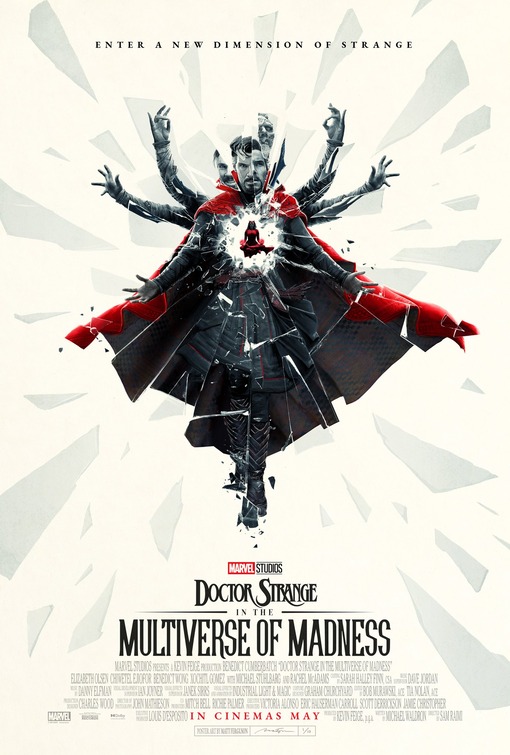
DOCTOR STRANGE IN THE MULTIVERSE OF MADNESS

 Benedict Cumberbatch     Elizabeth Olsen     Chiwetel Ejiofor     Benedict Wong
Xochitl Gomez     Michael Stuhlberg     Rachel McAdams     Patrick Stewart


            The strange wonders shown in this continuing saga of the Marvel universe(s) are a testament to the talent in filmmaking we’ve come to expect from Marvel, with a fine blending of story (Michael Waldron, Stan Lee, Steve Ditko), cast (Benedict Cumberbatch, Elizabeth Olsen, Benedict Wong, Xochitl Gomez, et al.), music (Danny Elfman), stunning  special effects and cinematography (John Mathieson).  All of these efforts are woven together into a spell-binding whole by director Sam Raimi.  Visually and emotionally, its powers draw the viewer into another colorful, fascinating, and sometimes terrifying world.

            One must carefully attend to the plot because of all the complexities involved in multiple universes with characters appearing in more than one, often with subtle differences among their different manifestations.  

            The hubris of Doctor Strange Cumberbatch), so evident in the previous (2018) story, is short-lived in this one.  Although starting out with his usual confidence in trying to incapacitate a huge octopus-like monster creating havoc on city streets and intent on capturing one small girl, Strange finds himself in need of assistance. He gets no small number of come-uppances from Wanda/Scarlet Witch (Olsen), a girl named America Chavez who is able to transverse universes at will, and others including the Doctor Strange in another universe.  Eventually, he is brought before the Illuminati summoned by Karl Mordo (Ejiofor) to sit in judgment of him.

            But throughout, there are major struggles with Scarlet Witch who appears to be power hungry, wanting to maintain her control in all the universes using Darkhold forces.  To do that, she is after America to steal the girl’s powers against the wishes and efforts of Dr. Strange who feels duty bound to protect America, who first appeared to him in a dream, although later she informs him that he was actually in another universe.

            As in the previous Doctor Strange, human conflicts are dramatically brought into the drama.  Significant here are the pull of motherhood on a woman, humans’ need for power and control, the duty of the strong to protect the weak, the wisdom of cooperation vs. going it alone, and the challenge of maintaining human relationships and managing grief and loss.

            Marvel movies are noteworthy for their broad-based appeal to young and old, fans of variable genres, and for their many historical, mythological, and literary references.  That they are based on comic books—usually considered light reading—must bring a smile to many.  Those who grew up on and have loved comic books might well say, “I could have told you so.”

            For those who love fantasy/action/adventure films that keep you on the edge of your seat, this is very likely to appeal.  In addition to the high drama and glittering visual display, it has human themes and moral conundrums worthy of post-theater discussion.


A mind-blowing experience traveling across multiple universes all of which have humans, some of whom appear in more than one, albeit with differing characteristics.


Grade:  A                              By Donna R. Copeland


Wednesday, August 9, 2017

WIND RIVER

Jeremy Renner     Elizabeth Olsen     Jon Bernthal     Martin Sensmeier     Julia Jones


      Taylor Sheridan (writer, director) is an artist who knows how to draw out the best from the other artists in his films—Cinematographer Ben Richardson, Musician Warren Ellis, Actors Jeremy Renner and Elizabeth Olsen and the rest of the cast, Production Designer Neil Spisak, Art Designer Lauren Slatten, and the other technical contributors.  Wind River represents a breathtaking example of the essence of accomplished filmmaking, from the sweeping snow-laden landscapes stained with blood, to the haunting musical score paired exactly with the dialog and action, to Renner’s wise old soul with extra sensory perception and gentle touch, and Olsen’s expert urban-trained FBI agent clearly not prepared for the different environment and population, but willing to learn.  There is even an exquisite/troubling blending of stunning beauty and unspeakable horror.
     I was especially impressed with cinematography that has the camera slink around with Cory tracking footprints in the snow, and guiding the eye upward or downward toward whatever it wants you to see.  A view to admire is one shot from an airplane over a snowy, mountainous landscape, showing lumbering trucks on the highway bearing heavy snowmobiles.  This prepares us for a showdown.
     One would like to imagine that the pristine snowscapes we admire on the screen (as we sit in our toasty, comfortable theater seats) would hold innocence and purity and be reflected in fit bodies and souls.  But alas, just as we hear about the brutal attack by a lion on a herd of cattle, we see a fallen human body in the snow with a head wound and blood coming out her mouth.  Tracker Cory (Renner) sadly knows who it is, which provokes memories of an earlier death that still tears at him.
     Cory is a good man, a respected local who, even without the memories, would willingly help FBI agent Banner (Olsen) who has been called in to solve the case.  These sequences constitute the few scenes tinged with humor, when the agent comes totally unprepared for the bone-chilling weather and has to borrow warm clothing from the sheriff’s stern wife.  (“Make sure you return it!”)  Later encounters with the locals are likewise amusing when Banner meets native Indians, unwittingly offending them, and roughnecks working on an oil drill.  Cory and the sheriff wryly get her up to speed from time to time, and she shows flashes of leadership and strength.  (I wish Sheridan had made her character much stronger, as many filmmakers are willing to do with females nowadays…but maybe this is happening only in action figures a la Wonder Woman, Atomic Blonde, and Valerian/City/Thousand/Planets?)
     This beautifully made film has substantive points to make as well as depth of character.  It’s about loss and death—especially of children—and the multifarious ways in which people cope with it; life on an Indian reservation (this part is not fiction); the nefarious effects of drugs on young people; the art of skillful, informed sleuthing and interrogation; and, finally, how satisfying justified retribution can be. 

Be prepared for an extravaganza of beauty in all its forms mixed with the realities of life lived.

Grade:  A                                    By Donna R. Copeland

Thursday, May 5, 2016

CAPTAIN AMERICA: CIVIL WAR

Chris Evans   Robert Downey, Jr.   Scarlett Johansson   Sebastian Stan   Anthony Mackie   Don Cheadle   Jeremy Renner   
Chadwick Boseman  Paul Bettany   Elizabeth Olsen   Paul Rudd   Tom Holland   Daniel Bruhl   William Hurt   Emily VanCamp


          Keep your eye firmly on the screen because this Captain America travels at lightning speed across the continents, through the story line and the 90+ characters, over 20 of which are central to the action. Despite this complexity, more than in many action films, screenwriters Christopher Markus and Stephen McFeely present a coherent plot, fairly easy to follow for non-diehard Marvel Comics fans.  Industrial Light & Magic’s visual effects are stunning.
      It seems that after numerous deadly encounters through the years between the superheroes and the bad guys, much collateral damage has been incurred, making citizens fearful and governments thinking the Avengers need to be reined in.  It’s proposed that a United Nations panel be appointed to supervise them and set limits on what they will be allowed to do.  Tony Stark, aka Ironman (Downey), specifically is confronted by the mother of a promising son who was involved in charity work when he was killed in Sokovia, incidental to the Avengers’ defeat of the super villain Ultron.  The nation of Sokovia was decimated in that battle.
          Out of some guilt and reasoning, Stark is in favor of going along with the UN proposal called the “Sokovia Accords” when Secretary of State Ross (Hurt) presents it to him.  Tony brings it up to a few other super heroes for consideration, including Captain America (Evans), Black Widow (Johansson), the Falcon (Mackie), and Scarlet Witch (Olsen).  Vision (Bettany) and the War Machine (Cheadle) are already on board with the Secretary.  The film laudably presents logical arguments for and against the proposal, which have to do with individual freedom versus community interest and true heroism versus vigilantism.  Those on Tony’s side—Black Widow, War Machine, and Vision—regard community concerns as paramount; whereas those taking the other side—Captain America, Scarlet Witch, and Falcon—trust their own moral judgments over a committee’s and foresee that their individual assessments in emergency situations will be more effective than judgments by a committee.  This mistrust on the Cap’s part continues the theme from the 2014 Captain America film; namely his experience of being betrayed by authorities.
          So the lines are drawn between Stark and Captain America representing both sides of the argument, both of whom bring in recruits:  Spiderman (Holland) by Stark and Hawkeye (Renner) and Ant-Man (Rudd) by Captain America.  Fierce battles will be waged until an evil plot of divide-and-conquer is uncovered.  The Winter Soldier (Stan), Black Panther (Boseman) and Zemo (Bruhl) will play pivotal roles.
         Directors Anthony and Joe Russo (Captain America:  Winter Soldier) with their writers create an adventure-filled fantasy while clearly and intelligently addressing important moral issues related to security, privacy, individualism, and the role of governments in our world.  Grief over major losses and testing friendships add social/emotional components to make the action more meaningful.
      The cast is phenomenal, with most of the experienced, well-known superheroes skillfully reprising their roles.  Tom Holland as Spiderman is a welcome newcomer, acing his role with competency and humor.  Chadwick Boseman as Black Panther with cat claws is likewise effective in his introductory appearance.

A visual effects extravaganza with exciting and still meaningful content.

Grade:  A                                    By Donna R. Copeland


Wednesday, March 30, 2016

I SAW THE LIGHT

Tom Hiddleston     Elizabeth Olsen     Bradley Whitford     Cherry Jones

          When the movie first opened, I was captured with Hank Williams (Hiddleston) singing “Cold, Cold Heart” without accompaniment and the chiaroscuro effect in the scene.  The mood was just right, and it was deeply moving.  Unfortunately, two basic flaws in I Saw the Light emerged soon after, which I attribute to Marc Abraham’s screenplay and direction.  He has primarily worked as a producer without much experience in writing and direction, hence, the movie sags almost every time there is dialog.  It doesn’t matter whether the conversation is between husband and wife in intimate moments or band members talking to one another or to agents—he puts the audience to sleep.  I marveled at how such an interesting person’s life could be made boring.
       The other problem I had with the film is the number of scenes where neither the issue nor the personalities involved are explored; they’re simply left unresolved.  A particular example is Hank and his agent Fred Rose (Whitford) visiting the MGM Studio, and their host wants Hank to take off his hat.  Hank refuses, and we don’t know why it’s so important to the MGM producer or to Hank.  We don’t even know whether he actually took it off or didn’t.  And we don’t know whether the incident ruined Hank’s chance to be supported by MGM.  With so many of such scenes in a film, it becomes unsettling.
      Hank Williams was decidedly a fascinating, complex person with a markedly eventful life, and whatever interest is maintained in the movie is because we’re curious about him and want o understand him and because Hiddleston aced the role.  Even though we’re presented with event after event in his life, it’s more like a chronicle; there is not much exploration into Hank’s character in the larger sense of the word that would essentially help us understand him. 
      On the other hand, Tom Hiddleston has done the seemingly impossible, converting his British accent into American country, learning to sing on pitch and play the guitar (tutored by Rodney Crowell), and moving his body like a person with spina bifida—all for this movie.  I had to smile when in an interview he said that he had heard a few Hank Williams’ songs before he got the role, but was more intrigued with the word ‘honky tonk’; he had no idea what it meant, but he loved the sound of it.  Hiddleston put on the Williams persona so completely and convincingly, it fit like a body suit.
      The talents of other main actors were fine supports:  Elizabeth Olsen as the disillusioned but shallow wife; Bradley Whitford as the agent-like-a-father Fred Rose; and Cherry Jones as the cloying, possessive mother of Hank.  I had anticipated seeing I Saw the Light, so was disappointed that it contained so little “fleshing out” of the characters. 
     On the other hand, Tom Hiddleston’s performance is worth the price of a ticket to the movie theater.  The last song, “Your Cheatin’ Heart” is a perfect ending.  After seeing important events in his life, he could just as well be singing the song to himself as to someone else. 

A reminder that good writing and direction are essential, although sometimes an actor’s performance is worth a viewing.

Grade:  D+                                    By Donna R. Copeland