Showing posts with label Ben Foster. Show all posts

Thursday, July 12, 2018

LEAVE NO TRACE

Thomasin McKenzie     Ben Foster     Dale Dickey


      Indie movies at their best weave an engaging story that pulls you right along the whole way, making you question and wonder and fills your heart with nostalgia and inspiration.  That’s what Leave No Trace does.  It’s a quiet film, following a father and daughter as they live contentedly in Forest Park, a nature preserve in Portland, Oregon. They live a simple life, with him home-schooling her, foraging for their food, and sleeping under the stars or under a makeshift lean-to in bad weather.  The father has schooled the daughter in leaving no tracks so they can remain undetectable in a secluded park in the Oregon countryside.
     Of course, this idyll cannot last, and before long they are detected (gracefully, by kind-hearted officials), and a kind-hearted benefactor who seems to understand their kind of thirst for independence, gives them a house, employs the father, and the girl is enrolled in school.  This is after they have both undergone numerous evaluations that indicate that they are both smart and she has been well schooled.  
     However no one seems to take into account that the father Will (Foster) is experiencing PTSD stemming from military service, and this is the way he has adamantly chosen to deal with it.  He is a model parent to his daughter Tom—as in Thomasin—(McKenzie), and they fare very well when left alone.  But society encroaches; it is no longer possible to be truly alone in our world with a degree of connectedness that has never been seen before.  
     Even as an Indie film, Leave No Trace is unusual in its portrayal of so many people being so open and kind to the unusual strangers Will and Tom, providing them with shelter, work, education, and friendship. They are polite and appreciative, but their benefactors are especially kind and giving.  Such a thing is actually very nice to see in our divided world where most strangers are regarded with suspicion, warranted or not.  
     The filmmaker Debra Granik (Winter’s Bone) clearly has her finger on the pulse of American life, and her portrayal of the Will and Tom duo (based on the novel by Peter Rock) should be praised for its attention to PTSD and how those affected cope in different ways. Clearly, some need to pursue their own lonely path and should be free to do so.  I especially liked the way the film ends—not with everything resolved—but with a realistic picture of how these things can be worked out.  It leaves you with the tender thought that two people so well connected are not likely ever to be separated permanently.
     Obviously, I took to this film and respect the messages it conveys.  But I couldn’t keep from noticing that everyone in it is white and fits the norm for our country.  We all know the trajectory of the story would be significantly different had the main characters been another color, ethnicity, sexual orientation, etc.  But perhaps that is for another movie.  We can appreciate here the soulful representation of very real characters in life.
     Ben Foster has achieved a reputation particularly for extraordinary performances in 3:10 to Yuma and Hell or High Water, but here he’s in a very different role—a taciturn but thoughtful wounded man—which he manages just as well.  Thomasin McKenzie is known primarily for her television roles, but she establishes her talent for film features here in her character’s perceptiveness shown on her face and in her body as she struggles with the tension between her father’s outlook and her own observations of society.  Like most teenagers, she sees something she likes and has few qualms about going after it.  The uniqueness of this film lies in her emotionally rational and healthy reasons for going on her own path (as opposed to avoiding conflict) and her father’s willingness to allow her this without anger and without putting much pressure on her.

Differing perceptions about living on the edge, unseen.

Grade:  B+                                                By Donna R. Copeland

Thursday, January 4, 2018

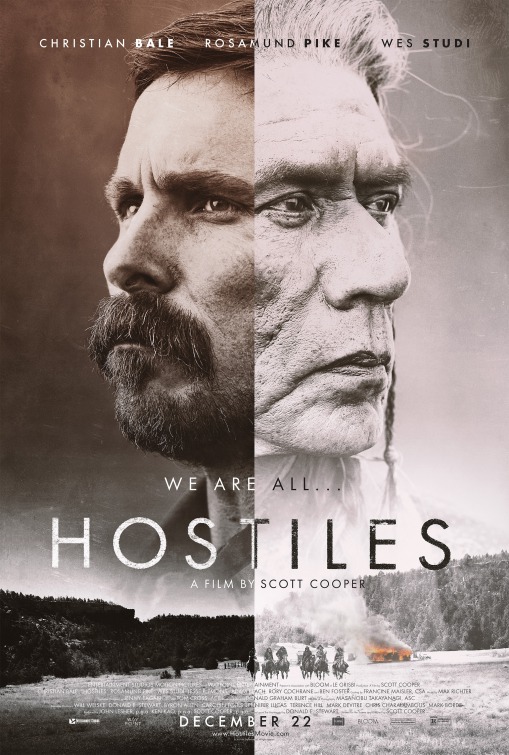
HOSTILES

Christian Bale     Rosamund Pike     Paul Anderson     Timothee Chalamet    
Ben Foster     Wes Studi     Adam Beach     Rory Cochrane


     Writer/director Scott Cooper is a master at highlighting genuine but dramatic human dilemmas, as seen in Out of the Furnace, Black Mass, Crazy Heart, and now, Hostiles.  Hostiles depicts the
US Army-Indian conflicts in the late 19th Century.  It opens with a brutal scene of the massacre of a family on an isolated farm/ranch.  American soldiers have experienced huge losses from Indian attacks, and some take great satisfaction in having retaliated in kind.  Cooper shows the varying ways in which soldiers cope with the killing.  One says, “If you kill enough people, you get used to it…but I hate losing my men.”  Another says, “I was just doing my job” [in slicing Apaches from stem to stern].  “An eye for an eye; a tooth for a tooth”, is his mantra as he reads the Bible regularly to reassure himself.
     Cooper is eloquent in showing men pushed to their limit, the ethical/moral dilemmas life presents, and—most heartening—men transformed by their experiences.  In Hostiles, we are captivated by Captain Blocker (Christian Bale in a stellar performance), who in the beginning sits patiently, but uncomfortably, when a trusted soldier under his command confesses to “Melancholia”, of which Capt. Blocker has no inkling.  That doesn’t mean he doesn’t care for this soldier—he values him—but depression?  That is not something he knows anything about. 
     Then he is assigned a task that is anathema to him—accompanying Apache chief Yellow Hawk (Studi) and his family to Montana, for burial at his birthplace.  The chief has cancer and is about to die, and the zeitgeist is turning toward being much more tolerant of the Indians.  President Harrison has ordered that the chief be accompanied by the U.S. military to Montana to assure his safe arrival.  Have you ever heard a silent scream?  That is Capt. Blocker’s response to the order, which he cannot refuse without jeopardizing his pension.
     What kind of transformation can a person like Capt. Blocker make?  It takes two warring parties traveling together (ahem...plus a woman?) to “humanize” him.  This film is about the profound emotional experiences that such a man as Capt. Blocker undergoes that go from silent listening and grunts to real, tender, sharing moments he has with those around him.  You don’t often see a cowboy/soldier self-actualized, but Cooper achieves just that.
     There are exemplary tender moments in this film, such as a simple “Thank you for your kindness” to a sympathetic laying of a hand on a person suffering in a tent, to a soulful “A part of me dies with you.”  The upshot is that Cooper understands so many aspects of men especially (not to entirely exclude women) and portrays them as few filmmakers have been able to do.
     Christian Bale brings out the character of Capt. Blocker in a way that perhaps no one else could.  His award-worthy performance (after stellar roles in The Big Short, American Hustle, and two Dark Knight films) should be recognized.  Supporting roles are well covered by Rosamund Pike, Wes Studi, and Rory Cochrane, but this is really Bale’s tours de force.

If you want to see a western with heart and substance, this is it.

Grade:  A                                    By Donna R. Copeland

Friday, October 28, 2016

INFERNO

Tom Hanks   Felicity Jones   Omar Sy   Irrfan Khan   Ben Foster   Sidse Babett Knudsen


          Inferno is based on the fourth book by Dan Brown about Cambridge symbolist Robert Langdon (Angels & Demons, The DaVinci Code, The Lost Symbol), who solves puzzles and crimes by interpreting the symbols associated with them.  This film opens with Langdon (Hanks) in the hospital following a head wound and suffering retrograde amnesia.  He can’t remember what happened to him, at least for the time being.  He’s given some information from his doctor, Sienna Brooks (Jones), but when bullet fire begins, she helps him escape and takes him to her apartment. 
         It takes a fair amount of time, skirmishes, and new characters like Bouchard (Sy) Sims (Khan), and Sinksy (Knudsen) showing up for Langdon to get a full picture of what is going on.  In the meantime, he and Brooks are running from assassins while Langdon tries to solve the puzzle of why this is happening.  They’re in the Palazzo Vecchio in Florence; then with more clues, they run to Venice, and finally must go to Istanbul to fill in the last of the puzzle.
     Director Ron Howard has made this an action film with much less time spent on presenting and deciphering clues as happened in the previous two works.  As a result, it is much less engaging.  The threat of a virus that has the potential to wipe out half of the world’s population adds some excitement, along with finding out more about the characters responsible (e.g., Zobrist, played by Foster).  But again, character development is weak, so we don’t know much more about him, only about his idealistic plan.
      Tom Hanks plays the befuddled hero well, as he has done with so many such characters.  Supporting actors Jones, Sy, Khan, Knudsen, and Foster likewise portray their roles well.  The ending with Langdon and Sinsky leaves much to be desired in its nostalgic parting of ways. 
          I’m not sure why this film was made.  I think maybe everyone involved signed on early on, but perhaps by the time shooting began, enthusiasm had waned considerably.

This is only for diehard Dan Brown/Robert Langdon fans.


Grade:  D                            By Donna R. Copeland

Thursday, July 28, 2016

HELL OR HIGH WATER

Chris Pine     Ben Foster     Jeff Bridges     Gil Birmingham


          All the filmmakers involved in making Hell or High Water deserve high accolades.  It’s a western taking place mostly in Texas, but takes a novel approach in its breadth of scale—its characterization of Texans, the depth and complexity of the characters and the actors playing them, the empathic focus on both the bank robbers and the Rangers pursuing them, social commentary, soulful tunes and soundtrack (Nick Cave, Warren Ellis), and cinematography (Giles Nuttgens) that captures the landscape as well as the intricacies of the plot.  Director David Mackenzie and screenwriter Taylor Sheridan, I commend you for your perceptiveness and creativity in making such an intelligent and entertaining film.
        Toby (Pine) and Tanner (Foster) fit the often typical dynamics of a broken home—one brother being the “good” one that stays devoted to his mother and the other a troublemaker with a prison record.  They are brought together after the mother’s death by Toby’s (the good guy) plan to re-coup funds that their mother lost to the bank for a quite legal reverse mortgage on the ranch and back taxes, which the bank paid.  Toby, who is resentful about being poor all his life, is way behind on his child support payments for his two boys, learns that unless the mortgage is paid off, he will lose the ranch.  There is a deadline for paying it off before the bank forecloses on it.
        Toby’s plan is to enlist his brother’s help (keep in mind his brother just got out of prison for bank robbery) in robbing banks and getting just enough cash to save the ranch. This plan is conceived by a very smart person, which is to get only small bills in small amounts (can’t be traced and FBI won’t be involved), only robbing small banks early in the day.
       Enter Texas Ranger Marcus (Bridges) and his sidekick Alberto (Birmingham).  Marcus is old and getting ready to retire, and Alberto goads him about this while Marcus makes cutting remarks about Alberto being a “half-breed” (Indian/Mexican).  It’s easy to see they’re both fond of one another in a manly way.  Marcus likes to play the fool, but there is calculation and perceptiveness behind all his apparent foolishness.  He knows people and reasons through what they’re likely to do next.  Bridges may get an Oscars nom for his outstanding performance.
        This is the art of Taylor Sheridan’s storytelling; he sets everything up, tells us who the characters are, and sprinkles in little surprises and wonderful humor along the way.  Example:  In the T-Bone Café, you’re asked about what you don’t want (vegetables), which leaves only a steak to order, and the crusty waitress knows exactly how to get you to order what will come to the table.  Touches of humor like this, extended moments of tender emotions, and quick splashes of violence punctuate the story.
       The film provides all the excitement you would want in resolving the outcome of the robberies and the pursuit of the perpetrators, all the while commenting on Texans’ infatuation with their guns, car chases (which are more realistically rendered than any current action movie), and the western movie genre.  Keep this in mind as you watch the film:  Marcus’ observation of “The things we do for our kids.”
      This must be one of the most thoughtful and clever endings in the history of film, completely pulled off by two gifted actors (I won’t tell you who they are).  Seeing and listening to their conversation gives us the full picture of the ethical/moral issues involved in the point of view of each.  One can easily imagine that ultimately they would agree with one another.  What a film!

A new connotation of “Best Western.”

Grade:  A                        By Donna R. Copeland

Thursday, June 9, 2016

WARCRAFT

Travis Fimmel   Ben Foster   Dominic Cooper   Paula Patton   Toby Kebbel  
Robert Kazinsky   Ben Schnetzer   Daniel Wu   Anna Galvin


          Warcraft, based on the “World of Warcraft” videogame, involves a complex story pitting different nationalities together, mixing in magical feats that can ward off predators and transport people through space.  The human magicians are called “guardians”, but like everyone else, they have vulnerabilities.  Humans live in a place called Azeroth, and peace has reigned between them and the Orcs for hundreds of years; however, a new predator has come on the scene that sets out to destroy both civilizations.  They are about to wipe out the Orcs, who are now going after humans and their lands to survive.
          Major players in Azeroth include King Llane Wrynn (Cooper), his leading soldier Lothar (Fimmel), the guardian Medivh (Foster), and an aspiring guardian Khadgar (Schnetzer).  There is a power struggle among the Orcs for chiefdom.  Gul’dan (Wu) is the current chief (evil) in desperate need of more fuel (his plans are to use captives for that purpose), and sends his “horde”, including Durotan (Kebbell) and his pregnant wife Draka (Galvin), and others into Azeroth for an initial attack on humans. 
         Amidst this attack, we’re introduced to Garona (Patton), half-Orc/half-human as a result of her parents’ mating, and now an outcast chained to one of the Orc warriors.  Lothar rescues her for the purpose of getting intel about the Orcs and promises to take care of her if she will help them, which she does, making her walk the line of divided loyalties.
This film throws a lot at the viewer to process, and many of the Orc characters look so much alike it’s hard to tell them apart.  Moreover, it’s so loaded with CGI, that aspect almost overwhelms the story.

Primarily for Warcraft game enthusiasts who favor CGI over story.


Grade:  D                         By Donna R. Copeland

Thursday, January 28, 2016

THE FINEST HOURS

Chris Pine     Casey Affleck     Ben Foster     Eric Bana


          The rescue boat for a sinking ocean liner ends up without a compass during the mission, and most of the audience could use a similar guide in order to understand what is going on in The Finest Hours.  Perhaps those with a Boston/New England accent will comprehend more, but unless they are familiar with nautical terms and have sharp ears for dialog over the cacophony of special effects sounds, I think they too will be mystified at least part of the time. 
         We get acquainted right away with Bernie Webber (Pine) and his friend Richard Livesay (Foster) as members of the Coast Guard in Massachusetts.  They’re easygoing and likeable, and Bernie has a reputation for going by the book.  He finds it easy to be polite and respectful of his elders and his superior, Captain Daniel Cluff (Bana), a man not well respected by the Coast Guard crew, who doubt his judgment.
           This is exemplified by his order for Webber to put together at great risk a rescue team on a 36-foot boat when a brutal nor’easter strikes and oilers at sea are sinking, one in particular being the Pendleton.  Chief Engineer Ray Sybert (Affleck) is on that ship, and since all the commanding officers were on the part of the ship broken off by hurricane strength winds and stormy seas, his knowledge of sailing makes him the effective leader.
          The Finest Hours is based on a true story written down by Michael Tougias and Casey Sherman in a book with the same title.  Even a small sample of their clearly written prose pulls the reader in immediately and sustains his/her attention.  The movie, The Finest Hours suffers from the screenwriters (Scott Silver, Paul Tamasy, and Eric Johnson) and Director Craig Gillespie not realizing that a naïve audience is not going to understand the technical terms that are indistinctly shouted out, even if they could hear them over the din of the rushing sea, howling winds, clanking of huge chains, and motor sounds.  We do get some of the heroics of the Webber and Sybert characters—remarkable with the Doubting Thomases surrounding them—but not to the extent that makes it clear what is happening in a scene.  Inserting some explanations along the way—perhaps voiced by other characters—would have been helpful.
          Instead, the script calls for the insertion of a rather silly love story with the female character clearly being drawn from male concepts of what a “strong” woman would do (e.g., propose to a man, think that she could cheekily appeal to a captain on an emotional basis, and then flounce off in a huff, leaving her coat and gloves behind during a winter storm!).  Of course, this character (unfortunately for the actress, Holliday Grainger) ends up being rather unlikeable. 
          The Finest Hours is in 3D, but I couldn’t see that it made that much of a difference.  Carter Burwell’s music and Javier Aguirresarobe’s cinematography do elevate the presentation of this film.

A film primarily for northeastern sea lovers; for the rest of us, it’s mainly continuous howling winds and stormy seas.

Grade:  D+                                    By Donna R. Copeland

Saturday, November 7, 2015

THE PROGRAM

Ben Foster     Chris O’Dowd     Dustin Hoffman     Jesse Clemons


          The Program’s opening scene is stark, showing a lone cyclist in the distance huffing and puffing up a steep road in the snow-covered Alps.  Lance Armstrong, the seven-time winner of the Tour de France only to be stripped of his titles years later for doping, has a desire, a hunger, to be a winner.  Soon after, we see him playing a game with a British reporter named David Walsh (O’Dowd), with the stakes that if Walsh loses to Armstrong (Foster), he has to shave off his beard.  Upon winning, Armstrong insists that Walsh follow through, which says a lot about the characters of both men.  Walsh does shave it off, but becomes relentless in pursuing a case against Armstrong for doping.
       The Program, directed by Stephen Frears (High Fidelity, The Queen, Philomena), is based on David Walsh’s novel with a screenplay by John Hodge.  It chronicles the meteoric rise and fall of the champion after overcoming testicular cancer with brain metastases and setting up a charity, Live Strong, to help others with the disease.  His decline resounded more loudly partly because of Armstrong’s cockiness and partly because he defended himself so vociferously for so long, even sacrificing some personal and professional relationships in the process.  After he brought a suit against Walsh and his newspaper, which resulted in Walsh being fired, two of his fellow cyclists who had been friends/colleagues but whom he had dumped along the way, testified against him, issuing in the beginning of the end.
      After an investigation ended in 2012, a U.S. Anti-Doping Agency decided that Armstrong had indeed used “performance-enhancing drugs” throughout his cycling competitions and banned him from competing in any sport that followed its code.  They stripped him of his titles as well.
       And Lance Armstrong did after many years ultimately acknowledge the doping, saying, his was “a mythic, perfect story, but it wasn’t true.”
Although many of us followed the news about Lance Armstrong and the pervasiveness of doping in cycling (in a context where most of the cycling leaders kept overlooking it), Frears’ movie gives a concise and interesting account of all the events, highlighting the kind of man Armstrong is and all the factors that led up to the outcome.  Ben Foster has an uncanny physical resemblance to Armstrong, and his acting skills in portraying the man are impressive. 

The Program is a good dramatization of the life so far of Lance Armstrong, the legendary cyclist.

Grade:  B                                    By Donna R. Copeland