Showing posts with label Western. Show all posts

Thursday, December 2, 2021

THE POWER OF THE DOG

 Benedict Cumberbatch     Kirsten Dunst     Jesse Plemons

Kodi Smit-McPhee     Thomasin McKenzie     Keith Carradine


            This well-conceived and crafted film is so evocative, you are likely to be talking about it and figuring it out with others after you see it.  That means, it’s necessary to watch and listen closely—even at the very beginning when there is a monolog spoken by Peter (Smit-McPhee).  

            The setting is a cattle ranch in 1925, but this won’t be like a typical American western.  The ranch is owned by two brothers who couldn’t be more different from one another.  Phil the older (in a stunning performance by Cumberbatch) is macho, glib, and sarcastic, lording over everyone—even to the point that in the local saloon when he thinks the party at the next table is too loud, he shuts them and the piano player up.  Everyone seems to kowtow to him.  His brother George (Plemons also at his personal finest) is his opposite—diffident, unexpressive, and self-effacing.  He clearly feels antagonistic and disapproving of his brother, but quakes in his boots when he feels forced to confront him.

            But George is man enough (and this film is clearly about manhood and how it’s achieved.  George manages to woo childhood friend Rose (Dunst) who is a widow now with a son, Peter, and marry her on the sly outside of Phil’s presence and control.  Of course, this does not sit well with Phil, and he disparages her and her son loudly and clearly.

            He is especially dismissive of Peter, who is artistic and studying to be a doctor like his deceased father.  Modeling themselves after Phil, the ranch hands yell out “faggot!” when Peter walks by, and when Phil takes it upon himself to teach Peter manly things like riding a horse, everyone is surprised.  Not Rose—she is horrified.  The antagonism between her and Phil is palpable.  

            The film is expert in bringing the viewer along with little puzzles to think and hypothesize about along the way.  It’s a study in personality types and how they might function within a family.  It’s an incredibly thoughtful movie with subtle references and signs.  Writer-director Jane Campion based it on Thomas Savage’s novel of the same title, The Power of the Dog, a biblical reference to Psalms 22:20, “But be not thou far from me, O LORD…haste thee to help me.  Deliver my soul from the sword; my darling from the power of the dog…”  [power of the dog as a symbol of gluttony, a scavenger, something evil].

            The actors are so well cast, and Cumberbatch put himself through all kinds of training exercises to learn ranching, an American western accent, and so on.  I would think he is at the top of award lists for best actor, even though he is a bit of a villain.  Plemons is in more and more films these days, and in the past seemed rather unremarkable; but in this film, he pulls off being a sympathetic character with authenticity.  Dunst herself disappears into a complex, troubled—yet vengeful—woman who lacks self-confidence except in the case of her son, whom she will defend to the end.

            As in her previous major work, The Piano, Jane Campion brings to life real people and real struggles to create a psychological drama in which the ending remains ambiguous, at least as far as the main characters are concerned.  We get attached to Peter, Rose, George and others, wondering what happened to them.


A psychological study of personality types and how they might function in a family.


Grade:  A                              By Donna R. Copeland

Wednesday, March 6, 2019

THE KID

Ethan Hawke     Chris Pratt     Jake Schur     Leila George     Dane DeHaan


     Although pretty much a typical western, The Kid has a few surprising twists and turns.  Rio (Schur) is a 14 year-old boy without a good father figure on which to pattern himself.  But he has read about Billy the Kid (played here by Dane DeHaan) and has a huge case of hero worship.  When he and his older sister Sara (George) are on the run after a tragic encounter with their uncle Grant (Pratt), whom should they meet on the way but Billy the Kid.  Sara, knowing the dangers of information, has cautioned Rio against telling anything about their story, so he doesn’t confide in Billy when they get holed up in an isolated house on the New Mexico prairie, despite Billy’s famous friendly chatter.  Rio does let him know a little of his story, and Billy is immediately touched, identifying with him and giving Rio a memento of their connection.
     Sheriff Pat Garrett (Hawke) has gotten a tip about where the bandidos are hiding, and appears on the scene, capturing Billy and his cohorts.  When Rio and Sara suddenly appear, it’s a surprise to the lawmen.  Sara tells the sheriff that they “got separated” from their father, and are on their way to Santa Fe to find their mother’s friend, and the sheriff—a clearly honorable man with a conscience—offers to let them ride with his train to the place where they will drop off one of the prisoners.  Then he will take them to Santa Fe before proceeding to Lincoln County with Billy.
     Most of the story takes place on these eventful rides, with Sara’s, Rio’s, and even Sheriff Garrett’s lives threatened here and there.  One of the most threatening is when Uncle Grant finds Rio and Sara and kidnaps her.   
     Sheriff Garrett senses that Rio is hiding something, and asks him over and over if he has anything to tell him; but Rio always says no and glosses over the real story.  
     The Kid has all the usual western tropes of gun slinging, posses, a sheriff who attempts to bring justice, etc.; but it also has:  The unlikely friendship between a wanted criminal and a boy who’s trying to figure out morality in life; men talking emotionally about their first kill; and periodic philosophical musings from a sheriff [e.g., “It’s the world we’re in“ (i.e., we’re not in control of everything); "It’s not intelligence; it’s lack of fear”, “It doesn’t matter what’s true; It matters the story they tell when you’re gone.”  
     Director Vincent D’Onofrio and writer Andrew Lanham have created a story with all the excitement and color of a western, but have inserted little elaborations that make it interesting, such as the thoughtfulness and humanity of the sheriff, reflections by men about their experiences of killing, the thoughts of a boy about life’s dilemmas, and the devastation of sexual exploitation upon a young woman.
     Outstanding actors include Ethan Hawke—always superb in his portrayals--Jake Schur as the impressionable but thoughtful Rio, Dane DeHaan as the crafty, teasing Billy the Kid, and Chris Pratt of the Jurassic World, Avengers, Guardians of the Galaxy, and Passengers world, becoming a bad guy in a western.  

For westerns fans, The Kid has something to offer beyond the usual fare.

Grade:  B                                 By Donna R. Copeland

Thursday, January 4, 2018

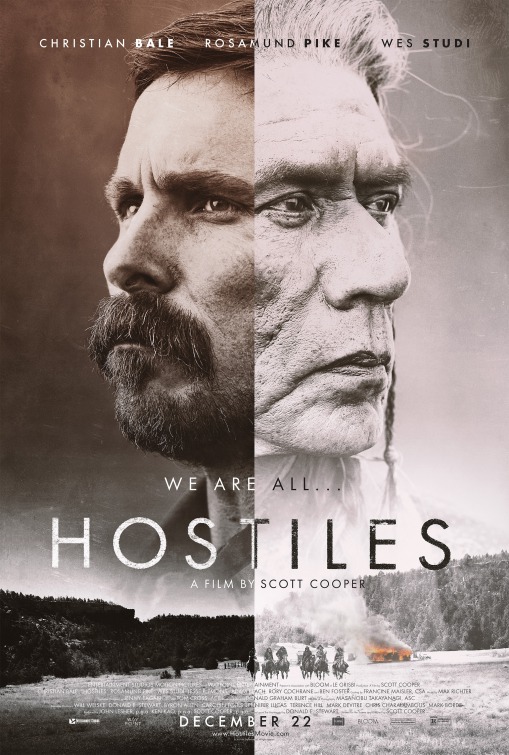
HOSTILES

Christian Bale     Rosamund Pike     Paul Anderson     Timothee Chalamet    
Ben Foster     Wes Studi     Adam Beach     Rory Cochrane


     Writer/director Scott Cooper is a master at highlighting genuine but dramatic human dilemmas, as seen in Out of the Furnace, Black Mass, Crazy Heart, and now, Hostiles.  Hostiles depicts the
US Army-Indian conflicts in the late 19th Century.  It opens with a brutal scene of the massacre of a family on an isolated farm/ranch.  American soldiers have experienced huge losses from Indian attacks, and some take great satisfaction in having retaliated in kind.  Cooper shows the varying ways in which soldiers cope with the killing.  One says, “If you kill enough people, you get used to it…but I hate losing my men.”  Another says, “I was just doing my job” [in slicing Apaches from stem to stern].  “An eye for an eye; a tooth for a tooth”, is his mantra as he reads the Bible regularly to reassure himself.
     Cooper is eloquent in showing men pushed to their limit, the ethical/moral dilemmas life presents, and—most heartening—men transformed by their experiences.  In Hostiles, we are captivated by Captain Blocker (Christian Bale in a stellar performance), who in the beginning sits patiently, but uncomfortably, when a trusted soldier under his command confesses to “Melancholia”, of which Capt. Blocker has no inkling.  That doesn’t mean he doesn’t care for this soldier—he values him—but depression?  That is not something he knows anything about. 
     Then he is assigned a task that is anathema to him—accompanying Apache chief Yellow Hawk (Studi) and his family to Montana, for burial at his birthplace.  The chief has cancer and is about to die, and the zeitgeist is turning toward being much more tolerant of the Indians.  President Harrison has ordered that the chief be accompanied by the U.S. military to Montana to assure his safe arrival.  Have you ever heard a silent scream?  That is Capt. Blocker’s response to the order, which he cannot refuse without jeopardizing his pension.
     What kind of transformation can a person like Capt. Blocker make?  It takes two warring parties traveling together (ahem...plus a woman?) to “humanize” him.  This film is about the profound emotional experiences that such a man as Capt. Blocker undergoes that go from silent listening and grunts to real, tender, sharing moments he has with those around him.  You don’t often see a cowboy/soldier self-actualized, but Cooper achieves just that.
     There are exemplary tender moments in this film, such as a simple “Thank you for your kindness” to a sympathetic laying of a hand on a person suffering in a tent, to a soulful “A part of me dies with you.”  The upshot is that Cooper understands so many aspects of men especially (not to entirely exclude women) and portrays them as few filmmakers have been able to do.
     Christian Bale brings out the character of Capt. Blocker in a way that perhaps no one else could.  His award-worthy performance (after stellar roles in The Big Short, American Hustle, and two Dark Knight films) should be recognized.  Supporting roles are well covered by Rosamund Pike, Wes Studi, and Rory Cochrane, but this is really Bale’s tours de force.

If you want to see a western with heart and substance, this is it.

Grade:  A                                    By Donna R. Copeland

Tuesday, March 14, 2017

THE BALLAD OF LEFTY BROWN

Bill Pullman     Jim Caviezal     Tommy Flanagan     Kathy Baker     Peter Fonda     Diego Josef


     After years of being overshadowed by his friends and considered to be a little dim, Lefty (Bill Pullman) is being left in charge of his life-long friend Eddie’s (Fonda) ranch in Montana.  He is intimidated by the prospect, and tries to refuse, but Eddie insists, and gives him what looks like his own very special gun.  Eddie is on his way to the Senate in Washington, D.C.  His wife Laura (Baker) is not happy at all about Lefty being in charge, and also tries to talk her husband out of it.  Just before they’re scheduled to leave, though, ranch hands notify Eddie that three of his horses have been stolen.  Not heeding his wife’s pleas to take a crew of men with him, he takes off with only Lefty to pursue the thieves.  There is a tragedy, and Lefty is determined to avenge his old friend, despite seeing himself as “a man who never got anything right in 60-odd years.”
     What follows is in the tradition of westerns in general, when individual citizens take it upon themselves to mete out justice however they see fit.  There is some talk of legal trials and judges, but it’s often only given lip service.  On the contrary a man might be hanged on the spot after a few decide he’s guilty.  One of the reasons Lefty doesn’t quite fit into the community is that he seems to be a pacifist.  He works very hard not to kill someone he’s captured—a rather odd motif in a western movie.  This offsets to some extent my revulsion in seeing the ubiquitous gun-toting cowpokes take matters in their own hands, especially when at one point people have decided that Lefty himself has committed a major crime. 
     Four men in town have been friends for many years.  Jimmy is the governor of the state; Eddie is a highly respected rancher with Lefty as his sidekick, and Tom is the U.S. Marshal.  The drama has twists and turns, shoot-outs, and a young man showing up with romantic notions of the wild west and burning to be a part of it.  Lefty’s good nature is apparent in his finally relenting to mentor Jeremiah and allow him in the group.  In the end, a major plot is uncovered which is shocking to all involved.
     Pullman is the heart of this film and artfully portrays his character as layered; on the surface, just a simple man, but having much more wit and sensibility than he is given credit for.  Some of his best is when he is telling western stories to the young Jeremiah.  Lefty seems always to have been in the shadow of his more dominant friends.  Jim Caviezal’s character is likewise an interesting inclusion into a western as a suave, literature quoting mannered man.  He, too, seems out of place in such a town, like Lefty, although for a different reason.  Tommy Flanagan and Kathy Baker deftly play characters who are not so admirable or thoughtful.  A refreshing part of the story is Diego Josef’s character, Jeremiah, who is earnest and a typical teenager just learning the way of the world and eager to make his mark.  I wish more of his story had been included; we’re never informed about why he is out in the wild on his own with no horse after his got bitten by a snake and had to be put down.
     Writer/director/producer Jared Moshe’s background is primarily as a producer, but his Ballad is engaging, beautifully filmed (David McFarland, cinematographer), and has a few twists in what is basically a traditional western. 

A ballad for a man who finds himself later in life and can be proud of what he proves.

Grade:  C                                    By Donna R. Copeland

Thursday, September 22, 2016

THE MAGNIFICENT SEVEN

Denzel Washington   Chris Pratt   Ethan Hawke   Vincent D’Onofrio   Haley Bennett  
Peter Sarsgaard   Byung-hun Lee   Manuel Garcia-Rulfo   Martin Sensmeier


          A motley group of seven men recruited one by one by a Kansas Warranty Officer Chisolm (Washington) band together to rescue a farming town from the evil miner Bartholomew Bogue (Sarsgaard), who wants their land and is willing to give them only a pittance for it and simply kill them if they refuse.  Chisolm is retained by Emma Cullen (Bennett), whose husband was one of those killed, but he agrees only after she gives him a significant bit of information. 
          Gradually, Chisolm meets up with a few malcontents who join him for one reason or another:  card shark/gambler/trickster Faraday (Pratt), haunted sharp shooter Robicheaux (Hawke), tracker-with-a-tomahawk Horne (D’Onofrio), knife-wielding assassin Billy Rocks (Lee), Mexican outlaw on the run Vasquez (Garcia-Rulfo), and Comanche arrows and bullets sharp shooter Red Harvest (Sensmeier).  These guys are not only colorful in their backgrounds, they bring much of the humor of the movie (sometimes a bit corny), presumably to balance the extreme violence shown in the film.  All these actors are superb in their roles, and elevate the film above the mundane script.
          Chisolm sends the cowardly sheriff (Dane Rhodes) to take the message to Bogue that the townsmen will not give up without a fight, and that he and his men will be defending them.  When Bogue learns there are only seven defenders, he thinks it will be a piece of cake.  His lackeys put together a small army, and head toward the town.  But Chisolm is a strategist who is able to anticipate his enemy’s maneuvers, and has made detailed plans involving explosive booby traps, trenches, placements of shooters, and even weapons training for the locals.  The battle that ensues is bloody and long, complicated by a ferocious weapon mercilessly fired by Bogue.
          This remake of two earlier films considered masterful, one in 1954 (Seven Samurai) by Akira Kurosawa, legendary Japanese filmmaker, and one in 1960 (The Magnificent Seven) by John Sturges seems unnecessary.  There could have been more updates, such as modernizing and making more realistic—even for the 19th Century—the Bennett character Emma.  For example, she defended the town admirably and saved Chisolm’s life, but he didn’t even thank her; instead, he took her gun away from her.  The filmmakers made sure that we would see her cry more than once, just to emphasize once again the stereotypical female.  Here’s a thought:  Include her and call the film The Magnificent Eight. 
          Musician James Horner should be acknowledged for his contribution to this film.  He had made considerable progress on the score, but died before the work was completed, so Simon Frangien was enlisted to complete it.  Mauro Fiore’s cinematography does justice to the exquisite western landscape, and his filming of the action scenes is artistic, as is the usual for him.

For western fans not bothered by mediocre remakes, this will hold your attention.


Grade:  C                                 By Donna R. Copeland


Tuesday, June 21, 2016

THE DUEL

Liam Hemsworth     Woody Harrelson     Alice Braga     Emory Cohen


          A quick look online shows that the duel is a popular topic for moviemakers, and has been brought to the forefront again in the Broadway musical Hamilton, (about Alexander Hamilton who died in a duel).  This rendition is a western, and could be classified as a tragedy in the literary sense.  It takes place in the 1800’s, opening with a duel in Texas and ending in the same town with a duel involving the son of the man killed 22 years before.
David Kingston (Hemsworth) is a Texas Ranger sent by the governor to investigate an area where Mexican General Calderone says his niece and nephew disappeared.  As a matter of fact, there have been many reports of Mexicans who have gone missing from the same area.  For his safety, David is sent incognito with the story that he is headed somewhere else.  We can see a complication right away when his wife Marisol (Braga) insists on going with him.  She is obviously Mexican, so going to a town that is suspected of killing Mexicans seems more than foolhardy, but she threatens to leave him otherwise, so he takes her along.
       They are greeted in the town of Helena by a polite, smooth talking Abraham (Harrelson), known as “The Preacher”, who keeps a tight rein on the townsfolk.  He gets them settled in a lodging, makes an impromptu visit to Marisol, and makes David sheriff.  David quietly does his sleuthing and of course—since this is a western—must prove his mettle with the locals, particularly Abraham’s ne’er-do-well son Isaac (Cohen).
           What David uncovers is major, and all the while he is investigating he has to contend with the passive-aggressive Abraham who creates a continual thread of ominous portents, aided by the open hostility of Isaac and his two sidekicks.
        Director Kieran Darcy-Smith is successful in sustaining the aura of mystery and danger, and gives the viewer some explanation as to how the characters fit together.  But he and the writer Matt Cook are not the most experienced in filmmaking, which shows up in questions about plot that remain unresolved.  For instance, Marisol becomes mysteriously ill soon after The Preacher predicts her fever.  After the ambiguous ending, we still don’t know exactly what happened or how she fits in with the characters other than David.  On one occasion, she seems to complain about it.  Another instance is David’s leaving his sick wife’s bedside and being out of town for an extended period of time without Abraham, who seemed to monitor him constantly, noticing. 
         Finally, at the end it’s not clear why the governor took no action on Kingston’s findings.  We never see David send a telegraph (which he was instructed to do), and when General Calderon asks for the governor’s support in investigating the site further, it was declined.  Maybe he didn’t want to start another Mexican-American war.
          Woody Harrelson knows creepy, and his performance is superior in this role.  He is electric in any scene he is in.  Hemsworth is very good, although not quite convincing as a Texas Ranger.  I was stunned to discover that Isaac is played by the same Emory Cohen who is such a hit as Eilis’ sweet American boyfriend in Brooklyn.  He is as offensive here in his character as he is appealing in Brooklyn.

This is a western that raises as many questions about the plot as it answers.

Grade:  C-                        By Donna R. Copeland


Thursday, March 17, 2016

IN A VALLEY OF VIOLENCE

Ethan Hawke     James Ransone     John Travolta     Taissa Farmiga     Karen Gillan


          Boy!  What a nice surprise for my last film at SXSW this year in Austin, Texas.  Ti West (Roost, The Innkeepers) has ventured into the western genre and devised some imaginative tactics to enrich the experience of a western film.  I really think the cleverest is inserting arguments among men in the midst of gunfights.  That is, it’s a different kind of humor than we normally experience to see the town Marshal arguing and negotiating terms with the rebel in logical discourse—while the gunfight is taking place!  Another feature that I fully appreciated is the inclusion of principles underlying revenge.  Revenge is sweet, but use your head!  The Marshal (Travolta) is wise in instructing his no-good son/deputy Gilly (Ransone) not to make another mistake in following someone “passing through” after having made a big one with him already.  Finally, it also illustrates how some people who, like Gilly, don’t hear good advice—such as “Get away from the window” during a gunfight.  West is a master, like Tarantino, in synthesizing violence with humor to make a point.
        Ethan Hawke is coming more and more into his own as an actor and as filmmaker (Good Kill, Boyhood, the Richard Linklater series, and as director of a documentary, Seymour:  An Introduction).  Here, he plays Paul, a taciturn loner bound for Mexico with his beloved dog Abby.  He is not looking for a fight, but he knows how to defend himself.  Hawke seems to know this character deep down in his psyche; Paul has been reduced by trauma and guilt to talking mostly to his dog Abby (one of the stars in the film).  We hear of his past only in bits and pieces, usually when Mary Anne (Farmiga), the co-owner of the inn in town, forces it out of him.  But Paul is not only intelligent, he is well trained (something the Marshal recognizes, but his son doesn’t), quick, and sure in his reactions.
        James Ransone makes an interesting bad guy; he has a handsome “Hollywood” face with beautiful eyes and an attractive dimple, but as his personality emerges, those characteristics become more and more sinister.  Taissa Farmiga and Karen Gillan look enough alike to be real sisters; in the movie they manage an inn while their father is dying in a bedroom.  They are chatterboxes—another clever idea by Ti West—but one is rather hysterical and the other more levelheaded and goal directed.  John Travolta is perfect for the role of town Marshal, and he makes the character much more complex and even appealing than is generally the case in westerns. 
      In a Valley of Violence was filmed in Santa Fe with its captivating landscapes by Cinematographer Eric Robbins.  His work enhances the mystery and action of the film.  
       In a Valley of Violence is about revenge, and challenges us to question the concept.  When is revenge justified?  Clearly, getting revenge for a narcissistic wound is likely to be foolhardy.  But when someone is unjustifiably cruel and likely to continue in it, we are likely to cheer, as when Paul vows, "Those men left me with nothing; I'm going to leave them with less."  Few of us are Gandhi.  Yet, even when it seems justified, revenge often results in unintended damage.

A finely crafted western outside the usual fare.

Grade:  A                                    By Donna R. Copeland

Sunday, December 20, 2015

THE HATEFUL EIGHT

Samuel L. Jackson   Kurt Russell   Jennifer Jason Leigh   Walton Goggins   Tim Roth   Bruce Dern   Demian Bichir   Channing Tatum


          The Hateful Eight is divided into chapters.  Chapter 1 is entitled, “A Last Stage to Red Rock”, the full meanings of which are not immediately clear.  On the stagecoach is John Rich (Russell), a hangman and bounty hunter (“When The Hangman catches you, you don’t die by no bullet; you hang”) with his prey Daisy Domergue (Leigh) handcuffed to his wrist so she can’t escape.  They’re racing to Red Rock trying to beat the blizzard fast approaching behind them, and come upon Major Marquis Warren (Jackson) needing a ride because his horse perished on the trail.  As usual for him, Rich grills him like he does anyone, and if they succeed in convincing him, he turns out to be rather folksy with them.  Despite a brutal exterior (he continually batters Daisy), he is a soft touch if someone hits a certain button, but his mood can change on a dime.
          In Chapter 2, “Son of a gun”, we meet another potential rider, Chris Mannix (Goggins), soon to be the sheriff of Red Rock if he can just get there.  He manages to get a ride as well, and the group continues until they have to stop at Minnie’s Haberdashery to wait for the blizzard to pass.  This is the site of most of the action in the picture, with skirmishes between different parties.  An air of suspicion rules since this is just after the Civil War (in Wyoming) and some are southern Confederates, and some Union sympathizers.  Racial tension is high in the presence of blacks, Mexicans, and whites.  And finally, the two bounty hunters, Rich and Warren (who’s bringing in dead bodies for his reward) must always be alert to protect their bounty.
        Writer/Director Quentin Tarantino is a master of plot twists and thrills, and here he keeps us guessing and thinking a resolution is imminent through six chapters, continually springing plot twists that give new meaning to a situation.  Additional characters include an old Confederate General (Dern), a British gentleman (Roth); Bob, the caretaker of Minnie’s place (Bichir); and the Brit’s driver (Michael Madsen).  When suddenly, death visits unexpectedly, the plot turns to a mystery and deducing who the killer is. 
        Characteristic of a Tarantino movie, violence is so rampant, the viewer becomes inured to it, and after a while, someone like me stops reacting so much, especially since he often blends a bit of humor into the violence.  Or he has made you hate a character so much you get satisfaction in seeing that one get his/her due. 
        Tarantino likes to work with people from his previous films, such as Samuel L. Jackson, musician Ennio Morricone, and cinematographer Robert Richardson, editor Fred Raskin, casting director Victoria Thomas, and costume designer Courtney Hoffman.  Their excellent contributions help make his films masters of art.  Particularly notable here is Morricone’s haunting musical score and Richardson’s sweeping snow-laden landscapes and the menacingly colorful interiors that capture the drama of suspicion and violence.  Remarkably, the film was shot with the old Panavision lenses in 70MM, which is purported to be spectacular; however, unfortunately, my screening was in the current digital projection.
    Kurt Russell, Jennifer Jason Leigh, Bruce Dern, Demian Bichir, Tim Roth, Walton Goggins, and Channing Tatum are Tarantino first-timers, but they are all superb in their roles.  Russell and Leigh constitute a unique pair that plays perfectly into sado-masochistic roles.  No matter how many times she gets battered, the Leigh character yells out whatever truth comes to mind, only to get immediately knocked in the teeth—and she never learns to keep her mouth shut; nevertheless she always comes out smiling and feisty.
        I must say I did have reservations about seeing a female so despised by almost all the males (there are notable exceptions), who seemed to be acting out deep-seated hatred.  Perhaps Tarantino is aware of this in our culture and means to highlight it.  Or is this coming from something deep inside him?  I obviously don’t know.

Another significant work of the artist Quentin Tarantino, master of plot twists and thrills, always with injections of humor.

Grade:  A-                                    By Donna R. Copeland

Wednesday, March 11, 2015

THE SALVATION

Mads Mikkelsen     Jeffrey Dean Morgan     Eva Green     Jonathan Price

            The Danish director, Kristian Lovring, states that The Salvation is an homage to American westerns and represents his wish to emulate his idols in film:  “John Ford, Sergio Leone, Akira Kurosawa…to be allowed to make a film in the genre where they excelled has been like a hallucinatory dream.”)  It’s clearly a western, which starts out with an excruciating scene of senseless violence, and ends up with violence perhaps justified.  The Danish ex-soldier Jon (Mikkelsen) has been in the US for seven years, making a place for his wife and son to join him.  He meets them at the train, and there is unspeakable joy in reuniting.  Unfortunately, they board a carriage for their home, and are confronted with two unsavory characters, one of which—Paul—behaves boorishly and seems to have no sense at all.  He drinks liberally from a jug and begins to harass the family, and ends up dumping Jon off on the side of the road when he protests.  But Jon is smart, and uses his head to track Paul down and find his wife and child.  He is successful, and takes out his vengeance on Paul for what he has done.
            Unbeknownst to Jon, perhaps—not clear—this invokes the wrath of Delarue (Morgan), Paul’s brother, who is even more unsavory.  Not only is he offended by someone daring to ignore his authority, but he is going to exact payment from the townspeople for his personal loss. 
Although the townspeople are aware of the brutality of Delarue and his gang, they seem to be helpless.  They’re being extorted for “protection” (a la the mafia), yet they stand by inert.  One even betrays Jon, presumably in the absurd hope that that will satisfy Delarue.  Will the hero they’ve been waiting for, ever arrive?
            Mikkelsen is made for this role—the patient, long-suffering good guy with the woeful eyes.  Although Morgan’s roles in film and television have usually been “good guys”, he is a repulsive character here, which shows his acting range.  Like most westerns, good and bad are drawn very clearly in The Salvation, with no gray In-between.  The only ambiguous character is the wife of the slain Paul (Michael-Raymond James), Madeleine, who was left mute years before by marauding Indians.  She has scars on her face, a mysterious tattoo, and eyes that, even though they speak to us, we cannot decipher.  By the end, however, she reveals her real self.
            This picture is from Denmark, and as such, gives us a glimpse of how people in other countries
regard our westerns.  That their fascination with them is so enduring, is a bit of a puzzle for me.  The director, Kristian Levring, says he asked himself why he wanted to return to a genre that is past its prime.  It had something to do with his love of westerns as a child, as well as emulating his heroes  Finally, he sees America’s western experience as similar to that of many Europeans’; that is, of people who venture far from their homes to join the birth of a new nation.

An American western coming from Denmark.

Grade:  B                        By Donna R. Copeland

Monday, October 27, 2014

THE HOMESMAN

Tommy Lee Jones     Hilary Swank     Grace Gummer     Miranda Otto    
Sonja Richter     Meryl Streep     John Lithgow     James Spader


     The Homesman is not your typical western movie; it has more to do with human psychology and sociology, and what sometimes happens to those who are under stress and ill-equipped to manage.  Mary Bee Cuddy (Hilary Swank) is apparently not one of these; she farms a homestead on her own, maintains her house, goes to church, does her Christian duty, and plays the piano.  When she doesn’t have a physical piano, she fingers a cloth keyboard and sings.  When three women in the congregation lose their minds, she volunteers to take them east to Iowa so their families can take care of them.  When two women protest that as a woman she should not take on the task, the minister (John Lithgow) says she is “as good a man as any man hereabouts.”
     She is nervous about transporting them in a wagon across the prairie, however, and when she comes upon a man (Tommy Lee Jones) hanging from a tree, she agrees to cut him down if he will help her take the women east to their families.  He agrees only out of desperation; he is not ready to die.
     The women are indeed psychotic; one has to be tied down because she attacks whoever is in sight.  They seem to have been driven crazy for various reasons, such as losing children to disease, but the film does not always clarify their histories.  We’re introduced to them rapidly in the beginning without much explanation—which I see as a weakness in the exposition. 
     At any rate, the women are loaded onto a makeshift wagon that can be locked from the outside, and Mary Bee Cuddy and “George Briggs”—a name he decides to call himself—take the reins of the horses and head out.  You can imagine (I actually had a hard time of it) some of the issues they would encounter along the way (a runaway, Indians, snow), let alone hygiene (one of the woman has to be held and told to pee), food preparation, sleeping arrangements, etc.  As expected, Cuddy and Briggs will have major disagreements along the way to establish dominance.  The resolution of their conflicts and the outcome of their destination is one of the perhaps unique and surprising endings of a western genre film.
     The Homesman is well directed by Tommy Lee Jones, and the cinematography by Rodrigo Prieto is exquisite.  The main actors (Jones, Swank, Lithgow, Spader, and Streep) are some of the best and shine in their roles.  Jones has a couple of song and dance routines that are totally out of his usual character presentations and are a hoot—although you may not be able to understand the lyrics; it’s enough to watch him dance and shout.    Swank easily conveys Cuddy’s strengths, and is able to elicit sympathy—maybe even pity—from the audience during her times of weakness.  Spader and Streep have only cameo roles, but are powerful in the brief time they are on screen.  The actresses portraying the psychotic women (Grace Gummer, Sonja Richter, and Miranda Otto) capture their distresses perfectly.
     The Homesman is not likely to be a film for everyone; I had mixed feelings about it when I left the theater—presumably because of some of the more depressing, hopeless scenes, as well as a rather surprising ending.  In addition, I think one character in particular is not consistent across time with how she is presented initially—not that I’m saying people don’t change, only that how this character is presented in the beginning does not plausibly lead to what happens later.  Not so with Briggs or the psychotic women, all of whose personalities are entirely consistent with their characters throughout. 

Not a homespun tale.

Grade:  B-                        By Donna R. Copeland