Showing posts with label Rosamund Pike. Show all posts

Saturday, July 25, 2020

RADIOACTIVE

Rosamund Pike     Sam Riley     Anya Taylor-Joy


     In an extraordinary production directed by Marjane Satrapi and starring Rosamund Pike as Madame Curie, we hear the story of an eccentric scientist who won two Nobel prizes through much conflict and a certain amount of public hatred. She was the first woman to win a Nobel, notably being relatively unimpressed with it, but at the same time fighting for her role in it.
     Madame Curie (nee, Marie Slodowska) was having a difficult time holding onto a lab to do her work—both because of her being a woman trying to do science and because of a rather cantankerous personality.  It was most fortunate that her path crossed that of Pierre Curie who recognized immediately that they could achieve much more working together. It was likewise fortunate that he knew how to “handle” her, which included being conscientiously careful in seeing that she received every credit she was due in their partnership. For instance, initially, the Nobel committee was intending to give the prize to him alone, but he would only accept it if they gave it to both of them.
     The story is fascinating in a number of ways; first of all in seeing the hurdles she had to jump over in even being able to be a scientist, but secondly because of a quirky, prickly personality.  She was highly complex in her make-up, having a phobia about hospitals, being ambivalent about recognition yet ferociously insisting on getting credit for her achievements, and giving in completely to the love she had toward her husband.  She and her husband were also unusual in their communication with one another and in the family. Sensitive topics were never out of bounds for discussion, and they could have heated arguments, then easily switch back to a loving relationship.
     Pike is well known for her talent and skill in acting, and here once again she captures what I presume is the essence of who Marie Curie really was.  It should be a career high for her.  (I have not read Lauren Redniss book on which Jack Thorne based the script, but would guess that the film is a fine representation of Redniss’ work, which was a finalist for the National Book Award in 2011.)  Sam Riley as Marie’s husband makes a good match with Pike, and the scenes they’re in together are electric.
     Another aspect to marvel at in this production is Anthony Dod Martle’s artistic cinematography, which he uses to further the story and accentuate the dramatics. I think it’s a case where one could look at and revel in the pictures alone without the sound.  Transitions, close-ups, and the blending of visuals are striking in their own right.
     Personally, I was very moved by Radioactive in that when I was a psychologist at M. D. Anderson Cancer Center, much of my research was about identifying the effects of central nervous system radiation on children’s ability to learn years after they received it.  Kudos also to the film for showing the positive and possible negative effects of scientific knowledge—about which Madame Curie eventually became all too aware.  Her redemption came partly from the effectiveness of radiation that was helpful even at that time, and in her daughter’s continuing discoveries of its use in medicine and on the battlefield.
     Radioactive is a film I wish all young people could see for its modeling of simple passion for science, the challenges that arise in the tension between family life and career, and the prejudices that can appear from a general public that is not educated or well informed enough to override petty concerns.  The film is most timely in all these aspects.

Now appearing on Amazon Prime, this is a story that will entertain, inspire, and inform anyone who sees it.

Grade:  A                                    By Donna R. Copeland

Friday, November 9, 2018

A PRIVATE WAR

Rosamund Pike     Jamie Dornan     Tom Hollander     Stanley Tucci


     I don’t know if other people will have the same experience in watching this film as I did, but to me it was like listening to television news stories from Sri Lanka, Iraq, Aphganistan, Libya, and Syria one after the other, highlighting mangled, bloodied bodies and cries of misery.  Our heroine, Marie Colvin—a journalist and real person—(played eloquently by Rosamund Pike) seems to be drawn to war zones, even as she hates them.  She says at one point, “In covering war, can we really make a difference?”  In her own mind, that is what she is about, trying to get the world to care.  And she is successful, at least in her editor’s mind, when he compliments her:  “You have the God-given talent to make people stop and care.”  I wish the story had moved me to a greater extent, but it didn’t, which I will address below.
     We first get a bit of background on Marie, at home in London with her husband David, a professor/novelist, when she is early in her career.  He makes a comment about her being away from home so much, and clearly doesn’t appreciate the passion she has for her work.  When she gets seriously injured in Sri Lanka and begins showing signs of PTSD, he tries to get her to change directions.  But after a stint in a mental hospital, in a couple of years she is headed to Iraq.
     That is where she will meet the photographer Paul Conroy (Dornan), who is awed by her and eventually becomes a devoted partner in covering war stories.  He sticks with her throughout, being a kind of protector (which she allows it) and pal.  They end up in Libya during the Arab Spring, and meet with Gaddafi—whom she has met before—and she asks him hard questions, which he responds to with heart and humor.  
     By this time, Marie is showing signs of serious alcohol problems and issues with Sean, her editor (Hollander).  She has met someone who—if anyone could—inspire her to rest on her laurels, but at this point, Sean tries to reel her in to continue.  She comes back with the argument that what she does protects him (and her readers).  “I see it so you don’t have to”, she says; whereupon Sean comes back with, “But if you lose your convictions, what hope do the rest of us have?”  That kind of guilt trip will always get to Marie, and she travels on to Syria and Assad’s bombing of civilians there.  
     I was taken with director Matthew Heineman’s previous films, which were documentaries: Cartel Land, City of Ghosts.  Here, he attempts to dramatize Marie Colvin’s life (based on Marie Brenner’s article in “Vanity Fair” magazine, with a screenplay by Arash Amel) as a gutsy, committed journalist whose life-long wish was to appeal to populations of the world to help those in desperate need.  But, surprisingly, the film doesn’t leave the viewer with a clear understanding of Marie herself.  Why did she keep chasing war stories to the point that it was almost—if not in fact—suicidal?  Did her editor, Sean Ryan (Hollander), try to keep her out of harm’s way—until the sensational story became more important?  Nor does the film pull us in emotionally so that we’re cheering at the end.  No, it’s missing the heart and soul that his documentaries captured so well.
     That being said, Pike’s performance is flawless and moving throughout.  She clearly understood and appreciated the character of Marie Colvin, in ways that I could not in seeing this film.

This is about recent wars and intended as an anti-war film.

Grade:  C+                                     By Donna R. Copeland

Thursday, April 12, 2018

BEIRUT

Rosamund Pike     Jon Hamm     Dean Norris     Shea Whigham     Harry Pine


     If you go to see Beirut, directed by Brad Anderson and written by Tony Gilroy, you would do well beforehand to acquaint yourself thoroughly with the actor-character pairs, because so many people are thrown at you at once, it’s hard to know who’s who.  This is after the opening scene of an energetic cocktail party gone bad.  No background information is given, either about the story or the characters. So there is a lot of figuring-out to do through most of the first half.  This, along with Mason Skiles’ (Hamm) continuous imbibing of hard liquor brings on a bit of wooziness.
     Skiles has gone into a deep funk and become an alcoholic after his diplomatic sojourn in Beirut where he loses all that is dear to him.  He returns to the States after an international reputation for negotiating, only to form a small two-man company that negotiates between small-town bosses and labor unions.  After his partner announces that he is joining another company, Skiles is suddenly presented with a puzzling offer from the CIA, which is to present a lecture at the American University in Beirut on negotiating.  Beirut is the last place he wants to go on earth, but the timeliness (and probably seductiveness of something more exciting than his boring life) of the charge, along with a first-class airplane ticket, cash, and passport, allows him to be “poured” (alcohol reference again) onto the plane.
     Once there, Skiles has a devil of a time trying to find out what he is expected to do, because he knows it is more than simply a lecture.  Sandy Crowley (Pike) is clearly tasked with squiring him around, but the agendas of three State Department officials is obscure—until it finally seeps out.  He is to negotiate the release of an American (a former friend when he was in Lebanon) who has been kidnapped by Palestinians.  The exchange is to be for one of the men involved in the 1972 Munich massacre.  This means he has to deal with Israel as well, as they are likely to have one of the perpetrators.
     There are additional complexities in the mix that make this film engaging; unfortunately, the viewer is presented with so many puzzles to figure out it simply becomes frustrating.  The filmmakers should have given us more background into characters like Skiles, Crowley, the State Department officials, young Karim (whom Skiles and his wife had sheltered and mentored), and the whole political situation at the time.  When I view a film, I want to be carried along by the story, not charged with figuring out who is who and what is going on throughout.
     The actors are the best part of this film, giving color and fascination to an intriguing subject.  I think we were let down by director Anderson and writer Gilroy, who failed to provide the essential elements to make this a captivating story—which it should have been.  It’s only towards the very end when Skiles is negotiating the exchange of prisoners that Beirut comes into its own.

Intrigues during the Lebanese civil war that should captivate us more than this film does.

Grade:  C                                    By Donna R. Copeland

Thursday, March 15, 2018

7 DAYS IN ENTEBBE

Rosamund Pike     Daniel Bruhl     Eddie Marsan     Lior Ashkenazi


     This is a fine account of an event that actually took place in 1976, in which Palestinian revolutionaries hi-jacked an Air France plane with the aim of getting Israel to negotiate with them.  They wanted back Palestinian prisoners that Israel had captured and held, in exchange for the release of Israeli hostages.  The movie illustrates very well the dilemmas that arise from policies about negotiating with terrorists.  There are good arguments on both sides of the issue.  The film goes back and forth between the Palestinian front revolutionaries (two of the main ones are Germans) and the Israeli government officials and—since they ended up in Uganda, Idi Amin finds himself in a position of choosing sides.  Also inserted from time to time is an Israeli dance group performing a number simply to reflect the writhing emotional experiences of all the characters.
     Rosamund Pike and Daniel Bruhl give sensitive performances of the two German Palestinian sympathizers, showing their angst—which goes back and forth between them.  She is more hard-nosed and committed than he is most of the time, but toward the end has second thoughts.  In this respect and in their relationships with others, we get a good idea of the terrorist experience and how differently they think and feel from one another, depending on what is happening at the time, and how they both waver between the two sides of their ambivalence.
     On the Israeli side Prime Minister Yitzhak Rabin (Ashkenazi) is in conflict with his defense minister, Shimon Peres (Marsan), the former leaning more toward negotiation and the latter decidedly favoring a military operation to rescue the hostages.  Eventually, the vote is put before the cabinet, all favoring the military plan.
     Director Jose Padilha and writer Gregory Burke present an engaging story in which I stayed engrossed, and one that seems to maintain good balance between strategy and emotion and human concerns.  The policy of negotiation/non-negotiation is topical—along with the Israeli-Palestinian dispute—both conundrums about which no one seems to have a really good answer.  The filmmakers stayed even-keel on these issues, allowing the viewers to see both sides and make their own judgments.
     Very educational!  For me, at least.  I understand a number of previous films have covered this high-jacking incident, (e.g., Victory at Entebbe, Raid on Entebbe, and Operation Thunderbolt), but none was very highly praised.   The criticism of 7 Days in Entebbe as just another remake that didn’t need to be done is likely justified.

Grade:  C                                    By Donna R. Copeland


Thursday, January 4, 2018

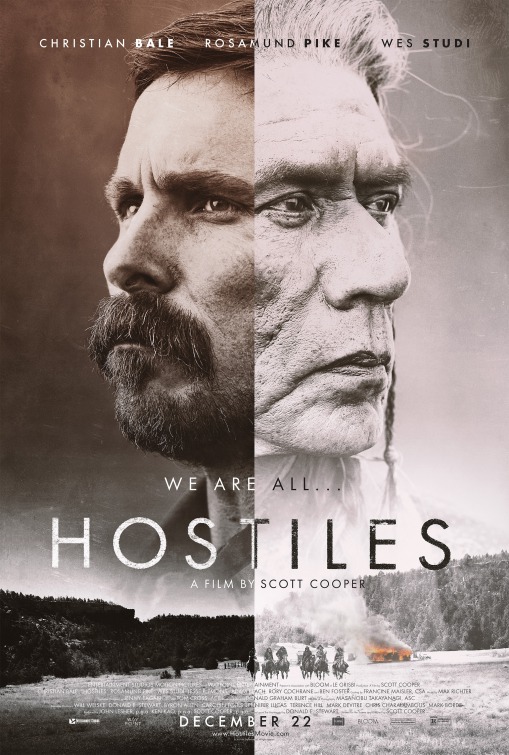
HOSTILES

Christian Bale     Rosamund Pike     Paul Anderson     Timothee Chalamet    
Ben Foster     Wes Studi     Adam Beach     Rory Cochrane


     Writer/director Scott Cooper is a master at highlighting genuine but dramatic human dilemmas, as seen in Out of the Furnace, Black Mass, Crazy Heart, and now, Hostiles.  Hostiles depicts the
US Army-Indian conflicts in the late 19th Century.  It opens with a brutal scene of the massacre of a family on an isolated farm/ranch.  American soldiers have experienced huge losses from Indian attacks, and some take great satisfaction in having retaliated in kind.  Cooper shows the varying ways in which soldiers cope with the killing.  One says, “If you kill enough people, you get used to it…but I hate losing my men.”  Another says, “I was just doing my job” [in slicing Apaches from stem to stern].  “An eye for an eye; a tooth for a tooth”, is his mantra as he reads the Bible regularly to reassure himself.
     Cooper is eloquent in showing men pushed to their limit, the ethical/moral dilemmas life presents, and—most heartening—men transformed by their experiences.  In Hostiles, we are captivated by Captain Blocker (Christian Bale in a stellar performance), who in the beginning sits patiently, but uncomfortably, when a trusted soldier under his command confesses to “Melancholia”, of which Capt. Blocker has no inkling.  That doesn’t mean he doesn’t care for this soldier—he values him—but depression?  That is not something he knows anything about. 
     Then he is assigned a task that is anathema to him—accompanying Apache chief Yellow Hawk (Studi) and his family to Montana, for burial at his birthplace.  The chief has cancer and is about to die, and the zeitgeist is turning toward being much more tolerant of the Indians.  President Harrison has ordered that the chief be accompanied by the U.S. military to Montana to assure his safe arrival.  Have you ever heard a silent scream?  That is Capt. Blocker’s response to the order, which he cannot refuse without jeopardizing his pension.
     What kind of transformation can a person like Capt. Blocker make?  It takes two warring parties traveling together (ahem...plus a woman?) to “humanize” him.  This film is about the profound emotional experiences that such a man as Capt. Blocker undergoes that go from silent listening and grunts to real, tender, sharing moments he has with those around him.  You don’t often see a cowboy/soldier self-actualized, but Cooper achieves just that.
     There are exemplary tender moments in this film, such as a simple “Thank you for your kindness” to a sympathetic laying of a hand on a person suffering in a tent, to a soulful “A part of me dies with you.”  The upshot is that Cooper understands so many aspects of men especially (not to entirely exclude women) and portrays them as few filmmakers have been able to do.
     Christian Bale brings out the character of Capt. Blocker in a way that perhaps no one else could.  His award-worthy performance (after stellar roles in The Big Short, American Hustle, and two Dark Knight films) should be recognized.  Supporting roles are well covered by Rosamund Pike, Wes Studi, and Rory Cochrane, but this is really Bale’s tours de force.

If you want to see a western with heart and substance, this is it.

Grade:  A                                    By Donna R. Copeland

Wednesday, February 22, 2017

A UNITED KINGDOM

David Oyelowo     Rosamund Pike     Jack Davenport     Tom Felton     Jessica Oyelowo     Vusi Kunene


     As in her previous film Belle, Director Amma Asante has pieced together a compelling production based on the true story of Seretse Khama (David Oyelowo).  In the 1940s, Khama underwent years of wrestling with his uncle, the Regent of Botswana in Africa and the British government to retain his right as the heir to the crown. The problem?  The uncle was devoted to his nephew until Seretse fell in love with a white British woman.  South Africa as a British commonwealth stood as a triangular player in the drama in its investment in apartheid and its importance to the British economy.  It’s a lesson on the intrusion of politics and self-interest into government affairs, which can influence leaders’ decisions.           The story is a heartbreaking account of how the Khamas endured long separations, even during Ruth’s (Pike) pregnancy, complicated by diphtheria and the birth of their child.
     Oyelowo and Pike as the two central figures bring passion, loyalty, empathy, commitment to service, and humility to their characters.  Each has an impressive record of well-deserved acting nominations and awards:  Oyelowo for Selma, Nightingale, The Butler, and The Queen of Katwe) and Pike for Gone Girl, An Education, and Made in Dagenham, and both bring their talents to bear in this film.
    Writer Guy Hibbert presents the historical record clearly, mixing in additional dramatic elements that make for a gripping tale.  Above all, it shows how insignificantly appearing one person can be on the world stage when he is involved in international affairs.  And, consequently, the deep-seated ire that is stirred up by his sense of helplessness.  But the history also shows how keeping a cool head, engaging support from wherever one can, and using wit and craft in fighting for causes may just be the winning hand.
     Cinematographer Sam McCurdy’s lush and culturally rich scenes in Africa contrast well with the urban busyness of London, and Patrick Doyle’s music from both countries meshes perfectly with the visual richness.
    This is an enlightening view of a history most are likely unfamiliar with, and which is eminently topical for today’s times.

A hard fought struggle to retain one’s due, and the threats posed by blatant racism.

Grade:  B                                                By Donna R. Copeland