Showing posts with label Colin Farrell. Show all posts

Wednesday, March 2, 2022

THE BATMAN

 Robert Pattinson     Zoe Kravitz     Paul Dano     Colin Farrell
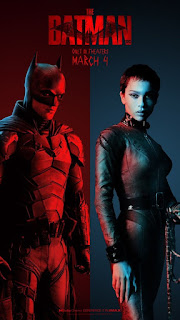
Peter Sarsgaard     Andy Serkis     Jeffrey Wright


            An eerie story with continually changing perspectives within a complex plot.  It’s especially remarkable that the musical theme throughout this action film is “Ave Maria” (part of the humor, I think).  Thankfully, in a three-hour film there is plenty of action to make the time go by quickly, especially since there are many, many characters to sort out and puzzles delivered by the Riddler to decipher.  Another entertaining aspect of the plot are numerous plays on words, such as “thumb drive” and one of the riddles being, “What does a liar do when he’s dead?...He lies still.”

            Robert Pattinson as this Batman in his second year of fighting crime convincingly portrays the mysterious, stoic figure he is known to be, even when sorely tried by The Riddler (who is targeting Gotham City residents) and fetchingly tempted by the exotic Selina Kyle (Kravitz), who is almost as fierce a fighter as Batman.  Colin Farrell is unrecognizable as a thug called The Penguin, and these fine actors are joined by Jeffrey Wright (a detective on the police force), Paul Dano (a crazed orphan grown up), Peter Sarsgaard (as a corrupt city official), Andy Serkis (in the purely dramatic role as Alfred Pennyworth), and John Turturro (in his rare portrayal of a bad guy).  

            Likewise, the crafts are well represented by Greig Fraser’s cinematography, Michael Giancchino’s music, and their colleagues in production design, sound (ah!, the effect of Batman’s ominous footsteps), costume and makeup, and special and visual effects.  Fraser has many scenes so dark it takes some work to figure out what is going on, and with some, being seen only through windows.  But stand-outs are the impressively composed shots that could stand alone as artistic productions. 

            I can say that the usual car chase that seems to be a must in this genre is present here as well, in just as much ridiculous, impossible feats as in all the others.  Two cars racing down a crowded turnpike while going against traffic and everyone in those two cars surviving goes way beyond the pale for me.

            All of these attributes (except for the car chase) are testament to Matt Reeves’ direction and co-authorship with Peter Craig.  (Bob Kane and Bill Finger are the original creators.)  Clearly these filmmakers and their associates collaborated well as a team in creating a work of art that allows us a sense of peeking in on an unfolding drama among real people that is relatable to most of our lives today.  I especially appreciated something not usually seen in this type of film—the realistic portrayal of deep emotions and conflicts (including Batman’s self doubts—which I think make the characters seem like real people to us.  Batman’s history with his family of origin and his having to sort out truth from fiction is an example of this asset.


The Batman is a combination of mystery, logical deduction, family drama, and spectacle that is likely to be entertaining to most people.


Grade:  A                              By Donna R. Copeland

Thursday, January 23, 2020

THE GENTLEMEN

Matthew McConaughey    Charlie Hunnam    Michelle Dockery     Hugh Grant
Jeremy Strong     Colin Farrell     Henry Golding     Eddie Marsan


     It takes intelligence and wit to create a drama that successfully mixes satire with extreme violence a la Quentin Tarantino (Once Upon a Time in Hollywood, Inglorious Bastards, and Pulp Fiction), and Guy Ritchie has done it here in giving us an entertaining spoof on the underworld of crime.  The characters must be colorful, are sometimes admirable, but do outrageous things and--most important—the script is key in smartly pulling it all together.  Ritchie, with co-writers Ivan Atkinson and Marn Davies, has woven together a complicated plot that fits together like a jigsaw puzzle.  It requires the viewer to pay attention and keep in mind intricate connections and multiple plots.
     The center of the action is legendary Mickey Pearson (McConaughey), who has established a multi-million dollar business in drugs, with the key element being that his operations are all top secret. His astute second, Ray (Hunnam), is entirely trustworthy and runs interference for him.  Mickey is devoted to his gorgeous wife Rosalind (Dockery), who has her own automobile business on the side.  All is humming along smoothly until word gets around that Mickey is ready to retire and pursue the good life.
     Enter sleazy Fletcher (Grant), a reporter who has been sent by his publisher (Big Dave) to take Mickey down by blackmailing him.  How he is trying to accomplish his assignment constitutes the major action of the story, which involves one of Mickey’s upper-class peers, Matthew (Strong); “Coach” (Farrell), a petty criminal trying to rehabilitate young bad boys; and numerous henchmen with brute strength on all sides.  This is a “guys’” movie in which all the main characters have brawn and lightning-quick reaction times, except for a few of the bad guys, who are shown to be quite puny.
     Casting is a strong asset, with cool McConaughey playing the good bad-guy, Hunnam being the canny one who must figure it all out, Grant being the smarty-pants who thinks he has it all figured out, and Farrell in a gem of a character role in which he is a little like the McConaughey figure—good and bad rolled up into one.  Michelle Dockery goes completely against her Downton Abbey persona to be a smart woman who has come up from the sticks with a Cockney accent.  Maybe I’ve been too swayed by HBO’s “Succession” drama, but Jeremy Strong—for all his good acting skills—just doesn’t seem quite believable as the evil Matthew.  Other supporting actors like Henry Golding and Eddie Marsan are excellent.
     Although the film is meant to be an entertaining spoof about different kinds of bad guys in the crime world, it does make some canny observations. One is that it goes against the common assumptions that upper class implies honesty and uprightness, while crime is more prevalent among the lower classes.  Ritchie mixes them all up in this drama.  Another point illustrated is that all drugs are not the same; some really do destroy lives and families, and other normally benign drugs can be contaminated.  Still another is that honor (and dishonor) can be found among all kinds of humans and their endeavors, and that even hideous violence can sometimes be supremely satisfying.
     BTW, I was especially gratified that there are no car chases in this action movie. Vehicles are used in various ways, and there are car accidents, but the generally obligatory car chase in most action movies is nowhere to be seen (satisfied “sigh!”).

This is an entertaining action movie with plenty of brawn, but one in which different wits are pitted against each other in a cat-and-mouse game.

Grade:  B                                    By Donna R. Copeland


Thursday, November 15, 2018

WIDOWS

Viola Davis     Liam Neeson     Robert Duvall     Colin Farrell     Michelle Rodriguez
Elizabeth Debieki     Cynthia Erivo     Brian Tyree Henry     Daniel Kaluuya


     Hold onto your seat; despite the leading title, this movie will keep you on edge—and on your toes—throughout the two-hours-plus time.  Rapid cuts between love scenes and major crime in the beginning shake you and disorient you, and then you must figure out who are all the characters thrown at you in the first few minutes.  
     Basically, if you’ve seen the previews, you know that the widow of a slain criminal contacts the other widows of her husband’s accomplices with a plan to secure their future after she finds the notebook he made sure she would get. As happens a lot in this film with men and women, he has underestimated her feminine wiles and will.
     In a role made for her, Viola Davis as Veronica uses her head after she is threatened by a rival gang, the Manning brothers (Henry and Kaluuya), who demand money from her that her husband Harry Rawlings (Neeson) stole.  Jamal Manning is determined to join the wealthy of the world, using his brother Jatemme as a fearsome hit man with no limits as to what he will do.  
     Corruption in city government is intertwined with criminal elements, assuring that interconnections among the characters will inevitably occur.  For example, Tom Mulligan (Duvall) and his son Jack (Farrell) are corrupt city officials who mete out city contracts to their friends.  Jack is currently running for city comptroller against Jamal Manning. All of them were well acquainted with Harry Rawlings when he was alive.  
     The main characters in this well-conceived plot are after the money that is now missing (burned up?) from the Rawlings caper that went down.  You will know who, if any, will end up with it only after many thrills and chills along the way.  The women occupy the stage most of the time, and actually, the men don’t come across well at all.  We see honor and care among the women who are following in their husband’s footsteps, but not in the same way.  The male characters are shown to be duplicitous, violent, and reactionary. 
     Writer-director Steve McQueen (12 Years a Slave, Shame) and screenwriter Gillian Flynn (Gone Girl) based the movie on the popular British television series written by Lynda La Plante of Prime Suspect fame.  With this much talent, it’s not surprising that their production is of such high quality.  No cheap thrills here, every inch of it is solid and has internal consistency and believability.  Hans Zimmer’s score and Sean Bobbitt’s cinematography provide an additional degree of excellence.
     Quotable quotes:  “You reap what you sow”; the reply:  “I hope so” and “If something goes wrong, I want my kids to know that I didn’t just sit there.” 

For an exciting, invigorating, suspense-filled evening go see Widows.

Grade:  A                                                  By Donna R. Copeland

Wednesday, October 25, 2017

THE KILLING OF A SACRED DEER

Nicole Kidman     Colin Farrell     Raffey Cassidy     Sunny Suljic
Barry Keoghan     Alicia Silverstone     Bill Camp


    The Murphy family looks like a sea without a ripple in it.  It appears that everything is under control, with little friction, and ever-polite conversation about mundane matters making up the family’s conversations.  Even lovemaking has a ritualistic quality to it.  And yet, occasionally one of them will burst out with some extremely personal information.  Steven Murphy (Farrell) is a heart surgeon, and his wife Anna (Kidman) is an opthalmologist and head of a clinic.  Teenager Kim (Cassidy) is bright, with an interest in music, and younger Bobby (Suljic) is also very bright, but has yet to show particular talents.  They live in a large, orderly house with neatly tended gardens.  What could go wrong?
     For some reason—we initially don’t know why—Steven befriends one of his daughter’s classmates, Martin (Keoghan), who is the son of one of his patients who died some years back.  Knowing that Martin and his mother are struggling financially—or perhaps for some other reason we don’t know—Steven treats him to meals and gifts.  Gradually, Martin begins insinuating himself into Steven’s life, appearing at the hospital, calling him on the phone, and meeting him in the hospital cafeteria.  He even invites Steven to his house for dinner with his mother, which, curiously, Steven accepts.  However, while there, he encounters a situation that makes him leave abruptly.
     But Martin does not leave him alone; he has fantasies in the form of predictions that, when he voices them, are weird and shocking, but understandable psychologically from what we know of him.  What we don’t understand until the final scenes is the power he comes to have over this family.  And is it his power?  We are left to speculate on the events that transpire during the last half of the film, which have curious resonance with what Martin has predicted will happen to Steven and his family.  And these are dire predictions. 
     We’re given a clue about the film’s title by learning that Kim wrote an essay at school for which she received an A+.  It was about the Greek myth of Iphigenia, Agamemnon’s daughter who had to be sacrificed because of Agamemnon’s offense of killing a sacred deer that belonged to Artemis.  Without this sacrifice, Artemis would interfere with the winds Agamemnon needed to sail to Troy. 
     This is a successful truly horrific film that keeps the viewer engaged in trying to figure out what is going on.  The acting is superb, with Farrell and Kidman lockstep in their talents portraying people who are conventional on the outside and with deep recesses in their core personalities.  The “gossip” that surrounds them (and helpful “friends” are only too happy to inform them) raises suspicions, but we never know whether these are reality-based or not.  Barry Keoghan evokes the teenager you definitely don’t want your daughter to date; he portrays a threatening eeriness that you can’t quite put your finger on, and although what he says might be hogwash, a part of you will believe it.
     Director Lorgos Lanthimas and writer Efthymis Filippou have collaborated on previous films (The Lobster, Dogtooth, and Alps) that tend toward the mysterious and bizarre, and this is no different.  It will intrigue you and repel you at the same time.  Perhaps Lanthimas selected the music for the soundtrack, which is mostly classical and modern orchestral and choral music—dissonant, even screeching at times, to accompany the feelings of dread and eeriness of the script.  In addition, there are a couple of popular tunes sung by Kim.
     The Killing of a Sacred Deer will not be to everyone’s taste, but for those who value creativity and insight into the human condition, it will be a gratifying experience. 

Vulnerability to human weaknesses can help explain this drama.

Grade:  A                                    By Donna R. Copeland

Thursday, June 29, 2017

THE BEGUILED

Nicole Kidman   Elle Fanning   Kirsten Dunst   Colin Farrell   Oona Laurence   Angourie Rice   Addison Riecke


     Beguile:  To deceive with charm.  By the end of the film, which ends up being something of a thriller, exactly to whom the title refers is ambiguous.  The wounded Union soldier found in the woods by a young girl, Amy (Laurence) on a southern plantation during the Civil War is charming, polite, and gracious to his rescuers/hosts.  Tenderhearted Amy has helped him limp to the girls boarding school where she lives, counting on the head mistress, Martha Farnsworth (Kidman) knowing what to do with him.  Miss Martha is a Christian who is committed to its principles, so thinks it moral and proper to treat him before sending him on his way or notifying Confederate soldiers.  Her ambivalence is increased when she talks to some passing soldiers with prisoners and find they are taking them to prison to die.
     Col. John McBurney’s (Farrell) charm has an oily feel to it from the start, prompting the viewer to wonder what he wants to get out of it; he is clearly not without guile.  He is lavish with his compliments anytime one of the residents does something for him, and he flirts shamelessly but knowledgeably—that is, he has a sense of what approach will be pleasing to each individual.  And he has a dark side, which will be revealed as the stress level rises. 
Quite the opposite, Miss Martha is crisp and direct with John, purposefully stifling any hope he might have of piercing her armor and being of help to him.  She makes it clear that she is only doing her duty and will send him on his way as soon as he is physically able.  Nevertheless, he persists, knowing from past experience that he is able to wheedle his way past feminine defenses. 
     But John has likely never been in a situation where he is surrounded by six females, all being drawn to him simply because he’s a male because it’s been so long since any of them have been around men.  They’re staying holed up in the school because for various reasons there is no other place for them to go.  Everyone else has gone home for Christmas.  He seems almost giddy about being the object of their competition with one another, particularly the three adult women, Martha, Edwina (Dunst), and Alicia (Fanning).  He has a special bond with Amy in their mutual fascination with plants and animals.  When he is better, he will work in the garden.  Jane (Rice) plays piano, which draws her to him, and Marie (Riecke) simply lets him know she cares about him.
     There are tense moments when soldiers come by the house (with John hidden), and as jealousies arise and John’s leg begins to heal, allowing him to be more mobile, the situation comes to a resounding crisis.  Feeling desperate and emasculated, John’s dark side surfaces, and the women must defend themselves.  This is where their guile sheds more light on the title, The Beguiled.
     The film is well conceived (based on a novel by Thomas Cullinan) and directed by Sofia Coppola, who well deserves the director’s prize she received for her work at this year’s film festival in Cannes.  Although I’m not always a fan of her work, this production moves along at a good pace, and facts about the characters are revealed gradually, heightening suspense.  In addition, the astute psychological observations about women, women and men, and how they behave in specific situations rings so true.
     Nicole Kidman won a special price at Cannes for being in four different films screened there, one of them being The Beguiled.  As Martha Farnsworth, an upper-class southerner, she carries the role with precision, with just the right degree of softness, authority, compassion, and intelligence.  Although keeping her emotions in check, she clearly shows affection for her charges, and listens to them respectfully like a wise leader.  Kirsten Dunst and Elle Fanning lend fine support in their veneers of compliance masking rebellious leanings.  I was really taken with Oona Laurence’s character Amy and her performance.  One of the delights of the film were the scenes when the females were together making decisions in a spirit of unity. 
     Philippe Le Sourd’s cinematography contributed greatly to the mood and look of The Beguiled, with varying brightness, darkness, and chiaroscuro effects.  Once, an exquisite close-up of a spider web clarified the visual and symbolic meaning of the scene and the film as a whole. 

An intriguing picture of women sparring with/over a man.

Grade:  A                                    By Donna R. Copeland

Tuesday, November 15, 2016

FANTASTIC BEASTS and WHERE TO FIND THEM

Eddie Redmayne   Katherine Waterston   Colin Farrell   Dan Fogler   Allison Sudol   Samantha Morton  
Ezra Miller   Ron Perlman   Jon Voight   Carmen Ejogo   Johnny Depp


          This spinoff of J.K. Rowling’s Harry Potter series contains all the excitement and fascination we would hope would follow the previous series.  Exceptionally directed by David Yates (who directed four of the eight Harry Potter series), it is Rowling’s first screenplay and verifies once again her talent as a writer.  It stars the chameleon actor Eddie Redmayne as a “magizoologist” who has written a text used by the Hogwarts School and whose interest is in protecting exotic beasts that the rest of the world seems to fear and want to wipe out.  He regards them as endangered species, and carries a handy little briefcase to tuck them into when the need arises.  From there, they are magically transported to a sanctuary he has built for them.
         Newt Scamander (Redmayne) has come to the U.S. to relocate a beast he has rescued into the Arizona desert.  What he encounters upon arriving in New York, though, is something like a terrorist threat.  The city is under attack from something—nobody seems to know what, and we get only vague descriptions of it, but it is wrecking everything in its path.  In addition, there seems to be tension among factions—those who want to stamp out magic, saying the practitioners are witches, those who want to preserve it (Magical Congress of the United States of America—MANCUSA), and No-Maj people (with no magical powers).  Everyone seems to want to protect these poor souls.
         Typical of Rowling, we see parallel stories develop with characters we care about, others with evil intent, and still others caught in the middle of these two forces.  We see Tina (Waterston) and her sister Queenie (Sudol) trying to use their magic in a positive way despite self-serving superiors like Percival Graves (Farrell) and possibly Seraphina (Ejogo), president of MACUSA, whose sentiments are not always discernible.  We see Mary Lou Barebone (Morton) who takes in orphans like Credence (Miller) and preaches against magic. And we see Percival Graves (Farrell) wielding his power over Credence to manipulate him into searching for someone Graves wants.  The intermixing of all these strains adds complexity and enhances our fascination with the tale.
        Cinematography (Phillippe Rousselot), production design (Stuart Craig and James Hambridge), and visual/special effects essentially carry this film, right along with the story and the characters portrayed by captivating actors.  It’s so rewarding to see Redmayne play a modest hero magically out to do good—but then, he is an expert at that, presumably because it taps into his own personal qualities.  Supporting actors Katherine Waterston, Allison Sudol, Samantha Morton, and Ron Perlman (always creepy) give notable performances that further the elevation of this film’s quality. 

J.K. Rowling:  You got it!

Grade:  A                                    By Donna R. Copeland

Saturday, October 25, 2014

MISS JULIE

Jessica Chastain     Samantha Morton     Colin Farrell


Miss Julie, based on a Strindberg play set in 1890, is meant to be “naturalistic” (realistic, with meaningful conflicts and a minimum of sub-plots), an approach that Strindberg felt strongly about, and which demonstrates his belief in the Darwinian principle of survival of the fittest; here it takes place in the form of a class struggle between the two main characters:  Miss Julie (Jessica Chastain), the daughter of a wealthy baron, and John (Colin Farrell), her father’s valet, who is from a poor background.  Sheltered Julie is curious about, but has no knowledge of, those beneath her station.  On the other hand, John has studied the upper classes all his life and educated himself through books and travel.  Both have lost someone dear early on; his brother died in the same bed as he, and Julie’s mother died when she was young.  She left her daughter a legacy for conflict however; she was taught to hate men; but, on the other hand, be more like a man herself, e.g., wears boots, flirts, barks out commands to her servants, and vies for control in any situation.  Moreover, her mother didn’t particularly like the child, which Julie says left her with a “black hole” inside.  Unbeknownst to Julie, John has loved her from afar since childhood when he would climb the estate fence and gaze upon her as she played in the garden.  She has noticed him now, though, as a young adult, and is attracted to him.  Naïve about social class in some respects, she begs him to dance with her and marvels that he “speaks like what I find in my books.”
John has always been a “ladies man”, so one evening after a day of taunting and flirting, he easily seduces her.  In the 1890’s, that means she is now a fallen woman.  Strindberg now uses her as an example of how the upper classes have become weak and vulnerable, whereas life struggles have strengthened those in John’s circumstances.  The two are very conflicted about perhaps running away together, and each vacillates back and forth about this possibility while wrestling for the power position.  Eventually, he realizes that she cannot “step down” to his level as she suggests at one point.  “No, he counters, “don’t step down; they will say you fell.”  Miss Julie has been very indiscreet about her flirtations with him, and the townspeople are keenly aware of what is going on.  So he comes up with a bitter, harsh solution, and she submits willingly.
There is a third character played by the talented Samantha Morton, who is informally engaged to John; Kathleen provides the Christian religious perspective, which serves as a counter to Darwinism.  She suggests to the two that John should come to Sunday morning services and confess his sins.  She doesn’t concern herself with Miss Julie’s predicament for a number of reasons, and unlike John, she has never aspired to Julie’s station, so doesn’t “see” her, in a sense.  To Kathleen, “Class is class”; one shouldn’t tamper with the existing social order.
The well-known actress in Swedish director Ingmar Bermann films, Liv Ullman, both wrote and directed Miss Julie.  I believe her work brilliantly captures Strindberg’s intent with his play, and she has created a beautiful synthesis of all the elements of filmmaking, specifically in the cast and characters, the music, and cinematography. 
The actors, Chastain, Farrell, and Morton have achieved career highs in their performances in Miss Julie.  Each one could be watched simply to see them mold their characters and capture their conflicts in their bodies, movements, and vocal expression.  Chastain and Farrell particularly must show huge vacillations that show the range of their capabilities.
The music by Mike Figgis—perhaps drawn from his own earlier production of Miss Julie—is beautifully rendered and perfectly captures the setting in time.

A classical piece well worth your time.

Grade:  A                                By Donna R. Copeland