Showing posts with label Robert Pattinson. Show all posts

Wednesday, March 2, 2022

THE BATMAN

 Robert Pattinson     Zoe Kravitz     Paul Dano     Colin Farrell
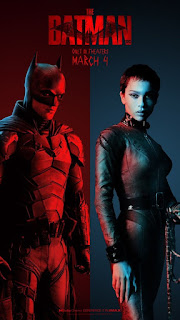
Peter Sarsgaard     Andy Serkis     Jeffrey Wright


            An eerie story with continually changing perspectives within a complex plot.  It’s especially remarkable that the musical theme throughout this action film is “Ave Maria” (part of the humor, I think).  Thankfully, in a three-hour film there is plenty of action to make the time go by quickly, especially since there are many, many characters to sort out and puzzles delivered by the Riddler to decipher.  Another entertaining aspect of the plot are numerous plays on words, such as “thumb drive” and one of the riddles being, “What does a liar do when he’s dead?...He lies still.”

            Robert Pattinson as this Batman in his second year of fighting crime convincingly portrays the mysterious, stoic figure he is known to be, even when sorely tried by The Riddler (who is targeting Gotham City residents) and fetchingly tempted by the exotic Selina Kyle (Kravitz), who is almost as fierce a fighter as Batman.  Colin Farrell is unrecognizable as a thug called The Penguin, and these fine actors are joined by Jeffrey Wright (a detective on the police force), Paul Dano (a crazed orphan grown up), Peter Sarsgaard (as a corrupt city official), Andy Serkis (in the purely dramatic role as Alfred Pennyworth), and John Turturro (in his rare portrayal of a bad guy).  

            Likewise, the crafts are well represented by Greig Fraser’s cinematography, Michael Giancchino’s music, and their colleagues in production design, sound (ah!, the effect of Batman’s ominous footsteps), costume and makeup, and special and visual effects.  Fraser has many scenes so dark it takes some work to figure out what is going on, and with some, being seen only through windows.  But stand-outs are the impressively composed shots that could stand alone as artistic productions. 

            I can say that the usual car chase that seems to be a must in this genre is present here as well, in just as much ridiculous, impossible feats as in all the others.  Two cars racing down a crowded turnpike while going against traffic and everyone in those two cars surviving goes way beyond the pale for me.

            All of these attributes (except for the car chase) are testament to Matt Reeves’ direction and co-authorship with Peter Craig.  (Bob Kane and Bill Finger are the original creators.)  Clearly these filmmakers and their associates collaborated well as a team in creating a work of art that allows us a sense of peeking in on an unfolding drama among real people that is relatable to most of our lives today.  I especially appreciated something not usually seen in this type of film—the realistic portrayal of deep emotions and conflicts (including Batman’s self doubts—which I think make the characters seem like real people to us.  Batman’s history with his family of origin and his having to sort out truth from fiction is an example of this asset.


The Batman is a combination of mystery, logical deduction, family drama, and spectacle that is likely to be entertaining to most people.


Grade:  A                              By Donna R. Copeland

Thursday, December 17, 2020

TENET

John David Washington    Robert Pattinson    Elizabeth Debicki     Kenneth Branagh    

 Michael Caine     Diimple Kapadia     Denzil Smith


     Tenet has all the hallmarks of a blockbuster—established filmmakers, actors, and a riveting story with themes of mind-ripping, intriguing, violence.  It certainly does all that.  What it doesn’t do is give the viewer time to reflect on any current, compelling issues that we should be concerned about nowadays, or probe personal relationships that make them seem to matter.  It’s more of an almost formulaic activation of tropes seen many times before.  This version seems to have been intended to tease us with time travel, frustrated love, and heroic battles between the hero and unrecognized/mysterious adversaries.

     The unnamed protagonist (Washington), a CIA agent, is recruited to match wits with a terrorist, Sator (Branagh) intent on destroying the world.  The first task is to actually come in contact with the man, not a direct route.  The Prospect meets Sir Crosby (Caine) for lunch who informs him cryptically about Tenet, a shadow organization attempting to save the whole world from destruction.  The Protagonist will be a part of that effort in his new assignment.  To achieve his task, the Protagonist tries at first to go through the wife of the infamous Russian Oligarch, Andrei Sator, Katherine “Kat)  (Debicki), an art dealer.  But this is with the intrusion of a fellow agent Neil (Pattinson), who appears and re-appears as a helper and, seemingly at times, a foe.  

In due time, the protagonist has a clear picture of what he is up against, in terms of arms dealers, their facilitators, and a world-wide plan.  

     Typical of writer/director Christopher Nolan, he plays around with time; and in this case, time inversion, which the evil Sator is trying to perfect for his own use.  It allows for something dropped to jump back up in one’s hand and cars to travel backwards on busy freeways—lending high-tension moments to the plot, along with well choreographed hand-to-hand combat and mental/physical cruelty.  More thrilling is a reverse bungee jump up the outside of a skyscraper.  (In a filmmaking aside:  The two actors start the jump, then stuntmen take over without a noticeable cut in the frame.

     Adding to the excellence in craft, Hoyte van Hoytema’s cinematographic feats maintain breathless action, accompanied by Ludwig Goransson’s always apt score. John David Washington is coming into his own as an actor earning action-figure status.  He mixes the heroic with sincerity and credibility, which adds to his appeal.  The stately Elizabeth Debicki plays Sator’s wounded wife with grace and expressive femininity, using her beautiful eyes to break through her mystique and help make her sympathetic.  Kenneth Branagh succeeds in filling his character with narcissistic loathsomeness making him easy to hate.  Bollywood’s well known star Dimple Kapadia does an admirable job in portraying a complex, woman with power.

     For Fans of Christopher Nolan Tenet will likely be satisfying and fun; others, as I did, may find it somewhat tedious to follow and feel impatience at the prolonged combat scenes.


Go on a time-inverted journey in Christopher Nolan’s newest thriller.


Grade:  B-                                    By Donna R. Copeland 


Thursday, October 31, 2019

THE KING

Timothee Chalamet     Joel Edgerton     Robert Pattinson     Ben Mendelsohn     Thomasin McKenzie    Lily-Rose Depp


     The King presents an interesting picture of King Henry V of England I in the early part of the 15thCentury.  The script, co-written by Joel Edgerton and director David Michod, draws some from history, more from Shakespeare’s plays, Henry IV and Henry V, and then elaborates on all sources.  The viewer should regard it as primarily a dramatization only loosely drawn from history and Shakespeare.
     As it turns out, the filmmakers have rewritten their sources to create a story about a “reluctant prince” who has major conflicts with his father, King Henry IV (Mendelsohn) about the constant wars the father has waged.  Henry V (Chalamet) is presented first as a playboy who has no desire to be a king, and doesn’t even want to attend to his ailing father. 
     It’s a bit of a stretch that such a person could suddenly turn into an admirable figure as he does in the film, but that’s the drama of it.  After the sudden change, Henry is shown to be a skilled and ferocious opponent in swordplay, a man who is astute and listens carefully to arguments presented to him, and makes shrewd decisions based upon his deductions.  He is not susceptible to indignations purposed upon him by others; he can take decisive, even ruthless, action when he suspects someone is lying or outright betraying him; and he keeps a cool head in negotiations with opponents.  Of course, he is also very handsome and appealing.
     The way Henry V becomes king is his take-charge stance after his father has chosen second son Thomas as his successor, someone who seems not to be a match for his brother, either intellectually or physically.  Henry tries to save him and avoid another war, but Thomas is recalcitrant, and after a series of events and time, the reluctant Henry becomes king.
     The rest of the story is about Henry’s being drawn into war, despite all his efforts against it, his need to identify those around him he can trust, and resorting to finding his old friend and caretaker John Falstaff (Edgerton) to be his primary advisor and strategist (especially in war) and supporter.
     The French don’t come across very well in this story; both the dauphin (Pattinson) and his father, King Charles VI, are disdainful and insolent toward Henry, refusing to go along with the ways he presents to avoid war.  Although they are partially redeemed by their eloquent--rather audacious—princess Catherine (Depp) who stands up to Henry in a very entertaining contretemps.  
     The craft of The King is admirable in Michod’s direction, the music (Nicholas Britell) and the cinematography (Adam Arkapaw), and the actors capture their roles well for the most part, especially Chalamet, Edgerton, McKenzie, and Depp.  Editing (Peter Sciberras) can be faulted for extending the battle scene far too long in a movie that is already over two hours in length. The scenes are effective in showing the bloodiness, muck, and brutality, but become tiring halfway through.
     I liked the Michod and Edgerton’s elaboration on historical events to present a character who is admirable in so many ways, trying to achieve peaceful resolutions, but mindful of counteracting forces.  This Henry V is someone we can admire, but viewers should not go with the expectation of seeing a production up to the level of a play by Shakespeare.

Henry V is an entertaining take-off of Shakespeare’s version, this one having a message of peace and the value of unity.

Grade:  C+                                                By Donna R Copeland

Thursday, August 24, 2017

GOOD TIME

Robert Pattinson     Benny Safdie     Jennifer Jason Leigh     Barkhad Abdi


            Robert Pattinson as Constantine “Connie” Nikas is the reason to see Good Time.  His performance as a poor-planning low-level crook is fascinating to watch.  This character is a great improviser, and although his (usually poor) planning doesn’t work out, he’s always got another trick up his sleeve and smooth talking to get what he wants.  He’s got enough smarts to dream up schemes—even on the spur of the moment—but not enough to work out a solid plan of execution.
            A major flaw in the script is related to the basic premise, which is, that Connie feels a great deal of responsibility for his brother Nick (Safdie), who is mentally challenged.  But the story never fills in just why Connie feels such possessiveness toward him.  He consistently tries to “rescue” Nick, but does it in ways that are unhelpful at best and dangerous at worst.  The “why” would be a much more interesting story to me, rather than watching mistake after mistake by Connie, ostensibly to rescue Nick.  Nick would be fine without him; society at its best—as it appears in this film—will take care of him responsibly.  Although, I must say that it could be that the filmmakers are making fun of psychological help in some, particularly the last one.
            Connie starts off making a mistake by having Nick be an accomplice in a bank robbery.  Nick clearly doesn’t have the wits needed to evade the police and gets arrested.  The authorities can see that he is not really responsible and provides him with help while they pursue his brother, who is scrambling to make bail for Nick.  (The bank has been clever with handing over the money, which is no longer usable.)
            What follows is a bizarre sequence of events involving an inept attempt to spring Nick from a hospital, an encounter with a grandmother and her granddaughter who will be duped, an attempt to rob an amusement park, and so on.  You’ve got the picture.  Desperation results in more and more schemes and bumbling.  The self-centeredness of Connie is illustrated in one sentence:  “Don’t be confused; it’s just going to make it worse for me.”  Said to a 16 year-old girl.
            The purpose of Good Time escapes me.  It has potential to be comedic, but only a few scenes are made laughable.  It could be about heists that go wrong, but there is nothing really clever about these heists.  It could be a drama about a dysfunctional family, but it is colorless in this respect.  The only redeeming value seems to be that justice is finally served for both Nick and Connie in the end.

Good time is not a good time at all.

Grade:  C-                        By Donna R. Copeland

Thursday, April 20, 2017

THE LOST CITY OF Z

Charlie Hunnam   Sienna Miller   Tom Holland   Robert Pattinson   Angus Macfadyen


       A gripping tale about one man’s obsession to make his mark on the world by locating the remains of a city that may have existed in the Amazon Jungle of Bolivia from 200 A.D. to the 1600’s.  Percy Fawcett (Hunnam), a middle-class British man in the early part of the century, is trying to be recognized for his military service, but now, the Royal Geographical Society has contacted him. He had distinguished himself in college with his mapping skills, and the Society wants him to use these skills in the Amazon, where Bolivia and Brazil are quarrelling about their boundaries, by mapping the river that courses between their two countries.  This would be an objective way to settle the dispute and avoid war.
     Fawcett is an earnest young man determined to over-ride his father’s disreputable reputation.  The complication is that he is married and has a young son, Jack.  But his wife Nina (Miller) shares his ambition and is as caught up in the quest for adventure and fame as he is.  So she gives her blessing and even does research in the library to help his cause.
Fawcett will make more than one journey into the Amazon Jungle, have both peaceful and life-threatening encounters with the natives, deal with unpredictable members of his parties, have to put off his wife who wants to accompany him on one expedition, and deal with the criticism of his teenage son.  He is away from home when his last two children are born.  Still, even after serving in WWI, he burns to dream his dream and “to seek the unknown” and find proof of a civilization that existed centuries earlier.
     The story, based on a book by David Grann, which drew upon true events, compels your attention through a relatively long film.  It switches rapidly back and forth between Great Britain, the Amazon, and the war theater—necessary, but sometimes abrupt because of the ground it has to cover.  In the process, the viewer is engaged with the dream of discovery of the unknown, the personal make-up of Fawcett, his attachment to his family, his wife’s heroism and faith in him, the politics involved in scientific expeditions, the mysteriousness of native cultures, and, ultimately, the outcome.
     Director James Gray has taken David Grann’s celebrated book about The Lost City of Z, and produced an intelligent, fascinating account of Percy Fawcett’s adventures.  His work is brilliantly enhanced by the cinematography of Darius Khondji, a master of light and shadow, photographic effects, and storytelling with the camera.  Charlie Hunnam is exactly right for the Percy Fawcett character, and I sing praises for Sienna Miller and her depiction of a woman of strength and purpose who could still be a model for women today.  The performances of Tom Holland, Robert Pattinson, and Angus Macfadyen provide lively support.
     The Lost City of Z is an opportunity to broaden your horizons, appreciate the scientific endeavors of committed explorers, and indulge yourself in exotic cultural experiences.  It says much about commitment and the exhortation to dream.

You may be able to find yourself in The Lost City of Z, and if you do, you’ll be the better for it.

Grade:  A                                    By Donna R. Copeland


Thursday, April 6, 2017

QUEEN OF THE DESERT

Nicole Kidman   James Franco   Damian Lewis   Robert Pattinson


     Celebrated filmmaker Werner Herzog takes us on a journey with Gertrude Bell, a remarkable British woman who in the early part of the 20th Century took it upon herself to explore the Middle East on her own with a small staff.  She was a writer, archeologist, explorer, mapmaker, and political advisor to the British Empire, wielding considerable influence on how boundaries were drawn in the area following WWI.  She developed a keen interest in the Bedouin tribes of Saudi Arabia, fearlessly walking into their settlements and requesting meetings with the reigning sheiks, which was apparently always granted.  Many of these men believed that she had a better understanding of them than anyone else in the West. 
     Educated at Oxford, Bell (beautifully played by Nicole Kidman) was very intelligent, but unlike most women in that age, was determined to navigate her own life as she pleased.  She single-mindedly pursued her goals, bristling at any male attempts to rein her in.  She could easily be an inspiration to women everywhere even today. 
     It appears that Herzog as writer and director of the film needed to add very little to the script that was not based on facts gathered from Bell’s books and personal correspondence.  Her written observations of the people she met, her photography, and her varied experiences provide rich information for the screenwriter and cinematographer.  Herzog has used Cinematographer Peter Zeitlinger for many of his movies, and the man has once again proved his worth with photography that is eloquent in its palette and the camera’s curious eye in navigating the terrain outdoors in the desert, within the tribal settlements, and in the cultured drawing rooms of British aristocracy.
     I found this to be a fascinating journey, particularly in light of current conditions in the Middle East and certainly in presenting the rare woman who could navigate her way in some of the most masculine-dominant situations.  Was she just lucky?  I think not.  There were far too many risky encounters for it to be that; she was canny, honest, forthright, and a skilled negotiator in getting what she wanted, while still maintaining respect for whoever was on the other side of the negotiation.
     Kidman seems just right for the role, and her playful flirtations with Henry (Franco), a character patterned after someone else Bell was involved with, add a little fun and romance to the story.  Bell’s later involvement with British officer Wylie (Lewis) doesn’t have the same chemistry, but is still entertaining.  Her interactions with archeologist T. E. Lawrence (Pattinson) capture well their mutual cynicism about British government decisions.
     Queen of the Desert presents a necessarily abbreviated but empathic account of a phenomenal woman in the beginning of the 20th Century who forged a path that is unique for women. Going where few or no others had dared to tread, Gertrude Bell came to know herself and what was important to her in her isolated travels in the Arabian Desert, which might seem secondary to the valuable connections she was making and information she was gathering about a mysterious culture.  In the history of women, however, it is groundbreaking.
     It could be criticized for skimping on the political information and negotiations Bell conducted, but I think that is in favor of the cinematic photographic sweep and focusing on Bell’s personality.  It’s classic Werner Herzog.

A delight to see a woman of action being so successful.

Grade:  A                                    By Donna R. Copeland

Thursday, March 5, 2015

MAPS TO THE STARS

Julianne Moore     Mia Wasikowska     John Cusack     Evan Bird     Robert Pattinson     Carrie Fisher


Maps to the Stars is something of a jumbled up mess.  We see a new arrival in town who doesn’t look like much but seems to have money to spare.  She overpays a driver waiting for a fare, and asks him if he has a map of Hollywood stars’ addresses.  He says no in a bored manner, and cites the few instances when he drove someone who was famous.  Agatha (Wasikowska) seems to have better connections, which he (Pattinson) doesn’t seem to get.  It turns out that Agatha knows Carrie Fisher (herself), who puts in a good word for her to Havana Segrand (Moore), a star desperately seeking work and needing an all-round assistant.  Havana is a bit put off by Agatha’s gloved arms covering burn scars, but hires her anyway, having no inkling about who Agatha is.
             Agatha is the estranged daughter of Havana’s “therapist” (Cusack), who with his wife is trying to keep Agatha away after she was discharged from a mental institution following an incident with fire.  They have aspirations for their son Benjie (Bird) to become a famous actor, and clearly want him to stay away from Agatha, particularly since he has just been released from rehab and his career can’t stand another scandal.
            Ah…parents have such delusions about their powers over their children.  Benjie and Agatha have always been close, and it is probably futile for anyone to think that they can be kept apart.
            David Cronenberg, the director seems to be on a quest exploring philosophical notions and the nature of human relationships (Eastern Promises, A History of Violence, Crash, The Fly).  He says, “I ask questions, but don’t have answers.  Moviemaking is a philosophical exploration.  I invite the audience to come on a journey and discover what they think and feel.”  He has also said, “I think all my movies are funny.”  I didn’t find much humor in this one that seems to be making a statement about the Hollywood culture with its single-minded quest for fame, its repudiation of boundaries and limits, and its need for soporifics to avoid pain. 
            As observed by another reviewer, it’s hard to tell if Cronenberg is kidding or serious (Matt Zoller Seitz, http://www.rogerebert.com/reviews/maps-to-the-stars-2015).  The view of Hollywood as presented in Maps to the Stars will likely not be surprising to anyone, and many may see it as a plausible account.  To me, the peek shown is too narrow to make it very encompassing of the whole scene.  So the film turns out to be more sensational than an insightful perspective.
            Certainly, the actors—notably Julianne Moore, Mia Wasikowska, John Cusack, Evan Bird, and Robert Pattinson—are truly fine in their portrayals.  I just wish the script by Bruce Wegner had more substance.

Go for the acting; not the story.

Grade:  C-            By Donna R. Copeland