Showing posts with label Kirsten Dunst. Show all posts

Thursday, December 2, 2021

THE POWER OF THE DOG

 Benedict Cumberbatch     Kirsten Dunst     Jesse Plemons

Kodi Smit-McPhee     Thomasin McKenzie     Keith Carradine


            This well-conceived and crafted film is so evocative, you are likely to be talking about it and figuring it out with others after you see it.  That means, it’s necessary to watch and listen closely—even at the very beginning when there is a monolog spoken by Peter (Smit-McPhee).  

            The setting is a cattle ranch in 1925, but this won’t be like a typical American western.  The ranch is owned by two brothers who couldn’t be more different from one another.  Phil the older (in a stunning performance by Cumberbatch) is macho, glib, and sarcastic, lording over everyone—even to the point that in the local saloon when he thinks the party at the next table is too loud, he shuts them and the piano player up.  Everyone seems to kowtow to him.  His brother George (Plemons also at his personal finest) is his opposite—diffident, unexpressive, and self-effacing.  He clearly feels antagonistic and disapproving of his brother, but quakes in his boots when he feels forced to confront him.

            But George is man enough (and this film is clearly about manhood and how it’s achieved.  George manages to woo childhood friend Rose (Dunst) who is a widow now with a son, Peter, and marry her on the sly outside of Phil’s presence and control.  Of course, this does not sit well with Phil, and he disparages her and her son loudly and clearly.

            He is especially dismissive of Peter, who is artistic and studying to be a doctor like his deceased father.  Modeling themselves after Phil, the ranch hands yell out “faggot!” when Peter walks by, and when Phil takes it upon himself to teach Peter manly things like riding a horse, everyone is surprised.  Not Rose—she is horrified.  The antagonism between her and Phil is palpable.  

            The film is expert in bringing the viewer along with little puzzles to think and hypothesize about along the way.  It’s a study in personality types and how they might function within a family.  It’s an incredibly thoughtful movie with subtle references and signs.  Writer-director Jane Campion based it on Thomas Savage’s novel of the same title, The Power of the Dog, a biblical reference to Psalms 22:20, “But be not thou far from me, O LORD…haste thee to help me.  Deliver my soul from the sword; my darling from the power of the dog…”  [power of the dog as a symbol of gluttony, a scavenger, something evil].

            The actors are so well cast, and Cumberbatch put himself through all kinds of training exercises to learn ranching, an American western accent, and so on.  I would think he is at the top of award lists for best actor, even though he is a bit of a villain.  Plemons is in more and more films these days, and in the past seemed rather unremarkable; but in this film, he pulls off being a sympathetic character with authenticity.  Dunst herself disappears into a complex, troubled—yet vengeful—woman who lacks self-confidence except in the case of her son, whom she will defend to the end.

            As in her previous major work, The Piano, Jane Campion brings to life real people and real struggles to create a psychological drama in which the ending remains ambiguous, at least as far as the main characters are concerned.  We get attached to Peter, Rose, George and others, wondering what happened to them.


A psychological study of personality types and how they might function in a family.


Grade:  A                              By Donna R. Copeland

Thursday, June 29, 2017

THE BEGUILED

Nicole Kidman   Elle Fanning   Kirsten Dunst   Colin Farrell   Oona Laurence   Angourie Rice   Addison Riecke


     Beguile:  To deceive with charm.  By the end of the film, which ends up being something of a thriller, exactly to whom the title refers is ambiguous.  The wounded Union soldier found in the woods by a young girl, Amy (Laurence) on a southern plantation during the Civil War is charming, polite, and gracious to his rescuers/hosts.  Tenderhearted Amy has helped him limp to the girls boarding school where she lives, counting on the head mistress, Martha Farnsworth (Kidman) knowing what to do with him.  Miss Martha is a Christian who is committed to its principles, so thinks it moral and proper to treat him before sending him on his way or notifying Confederate soldiers.  Her ambivalence is increased when she talks to some passing soldiers with prisoners and find they are taking them to prison to die.
     Col. John McBurney’s (Farrell) charm has an oily feel to it from the start, prompting the viewer to wonder what he wants to get out of it; he is clearly not without guile.  He is lavish with his compliments anytime one of the residents does something for him, and he flirts shamelessly but knowledgeably—that is, he has a sense of what approach will be pleasing to each individual.  And he has a dark side, which will be revealed as the stress level rises. 
Quite the opposite, Miss Martha is crisp and direct with John, purposefully stifling any hope he might have of piercing her armor and being of help to him.  She makes it clear that she is only doing her duty and will send him on his way as soon as he is physically able.  Nevertheless, he persists, knowing from past experience that he is able to wheedle his way past feminine defenses. 
     But John has likely never been in a situation where he is surrounded by six females, all being drawn to him simply because he’s a male because it’s been so long since any of them have been around men.  They’re staying holed up in the school because for various reasons there is no other place for them to go.  Everyone else has gone home for Christmas.  He seems almost giddy about being the object of their competition with one another, particularly the three adult women, Martha, Edwina (Dunst), and Alicia (Fanning).  He has a special bond with Amy in their mutual fascination with plants and animals.  When he is better, he will work in the garden.  Jane (Rice) plays piano, which draws her to him, and Marie (Riecke) simply lets him know she cares about him.
     There are tense moments when soldiers come by the house (with John hidden), and as jealousies arise and John’s leg begins to heal, allowing him to be more mobile, the situation comes to a resounding crisis.  Feeling desperate and emasculated, John’s dark side surfaces, and the women must defend themselves.  This is where their guile sheds more light on the title, The Beguiled.
     The film is well conceived (based on a novel by Thomas Cullinan) and directed by Sofia Coppola, who well deserves the director’s prize she received for her work at this year’s film festival in Cannes.  Although I’m not always a fan of her work, this production moves along at a good pace, and facts about the characters are revealed gradually, heightening suspense.  In addition, the astute psychological observations about women, women and men, and how they behave in specific situations rings so true.
     Nicole Kidman won a special price at Cannes for being in four different films screened there, one of them being The Beguiled.  As Martha Farnsworth, an upper-class southerner, she carries the role with precision, with just the right degree of softness, authority, compassion, and intelligence.  Although keeping her emotions in check, she clearly shows affection for her charges, and listens to them respectfully like a wise leader.  Kirsten Dunst and Elle Fanning lend fine support in their veneers of compliance masking rebellious leanings.  I was really taken with Oona Laurence’s character Amy and her performance.  One of the delights of the film were the scenes when the females were together making decisions in a spirit of unity. 
     Philippe Le Sourd’s cinematography contributed greatly to the mood and look of The Beguiled, with varying brightness, darkness, and chiaroscuro effects.  Once, an exquisite close-up of a spider web clarified the visual and symbolic meaning of the scene and the film as a whole. 

An intriguing picture of women sparring with/over a man.

Grade:  A                                    By Donna R. Copeland

Wednesday, December 28, 2016

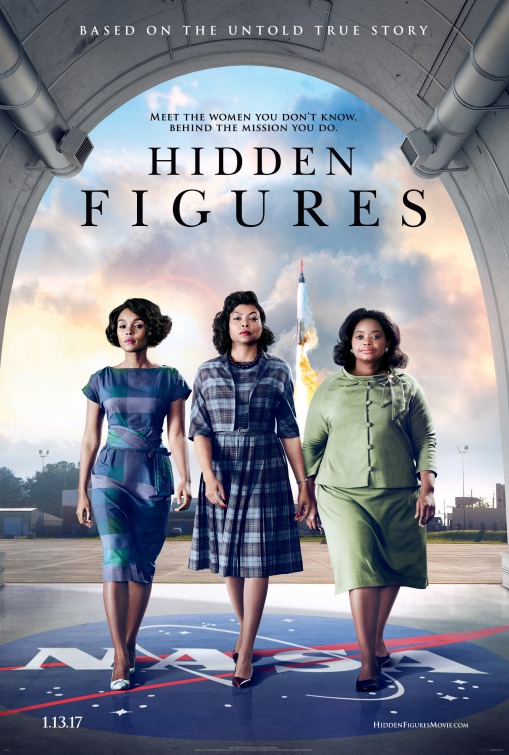
HIDDEN FIGURES

Taraji P. Henson     Octavia Spencer     Janelle Monae     Kevin Costner     Kirsten Dunst     Jim Parsons     Mahershala Ali


       Heartbreaking, thrilling, suspenseful, funny—Hidden Figures embodies all these, including inspirational.  I’m sorry it has taken so long for the story about three heroic black mathematicians at NASA to be told to the mainstream.  But at least it’s out now for all to see at their local theaters.  The film is based on the book, Hidden Figures, by Margot Lee Shetterly, who also served as one of the producers.  Shetterly won an Alfred P. Sloane Fellowship based on this work, and apparently, Levantine Films bought the film rights soon after she completed it (or maybe before, since her book is dated 2016).
         The film opens with little Katherine Harrison (Henson) demonstrating her mathematical genius to school officials when she was in the sixth grade.  Her teacher was determined that she would have educational opportunities that were appropriate for her.  Soon, we meet her as a grown-up on the road to work at NASA with her two friends, Dorothy (Spencer) and Mary (Monae).  They’re having car trouble, but since Dorothy is a mechanical as well as math genius, she fixes it.  After showing their work IDs to a stunned policeman who had stopped to investigate, he offers to escort them to work with red lights blinking so their delay won’t make them late. 
         Most of us simply have no idea about the countless indignities these women will have to face, from having to go to the restroom labeled “Colored Women” a half-mile away, to having pertinent information for their jobs hidden from them, to a separate coffee maker (so white people won’t have to touch it)…we could go on and on.  Throughout, the women are polite, patient, and kind (until pushed too far, then they react strongly, effectively, and appropriately).  The rationalization they are given for such treatment?  “That’s just the way it is.”
         Hidden Figures, to its credit, gets into the fears about the Soviets and the space race at the time, which shows up at NASA certainly, but also by the patrolman on the country road and by the children at school who have drills to get under their desks in case the Soviets attack the U.S.  President Kennedy is featured prominently in showing the pressure to be first in the space race, which dials up the pressure on NASA.  All this reinforces the importance of three black women in their previously unheard of roles.
         Henson, Spencer, and Monae are all standouts, but Henson shows special flair when she answers in an outburst why she disappears for 40 minutes at a time (the walk to the restroom) and why it’s crucial for her to receive updated information immediately.  She also shines when she’s perched on a ladder writing complicated formulas for problems that have perplexed a whole room full of mathematicians.  In the evening, she slides into being a loving, demonstrative mother to her three girls.  I loved Henson’s portrayal of her policewoman character in CBS TV’s “Person of Interest”, where she showed intelligence, canniness, and wit, just like she does here; but here, she’s in an elevated position finally being recognized for her worth.  Ah…..!

A story that should have been told long ago.

Grade:  A                                    By Donna R. Copeland

Sunday, March 13, 2016

MIDNIGHT SPECIAL

Michael Shannon    Kirsten Dunst     Joel Edgerton     Adam Driver     Sam Shepard     Jaeden Lieberher


        For a fanciful blend of creativity and imagination with reality and clever CGI effects, go see Midnight Special.  Jeff Nichols (Mud, Take Shelter) spun this from his brain soon after he became a first-time father.  When his son was a newborn he had a febrile seizure, which the author drew on for the script.  Parental responsibility is one of several themes of the film, and the parents here—while outside the norm—demonstrate their love of their son in a way that is beyond that of most parents.
      The movie opens with a newscast of a child kidnapping, focusing on a religious sect housed on a ranch in the community—an unusual first look.  Viewers are apprised of the details gradually in a way that prolongs the suspense.  In short, there are two sets of parents, not necessarily on different sides, an intense search going on led by the FBI, and a state trooper risking his life in helping a childhood friend, one of the fathers.
      The reason the FBI is involved is that classified government data has been breached from a satellite meant to detect nuclear activity.  Moreover, the religious group has been apprised of the government codes, has formed their religious beliefs around them, and have become convinced that a day of judgment is at hand.  All this centers around a young boy named Alton (Lieberher), whom his biological father (Shannon) has in tow with the assistance of his friend (Edgerton).  The religious group wants him because if he is with them, they’ll be saved on the day of judgment.  Government officials are seeking the boy, who could possibly be a weapon.  Alarming events can happen when the boy goes into apparent seizures, such as brilliant lights streaming down from the sky and exploding on earth. 
      The actor playing Alton is very effective, partly just because of his looks, which are accentuated with blue-green goggles he wears when he is reading his comic books, as well as his sheer talent.  Shannon and Edgerton deliver their usual exceptional performances as the two “kidnappers”, and Dunst comes in as the boy’s mother—all of them demonstrating sensitivity to the boy’s needs despite being outliers and all looking a bit odd.  Driver has his moments as the NSA’s man whose training is in his expertise in understanding religious groups and chasing down evidence and data.  He has a major transformation in his encounters with this motley group of people that is cleverly inserted to help convince us of the validity of the boy’s visions.
      Jeff Nichols has become one of the rare writers/directors who is able to weave reality and fantasy together while still keeping the plot tight, without holes.  His and his team’s CGI is beautiful to behold, and serves a key function in depicting Alton’s surreal experience and the effects of other-world events. 

A TRULY SPECIAL MIDNIGHT RIDE.


Grade:  A           By Donna R. Copeland