Showing posts with label Cherry Jones. Show all posts

Thursday, February 10, 2022

THE SKY IS EVERYWHERE

 Grace Kaufman     Jason Segel     Cherry Jones     Pico Alexander     Havana Rose Liu
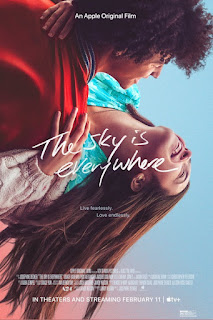
        Grief is one of those experiences that may take many twists and turns.  That’s the theme of The Sky is Everywhere.  Lennie (Kayfman) loses an idolized older sister who she assumed would be with her going to Julliard and beyond.  But that’s not what happens; her sister Bailey (Liu) undergoes an arrhythmia that takes her life.  Lennie had already lost her mother (to the same condition) and has been brought up by her grandmother (Jones) and Uncle Big (Segel), two quirky, entertaining characters who go against stereotypes.  Lennie and Bailey were extremely close—almost like twins—and the loss for Lennie is profound.

            There are a few hokey scenes, as when Lennie muses about her sister’s death and says that all she can think about is falling into somebody’s arms.  And then what follows are scenes of the teens at high school swooning over a trumpet player’s (Coliman) tunes.  Another is when creeping stems of roses wind around subjects in a seduction.  But in a surprising turn (and redemptive for the movie) is when Lennie discovers the trumpet player, Joe, has been admiring her musical talent, and as soon as he gets a chance begins to woo her.  

            The complexities of the relationships in this film are testament to its going beyond rom-com to a story that has something important to say.  First of all, is the portrayal of the different kinds of grief expressed by those connected to the lost one—the sister, the lover, the grandmother.  The film does a good job in showing how differently grief is manifest in figures left behind.  It deals with the typical complaint that the “wrong one” was taken, that it should have been “me.”  And it sustains suspense in how Lennie will resolve her dilemma.  The film is also very good in showing how crutches people often use to cope with grief are not necessarily helpful.

            This is a film that surprised me in its depth of portraying loss and in its going beyond the usual in showing ways of coping and how it takes family and friends to be of real support in getting through it.  Director Josephine Decker showed her insight into female roles in Shirley (2020) and accomplishes it again here in a professionally aspiring woman’s dilemmas when she is confronted with real-life situations.


An honest, enlightened portrait of grief, showing once again the pull between personal and professional goals.


Grade:  B                              By Donna R. Copeland

Thursday, September 16, 2021

THE EYES OF TAMMY FAYE

Jessica Chastain     Andrew Garfield     Cherry Jones     Vincent D’Onofrio

 Fredric Lehne     Louis Cancelmi     Sam Jaeger 


             A little girl with a rejecting mother finds redemption for herself at a Second Adventist Church when she bursts in on a service (against her mother’s wishes) and the preacher accepts her testament of faith.  She is so overjoyed she begins speaking in tongues, whereupon the congregation is convinced she is from God.

            A young man driving his father’s car gets distracted and hits a young boy, seriously injuring him.  The teenager is so distraught he prays for the child, promising God that if the child lives, he will devote himself to preaching the Gospel.

            Tammy Faye (Chastain) and Jim Bakker (Garfield) meet, fall in love and elope before Tammy’s mother knows what is going on.  He aspires to become a television evangelist a la Pat Robertson, and Tammy Faye fits herself right in with a singing voice and creativity in appealing to anyone—adults or children—who listens.  They’re both talented, and building on childhood dreams, manage to develop a following among evangelical Christians.  Of course, this provokes the interest of Pat Robertson and Jerry Falwell who aren’t quite ready for the competition.

            Those of us of a certain age remember the Bakkers and their making religion more entertaining with playful puppets and delivering messages like “God doesn’t want us to be poor” on their PTL (Praise the Lord) network.  They even recruit Gary Paxton, a Grammy winning songwriter who comes up with something like “Don’t Give Up; You’re on the brink of a miracle” for Tammy Faye to sing.  For her, God is a loving god with tolerance for everything he has made.  When Falwell is condemning homosexuality and claiming that AIDS is God’s punishment for it, her approach is that we should love all God’s creatures, because “God don’t make no junk.”

            This starts to be a fairy tale story, as the Bakkers’ messages—and confessions—strike a chord in the hearts of Christians and the donations coming in go over the top.  Jim’s plans and dreams grow in kind, as in elaborate water parks and vacation lands on the PTL property, along with Tammy Faye’s social programs (e.g., homes for unwed mothers and children with special needs).  Unfortunately, the Bakkers are susceptible to human enticements, and no one in their organization has learned money management, which ends up being a major problem.

            Certainly, the outstanding part of this production is Jessica Chastain’s performance as Tammy Faye.  She so encapsulates the character, the viewer ceases to see Chastain at all—only Tammy Faye.  Chastain captures Tammy’s chameleon personality flawlessly, and we get seduced just as all the characters are by her enticing charm.  There is a genuineness in Tammy Faye that Chastain has picked up on that makes her a sympathetic character rather than one usually disdained.  Andrew Garfield is likewise perfectly cast as one who, though mostly sincere, is naïve, easily influenced, and devoid of a sense of practicalities. 

            There are a couple of problems with an otherwise well produced movie.  One for me is that the two characters become wearing over time, with their inability to grow and change and their persistent denial of reality, even though I realize this is probably how people experienced them at the time.  But the filmmakers could have used more judicious editing and omitted some of the scenes--especially toward the end—when the movie seems to drag on and on.

            I did appreciate the honesty of both of these characters when they are confronted by each other; ultimately, they were truthful—at least with one another.  Whether or not that holds for the real people, I couldn’t say.


Tammy Faye shows how even those with good intentions and caring hearts can be seduced by fame and fortune to their detriment.  Nevertheless, the voyage in getting there may make it all seem worthwhile.  Didn’t the characters say in the end that they didn’t regret anything?  I was left with that impression.

Grade:  B                              By Donna R. Copeland


Thursday, October 1, 2020

A RAINY DAY IN NEW YORK

Timothee Chalamet     Elle Fanning     Liev Schreiber     Jude Law     Diego Luna

Selena Gomez     Rebecca Hall     Cherry Jones

     Completely fanciful.  Woody Allen’s latest film comes straight from his brain—probably on a rainy day in New York.  In the beginning, the dialog, the music, Chalamet’s character—everything is so enigmatic of the creator that it’s hard to put Woody out of the story.  And he still stays for much of the story, but as it gets more and more madcap, he recedes a little bit.

     Two upstate New York college students are off to New York City for her, a budding journalist, to interview a well-known filmmaker about his latest film for the college newspaper.  She is definitely star-struck, and he is simply excited about going back to his hometown to revisit places like MOMA, the Carlton, Restaurant Daniel, and his favorite piano bars.  Allen seems well aware of males in such situations to make her trip his trip.  They head out, happily in love; he greeting the rainy weather as a welcome friend and romantic opportunity.  (One of the things I found hilarious about the movie is the constant rain and characters’ different reactions to it.)

     The differences in their expectations make up the heart of the movie.  Very soon after they arrive, Ashleigh (Fanning) and Gatsby (intended reference), played by Chalamet, are on very different arcs of experience.  As evidence(?) of her southwestern U.S. routes, she is carried along by people she’s impressed with, with little will of her own.  He, being the cosmopolitan New Yorker, is constantly thrown to his own devices, which is de rigueur for him, and he orchestrates his own way, keeping a well balanced eye on who he is.  She loses herself completely in situations; he is constantly aware of who he is wherever he is, even when new experiences come his way.

     Ashleigh confronts a famous film director’s (Schreiber) existential crisis, his writer’s (Law) dealing with marital infidelity, and a film idol’s (Luna) disingenuous flirtation.  Actually, they’re all smitten with Ashleigh—I suppose, to make a point in that it’s almost a cliché now.  She embodies that wish that they all have of a young, beautiful woman who’s always sympathetic and adoring.

     On the other hand, Gatsby deals with not being adored all the time, having to interact with an ex-girlfriend’s little sister (Gomez) who is clearly not impressed with him and apprises him of her sister’s low ratings of him.  When he ends up having to attend his mother’s (marvelous Jones, as you’ve never seen her) hated society bash and he has a real conversation with her, the film gets down to the bottom line of what I think it’s about—which is, biases that separate people on trivial grounds and the importance of going beyond the apparent and digging deeper into situations and people.

     Woody Allen is one of our most gifted filmmakers who is able to attract the best actors, keep his Oscar-winning cinematographer Vittorio Storaro (too many awards to name) on board, and provide music that captures every moment of every scene.  Artistry abounds in every component of his films.  Yet, something has happened that A Rainy Day in New York is met with only mediocre ratings by critics.

     Maybe it’s too much Woody?  His genes are in the story from start to finish, to be sure, and this starts to feel like a tired joke.  And much of the action recalls too many of his previous works.       This is all true.  Beyond that, my personal reaction was against his casting a woman from Arizona as stereotypically naïve/uninformed/rather stupid. Numerous jokes about non-New York people were made as if anyone outside New York City is naïve at best and uneducated and uncouth at worst—all reflecting the old joke that New Yorkers don’t recognize anything beyond its borders.   


Ya have to be a Woody Allen fan to enjoy this movie; otherwise, you may be nonplussed unimpressed, or even offended.


Grade:  C+                                    By Donna R. Copeland


Thursday, October 31, 2019

MOTHERLESS BROOKLYN

Edward Norton     Willem Dafoe     Gugu Mbitha-Raw     Bruce Willis     Alec Baldwin
Dallas Roberts     Leslie Mann     Bobby Cannavale     Michael Kenneth Williams     Cherry Jones


     Picture New York City in the 1950’s with a gumshoe detective following clues to weed out the killer of his life-long mentor.  Or at least picture one of the detective films you’ve seen—or heard on the radio—from that time (e.g., Mr. Keen, Tracer of lost personsDragnet), with the smokiness of the rooms, the seediness of the neighborhoods, and the persistence of a committed private detective.  That’s the movie Edward Norton has written (based on Jonathan Lethen’s novel), produced, directed, and starred in, in Motherless Brooklyn.  Norton and his cinematographer Dick Pope capture this period’s mood and effluence of city corruption that ends up being a crime thriller, complete with car chases, goons, and the pressure of rescuing an endangered damsel.
     The extra intriguing twist to this story is that the main character Lionel Essrog (what a name!), played spot on by Norton, has Tourette’s Syndrome (a disorder involving involuntary tics and utterances).  It’s not really relevant or essential to the story, but adds a touch of color.  Lionel works in a private detective agency headed by his lifelong mentor Frank Minna (Willis).  From the time Frank took pity on and rescued Lionel from bullies in a boy’s home, he has continued to protect him.
     But Frank is also mysterious about jobs he’s working on, giving Lionel and the others only sketchy details about it, but explicit instructions about how to keep an eye out and what to do if…  The movie begins with just such a job, during which Frank is killed.  What ensues is Lionel following the slim clues he’s been given or picked up to find the killer.
     This leads him into major city politics and Frank’s role in it; Moses Randolph (Baldwin), who seems to be in charge of major city “improvements”; a homeless man (Dafoe); activist    Gabby Horowitz (Jones); and a mysterious “black woman” Laura Rose (Mbitha-Raw).
     The novel—and consequently the film—seem to be at least loosely based on true historical events in the 1950’s, documented in a 2018 film, Citizen Jane:  Battle for the City, when Robert Moses, a city planner, began to dismantle city neighborhoods to construct freeways and bridges through them without regard for the people affected.  That is what is happening in this film, but it’s put into a drama that is exciting and will pull at the heartstrings.  
     This is a fun movie for those who can get into period dramas from not too long ago and follow leads and cues the detective Lionel chases—all while explaining his “brain problem.”  The cast is superb (what a juxtaposition of Baldwin’s Moses Randolph and his “Saturday Night Live” Trump impersonations), with Norton capturing the Tourette-plagued Lionel, Mbitha-Raw as an attractive, accomplished woman with a dark history, Willem Dafoe as the mysterious homeless man with a significant background, Bobby Cannavale as a compromised man, and Leslie Mann, Michael K. Williams, and Cherry Jones all providing star-quality performances.

A cloak and dagger story harking back to the 1950s with the added twist of a detective with Tourette’s, but possessing a formidable memory.

Grade:  B                                                By Donna R. Copeland

Thursday, March 1, 2018

THE PARTY

Timothy Spall     Kristin Scott Thomas     Patricia Clarkson     Bruno Ganz    
Cherry Jones     Emily Mortimer     Cillian Murphy


     This is a British comedy, probably not to American tastes, that presents as a staged theatre production in black and white film.  It starts as a drama among a group of intelligent academic types, and quickly transforms into a satirical comedy.  Janet (Thomas) is celebrating a political victory with a party in her home with close friends after she wins the position of shadow health minister.  With the support of her friends, she has aspirations eventually for party leadership and even prime minister.  Her husband Bill (Spall), a professor, seems a bit out of it, sitting in his rocking chair and drinking wine, until their friends April (Clarkson) and Gottfried (Ganz) arrive and he spends most of the rest of the time talking and drinking with Gottfried.  April is rather cynical, and satisfyingly reports that she and Gottfried are separated.  Gottfried is a “healer” of some kind who always takes an optimistic view of whatever is confronting him; hence his and April’s conflicts.  She constantly puts him down, but he never seems to notice.
     Janet is in the kitchen preparing canapes, while periodically taking calls from an apparent lover, when financier Tom (Murphy) arrives, looking very agitated, disappearing into the bathroom repeatedly, and conflicted about a gun he is carrying/hiding.  The other two guests at the party are Lesbians, Martha (Jones) and Jinny (Mortimer), who announce they are having triplets.  Jinny is the pregnant one, and she also has to disappear into the bathroom now and then, where she runs into Tom.
     The “fun” comes when crises erupt and secrets emerge, which seem to be related to all their relationships.  It turns out that the group is enmeshed with a colorful history that is impinging on their current lives.  As the secrets unfold, we see the reactions of each, and in the process are greatly entertained by their all-too-human reactions and solutions. 
     The Party does not contain profound observations, but it has sharp-witted conversation and striking characters played by top-tier actors.

Sit and enjoy the banter and barbs of long-time friends gathering for a celebration, which gets completely lost in the revelations of so many secrets.

Grade:  B                                    By Donna R. Copeland


Wednesday, March 30, 2016

I SAW THE LIGHT

Tom Hiddleston     Elizabeth Olsen     Bradley Whitford     Cherry Jones

          When the movie first opened, I was captured with Hank Williams (Hiddleston) singing “Cold, Cold Heart” without accompaniment and the chiaroscuro effect in the scene.  The mood was just right, and it was deeply moving.  Unfortunately, two basic flaws in I Saw the Light emerged soon after, which I attribute to Marc Abraham’s screenplay and direction.  He has primarily worked as a producer without much experience in writing and direction, hence, the movie sags almost every time there is dialog.  It doesn’t matter whether the conversation is between husband and wife in intimate moments or band members talking to one another or to agents—he puts the audience to sleep.  I marveled at how such an interesting person’s life could be made boring.
       The other problem I had with the film is the number of scenes where neither the issue nor the personalities involved are explored; they’re simply left unresolved.  A particular example is Hank and his agent Fred Rose (Whitford) visiting the MGM Studio, and their host wants Hank to take off his hat.  Hank refuses, and we don’t know why it’s so important to the MGM producer or to Hank.  We don’t even know whether he actually took it off or didn’t.  And we don’t know whether the incident ruined Hank’s chance to be supported by MGM.  With so many of such scenes in a film, it becomes unsettling.
      Hank Williams was decidedly a fascinating, complex person with a markedly eventful life, and whatever interest is maintained in the movie is because we’re curious about him and want o understand him and because Hiddleston aced the role.  Even though we’re presented with event after event in his life, it’s more like a chronicle; there is not much exploration into Hank’s character in the larger sense of the word that would essentially help us understand him. 
      On the other hand, Tom Hiddleston has done the seemingly impossible, converting his British accent into American country, learning to sing on pitch and play the guitar (tutored by Rodney Crowell), and moving his body like a person with spina bifida—all for this movie.  I had to smile when in an interview he said that he had heard a few Hank Williams’ songs before he got the role, but was more intrigued with the word ‘honky tonk’; he had no idea what it meant, but he loved the sound of it.  Hiddleston put on the Williams persona so completely and convincingly, it fit like a body suit.
      The talents of other main actors were fine supports:  Elizabeth Olsen as the disillusioned but shallow wife; Bradley Whitford as the agent-like-a-father Fred Rose; and Cherry Jones as the cloying, possessive mother of Hank.  I had anticipated seeing I Saw the Light, so was disappointed that it contained so little “fleshing out” of the characters. 
     On the other hand, Tom Hiddleston’s performance is worth the price of a ticket to the movie theater.  The last song, “Your Cheatin’ Heart” is a perfect ending.  After seeing important events in his life, he could just as well be singing the song to himself as to someone else. 

A reminder that good writing and direction are essential, although sometimes an actor’s performance is worth a viewing.

Grade:  D+                                    By Donna R. Copeland