Showing posts with label Frances McDormand. Show all posts

Thursday, December 23, 2021

THE TRAGEDY OF MACBETH

 Denzel Washington     Frances McDormand     Corey Hawkins     
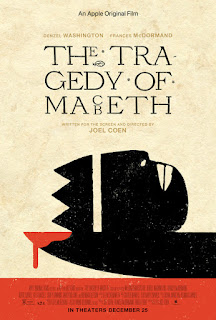
Brendan Gleeson     Bertie Carvel     Harry Melling     Kathryn Hunter


            It’s somewhat curious to me that the famed director Joel Coen (usually with his brother Ethan, but not this time) would choose to film a Shakespeare play.  We don’t seem to be in the right climate for that now, but I read that his wife Frances McDormand had for some time wanted him to direct the Macbeth play.  When he finally decided to do it, it was to make a film of it, although it was important to him to maintain a sense of the play.

            The two lead actors McDormand (Macbeth’s wife) and Denzel Washington (Macbeth) have both had experience acting in Shakespearean plays, and their renditions of the cadence and verse of the familiar lines appear natural and authentic.  Their performances here are award-worthy.  Roles played by the supporting actors (Corey Hawkins, Brendan Gleeson Harry Melling, and Bertie Carvel) are strong as well.  The cast and the special effects are the most appealing aspects of the film, a testament to Joel Coen’s direction and production abilities.

            The film is black and white, contributing to the intended qualities of starkness and eeriness.  When the witches—especially Hecate (Kathryn Hunter)—foretell the future, special effects add emphasis most effectively.  Hunter is such a wonder in contorting her body into seemingly impossible positions, it almost distracts from her prophesies.  But clearly Macbeth remains captivated and convinced that she is telling the truth, that he will one day be king of Scotland.  When he is in doubt, he evokes these spirits to reassure him, although of course he does not fully comprehend what the prophecies actually say.

Essential to the production was Stefan Dechant’s production design.  He and cinematographer Bruno Delbonnel created dark, foggy scenes outside and indoors that reflected the required mysteriousness and drama in the plot.  Likewise, Carter Burwell’s musical score with a mix of medieval and modern music sounds fit with all the different moods and auras of the film.

I was not excited to see a Shakespearean drama, but as I started watching and getting into TheTragedy of Macbeth, I began to be engrossed.  Surprising were the little thrills I got when some familiar quote appeared, and I realized that although I recognized them as Shakespeare, I had forgotten they came from this particular play.  Seeing them in context was especially pleasing.  I was also charmed by the language at times, such as “Let us not be dainty of leave taking” when two actors realize they need to disappear post-haste.


Shakespeare is not to everyone’s taste, but for those who still relish it, this impressive production of The Tragedy of Macbeth will surely please.


Grade:  A                              By Donna R. Copeland

Thursday, October 28, 2021

THE FRENCH DISPATCH

 Benecio del Toro     Adrien Brody     Tilda Swinton     Lea Seydoux     Frances McDormand     Timothee Chalamet

Jeffrey Wright     Bill Murray     Owen Wilson     Bob Balaban     Henry Winkler


            Wes Anderson’s stamp (wry humor, meaningful free association, characters in caricature, intrigue/mystery, curiosity, folksy drama, to name a few) is all over The French Dispatch, a group of stories about a Frenchified newspaper in Lawrence Kansas with that name owned by Arthur Howitzer, Jr., after his father, the founder of the publication died.  The first scenes of what look like a painting of a French village are captivating for both their artistry and the action figures that move within them.  The pictures represent the town of Ennui (pun intended), which has endured all kinds of crises during its existence.  We get to hear about some of those in this fanciful production.

            Another Anderson stamp is his continuing to engage actors and crew from his previous movies.  It gets to be another fun part of watching one of his films—identifying all the scores of actors who have appeared in his previous works.  Anderson puts them in completely different roles from what you would expect.  For instance, Tilda Swinton as an art curator is made up to look strikingly like Sofia Loren.  Well-known artists like cinematographer Robert D. Young and musician Alexandre Desplat are likewise regulars, playing essential roles in conveying the experiences Anderson wants you to have when viewing his films.

            The French Dispatch will not be to everyone’s taste, even for those who are fans.  Unlike his previous films, there seems to be no overarching point to this one.  It’s more like one where you just sit back and enjoy hundreds of moments in time with interesting people and situations that will somehow be recognizable to everyone.  The dialog is so sharp and fast-moving, I wished I had had a script in front of me or already read one where I could stop and savor the import of every scene.  It all goes by very fast.

            It’s curious at times to observe the dominance of women in this production.  Lea Seydoux does an exquisite rendition of a model/guard/dominatrix of an artist named Moses Rosenthal (Benecio del Toro), who is in prison for murder.  (Think of all the associations it took to come up with that image.)  Moreover, older women like Upshur ‘Maw’ Champette (Lois Smith) appear in decision-making scenes, and Lucinda Krementa (McDormand), a middle-aged writer for the Dispatch is shown in bed with young student activist Zeffirelli (Chalamet).  These encounters—like all others—are presented as droll pictures of a normal world.

            When Anderson seems to be spoofing or even criticizing things is not always clear.  For instance, he often shows characters smoking.  Now, Anderson does not smoke and thinks it’s bad for people, but he says, “It looks good on film.”  That is frequently seen in this movie, and, true, it often looks good; but there are also instances where he seems to be making some kind of point, say, about student protests or government agencies.  Maybe he’s leaving it up to the viewer to make up his/her own mind.

            As much as I love Wed Anderson films, I doubt this one will be a blockbuster.  I certainly enjoyed it and would like to see it again—maybe even read the script—but it is likely not to appeal to all Anderson fans, and certainly not to the general public.  


A quirky Wes Anderson film with a collection of stories that will only be savored by some.


Grade:  B                              By Donna R. Copeland


Thursday, December 10, 2020

NOMADLAND

Frances McDormand     Linda May     Bob Wells     Charlene Swankie     David Strathairn

     What people do when they get older varies immeasurably, depending on family, circumstances, personal preference, and many other reasons.  That there is a group of oldsters who travel around—mostly in vans and RVs—is new to me, as probably for most of us.  Some are facing the end of life and want to make the most of it, while others seem not to be thinking about an ending date at all. Fran (McDormand) is one of them and a bit of a mystery, but we discover a lot about her as the story wends its way.  Her husband has died, the town she lived in lost its industry—taking her job with it—during an economic recession—and with a wandering spirit, Fran decides to outfit her van and take to the road.  

     Nomadland is the story of the people she meets along the way, but it’s also a picture book of all the breathtaking vistas she gazes out on as she travels the American upper Midwest—Nevada, South Dakota, Nebraska, California, and Arizona.  Cinematographer Joshua James Richards captures the colorful sunsets, the hills of the Badlands in South Dakota, and much more, along with the wizened, expressive faces of people coming from all kinds of different histories and current circumstances.  He deserves aThe music supplied by Ludovico Einaudi enhances all these scenes with melodic—sometimes haunting—strains.  His piano music is especially pleasing.

     Nomadlandis just as much a character story as a travelogue.  Fran is a complex mix of thoughtfulness and kindness—no one is a stranger for long with her—and a near-fierce self-sufficiency and independence.  She has plenty of welcoming opportunities to stay put, but a pressing need keeps her moving on.  We don’t learn a lot about her early life; she reflects on it at times and relates a bit about it, and her sister provides more information, but we see little of her core and reflections about her present.  I think the film could have put in more of her past to give us a better idea of how she came to be the way she is.

     With her usual expertise, Frances McDormand embodies Fran so well, she comes across as a real person and someone we would all enjoy meeting.  She will certainly be considered during awards time for this performance.  It’s impressive how well the actual people found on the road enlisted to be in this film played their parts.  Linda May, Charlene Swankie, Gay DeForest, Patricia Grier, Bob Wells, and many others are applauded for their willingness to be filmed and managing to come across as themselves.  What we see  loud and clear is the increasing tolerance for others and their opinions that people seem to gain as they age and become wiser.

     Nomadland is not likely to appeal to everyone, but for those who contemplate their later years, it provides some reassurance that everything should be just fine, provided, of course, the world stays reasonably stable.


A different look at the elder years from what we’re used to, Nomadland provides a pleasant journey into what it might—and what we hope—will be.


Grade:  B                                    By Donna R. Copeland


Monday, November 13, 2017

THREE BILLBOARDS OUTSIDE EBBING, MISSOURI

Frances McDormand     Woody Harrelson     Sam Rockwell     Lucas Hedges     Peter Dinklage     John Hawkes


     The wistful opening song (“The Last Rose of Summer”) previews the emotional tone underpinning this story, even though comedy and drama emerge time and again throughout.  Seven months before, Mildred’s (McDormand) teenage daughter was raped and killed, and as time goes on and no arrests are made, Mildred—never one to shrink from conflict—starts to agitate for more action from the police, specifically Sheriff Willoughby (Harrelson).  He responds to her respectfully, explaining why, and he sounds reasonable; but Mildred is not to be mollified.  To make her case a public issue, she buys space on three billboards outside of town to post this message:  “Raped while dying.  And still no arrests.  How come, Chief Willoughby?” 
     With this action, writer/director Martin McDonagh (In Bruges, Seven Psychopaths) gives us a window into Smalltown, USA, and how politics often work there.  And this is one where the Chief of Police is really conscientious, a mensch.  Not so much one of his officers, Jason Dixon (Rockwell), who has a huge chip on his shoulder, is unapologetic about his racist views, and has no trouble bending the law to suit himself.  Sheriff Willoughby has a challenge in mentoring him in his wish to become a detective. 
     When Mildred singles Willoughby out for her rage, she riles up most of the town folk who are already feeling sympathy for him because word has gotten out that he has cancer.  Some of the truths McDormand is illustrating is that the general public’s memory is short (seven months has made them “forget” the murder); few understand the depth of grief following the loss of a child (the very worst thing to happen to people and something that keeps going on across time), particularly when guilt is involved; and still the genuine caring and protectiveness seen when some in the community understand the issues and act accordingly.  McDonagh shows all these complexities with sensitivity and an even hand. 
     How does an Irishman get to know this?  McDonagh talks about taking bus rides around the U.S., visiting small towns, and acquainting himself with the people who lived there (Interview on Charlie Rose, 11/9/17 on PBS).  He saw a billboard in one place that first stimulated his thoughts about making this film.  In addition, McDonagh brings his own sensibilities to his dramas; in this case, showing characters in such depth, we see their strengths and weaknesses in equal measure.  And he goes further in showing redemptive experiences, where his characters actually acquire some insight and valiantly try to make positive changes. 
     McDonagh chose his cast carefully and well.  From the beginning, he knew he wanted McDormand, Harrelson, and Rockwell; and do they all shine.  McDormand is a shoo-in for award nominations for her performance here (previous wins have been an Oscar for Fargo, a Golden Globe for Olive Kitteridge, and Independent Spirit Awards for Friends with Money and Fargo), and her work has been consistently top-notch.  Rockwell deserves supporting role awards for his Dixon, whom he manages to make you hate in the beginning, and then have some sympathy for when he at least partially redeems himself.  Harrelson may not be considered for an award this year for this film, but he lends his expert rendition of a character with good judgment for whom we have great sympathy.  He, McDormand, and     Rockwell are all good for the high comedic moments as well as the drama in this film.
     McDonagh’s collaborators in music (Carter Burwell) and cinematography (Ben Davis) help make this film the artistic triumph it is.

A film likely to be on the award circuit when the time comes.

Grade:  A                                    By Donna R. Copeland

Wednesday, February 3, 2016

HAIL, CAESAR!

Josh Brolin   George Clooney   Alden Ehrenreich   Ralph Fiennes   Tilda Swinton   Frances McDormand   Scarlett Johansson   Channing Tatum


           When the Coen Brothers are having fun, we’re having fun.  And I can just imagine how the whole crew of Hail Caesar! had loads of good times making this film.  As a matter of fact, Roger Deakins, the DP, mentioned that in an interview.  The Coens let their imaginations run wild here, and managed to successfully throw in all kinds of references to movies (mostly), philosophy, politics, history, and American culture, spoofing all.
          The central figure is the beleaguered “fixer” at Capitol Pictures in Hollywood, Eddie Mannix (Brolin), whose long days are spent putting out fires on the multiple sets of films like Hail Caesar!, On Wings as Eagles, Merrily We Dance, and Lazy Ole Moon (Coens came up with the titles, of course).  In addition, Mannix tries hard to pay attention to his family, consider a lucrative offer, and go to Catholic confession frequently. 
           One of his dilemmas now is that his most famous star, Baird Whitlock (Clooney), has gone missing.  A little sleuthing and a phone call reveals that Baird has been kidnapped and the culprits are asking for $100K ransom money.  This is not much of a problem—demonstrating how cash was like play money in Hollywood in the ‘50s—but who is responsible is a testament to the Coens’ wit and fancy in even dreaming it up, but also in its touching a bit on reality.  It’s a motley crew of disgruntled writers and left-leaning professors in a “study group” (I won’t say more).  When the actor comes to after being drugged and learns of the plot, he asks to have a share of the spoils, but the professors quickly say that that would be unethical; ransom money is not for the victim! 
         I thought Brolin and Clooney would be stand-outs, and Brolin is a perfect fit for his part; however, as good an actor as Clooney is, it was difficult to see his character without seeing the Clooney persona, despite his always being in ancient Roman garb.  A surprising standout is the aw-shucks Southern cowboy played by Alden Ehrenreich as Hobie Doyle.  Hobie can stand on his head while riding a galloping horse, do lasso tricks, and sing.  He has a little trouble with the verbal part of acting, but with a little coaching, his timing in saying, “It’s…complicated” is perfect.  And it turns out that he is much smarter than he sounds, but always sincere and honest.
         The film is more like a revue with little vignettes, always light and entertaining and lovely to look at.  Shining in their parts are Scarlett Johansson, Frances McDormand, Tilda Swinton, Channing Tatum, Ralph Fiennes, and Jonah Hill.
         With the Coens, Cinematographer Roger Deakins and Composer Composer Carter Burwell round out this supremely talented filmmaking team

Sit back, chuckle, wonder, and be entertained in Hail, Caesar!


Grade:  A                                                  By Donna R. Copeland