Showing posts with label Peter Dinklage. Show all posts

Thursday, December 30, 2021

CYRANO

 Peter Dinklage     Helen Bennett     Kelvin Harrison, Jr.     Ben Mendelsohn
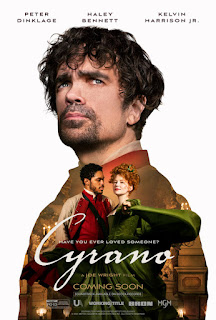

            Cyrano is a musical in which a princess, Roxanne (Bennett), is pining for love, to which her lady in waiting argues that “Love doesn’t last; what lasts is compromise and sacrifice.”  (She means that Roxanne should be looking out for her economic welfare over love considerations), which goes right over the beautiful young woman’s head.  Roxanne (Bennett) sings back that she never wants to marry unless she can find someone to love.  Her current suitor, the Duke De Guiche (Mendelsohn) could indeed be her future, but Roxanne loathes him, and only sees him for what she can get from him (e.g., theater tickets).

            What Roxanne doesn’t know is that her friend since childhood, Cyrano (Dinklage), has always loved her, but thinks that she will simply laugh at him for thinking she could fall in love with such a short man.  The story develops from there, such that the man Roxanne is attracted to (from just a glance) is Christian (Harrison), a handsome guard under Cyrano’s command.  The two exchange one glance from afar and both literally fall in love at first sight (or so it seems).

            When Roxanne confesses to her friend Cyrano her love for Christian, who has just been recruited into the guard, she begs Cyrano to mentor and protect her love.  Since he cannot deny Roxanne anything, he promises to do so, which puts him into a serious bind between his own interest and what he has promised.  This bind leads to his writing love letters for Christian to send as his own to Roxanne.

            It was serendipity that scheduled Houston critics to see Spielberg’s West Side Story the night before Cyrano, giving us the opportunity to contrast the two love stories.  And what a difference; where West Side Story, despite its performance value (and my usual admiration for Spielberg), seemed to me to be a tiresome, dated, story of machismo, Joe Wright’s Cyrano makes an elegiac tribute to a man in an older period piece (17th Century), for whom compromise and sacrifice become very real to him, despite his acclaimed swordsmanship.

            Sprinkled throughout the drama are bits of humor (Cyrano’s claim that “Halloween is my favorite holiday” after he has been called a freak, statements like “Her imperfections are perfect”), insightful observations (a narcissistic young woman singing, “I need more”), the non-glorification of fighting—even in the case of war), and demonstrations of true love (seen in Cyrano’s letters, soldiers’ letters home, and the final scene).

            Screenwriter Erica Schmidt is the one who took a different view of Cyrano the character by focusing not on his nose, but making him a dwarf mocked for his stature, and one who believes no woman could love him as he is.  (There is tenderness in this concept in that Schmidt is married to Dinklage, and she wrote the part specifically for him.)

            Peter Dinklage has long been one of my favorite actors, and it is high time he gets an Academy award for his performance as lead in a major motion picture.  He has numerous other awards to count, but I think it’s time his nominations and awards for “Most Promising Actor” in The Station Agent (2004) and supporting actor for Game of Thrones and Three Billboards Outside Ebbing, Missouri  be followed up with more than a nod from the Academy—for his acting.  Admittedly, singing is not his strong suit, but his resonant bass still pleases.

            Joe Wright’s previous films (e.g., Pride and Prejudice, Atonement, Darkest Hour) are testament to his talent in the art and craft of filmmaking.  Elements contributing to his success in Cyrano include Aaron and Bryce Dessner’s music, Seamus McGarvey’s cinematography, and Sarah Greenwood’s production design, some of whom have collaborated with Wright on other projects.


Cyrano, with the swagger and expert swordplay of Tyrion (Dinklage) in Game of Thrones has a much bigger heart and compassion to go with his more macho qualities.  He is a truly admirable soldier in this production, but as skilled in the art of language as he is in wielding a sword.


Grade:  A                              By Donna R. Copeland

Monday, November 13, 2017

THREE BILLBOARDS OUTSIDE EBBING, MISSOURI

Frances McDormand     Woody Harrelson     Sam Rockwell     Lucas Hedges     Peter Dinklage     John Hawkes


     The wistful opening song (“The Last Rose of Summer”) previews the emotional tone underpinning this story, even though comedy and drama emerge time and again throughout.  Seven months before, Mildred’s (McDormand) teenage daughter was raped and killed, and as time goes on and no arrests are made, Mildred—never one to shrink from conflict—starts to agitate for more action from the police, specifically Sheriff Willoughby (Harrelson).  He responds to her respectfully, explaining why, and he sounds reasonable; but Mildred is not to be mollified.  To make her case a public issue, she buys space on three billboards outside of town to post this message:  “Raped while dying.  And still no arrests.  How come, Chief Willoughby?” 
     With this action, writer/director Martin McDonagh (In Bruges, Seven Psychopaths) gives us a window into Smalltown, USA, and how politics often work there.  And this is one where the Chief of Police is really conscientious, a mensch.  Not so much one of his officers, Jason Dixon (Rockwell), who has a huge chip on his shoulder, is unapologetic about his racist views, and has no trouble bending the law to suit himself.  Sheriff Willoughby has a challenge in mentoring him in his wish to become a detective. 
     When Mildred singles Willoughby out for her rage, she riles up most of the town folk who are already feeling sympathy for him because word has gotten out that he has cancer.  Some of the truths McDormand is illustrating is that the general public’s memory is short (seven months has made them “forget” the murder); few understand the depth of grief following the loss of a child (the very worst thing to happen to people and something that keeps going on across time), particularly when guilt is involved; and still the genuine caring and protectiveness seen when some in the community understand the issues and act accordingly.  McDonagh shows all these complexities with sensitivity and an even hand. 
     How does an Irishman get to know this?  McDonagh talks about taking bus rides around the U.S., visiting small towns, and acquainting himself with the people who lived there (Interview on Charlie Rose, 11/9/17 on PBS).  He saw a billboard in one place that first stimulated his thoughts about making this film.  In addition, McDonagh brings his own sensibilities to his dramas; in this case, showing characters in such depth, we see their strengths and weaknesses in equal measure.  And he goes further in showing redemptive experiences, where his characters actually acquire some insight and valiantly try to make positive changes. 
     McDonagh chose his cast carefully and well.  From the beginning, he knew he wanted McDormand, Harrelson, and Rockwell; and do they all shine.  McDormand is a shoo-in for award nominations for her performance here (previous wins have been an Oscar for Fargo, a Golden Globe for Olive Kitteridge, and Independent Spirit Awards for Friends with Money and Fargo), and her work has been consistently top-notch.  Rockwell deserves supporting role awards for his Dixon, whom he manages to make you hate in the beginning, and then have some sympathy for when he at least partially redeems himself.  Harrelson may not be considered for an award this year for this film, but he lends his expert rendition of a character with good judgment for whom we have great sympathy.  He, McDormand, and     Rockwell are all good for the high comedic moments as well as the drama in this film.
     McDonagh’s collaborators in music (Carter Burwell) and cinematography (Ben Davis) help make this film the artistic triumph it is.

A film likely to be on the award circuit when the time comes.

Grade:  A                                    By Donna R. Copeland

Wednesday, April 6, 2016

THE BOSS

Melissa McCarthy   Kristen Bell   Peter Dinklage   Kathy Bates   
Cecily Strong   Kristen Schaal   Ben Falcone


        The Boss is typical Melissa McCarthy fare (Bridesmaids, This is 40, Identity Thief, Tammy), and if you like those films, you will like this one.  I see her role in Spy (written and directed by Paul Feig) as one that shows her more serious acting abilities, and the direction I wish she would go in her career.  McCarthy has considerable acting talent, and I think it’s time for her to part with the slapstick persona she is known for and get serious.  She is one of those interesting women who are heavy, but beautiful and talented.  The reason I liked Spy so much is that Feig showed a blended, more complex character, with smarts overriding klutz.
     The story in this film is that Michelle Darnell (McCarthy) is a highly successful businesswoman who grew up as a foster child—one that was returned surreptitiously to the orphanage numerous times—and now has a chip on her shoulder and determined to “make it”, no matter the cost.  And she does, but along the way she allies with “Renault” (Dinklage), her “twin” in business practices (win, whatever it takes) and sometimes lover.
          When he feels betrayed by her, he gets her charged with inside trading (the reference to Martha Stewart is explicit), and while she is in prison sees that her company goes bankrupt.  When she is released from prison, she has to completely start over, and relies on her previous assistant Claire (Bell)—whom she treated very badly—to reenter society. 
      This story is very much about sociopathy—essentially using other people (in the negative sense of the word) for one’s own narcissistic needs.  So Michelle blithely barges in on Claire and her daughter, co-opts the child’s Girl Scout cookie project to form a competing organization, all in the guise of being more generous to children than the Girl Scouts.  But Michelle’s rival, Renault (Ron, really, since he is from Brooklyn) is still seething and out to get her again.
        I won’t tell you how this turns out because I don’t need to; I’m sure you’ve already guessed.  But if you enjoy these kinds of comedies, then it will be to your taste.
         I object to this kind of movie on a number of fronts.  First, it wastes so much talent (the cast is truly fine in every respect) on a story with so much potential for substance.  Second, it models really bad behaviors too numerous to list and treats them as comedic material.  Do we really want to laugh at corporate misconduct, exploitation of employees and children, and physical altercations (note that when men fight, it is admired or at least exhilarating; when women do it, it’s comedic or even sexually titillating for some).  Well, despite the considerable talent—and the obvious enjoyment by many in the screening audience—I have to give this film a thumbs-down.

Typical Melissa McCarthy fare, in which bad business practices are presented as comedy by a very talented cast.

Grade:  D+                        By Donna R. Copeland