Showing posts with label Timothee Chalamet. Show all posts

Wednesday, December 8, 2021

DON'T LOOK UP

 Leonardo DiCaprio     Jennifer Lawrence     Rob Morgan     Jonah Hill     Mark Rylance

Tyler Perry     Timothee Chalamet     Cate Blanchett     Meryl Streep     Ron Perlman
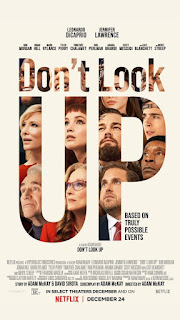


            In the beginning when astronomer Dr. Randall Mindy (DiCaprio) and his graduate student Kate (Lawrence) first discover a “planet destroying comet” headed for Earth they attempt to inform the proper authorities and American people that the country has only six months to get ready for it.  They’re wanting everyone to look up and see the moving light with a tail and understand it is coming our way.  The movie gets its title from those not wanting to accept that a comet is on its way and very dangerous; when it appears to the naked eye in the sky some advise others, “Don’t look up.”

         Well, the movie is a very funny parody about our political times, shining its light on climate change deniers, right-wingers, Fox News, the media’s exploitation of trivialities and current pop interests over serious news, and prominent Republicans who have their own ethics and their own interests at heart.  Topping the list is the President (Streep) with long blonde hair and a primary interest in getting re-elected [her empty-headed son Jason (Hill) serves as her Chief of Staff].  As expected, the President and her “scientific” appointees want to keep the news quiet and just “sit on it” for a while (i.e., until after the mid-terms).  DiCaprio has observed that “Adam [McKay] has woven an incredibly timely message about society, how we communicate, our current priorities, and the climate crisis into an absurdly funny yet important movie."  https://www.elle.com/culture/movies-tv/a37512771/dont-look-up-news-cast-spoilers-date/

       Upon hearing the news, the administration’s reaction and its influence spreads and influences those who similarly want to ignore science and scientists, ridicule them, and even become very nasty toward them on social media. The two scientists’ media advisors tell them to “keep it simple—no math”, to which Dr. Mindy replies, “But it is math!” Clearly, because he is a male and speaks a language many can’t/won’t understand, Dr. Mindy is made a darling; whereas Kate—younger, more articulate in plain language and more in touch with her emotions—becomes a pariah.  And gets arrested by the FBI more than once.

            Even the sexual boundary issues are brought into play, with a sensuous “Daily Rip” TV show host, Brie (Blanchett) seducing Randall and promoting him so long as he does her bidding.  (Her show with co-host, Jack Bremmer (Perry) is clearly a reference to “Fox and Friends” on Fox News.)   In Kate’s circle, the men are aware of the Me Too movement, such as one asking politely if he may touch Kate’s hair in a “nonsexual manner.”  These are anti-war anti-violence protesters who are gentle and respectful of women.  (The currently adored Chalamet plays one of them.)  

            The cast is huge and full of some of our best actors who are at the top of their game.  DiCaprio is almost unrecognizable in his slightly befuddled scientist mode.  It’s good to see Jennifer Lawrence back in action after a brief hiatus, and she plays the fiery young scientist most convincingly.  It’s too bad the writers had both scientists becoming uncharacteristically (for scientists) hysterical and verbally combative at times.  It undermined their believability in a significant way.

            A scene-stealer is Mark Rylance in his most surprising role:  that of an owner of a tech (phone) company who sees himself as a scientist because his company uses algorithms.  He comes across as an odd kind of person, but is a large donor to President Orlean’s campaign, so has her ear.  He convinces her of his alternative plan to deal with the comet, and we see how that works out.

            Entertaining is Ariana Grande’s performance as a pop star whose love life steals away the public’s attention from the impending danger to the outcome of her current romance.  It’s still another comment about the current attention span and the public’s and media’s focus on their idols.  Other actors who should be acknowledged are Rob Morgan as a Black scientist and Ron Perlman as the Administration’s willing sacrificial lamb (who didn’t have to serve when the mission he was on was aborted) but who nevertheless saw himself as a fighter and a hero.

            Adam McKay has had a significant role in movie productions including The Big Short and Vice, and the current TV series “Succession”, but Don’t Look Up seems to be a major shift into satirical parody.  He clearly has his finger on the times, and doesn’t mind at all skewering others when apt.  This is a “feel good” movie for those of us more politically liberal and concerned about the future of our democracy.  It describes so well the world we live in with all its puzzlements and outrageous people and behaviors.

            Don’t Look Up refers to the time when the deniers are the most desperate in wanting people to deny reality.


Don’t Look Up:  A must-see for everyone now living in a most perplexing age as far as people are concerned, but where science is concerned everything is quite clear.


Grade:  A-                             By Donna R. Copeland

Thursday, October 28, 2021

THE FRENCH DISPATCH

 Benecio del Toro     Adrien Brody     Tilda Swinton     Lea Seydoux     Frances McDormand     Timothee Chalamet

Jeffrey Wright     Bill Murray     Owen Wilson     Bob Balaban     Henry Winkler


            Wes Anderson’s stamp (wry humor, meaningful free association, characters in caricature, intrigue/mystery, curiosity, folksy drama, to name a few) is all over The French Dispatch, a group of stories about a Frenchified newspaper in Lawrence Kansas with that name owned by Arthur Howitzer, Jr., after his father, the founder of the publication died.  The first scenes of what look like a painting of a French village are captivating for both their artistry and the action figures that move within them.  The pictures represent the town of Ennui (pun intended), which has endured all kinds of crises during its existence.  We get to hear about some of those in this fanciful production.

            Another Anderson stamp is his continuing to engage actors and crew from his previous movies.  It gets to be another fun part of watching one of his films—identifying all the scores of actors who have appeared in his previous works.  Anderson puts them in completely different roles from what you would expect.  For instance, Tilda Swinton as an art curator is made up to look strikingly like Sofia Loren.  Well-known artists like cinematographer Robert D. Young and musician Alexandre Desplat are likewise regulars, playing essential roles in conveying the experiences Anderson wants you to have when viewing his films.

            The French Dispatch will not be to everyone’s taste, even for those who are fans.  Unlike his previous films, there seems to be no overarching point to this one.  It’s more like one where you just sit back and enjoy hundreds of moments in time with interesting people and situations that will somehow be recognizable to everyone.  The dialog is so sharp and fast-moving, I wished I had had a script in front of me or already read one where I could stop and savor the import of every scene.  It all goes by very fast.

            It’s curious at times to observe the dominance of women in this production.  Lea Seydoux does an exquisite rendition of a model/guard/dominatrix of an artist named Moses Rosenthal (Benecio del Toro), who is in prison for murder.  (Think of all the associations it took to come up with that image.)  Moreover, older women like Upshur ‘Maw’ Champette (Lois Smith) appear in decision-making scenes, and Lucinda Krementa (McDormand), a middle-aged writer for the Dispatch is shown in bed with young student activist Zeffirelli (Chalamet).  These encounters—like all others—are presented as droll pictures of a normal world.

            When Anderson seems to be spoofing or even criticizing things is not always clear.  For instance, he often shows characters smoking.  Now, Anderson does not smoke and thinks it’s bad for people, but he says, “It looks good on film.”  That is frequently seen in this movie, and, true, it often looks good; but there are also instances where he seems to be making some kind of point, say, about student protests or government agencies.  Maybe he’s leaving it up to the viewer to make up his/her own mind.

            As much as I love Wed Anderson films, I doubt this one will be a blockbuster.  I certainly enjoyed it and would like to see it again—maybe even read the script—but it is likely not to appeal to all Anderson fans, and certainly not to the general public.  


A quirky Wes Anderson film with a collection of stories that will only be savored by some.


Grade:  B                              By Donna R. Copeland


Thursday, October 21, 2021

DUNE

Timothee Chalamet     Rebecca Ferguson     Oscar Isaac     Zendaya     Jason Momoa

Stellen Skarsgard     Stephen McKinley Henderson     Javier Bardem     Chen Chang

Sharon Duncan-Brewster     Dave Bautista     Charlotte Rampling

            I would say it’s just glorious to be enthralled by the sensory extravaganza that Dune presents.  The vistas and patterns of shimmering sand in the desert (Greig Fraser, Cinematographer), the elegance of the aircraft, the fascinating production design (Patrice Vermette), the eeriness of the music (Hans Zimmer) and sound effects—Denis Villeneuve and his collaborating filmmakers mesh together so well, the film is like a living tapestry that is spellbinding.  

            And the cast!  Beginning with Chalamet as an ideal Paul Atreides, a duke’s son trained in a comprehensive framework of arms, politics and government, and prophecy.  His eyes, his bearing, his obvious sincerity all convey a special person—let alone his handsome looks.  All the casting choices are spot on.  We get Oscar Isaac as Paul’s father and Duke of Atreides cynically awarded a planet in the Imperium by jealous calculating emperor Shaddam.  He portrays nobility and a genuine sense of fairness in the universe. Rebecca Ferguson as Paul’s mother sees that he is physically/mentally/emotionally prepared for an expected destiny.  She demonstrates the power of the Bene Gesserit sisterhood which is intimidating physically and emotionally and keenly perceptive.  Jason Momoa as Duncan the Atreides’ swordmaster, Josh Brolin as the Atreides’ weapons expert, and Javier Bardem as Stilgar the leader of the desert Fremen all demonstrate their characters’ particular skills and their mentoring attachment to Paul.  Sharon Duncan-Brewster as the ecology-aware Dr. Liet Kynes; and Charlotte Rampling as the Reverend Mother Mohiam, from the exclusive sisterhood Bene Gesserit aptly fill out a stellar cast.  In a departure from the book, Dr. Kynes (played by Sharon Duncan-Brewster) is a female, presumably a nod to contemporary times.

            For those not familiar with the story, the universe consists of a number of planets, each with its own head.  Over all is the emperor of the conglomerate, the Imperium, which has a huge army, the Sardauker.  In the mix is the planet Arrakis, which is extremely valuable for its “spice” found in the sands of its desert.  This spice, mélange, promotes youth, vitality, and lifespan, is a valuable resource.  Planet Harkonnen has held its sway on Arrakis for years, exploiting the crop of spice for its own benefit, along with cooking the books to favor itself.  Now, the emperor is not only worried about his revenue from this planet, but he is jealous of Lord Atreides of Caladan.  

            Thinking he will win by pitting the two against each other, the emperor appoints Lord Atreides to the Arrakis planet in direct opposition to Harkonnen.  (The fact that he will eventually favor Harkonnen over Atreides is part of the story.)  But he hasn’t taken into account the Atreides’ humanitarian bent.  The Duke is committed to good governance, which includes diplomatically engaging the Fremen, masters of the desert, whom the Harkonnens have mistreated.

            This account of Dune ends with Paul and his mother Lady Jessica being rescued from the desert by the Fremen who are wondering if he is their messiah.  This is Villeneuve’s Part One; Part Two is planned for a later release.


Thrill to the story of interplanetary competition mixed in with mystical realism in an epochal battle for the good.


Grade:  A                              By Donna R. Copeland 


Thursday, October 1, 2020

A RAINY DAY IN NEW YORK

Timothee Chalamet     Elle Fanning     Liev Schreiber     Jude Law     Diego Luna

Selena Gomez     Rebecca Hall     Cherry Jones

     Completely fanciful.  Woody Allen’s latest film comes straight from his brain—probably on a rainy day in New York.  In the beginning, the dialog, the music, Chalamet’s character—everything is so enigmatic of the creator that it’s hard to put Woody out of the story.  And he still stays for much of the story, but as it gets more and more madcap, he recedes a little bit.

     Two upstate New York college students are off to New York City for her, a budding journalist, to interview a well-known filmmaker about his latest film for the college newspaper.  She is definitely star-struck, and he is simply excited about going back to his hometown to revisit places like MOMA, the Carlton, Restaurant Daniel, and his favorite piano bars.  Allen seems well aware of males in such situations to make her trip his trip.  They head out, happily in love; he greeting the rainy weather as a welcome friend and romantic opportunity.  (One of the things I found hilarious about the movie is the constant rain and characters’ different reactions to it.)

     The differences in their expectations make up the heart of the movie.  Very soon after they arrive, Ashleigh (Fanning) and Gatsby (intended reference), played by Chalamet, are on very different arcs of experience.  As evidence(?) of her southwestern U.S. routes, she is carried along by people she’s impressed with, with little will of her own.  He, being the cosmopolitan New Yorker, is constantly thrown to his own devices, which is de rigueur for him, and he orchestrates his own way, keeping a well balanced eye on who he is.  She loses herself completely in situations; he is constantly aware of who he is wherever he is, even when new experiences come his way.

     Ashleigh confronts a famous film director’s (Schreiber) existential crisis, his writer’s (Law) dealing with marital infidelity, and a film idol’s (Luna) disingenuous flirtation.  Actually, they’re all smitten with Ashleigh—I suppose, to make a point in that it’s almost a cliché now.  She embodies that wish that they all have of a young, beautiful woman who’s always sympathetic and adoring.

     On the other hand, Gatsby deals with not being adored all the time, having to interact with an ex-girlfriend’s little sister (Gomez) who is clearly not impressed with him and apprises him of her sister’s low ratings of him.  When he ends up having to attend his mother’s (marvelous Jones, as you’ve never seen her) hated society bash and he has a real conversation with her, the film gets down to the bottom line of what I think it’s about—which is, biases that separate people on trivial grounds and the importance of going beyond the apparent and digging deeper into situations and people.

     Woody Allen is one of our most gifted filmmakers who is able to attract the best actors, keep his Oscar-winning cinematographer Vittorio Storaro (too many awards to name) on board, and provide music that captures every moment of every scene.  Artistry abounds in every component of his films.  Yet, something has happened that A Rainy Day in New York is met with only mediocre ratings by critics.

     Maybe it’s too much Woody?  His genes are in the story from start to finish, to be sure, and this starts to feel like a tired joke.  And much of the action recalls too many of his previous works.       This is all true.  Beyond that, my personal reaction was against his casting a woman from Arizona as stereotypically naïve/uninformed/rather stupid. Numerous jokes about non-New York people were made as if anyone outside New York City is naïve at best and uneducated and uncouth at worst—all reflecting the old joke that New Yorkers don’t recognize anything beyond its borders.   


Ya have to be a Woody Allen fan to enjoy this movie; otherwise, you may be nonplussed unimpressed, or even offended.


Grade:  C+                                    By Donna R. Copeland


Tuesday, December 24, 2019

LITTLE WOMEN

Saoirse Ronan     Emma Watson     Florence Pugh     Eliza Scanlon     Laura Dern
Timothee Chalamet     Tracy Letts     Bob Odenkirk     Chris Cooper     James Norton     Meryl Streep


     Greta Gerwig updates this traditional story based on Louisa May Alcott’s book for girls by emphasizing the March girls’ ambitions, particularly those that depart from the standard get-married-have children tale.  Most notable are the lines inspired by Gerwig’s conversation with Meryl Streep, who plays Aunt March in the film, during first conceptualizations of the film.  The lines are spoken by Amy March (Pugh), the youngest sister, complaining about women not having rights—they can’t own anything; if they leave a marriage, even property they had before marriage, even their children, would belong to the husband.
     Much of the film, however, adheres to Alcott’s novels.  Four sisters are being brought up by their mother while their father is serving as a chaplain during the Civil War.  Marmee (Hurd) is a strong female model for them, managing—with the help of the two older daughters Jo (Ronan) and Meg (Watson)—financially, and beyond that, instilling strong values (helping the sick and the poor, with a strong commitment to forgiveness) in her daughters.  
     The family reflects the temper of the times, particularly where women are concerned. What makes the story most interesting are the differences in personality and temperament among the four sisters, and how these play out with family and friends.  Jo departs most from the norm by pursuing independence at almost any cost, Meg by marrying for love over “prospects”, Beth (Scanlon) by her musical ability, and artistic Amy at first by her self-entitlement and later by her practicality. 
     A bonus in this rendition of Little Women comes at the end when Jo is clearly taking charge of her career by cannily negotiating with the editor Mr. Dashwood (Letts) on a cash advancement, copyright, and share of the profits.  (Although she does have to make one major compromise so that the story ending will sell.)
     Yorick Le Saux’s cinematography with its warm, bright palette and vividness of interior and outside scenes contributes majorly to the production, helping to give it soul, along with the pleasant, era-capturing score of Alexandre Desplat. Saoirse Ronan’s performance is exemplary, attaining the promise of her work in HannaBrooklyn, and Atonement, and being a major force in capturing our attention.  She is well supported by Emma Watson, Florence Pugh, Eliza Scanlen, and Laura Dern as sisters and mother.  As love interest to more than one sister, Timothee Chalamet glitters as an honorable heartthrob not just for the sisters, but for some audience members as well.  It is a treat to see Tracy Letts playing the discerning publisher with a soft heart, following on his bombastic performance as Ford in Ford v Ferrari. Likewise, seeing Chris Cooper as a benevolent, wealthy Mr. Laurence after the revolting father he played in A Beautiful Day in the Neighborhood is refreshing.  Finally, Meryl Streep proves her value once again in playing a rich dowager who is bound to the past.
     Perhaps because I personally was never an impassioned devotee of Little Women, I’m not enthralled with Greta Gerwig’s remake of the classical tale.  Interesting and entertaining as it is, it makes me question remakes in general. That is, this tale has been told on stage, on television, and in film almost continuously since 1933.  This version, although set in the 19thcentury, is meant to capture the sentiments of today.  And it does, with flair to a great extent.  I just have a problem with telling a story already well told.

19thCentury women being little women—already a tale well told.

Grade:  B                        By Donna R. Copeland


Thursday, October 31, 2019

THE KING

Timothee Chalamet     Joel Edgerton     Robert Pattinson     Ben Mendelsohn     Thomasin McKenzie    Lily-Rose Depp


     The King presents an interesting picture of King Henry V of England I in the early part of the 15thCentury.  The script, co-written by Joel Edgerton and director David Michod, draws some from history, more from Shakespeare’s plays, Henry IV and Henry V, and then elaborates on all sources.  The viewer should regard it as primarily a dramatization only loosely drawn from history and Shakespeare.
     As it turns out, the filmmakers have rewritten their sources to create a story about a “reluctant prince” who has major conflicts with his father, King Henry IV (Mendelsohn) about the constant wars the father has waged.  Henry V (Chalamet) is presented first as a playboy who has no desire to be a king, and doesn’t even want to attend to his ailing father. 
     It’s a bit of a stretch that such a person could suddenly turn into an admirable figure as he does in the film, but that’s the drama of it.  After the sudden change, Henry is shown to be a skilled and ferocious opponent in swordplay, a man who is astute and listens carefully to arguments presented to him, and makes shrewd decisions based upon his deductions.  He is not susceptible to indignations purposed upon him by others; he can take decisive, even ruthless, action when he suspects someone is lying or outright betraying him; and he keeps a cool head in negotiations with opponents.  Of course, he is also very handsome and appealing.
     The way Henry V becomes king is his take-charge stance after his father has chosen second son Thomas as his successor, someone who seems not to be a match for his brother, either intellectually or physically.  Henry tries to save him and avoid another war, but Thomas is recalcitrant, and after a series of events and time, the reluctant Henry becomes king.
     The rest of the story is about Henry’s being drawn into war, despite all his efforts against it, his need to identify those around him he can trust, and resorting to finding his old friend and caretaker John Falstaff (Edgerton) to be his primary advisor and strategist (especially in war) and supporter.
     The French don’t come across very well in this story; both the dauphin (Pattinson) and his father, King Charles VI, are disdainful and insolent toward Henry, refusing to go along with the ways he presents to avoid war.  Although they are partially redeemed by their eloquent--rather audacious—princess Catherine (Depp) who stands up to Henry in a very entertaining contretemps.  
     The craft of The King is admirable in Michod’s direction, the music (Nicholas Britell) and the cinematography (Adam Arkapaw), and the actors capture their roles well for the most part, especially Chalamet, Edgerton, McKenzie, and Depp.  Editing (Peter Sciberras) can be faulted for extending the battle scene far too long in a movie that is already over two hours in length. The scenes are effective in showing the bloodiness, muck, and brutality, but become tiring halfway through.
     I liked the Michod and Edgerton’s elaboration on historical events to present a character who is admirable in so many ways, trying to achieve peaceful resolutions, but mindful of counteracting forces.  This Henry V is someone we can admire, but viewers should not go with the expectation of seeing a production up to the level of a play by Shakespeare.

Henry V is an entertaining take-off of Shakespeare’s version, this one having a message of peace and the value of unity.

Grade:  C+                                                By Donna R Copeland

Monday, October 29, 2018

BEAUTIFUL BOY

Steve Carell     Timothee Chalamet     Maura Tierney     Amy Ryan


     And he apparently was a beautiful boy when he was younger, but as the doctors point out, crystal meth does things to your brain.  One of the things, of course, is addiction.  Nic (Chalamet) is engaging and attractive, and likes to have fun with his younger half-siblings.  He makes good grades, and is optimistic about his educational future.  He has a very close relationship with his father David (Carell), and their family is financially well off.  Nic’s stepmother Karen (Tierney) has doted on him from the beginning. There is no lack of love in this family.  So…what could go wrong?  
     This film is excellent in showing the ravages of drug addiction across a family, even when everything else is about perfect.  It’s an important point today when addiction is such a major problem, and this film is meant to show that it can happen to any family, even those who are strong in every way.  The stereotype of drug addiction is of a disadvantaged, racial minority; but now, it seems to have invaded diverse groups of people in the U.S.
    Beautiful Boy is the story of a gifted boy who, for some unexplainable reason, gets involved in drugs.  In Terry Gross interviews (NPR’s “Fresh Air”) with the actual father and son, whose memoirs form the basis for the film, a physician explained that some people’s brains are more susceptible to addiction and its effects, particularly teenagers, whose brains are still developing. Perhaps that accounts for what happens to Nic.
     In short, he is in and out of drug use and rehabilitation, and this goes on for years (from age 17 to 23).  There are desperate calls usually to his father, episodic good times with his family, starts and stops with college, and the gradual wearing down of them all. In addition to their own let-down feelings, David and Karen have to deal with the disappointments of their children when Nic doesn’t show up for special events or leaves abruptly from family gatherings or pilfers cash and sellable items.  Nic’s biological mother Vicki (Ryan) is brought in to help at one point, but it becomes clear that it will take some kind of resolve on Nic’s own part to get his life back on track.
     Carell’s performance as an understanding, patient father is commendable for his capturing the angst, love, and bewilderment that a father undergoes in these circumstances.  The supporting figures Maura Tierney and Amy Ryan are likewise strong in their roles.  Chalamet, who has become almost an iconic symbol of a physically attractive, sensitive young man, takes on the depleted, desperate look and demeanor of a drug addict (losing 25 lbs. to prepare) just to the point where you will still be sympathetic toward him. He is an actor with a great future ahead.
     Despite its high quality of filmmaking, Beautiful Boy may not make it to awards season.  I attribute that primarily to the subject, which is depressing indeed—not excitingly dark—but simply depressing.  I applaud the filmmakers for capturing the addiction experience so well, it almost looks like a documentary.

A profoundly emotional—and realistic—account of drug addiction and its far-reaching effects.

Grade:  B                                    By Donna R. Copeland