Showing posts with label Janelle Monae. Show all posts

Thursday, October 15, 2020

DAVID BYRNE'S AMERICAN UTOPIA


     This is a (truly) feel-good musical.  It’s David Byrne’s way of playing a small part in bringing together a country fractured by politics, the pandemic, and social unrest.  The production is beautifully done, blending together meaningful lyrics, interesting music with ear-catching sound effects, choreography by Annie-B Parson that resembles a kaleidoscope, sophisticated production design by Alex Timbers and a rhapsodic spirit.  It’s so creative throughout, the time flashes by as you try to soak in all the elements.  

     All this is with the backdrop of muted colors—mostly shades of gray—and everyone barefoot.  Aptly, it shows children’s drawings first (going back to our roots), then David Byrne holds up one of those brain models you’ve probably only seen in college classes.  He points out the part that survives even when it is disconnected from the other parts, and highlights those parts that provide clarity or confusion, parts that process sound, and those related to hallucinations.  He observes that babies’ brains have millions of connections, but as we grow, only those that are meaningful to our experience remain, that place where the world makes sense. He will come back to referencing the ethos of America and our ways of changing and making sense of life as the show goes on.

     In his songs, David Byrne attends to the universal experiences of loneliness, awkwardness, feelings of not belonging, love for people, aspirations, senselessness, displacement, violence, and much more.  He has songs about the experience of soaring along and then suddenly wondering, “How did I get here?”  And afterwards, realizations that “it’s the same as it ever was.”  So…what are we to do? His answer has to do with valuing other people, dancing, being sensitive to what is around us, and being alert to possible dangers.  

     There is a topical, very moving number toward the end—Janelle Monae’s “Hell You Talmabout”, in which the singers repeat the names of blacks Emmet Till (1955), Eric Garner (2014) and others more recently killed at the hands of the police. But many oldie favorites of Byrne’s songs are sprinkled throughout.

     American Utopia is a beautiful collaboration between Spike Lee and David Byrne in converting Byrne’s Broadway stage show (which had to stop performing live when the pandemic hit) into a movie whose songs—some old, some new—continue to resound in your brain long after the ending.  The same happens with the many different moods brought up by the production.


A musical rare in its encompassing so many elements of human existence, particularly in these troubling times, ultimately leading to a sense of healing and peace.


Grade:  A                                    By Donna R. Copeland

Wednesday, September 30, 2020

THE GLORIAS

Alicia Vikander    Julianne Moore    Timothy Hutton    Lulu Wilson    Ryan Kiera Armstrong

Janelle Monae     Bette Midler     Lorraine Tousaint


     “You will do what you want to do with your life.”  Words so aptly spoken to Gloria Steinem by a wise doctor getting a solemn promise from her.  This film of Gloria Steinem’s life—drawn from her memoir, My Life on the Road--constitutes one of the more artistic renditions of a famous person’s life.  Julie Taymor, writer/director/producer, is as interested in portraying the essence of the woman as she is in presenting factual information.  Toward that end, she flips back and forth in time, showing Gloria as a younger child, an older child, a young woman, and a fully developed activist for human rights.  During the film, these different “Glorias” talk to one another, illustrating how we carry our different ages and memories along with us throughout our life span.  So the film moves back and forth in time—which usually annoys me—but the way it is shown here makes sense.

     Taymor shows Gloria growing up in a family of modest means, the child adoring her fantasy-loving father (Timothy Hutton), who follows his own dreams, leaving her and her older sister—but primarily Gloria—to assume responsibility for a mentally disturbed mother.  This woman, despite her weaknesses, saw to it that her daughter was able to attend the renowned Smith College from where she graduated with honors.

     The film shows the young woman’s encounters as she makes her way in journalism—sometimes having to take time out for supporting herself by dancing—but showing her ability to withstand easy, compromising paths while being attuned to the important issues of the day (e.g., racism, labor unions, reproductive rights), and demonstrating her capacity for empathy and nurturance.  

At a time when women were discouraged from speaking their minds, Gloria asserted herself, and despite an almost debilitating fear of speaking in public, managed to overcome it to advocate for principles she felt strongly about. Although she is known primarily for her work in women’s interests, she also championed causes for blacks, farm workers, and Native Americans.  

     Taymor has fun with filmmaking when about half-way through the story, she inserts a sequence of pure fantasy, visualizing what she would like to see happen to a chauvinist interviewer who asks Gloria inappropriate questions.  (We see him spun out into space in a red cloudburst.)

     But on a more serious note, the film is timely in its release just after the death of Supreme Court Judge Ruth Bader Ginsburg, who had to endure discrimination at Harvard University when she was attending as a woman.  When Harvard invited Gloria to speak there years later, she was able to scold them in a way that actually won points for her, despite her chiding the professors for claiming that rape was a very small assault and for their course list omitting any reference to women.

     The four extremely effective actors (the four Glorias, Lulu Wilson, Ryan Kiera Armstrong, Alicia Vikander, and Julianne Moore) are superb, and helped along majorly by Lorraine Tousaint’s Flo Kennedy, Janelle Monae’s Dorothy Pitman Hughes, Timothy Hutton’s Leo Steinem, and Bette Midler’s Bella Abzug.

            I found The Glorias to be maximally entertaining as well as informative and inspiring in its depiction of the “notorious” Gloria Steinem. THE GLORIAS is available for purchase on Digital and Streaming exclusively on Prime Video starting September 30th


Walk on the wild side with an endearing “rabble rouser” as you see her fight for human rights.


Grade:  A                                    By Donna R. Copeland


Thursday, October 31, 2019

HARRIET

Cynthia Erivo     Leslie Odom, Jr.     Janelle Monae     Joe Alwyn     Jennifer Nettles     Clarke Peters


     This story about the American hero, Harriet Tubman, who risked her life many times, first to save herself, then to save others, is a sobering account.  Its strength—not a singular one—is in showing how despicable slavery is to the human body and soul and the strength and assertiveness of one woman in rebelliously going against a whole society in her efforts to free slaves.
     The movie begins showing Harriet as a young woman married to a free man.  It becomes apparent to her when the prospect of being sold arises, that there is a way out, and she’s ready to take that step (literally, a “Give me liberty or give me death” move). Leaving her reluctant husband behind, she runs, swims, gets surreptitious help along the way, and somehow manages to get 100 miles north of her home in Maryland. Although she can’t read, she’s very good at following directions and locating people she is told will help her.  That is when she is directed to and reaches an organization in Philadelphia that runs the Underground Railroad.  
     Not content to make a life of her own at that point, Tubman continues to return home to help family members escape.  Her first trip to bring her husband with her results in some disappointing news, but she is able to rescue other family members.  She develops such a passion for freedom, she continues to help people get to the underground railroad, soon being named a “conductor” among the abolitionists.
     Cynthia Erivo is exemplary as Tubman, and I don’t know if the real Tubman sang, but when Erivo belts out a song at meaningful times, her voice is beautiful. Strong support is lent by Leslie Odom, Jr. as a major abolitionist for the Underground Railroad and Janelle Monae in a cameo role, as an ally who helps Tubman present herself as a free woman.  Also strong in a ferocious way is Joe Alwyn, as the slave owner’s son, who has loving memories of Tubman caring for him when he was gravely ill, but has self-entitlement so ingrained it gives him more impetus to catch her, with the aim of …you can guess.
     I kept feeling like I should like this film better than I did.  It was depressing, as tales of slavery always are and that’s understandable, but when evil or heroism are being portrayed, it lacks the “zip’ that would make it a moving experience.  This may be attributed to Kasi Lemmons’ direction along with the editing by Wyatt Smith.  Two other detractions related to implausibility are the depictions of Tubman’s visions, which I found hard to believe, and a scene in which Alwyn could have easily picked up his gun and stopped the fleeing Tubman.  It’s too bad the story ended when it did, leaving out Tubman’s later career in spying for the Union Army during the Civil War and her continued assistance to others.
     It is a good thing that Harriet Tubman’s story is—finally—being told.  I hope that other films follow with more of an in-depth look into what an extraordinary person she was.

A story about the American heroine Harriet Tubman that, unfortunately, lacks dramatic weight.

Grade:  C                                    By Donna R. Copeland

Thursday, May 2, 2019

UGLY DOLLS

Voices of:  Kelly Clarkson     Nick Jonas     Janelle Monae     Emma Roberts
Wanda Sykes     Gabriel Iglesias     Blake Shelton     Leehon Wang


     UglyDolls is not really about being ugly; it’s about being different or outside the mold.  The message is worthwhile, but it takes a long time to get there, and the means of delivering it simply doesn’t measure up in terms of being interesting, entertaining, or inspiring.  On the contrary, it seemed to me that I was enduring an extended commercial made by advertising executives trying to sell the concept of inclusiveness (including messages like “Satisfaction guaranteed” along the way). The film has catchy tunes, but the story itself is without much creativity.  
     The “ugly” dolls are actually appealing, and Moxy (Clarkson) stands out for her perseverance and “we can do it” attitude.  It is rewarding to see her actively ignore naysayers—even among her friends and mentor, Ox (Shelton)—and press on towards her dream of going to the “big world” (being chosen to be a real child’s doll).  Her ever-loyal friends—Babo (Iglesia), Mandy (Monae), Wage (Sykes), and Lucky Bat (Wang)—stay with her all the way, even when they’re puzzled and questioning of her.
     Moxy’s main adversary in her endeavor—when she and her pals finally make it to the “Institute of Perfection”—is Lou (Jonas), the trainer of dolls, who claims they have to be perfect so they will be chosen and loved by a child in the “big world” and never be discarded—or in Lou’s terms, “recycled.”  Lou is the narcissistic idol of the dolls in perfection land who is impeccably coifed and dressed and always ready with a cutting remark about how others could improve their appearance.  (The focus is, of course, on physical appearance.) He refers to Moxy and her friends as “a little band of sock puppets” who could never “pass through the gauntlet;” that is, be accepted as a lovable doll.  He fits the idol mold in that all the dolls in his realm constantly look for his approval and attention.  Everyone wants to be special, of course.  And he can make that happen—unless, of course, the doll is hopeless.  Then it should be sent to recycling.  
     Director Kelly Asbury and her creative team perhaps aspired to the likes of Pinocchio,  Ratatouille, or Ponyo, but this production doesn’t measure up to the creative genius in those earlier works, primarily because the principles of inclusion are presented in such simplistic terms (i.e., focusing primarily on physical appearance).  Not as much was highlighted about how much quality of life was so much better in Uglytown before they lost confidence in themselves, than it was in the Perfection Institute.    
     The actors, Clarkson, Jonas, Monae, Sykes, Iglesias, Wang, Shelton, and Roberts are delightful in their renditions of the characters, and that is truly enjoyable, along with the artistic animations and sets.

There are much better movies for children than UglyDolls.

Grade:  D                                    By Donna R. Copeland

Thursday, December 20, 2018

WELCOME TO MARWEN

Eiza Gonzalez     Steve Carell     Leslie Mann     Diane Kruger
Gwendoline Christie     Janelle Monae     Merritt Wever


     “Welcome to Marwen”—just know that your visit will be a strange one.  Based on a true story, this film by director and co-writer Robert Zemeckis was inspired by a 2010 documentary about the life and work of Mark Hogancamp, a man who was severely beaten outside a bar after his reference to people he was chatting with about cross-dressing.  Prior to this incident, he was an illustrator; but after his impairments (occurring after a nine-day coma and having to relearn how to eat, talk and write), he turned to photography; and to cope with the psychological after-effects, he used dolls and fantasies about them to work through his increased anxiety.
     The film begins with one of these fantasies in which the doll “Mark” (Carell) encounters German soldiers in WWII, and just when it looks like they will capture him, a group of powerful female soldiers rescue him and finish off the Germans.  This is only one of hundreds of scenarios Mark has come up with, in which he draws on the people he meets in his community for his characters (dolls).
     Mark Hogancamp is regarded as an “outsider artist”, one who has little/no educational background, but whose works become highly regarded by connoisseurs.  It’s admirable that he was able to use his remaining skills after the injuries to therapeutically work through the trauma.  Robert Zemeckis’s idea of using this material for a feature film is intriguing, but somehow it doesn’t work.  The actors are excellent (especially Carell showing the confusion and bewilderment of a troubled soul), and the special effects to capture puppets as real people are likewise impressive.  However, the alternations between reality and fantasy fail to engage.  I think another aspect of the film that doesn’t work is the attempt to portray a therapeutic approach—especially one used by an individual on his own. This is a turn-off for many viewers, who are not necessarily able to grasp the value of, for instance, an adult “playing” with dolls.  Unfortunately, I imagine that many will regard this as simply silly, even though it’s not, really.
     On a final note, it’s disquieting to see so many fine actresses wasted, such as Diane Kruger, Gwendoline Christie, and Janelle Monae.  Their roles are minimal.  Merritt Wever is perfect as a sensible, kind helper who is able to see past the weaknesses of Mark. Leslie Mann is featured more than the other actresses, but her child-like voice and manner bring nothing to the table of quality.

Visiting Marwen is likely to unnerve most viewers.

Grade:  C+                                    By Donna R. Copeland

Wednesday, December 28, 2016

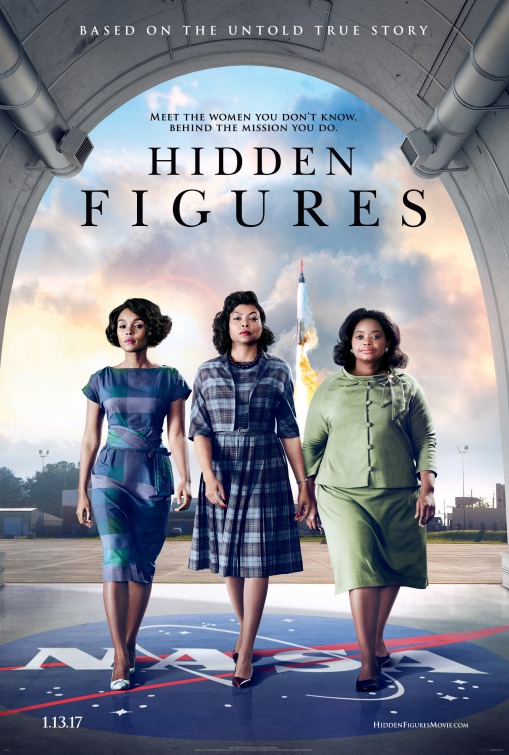
HIDDEN FIGURES

Taraji P. Henson     Octavia Spencer     Janelle Monae     Kevin Costner     Kirsten Dunst     Jim Parsons     Mahershala Ali


       Heartbreaking, thrilling, suspenseful, funny—Hidden Figures embodies all these, including inspirational.  I’m sorry it has taken so long for the story about three heroic black mathematicians at NASA to be told to the mainstream.  But at least it’s out now for all to see at their local theaters.  The film is based on the book, Hidden Figures, by Margot Lee Shetterly, who also served as one of the producers.  Shetterly won an Alfred P. Sloane Fellowship based on this work, and apparently, Levantine Films bought the film rights soon after she completed it (or maybe before, since her book is dated 2016).
         The film opens with little Katherine Harrison (Henson) demonstrating her mathematical genius to school officials when she was in the sixth grade.  Her teacher was determined that she would have educational opportunities that were appropriate for her.  Soon, we meet her as a grown-up on the road to work at NASA with her two friends, Dorothy (Spencer) and Mary (Monae).  They’re having car trouble, but since Dorothy is a mechanical as well as math genius, she fixes it.  After showing their work IDs to a stunned policeman who had stopped to investigate, he offers to escort them to work with red lights blinking so their delay won’t make them late. 
         Most of us simply have no idea about the countless indignities these women will have to face, from having to go to the restroom labeled “Colored Women” a half-mile away, to having pertinent information for their jobs hidden from them, to a separate coffee maker (so white people won’t have to touch it)…we could go on and on.  Throughout, the women are polite, patient, and kind (until pushed too far, then they react strongly, effectively, and appropriately).  The rationalization they are given for such treatment?  “That’s just the way it is.”
         Hidden Figures, to its credit, gets into the fears about the Soviets and the space race at the time, which shows up at NASA certainly, but also by the patrolman on the country road and by the children at school who have drills to get under their desks in case the Soviets attack the U.S.  President Kennedy is featured prominently in showing the pressure to be first in the space race, which dials up the pressure on NASA.  All this reinforces the importance of three black women in their previously unheard of roles.
         Henson, Spencer, and Monae are all standouts, but Henson shows special flair when she answers in an outburst why she disappears for 40 minutes at a time (the walk to the restroom) and why it’s crucial for her to receive updated information immediately.  She also shines when she’s perched on a ladder writing complicated formulas for problems that have perplexed a whole room full of mathematicians.  In the evening, she slides into being a loving, demonstrative mother to her three girls.  I loved Henson’s portrayal of her policewoman character in CBS TV’s “Person of Interest”, where she showed intelligence, canniness, and wit, just like she does here; but here, she’s in an elevated position finally being recognized for her worth.  Ah…..!

A story that should have been told long ago.

Grade:  A                                    By Donna R. Copeland

Thursday, November 3, 2016

MOONLIGHT

Mahershala Ali     Alex Hibbert     Ashton Sanders     Trevante Rhodes     Naomie Harris     Janelle Monae     Andre Holland


           This is an artfully rendered film in which the viewer participates by filling in details that are omitted from the storyline, which proceeds from the main character’s childhood to adulthood.  Little/Black/Chiron is the character named differently, depending on his age and the section of the movie.  (The three very fine actors are Alex Hibbert, Ashton Sanders, and Trevante Rhodes.)  Little is picked on as a child because he’s not “hard”; he gets bullied and teased for being a “faggot”, and rarely stands up for himself.  His only friend Kevin (Jadon Piner, Andre Holland, Jharrel Jerome) tries to help him by telling him to fight back, but even in high school, he remains passive.  He’s a boy/man of few words, although the considerable turbulence inside shows on his face to an astute observer.
            When a kind-hearted drug dealer Juan (Ali) finds Little in a “drug hole”, he makes an effort to befriend him, find out where he lives, and who his parents are.  But Little is mostly mute, and it takes Juan’s girlfriend Teresa (Monae) to draw him out enough to find out where he lives.  When Juan takes him home, much is gradually revealed, and we begin to sort out the relationships in the community and why Little’s life is so hard.  We see Juan taking him under his wing, realizing he needs a father figure (which shows up later when Chiron adopts the appearance and occupation of this most important man in his life).
            The switching of actors (three for Chiron and three for Kevin) makes following the story a bit difficult, especially since Chiron says so little, but the actors are so skilled it doesn’t take long to sort it out.  The pace of the film and Chiron’s reticence is skillful in eliciting our empathy, and will hopefully have the effect of helping more of us understand and have sympathy for those caught up in the drug culture in poorer neighborhoods and the trials that gay people undergo even at a young age.  This is a picture of a segment of society that few of us have seen so tenderly portrayed.
            Co-writer with Terell McCraney, director Barry Jenkins has created a portrait of a boy and his milieu that is evocative while being so quiet, eloquent while making the main character Chiron so mute, and heartwarming in its highlights of kindnesses shown toward Chiron.  Its style and form seem groundbreaking to me.
             
An Impressionist painting of a gay child growing up in a black drug culture that elicits our empathy and sympathy.


Grade:  A                                    By Donna R. Copeland