Showing posts with label Marisa Tomei. Show all posts

Thursday, December 16, 2021

SPIDER-MAN: NO WAY HOME

 Tom Holland     Zendaya     Benedict Cumberbatch     Jon Favreau     Marisa Tomei
Jacob Batalon     Alfred Molina     Willem Dafoe     J. K. Simmons     Jamie Foxx


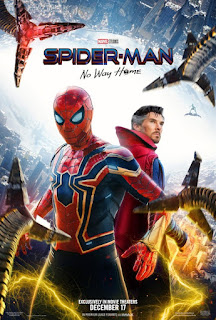
This edition is most remarkable for cleverly integrating past Spider-Man movies and their characters into Spider-Man:  No Way Home.  If a viewer has not seen or can’t remember the past versions, it is easy enough to follow the plot.  However, a much richer experience will be had by those who have kept up with all the versions through the years and recognize all the past characters referenced and the actors who play them.  

The story opens with the chaos caused when Spider-Man’s identity is revealed to be Peter Parker (Holland).  The star broadcaster J. Jonah James (Simmons) at the Daily Fix has seen to that.  The item surfaced when the criminal illusionist Mysterio in his dying breath revealed the identity of Spider-Man, who had just killed him in the previous Spider-Man:  Far From Home (2019).  But now, Mysterio is being made a hero, and Spider-Man  as the presumed villain has to deal with the public rancor that ensues, along with monsters that are suddenly showing up mysteriously on earth.

Peter has sought the help of Dr. Strange (Cumberbatch), who condescendingly agrees to help, but is super-annoyed when Peter keeps interrupting the spell with conditions he thinks of while the spell is being produced.  This has consequences, the extent of which Peter only realizes later, making this something of a coming-of-age story.  It’s going to come home to Peter that gifts he has received come with responsibilities, and the process of learning that is repeated throughout this story line. 

Production of this version of Spider-Man directed by John Watts is engaging in its special effects and script by Chris McKenna and Erik Sommers, based on the Marvel comic by Stan Lee and Steve Ditka.  The cast realizes the action by numerous talented actors:  Tom Holland, Zendaya, Benedict Cumberbatch, Marisa Tomei, Alfred Molina, Willem Dafoe, Jamie Foxx, J. K. Simmons, and others.  All are top-notch.  

Like many films nowadays, judicious editing could have improved the production and reduced it a half-hour to a two-hour limit.  The story bogs down in the middle when one super-human sequence follows another, with technological aspects of filming taking precedence over story and characters.  I’m compelled to reiterate my usual irritation with these movies inevitably ending with a fist fight between two characters followed by tender, emotional scenes meant to pull on the heartstrings.  I like the latter, but why the fist fights when the characters have access to all kinds of technological tools?


With such a clever script, this is probably a true gem for Spider-Man and Marvel Comics fans.  For others, it can be mostly entertaining, except for the length.


Grade:  B                              By Donna R. Copeland

Thursday, November 7, 2019

FRANKIE

Isabelle Huppert     Brendan Gleeson     Marisa Tomei     Greg Kinnear     Jeremie Renier


     This is a sad story in many ways—not agonizingly so—but sorrowful and melancholic.  Frankie, or rather Francoise Cremant, is a successful film star with many admirers (played by the inimitable Huppert).  She has an occasion to invite her complex family group for a vacation in the resort town of Sentra, Portugal, with striking views of the sea, the sky, hillsides, and the village—everywhere the eye turns.  But this is in sharp contrast with the lack of intimacy and veiled feelings of disquiet that permeate the group, some wrestling with relationships, some with illness, some with other kinds of dissatisfaction. 
     Frankie is there with her second husband Jimmie (Gleeson) who clearly adores her, but she is somewhat ephemeral and drifts off from time to time for solo walks. They never seem to have a conversation of substance.  Her current primary aim is to find a mate for her son Paul (Renier), who is moving to New York.  So she has the not so subtle idea of inviting her good friend Ilene (Tomei) to come as well.  She lives in New York (she has been Frankie’s hairdresser for a number of movies, and they’ve become good friends), and she thinks she is helping Paul by introducing him to Ilene. Paul is not pleased, and has the only outburst in this mostly agonizingly quiet gathering.  Unbeknownst to Frankie beforehand, Ilene has brought her friend Gary (Kinnear) with her.  
     In addition to these guests, Jimmie’s daughter has also arrived with her husband and daughter.  And Frankie’s first husband Michel (Paul’s father) is present as well.
     The whole entourage is a bit like a tour bus of travelers passing through, exchanging pleasantries, meeting and chatting on street corners or joining in walks together.  There are occasional arguments between a couple in their room, but at no time do we see the whole family all together enjoying a meal or sharing experiences.  There are only little groups of two or three, in which a conversation of depth or of personal importance might get started, but then trails off.
     Frankie has hopes that this reunion—which could be their last—will be congenial and close.  But it’s clear to the observer that their connections have never been freewheeling and intimate, where significant events are discussed and worked through.  So we get the impression the family’s typical ways of coping with major life events will be repeated here  Interestingly, the structure and dynamics of the film seem to be derived from the kind of family director Ira Sachs and his co-writer Mauricio Zacharias have created.  As a consequence, we never learn enough about the characters to really know them and care about them. Each vignette about a couple/family/individual is just a snippet so short we can’t possibly get an idea of who they are.  Similarly, drama and deep emotional concerns are never allowed to surface.  

Visually, this is a gorgeous film, but it lacks real human warmth and understanding.  The icon Huppert cannot compensate for a limpid script.

Grade:  C-                                    By Donna R. Copeland

Tuesday, July 3, 2018

THE FIRST PURGE

Y’lan Noel     Lex Scott Davis     Marisa Tomei     Joivan Wade     Patch Darragh


       How a whole franchise could be built on a false premise is more than a mystery to me; it’s exasperating.  The premise is that stored up anger can be released during sanctioned violence—and it will be effective within a 12-hour time period.  Oh, sure!  
     Apparently, a psychologist, Dr. Updale (Tomei), has dreamed up this “experiment” (which, incidentally, would not be approved by any review board in the country, a requirement for all research protocols) as a way to demonstrate that such an opportunity would lower the crime rate to less than 1% for the rest of the year.  The filmmakers apparently think this is possible, because, initially, when the purge period starts, most people are celebrating at “purge parties.”  
     But that would make this boring, so James DeMonaco (writer and producer in this version and director of the previous three) inserts dirty tricks by having the “chief of staff”, Updale’s supervisor, stack the deck.  Arlo Sabian (Darragh) was hoping the experiment would result in people in poor neighborhoods massacring themselves. He is a member of NFFA (New Founding Fathers of America), which is funding the research that, if successful in their minds, will reduce the number of people needing Federal assistance. When that does not happen, he sends in his recruits to increase the violence, which, of course, will give him points in the NFFA.  
     What are we to make of this film?  On the one hand, it reflects the strong sense of community among people in poor neighborhoods, their solidarity, intelligence, and awareness, and the dual role gangsters have (partly protective, partly exploitive) in their lives.  On the other hand, it plays into fears about “psychology”, “research”, and government that can unjustifiably undermine trust in those areas.  That is the main problem I have with this film.
     The First Purge gets higher marks from me in its social commentary on the solidarity of minority communities, the manipulations of some in power who can swing the tide against them for selfish reasons, and the exquisite bind experienced by drug dealers in their influence for good and ill in their communities (also seen in Moonlight, last year’s Oscar winner).  In First Purge, Staten Island kingpin Dimitri (expertly rendered by Y’lan Noel) is truly a hero, managing to fight off dozens of killers to rescue those closest to him, one of whom is his sweetheart Nya (Davis), who intrigues us with her fierceness in protecting her own.  She has a younger brother Isaiah (deftly played by Wade) briefly seduced into participating in the purge at first.
     This film does not differ enough from its predecessors to continue as a franchise.

A false premise acted out enough already for us to have gotten the message.

Grade:  C-                                    By Donna R. Copeland

Thursday, July 6, 2017

SPIDER-MAN HOMECOMING

Tom Holland   Michael Keaton   Robert Downey, Jr.   Marisa Tomei   Jon Favreau  
Jacob Batalon   Zendaya   Laura Harrier   Donald Glover   voice of Jennifer Connelly


      The Spider-Man series is a mixed bag, but manages to be the tenth highest grossing film franchise in history.  Homecoming is the sixth titled work after Spider-Man (2002, 2004, 2007); The Amazing Spider-Man (2012), and The Amazing Spider-Man 2, (2014).  But beyond these, Spider-Man has been a character in nine live-action films.  In the most recent, Captain America, Spider-Man assumes prominence and recognition from Tony Stark.  Homecoming is something of a follow-up story, with Peter Parker (Holland) being a nerd-like teenager who, as Spider-Man, has aspirations of becoming Stark’s (Downey) right-hand super-hero.  In this film, he has to prove himself against the doubts of Stark and his agent Happy Hogan (Favreau).  To his chagrin, he is sent back to his Queens high school and advised to stay away from heroics.
    This rendition has Peter as an annoying teenager who has little recognition of his limitations but great confidence in his abilities.  While praising and even idolizing his mentors Happy Hogan and Stark, he thinks he is “good to go” in seeking out the crooks, specifically, The Vulture (Keaton), despite the cautions of Hogan and Stark.  It’s something like a coming-of-age story in which the incorrigible Parker gradually learns through his headstrong mistakes. 
    Homecoming is different from previous versions in Peter’s divulging his Spider-Man identity to his nerdy close friend Ned (Batalon) who is so blown away impressed, he can’t keep a secret either, creating more complications.  The villain in this production is Adrian Toomes, aka The Vulture (Keaton).  Toomes owns a salvage company that does not always stay within the law, and he is furious that Tony Stark (Downey Jr.) has edged him out of a lucrative job.  As he goes about his criminal activities, his path crosses that of Parker, who cannot resist getting involved, despite the warnings he’s been given.  There is a spectacular scene on the Staten Island Ferry, which is shown in the previews.
     Tom Holland puts in a forcible performance as Parker/Spider-Man, doing as many of the stunts as he could, although he was hampered by a broken leg after a fall down stairs at home.  Director Jon Watts has joked that Holland was as excited about landing the role as his character is in getting to be Spider-Man, and it shows in his performance.  Since he is a former gymnast, he can impress with feats like back-flips on command. 
     Michael Keaton, Robert Downey, Jr., Jon Favreau, and Marisa Tomei are their usual pro-selves, convincing in every way.  I understand that Keaton particularly enjoyed being the baddest villain he could be.  Younger Jacob Batalon and Zendaya bring fresh spirit and talent to the group.
     Jon Watts has achieved something many thought was undoable in resurrecting Spider-Man in a way that is engaging, entertaining, and sometimes surprising.  The last act has a very nice shocker in it.  Music by Michael Giacchino expertly and lyrically hits the right notes in every scene. 
     The movie is well done; I personally tired of seeing what I thought was much the same story in every previous rendition of Spider-Man.

An enthusiastic teen challenges Tony Stark’s patience with his gutsiness and impresses The Vulture with his nerve.

Grade:  B                                    By Donna R. Copeland

Thursday, April 20, 2017

CITIZEN JANE: BATTLE FOR THE CITY


     Courageous Jane, taking on the influential leaders of New York City in the l950’s, made landmark strides in challenging them to take a different perspective on city planning.  The importance of the topic is noted by the observation that the scale and speed of urbanization from the 1950’s to now is the greatest in the history of cities.  Moreover, what we’re doing now will shape cities for years to come.  This documentary addresses the question of what constitutes a successful city and who it is who makes decisions about its size, form, and function, as well as who will live there.
     In the mid-20th Century, two figures stand out as embodying the issue of city planning.  One is Robert Moses, a modernist New York City planner with grandiose ideas about what was possible, as well as strong beliefs about public housing and transportation.  His opposition included a cheeky journalist named Jane Jacobs, who contended that cities should be about people, public places, and neighborhoods that are inter-connected and accessible.  Moses championed the automobile and the need for throughways that necessarily had to cut through green space and neighborhoods.  And although he started out as a progressive wanting to address city blight and areas of poverty, he was looking at it from a distance—an aerial view, so to speak.  Whereas Jane walked the streets and made astute observations from which she formed her ideas about what makes a city vibrant and successful.
     To address the city’s poverty, Moses favored tearing down tenements (which he did by the thousands), “wiping the slate clean”, and starting all over again, eliminating the sidewalk culture and people clustering together.  He was late in realizing that this vision resulted in isolated communities, dead-end streets, and separation of work, residential, and recreational areas, along with residential sectioning based on social class.  Three of his most outrageous ideas were to 1) build the Cross Bronx Expressway, tearing up vital neighborhoods and essentially creating a wall between north and south Bronx; 2) build the Lower Manhattan Expressway, dividing it up like he did the Bronx; and 3) run Fifth Avenue through Washington Square Park.  Fortunately, because of the activists’ efforts, he was denied the last two ideas.
     Jane Jacobs expressed her opinions on city planning in one of eight books she wrote.  In The Death and Life of Great American Cities, she questioned city planners (Moses’ brand was repeated in cities across the country) and countered them with her own vision of what constitutes successful cities:  Diversity in people, jobs, uses of streets, types of buildings, and the accessibility of all these to all people.  “Fit your plans to people; not buildings”, she would say.  One of Jacobs’ most fundamental beliefs about cities is that the city is a living, ever-changing organism, and we need to manage the change organically and on the basis of our observations, getting input from the people who reside in it, rather than taking a top-down approach to planning.
     The comprehensive, engaging documentary traces the early lives of Moses and Jacobs and the evolvement of their ideas and actions across the many years of their careers.  The cinematography by Chris Dapkins is extraordinarily good in lustrous black and white, eye-catching colors, and original footage from the time.
     A cautionary note at the end of the film is that what happened in the U.S. in the fifties, is now going on in China, where they are creating isolated developments without streets that are likely to become the slums of the future.

Citizen Jane Jacobs challenges the concepts of noted New York City planner Robert Moses.

Grade:  A                                    By Donna R. Copeland


Wednesday, November 11, 2015

LOVE THE COOPERS

Alan Arkin   Diane Keaton   John Goodman   Marisa Tomei   June Squibb
                                        Olivia Wilde   Amanda Seyfried   Anthony Mackie   Ed Helms   Jake Lacy


          And you probably will end up loving the Coopers in a film that many will see as a perfect holiday movie.  Although don’t expect to be immersed in warm fuzzy feelings throughout; this is a family that can throw barbs and “gotchas” with hardly a twitch of an eyebrow.  They all seem to have some gene that eventually and invariably alienates the person they’re talking to.  The script reads a bit like Little Miss Sunshine in its mixture of bittersweet, tender, and outright comedy.  The difference is that in Love the Coopers there’s a lot more bitterness in tone, especially in the beginning when everyone seems to be writhing with unhappiness—or maybe it’s just anxiety about the upcoming get-together.
         The drama mainly centers around couples—not necessarily the expected pairings.  The paterfamilias (Arkin) is alone in his old age, but has made a solid friendship with a young waitress at the local diner (Seyfried).  His daughter Charlotte (Keaton) has been married to Sam (Goodman) for 40 years, but it looks like the parting of the ways for them.  Their current issue is whether or not to announce their separation at the family celebration.  Son Hank (Helms) is going through a divorce, and he is not in good shape at all.  His other daughter Emma (Tomei) is alone not by choice, except maybe it has something to do with her not being able to form a bond with anyone and tending to feel sorry for herself in being alone.  We’re introduced to Charlotte’s and Sam’s daughter Eleanor (Wilde) in the airport where she has bumped into Joe (Lacy) who is headed out to report to duty.  Present at the Christmas celebration are also a number of grandchildren who are as quick-witted and verbal as their elders.
          Certain interchanges between characters in the drama really entertained and sparked my interest.  One was Eleanor and Joe doing a complex, often contradictory, mating dance that epitomizes budding relationships today.  Liberal meets conservative, but somehow, after many fits and starts, they find more common ground than conflict.  Another was that between Emma and the policeman (Anthony Mackie) who arrests her for shoplifting.  Being a life coach, she starts out asking him about himself, but when it ends up, he is giving her valuable advice.  They end up helping each other, and he is to be admired for insisting on appropriate boundaries. 
        The depiction of Sam’s and Charlotte’s relationship is not terribly interesting—it’s rather hackneyed—and although these are fine actors, I found myself yawning and fidgeting during their interchanges.  The best ones (Eleanor and Joe; Emma and Officer Williams) entertain us and make us think, and therein lies the best of this movie.

A soulful family Christmas with meaningful observations on mating.

Grade:  B                                                            By Donna R. Copeland