Showing posts with label Dick Pope. Show all posts

Thursday, March 17, 2022

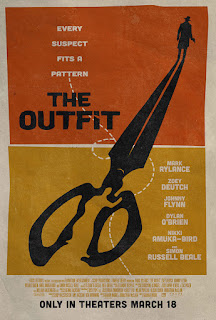
THE OUTFIT

Mark Rylance     Zoey Deutch     Dylan O’Brien     Johnny Flynn     Simon Russell Beale


            A lowly tailor plays a bait and switch game when he is involved in complicated situations with some of his customers, most of whom are criminals.  He can weave a convincing story on the spot, which saves his life numerous times and provides us with great entertainment.  Director Graham Moore (who wrote the script for The Imitation Game) and co-writer Johnathan McClain’s script is a wonder in itself with its constant situational changes suffused with threat and requiring immediate action—all while being intelligently calculated.  Background stories of all the main characters are dribbled out deliberately and explain why the person we see is who he/she is.  “Ah ha!” moments will occur throughout the viewing time for this movie, which is also part of its enjoyment.

            It seems as if the Leonard Burling character was written precisely for Mark Rylance.  As a soft-spoken British man outwardly unassuming ([tailoring] “isn’t art.  It’s a craft.”) he carries a big stick of craftmanship and wit that frequently take his listener off guard.  He knows how to charm and distract the most fearsome mobster into listening to his story as it is unfolding, and he knows how not to be seen slipping away for some contrivance that will be all-important later.  In addition to the plot, just observing him in action is fascinating.  Rylance is well known and respected internationally, most notably for his work in Bridge of Spies, Wolf Hall, and this past year in Don’t Look Up in which he plays a less than admirable character to great effect.

            It is curious that the tailor allows a drop-box at the back of his shop for his star client mobster Roy Boyle’s (Beale) gang to communicate with one another and plan operations.  Burling makes no eye contact with them as they pass through his work room, being completely engrossed in his tailoring. His receptionist Mable (Deutch) resembles her boss in her astuteness and pleasant overlay, but she too is interesting to observe as the story unfolds.  In the end, we will see how all this fits together and makes sense.

            Composer Alexandre Desplat’s music and Dick Pope’s cinematography capture and elaborate upon The Outfit’s mood and suspenseful uncertainty in a way that makes it all of a piece.  


It’s always a joy to see a smart, clever person with a good heart in action.


Grade:  A                                 By Donna R. Copeland

Thursday, October 31, 2019

MOTHERLESS BROOKLYN

Edward Norton     Willem Dafoe     Gugu Mbitha-Raw     Bruce Willis     Alec Baldwin
Dallas Roberts     Leslie Mann     Bobby Cannavale     Michael Kenneth Williams     Cherry Jones


     Picture New York City in the 1950’s with a gumshoe detective following clues to weed out the killer of his life-long mentor.  Or at least picture one of the detective films you’ve seen—or heard on the radio—from that time (e.g., Mr. Keen, Tracer of lost personsDragnet), with the smokiness of the rooms, the seediness of the neighborhoods, and the persistence of a committed private detective.  That’s the movie Edward Norton has written (based on Jonathan Lethen’s novel), produced, directed, and starred in, in Motherless Brooklyn.  Norton and his cinematographer Dick Pope capture this period’s mood and effluence of city corruption that ends up being a crime thriller, complete with car chases, goons, and the pressure of rescuing an endangered damsel.
     The extra intriguing twist to this story is that the main character Lionel Essrog (what a name!), played spot on by Norton, has Tourette’s Syndrome (a disorder involving involuntary tics and utterances).  It’s not really relevant or essential to the story, but adds a touch of color.  Lionel works in a private detective agency headed by his lifelong mentor Frank Minna (Willis).  From the time Frank took pity on and rescued Lionel from bullies in a boy’s home, he has continued to protect him.
     But Frank is also mysterious about jobs he’s working on, giving Lionel and the others only sketchy details about it, but explicit instructions about how to keep an eye out and what to do if…  The movie begins with just such a job, during which Frank is killed.  What ensues is Lionel following the slim clues he’s been given or picked up to find the killer.
     This leads him into major city politics and Frank’s role in it; Moses Randolph (Baldwin), who seems to be in charge of major city “improvements”; a homeless man (Dafoe); activist    Gabby Horowitz (Jones); and a mysterious “black woman” Laura Rose (Mbitha-Raw).
     The novel—and consequently the film—seem to be at least loosely based on true historical events in the 1950’s, documented in a 2018 film, Citizen Jane:  Battle for the City, when Robert Moses, a city planner, began to dismantle city neighborhoods to construct freeways and bridges through them without regard for the people affected.  That is what is happening in this film, but it’s put into a drama that is exciting and will pull at the heartstrings.  
     This is a fun movie for those who can get into period dramas from not too long ago and follow leads and cues the detective Lionel chases—all while explaining his “brain problem.”  The cast is superb (what a juxtaposition of Baldwin’s Moses Randolph and his “Saturday Night Live” Trump impersonations), with Norton capturing the Tourette-plagued Lionel, Mbitha-Raw as an attractive, accomplished woman with a dark history, Willem Dafoe as the mysterious homeless man with a significant background, Bobby Cannavale as a compromised man, and Leslie Mann, Michael K. Williams, and Cherry Jones all providing star-quality performances.

A cloak and dagger story harking back to the 1950s with the added twist of a detective with Tourette’s, but possessing a formidable memory.

Grade:  B                                                By Donna R. Copeland

Sunday, March 3, 2019

THE BOY WHO HARNESSED THE WIND

Chiwetel Ejiofor     Maxwell Simba     Aissa Maiga     Lily Bande


     Take a trip to Africa to revel in the scenery, the music, the costumes, and the culture. Talented actor Chiwetel Ejiofor’s first venture in directing a feature film should assure him of a promising future in this aspect of moviemaking.  His selection of story, timing of plot progression, and, in partnership with the producers, assembling a team for casting, music, cinematography, and other artistic components are optimal.  
     With Ejiofor’s own script based on William Kamkwamba’s memoir with the same title, Dick Pope’s cinematography, Antonio Pinto’s music, Bia Salgado’s costumes, and Alexa L. Fogel’s casting, the viewer is able to experience what it was like in 2001 Malawi when young William was struggling to introduce the windmill to his village.  It was in the middle of a drought when his family and the villagers were suffering in a famine after poor decisions  were made by governments at all levels and by the world economic slump following the 9-1-1 terrorist attack.  And these aren’t the only tragedies in the family story; others involve beatings, stealing, and a runaway teen.  
     On a lighter note, it’s fun seeing William and his friends rummaging through the scrap yard looking for wires, pipes, wood, and metal without our knowing exactly how he’s going to put it all together.  The hardest to come by are bicycle wheels and other parts, and some of the saddest scenes are when William asks his father if he can have his bicycle, the family’s only transportation.  The father is so incredulous, it’s clear he thinks his son has lost his senses.
     I had seen and enjoyed Ben Nabors’ and Tom Rielly’s very fine 2013 documentary, William and the Windmill, but this feature gave me the opportunity to experience William’s discoveries emotionally and learn more about his family and where he grew up.  At least for me, it’s a real tearjerker—in a good way.  One is inspired as much by the child’s fortitude and his family’s struggles as touched by the sadness and tension of his story.
     In his first major acting role, Maxwell Simba captures well the child William’s excitement, self-confidence, and ups and downs in trying to cling to his school studies and inveigle ways to carry on independent research in the tiny local library for his project.  His acting skill—likely honed by the director—is especially notable in scenes with the experienced Ejiofor, who plays his father.  The father initially has no faith in his son’s capabilities, calling earlier versions of the windmill model “toys”, and insisting on William’s helping him more in the farm fields.  
     The film ends on a high note that emphasizes the family’s solidarity and William’s vindication, support from their friends and the townspeople, and a glimpse of William’s life thereafter.
     As a follow-up, it’s satisfying to learn that as a result of his invention, William was able to graduate from college, receive funding from venture capitalists, and achieve no small amount of fame.  He has spoken at T.E.D. conferences and appeared on television, and in 2013 was named by Time Magazine as one of 30 People under 30 Changing the World.  He continues his community service by consulting worldwide on projects that explore renewable energy sources, and agricultural, water, and sanitation improvements, along with being involved in providing educational help and resources for students. Most of all, he exemplifies a young man who retains the commitment to community service and assistance for everyone around the world.  

The Boy Who Harnessed the Wind will surprise and inspire you, pull on your emotions, and astonish you in witnessing the confident, creative genius of a child.  On Netflix.

Grade:  A                                    By Donna R. Copeland