Showing posts with label Mark Rylance. Show all posts

Thursday, March 17, 2022

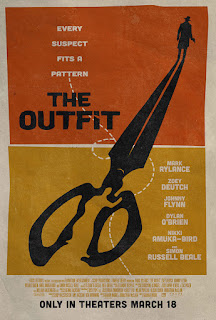
THE OUTFIT

Mark Rylance     Zoey Deutch     Dylan O’Brien     Johnny Flynn     Simon Russell Beale


            A lowly tailor plays a bait and switch game when he is involved in complicated situations with some of his customers, most of whom are criminals.  He can weave a convincing story on the spot, which saves his life numerous times and provides us with great entertainment.  Director Graham Moore (who wrote the script for The Imitation Game) and co-writer Johnathan McClain’s script is a wonder in itself with its constant situational changes suffused with threat and requiring immediate action—all while being intelligently calculated.  Background stories of all the main characters are dribbled out deliberately and explain why the person we see is who he/she is.  “Ah ha!” moments will occur throughout the viewing time for this movie, which is also part of its enjoyment.

            It seems as if the Leonard Burling character was written precisely for Mark Rylance.  As a soft-spoken British man outwardly unassuming ([tailoring] “isn’t art.  It’s a craft.”) he carries a big stick of craftmanship and wit that frequently take his listener off guard.  He knows how to charm and distract the most fearsome mobster into listening to his story as it is unfolding, and he knows how not to be seen slipping away for some contrivance that will be all-important later.  In addition to the plot, just observing him in action is fascinating.  Rylance is well known and respected internationally, most notably for his work in Bridge of Spies, Wolf Hall, and this past year in Don’t Look Up in which he plays a less than admirable character to great effect.

            It is curious that the tailor allows a drop-box at the back of his shop for his star client mobster Roy Boyle’s (Beale) gang to communicate with one another and plan operations.  Burling makes no eye contact with them as they pass through his work room, being completely engrossed in his tailoring. His receptionist Mable (Deutch) resembles her boss in her astuteness and pleasant overlay, but she too is interesting to observe as the story unfolds.  In the end, we will see how all this fits together and makes sense.

            Composer Alexandre Desplat’s music and Dick Pope’s cinematography capture and elaborate upon The Outfit’s mood and suspenseful uncertainty in a way that makes it all of a piece.  


It’s always a joy to see a smart, clever person with a good heart in action.


Grade:  A                                 By Donna R. Copeland

Wednesday, December 8, 2021

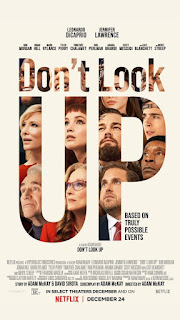
DON'T LOOK UP

 Leonardo DiCaprio     Jennifer Lawrence     Rob Morgan     Jonah Hill     Mark Rylance

Tyler Perry     Timothee Chalamet     Cate Blanchett     Meryl Streep     Ron Perlman


            In the beginning when astronomer Dr. Randall Mindy (DiCaprio) and his graduate student Kate (Lawrence) first discover a “planet destroying comet” headed for Earth they attempt to inform the proper authorities and American people that the country has only six months to get ready for it.  They’re wanting everyone to look up and see the moving light with a tail and understand it is coming our way.  The movie gets its title from those not wanting to accept that a comet is on its way and very dangerous; when it appears to the naked eye in the sky some advise others, “Don’t look up.”

         Well, the movie is a very funny parody about our political times, shining its light on climate change deniers, right-wingers, Fox News, the media’s exploitation of trivialities and current pop interests over serious news, and prominent Republicans who have their own ethics and their own interests at heart.  Topping the list is the President (Streep) with long blonde hair and a primary interest in getting re-elected [her empty-headed son Jason (Hill) serves as her Chief of Staff].  As expected, the President and her “scientific” appointees want to keep the news quiet and just “sit on it” for a while (i.e., until after the mid-terms).  DiCaprio has observed that “Adam [McKay] has woven an incredibly timely message about society, how we communicate, our current priorities, and the climate crisis into an absurdly funny yet important movie."  https://www.elle.com/culture/movies-tv/a37512771/dont-look-up-news-cast-spoilers-date/

       Upon hearing the news, the administration’s reaction and its influence spreads and influences those who similarly want to ignore science and scientists, ridicule them, and even become very nasty toward them on social media. The two scientists’ media advisors tell them to “keep it simple—no math”, to which Dr. Mindy replies, “But it is math!” Clearly, because he is a male and speaks a language many can’t/won’t understand, Dr. Mindy is made a darling; whereas Kate—younger, more articulate in plain language and more in touch with her emotions—becomes a pariah.  And gets arrested by the FBI more than once.

            Even the sexual boundary issues are brought into play, with a sensuous “Daily Rip” TV show host, Brie (Blanchett) seducing Randall and promoting him so long as he does her bidding.  (Her show with co-host, Jack Bremmer (Perry) is clearly a reference to “Fox and Friends” on Fox News.)   In Kate’s circle, the men are aware of the Me Too movement, such as one asking politely if he may touch Kate’s hair in a “nonsexual manner.”  These are anti-war anti-violence protesters who are gentle and respectful of women.  (The currently adored Chalamet plays one of them.)  

            The cast is huge and full of some of our best actors who are at the top of their game.  DiCaprio is almost unrecognizable in his slightly befuddled scientist mode.  It’s good to see Jennifer Lawrence back in action after a brief hiatus, and she plays the fiery young scientist most convincingly.  It’s too bad the writers had both scientists becoming uncharacteristically (for scientists) hysterical and verbally combative at times.  It undermined their believability in a significant way.

            A scene-stealer is Mark Rylance in his most surprising role:  that of an owner of a tech (phone) company who sees himself as a scientist because his company uses algorithms.  He comes across as an odd kind of person, but is a large donor to President Orlean’s campaign, so has her ear.  He convinces her of his alternative plan to deal with the comet, and we see how that works out.

            Entertaining is Ariana Grande’s performance as a pop star whose love life steals away the public’s attention from the impending danger to the outcome of her current romance.  It’s still another comment about the current attention span and the public’s and media’s focus on their idols.  Other actors who should be acknowledged are Rob Morgan as a Black scientist and Ron Perlman as the Administration’s willing sacrificial lamb (who didn’t have to serve when the mission he was on was aborted) but who nevertheless saw himself as a fighter and a hero.

            Adam McKay has had a significant role in movie productions including The Big Short and Vice, and the current TV series “Succession”, but Don’t Look Up seems to be a major shift into satirical parody.  He clearly has his finger on the times, and doesn’t mind at all skewering others when apt.  This is a “feel good” movie for those of us more politically liberal and concerned about the future of our democracy.  It describes so well the world we live in with all its puzzlements and outrageous people and behaviors.

            Don’t Look Up refers to the time when the deniers are the most desperate in wanting people to deny reality.


Don’t Look Up:  A must-see for everyone now living in a most perplexing age as far as people are concerned, but where science is concerned everything is quite clear.


Grade:  A-                             By Donna R. Copeland

Thursday, September 24, 2020

THE TRIAL OF THE CHICAGO 7

Eddie Redmayne     Sacha Baron Cohen    Jeremy Strong    Yahha Abdul Mateen II     Mark Rylance

Joseph Gordon-Levitt     Frank Langella     Michael Keaton     John Carroll Lynch     Ben Shenkman     Alex Sharp

     With a stunning cast of actors, Aaron Sorkin (probably best known for The Social Network, The West Wing and Steve Jobs) has written and directed what is likely to be one of the most important films of this year.  It’s been a long time since the 1960’s, but anyone alive then will vividly recall the turmoil surrounding America’s involvement in the Viet Nam War and the heated, controversial trial of the protesters after the Democratic Convention in Chicago.  Sorkin vividly describes who were the major players in that drama, the events leading up to the trial, and a detailed description of the trial in 1969 that lasted for 151 days.

     The Government was at a disadvantage in bringing the case against the defendants. 1)  because it used the charge of conspiracy when the defendants had not made plans together; 2) one of the defendants was not acquainted with the others and had only been in the city four hours, 3) the judge who led the trial did so poorly he was later considered unqualified, and, finally, 4) politics got mixed in when Richard Nixon was elected President. Whereas the previous administration under Lyndon Johnson had concluded that the Chicago police actually incited the riot at the Convention, rather than the defendants, Nixon’s Attorney General, John Mitchell, was determined to find the protesters guilty.

      During the film, we are shown revealing defense meetings, the trial, and clips of the protests, all of which make for exciting drama.  It should be said that some of the defendants (Abbie Hoffman, Jerry Rubin particularly) were colorful in their own right and were gleeful in their irreverence and playfulness with the authorities.  But others were respectful, like defense counsel William Kuntsler and defendant Tom Hayden, but who, at times, dropped decorum and stood firmly in their beliefs.  

     Along with the writing and direction, the cast comes through superbly in portraying their characters.  Eddie Redmayne as Tom Hayden repeats his past fine performances in depicting someone knowledgeable in the law, impulsive at times when his humanitarian buttons are pushed, but usually maintaining his composure.  Abbie Hoffman and Jerry Rubin, portrayed by Sacha Baron Cohen and Jeremy Strong, respectively, are a hoot, just as the real men were; so shocking you get surprised at their intelligence. I completely forgot the actors during their performances, which is saying a lot, since each is so prominent in very different current and recent roles. 

     It was great fun to see Frank Langella, long-time nominee with few wins, play the disingenuous judge for whom the whole proceedings were overwhelming.  I think he captured his role just right, and hope he is nominated for an overdue award.  Joseph Gordon-Levitt is also one perfectly cast for his role as the lead prosecutor who is young enough to have maintained the strong principles he acquired from law school, but well brought up in American values and social skills. He maintains a perfect balance between knowing what will affect his career while still adhering to his basic ethics.  

     Michael Keaton is another actor who always comes through with just what is needed. And in this case, in portraying Ramsey Clark (Johnson’s attorney general), he shows a man without many pretensions but having basic human values about the difference between right and wrong.  He will take personal risks to see that justice is done.

     There are a dizzying number of characters thrown at the viewer right in the beginning, which requires good concentration.  Then, as the drama unfolds, you get caught up in it, both with your brain and your emotions.  It is an exceptional rendering of history that is reflective of real events as we experience them.  This is an informative as well as engrossing story to watch.  In light of today’s politics, it may be positive or sobering—we’ll see.  The film can be seen on Netflix.


Dip into a taste of history that can be seen as hyper-relevant today in this brief look back.

Grade:  A                                    By Donna R. Copeland


Thursday, March 29, 2018

READY PLAYER ONE

Tye Sheridan     Olivia Cooke     Ben Mendelsohn     Lena Waithe     
T. J. Miller     Simon Pegg     Mark Rylance
Philip Zhao     Win Morisaki     Hannah John-Kamen


      Are you ready for the world of 2045?  Steven Spielberg’s vision is that everyone will be so absorbed in virtual reality (VR) games they’ll be spending most of their time there, rather than in the work-a-day real world.  We get a striking picture of how that will be by watching Ready Player One.  Unfortunately (for me), most of the action is like a video game with car chases, fights, and wars.  But there is a story underlying all the racing around, plotting, and attempts to figure out a master gamer’s clues leading to a lot of money and ownership of the Oasis, the ultimate gaming organization of the time.
    Humble Wade Waits (Sheridan) lives in the “Stacks”, a slum in Columbus, Ohio, consisting of house trailers (rather then apartments or condos) stacked upon one another (a visual masterpiece reminding of the favelas up a mountainside above Rio de Janeiro, Brazil), and right away we get to watch him traverse down to the street level by jumping, leaping over balconies, and sliding down a rope.  Wade’s parents died, and he lives with his sister Alice (Susan Lynch) and her current boyfriend, an abusing lout. 
     Now, Wade has an avatar, Parzival, and he is hell-bent on solving the riddles left by the mischievous creator and owner of Oasis, Halliday (Rylance), who—by the way—has died.  But whoever solves his riddles for three keys will become rich and gain the power of ownership of Oasis. 
     Parzival manages to develop a kinship with other avatars, and they form a party of five:  Wade/Parvizal, Samantha/Art3mis (Cooke), Aech/Helen (Aech), Sho (Zhao), and Daito (Morisaki), working together to find the keys; but they are thwarted by the unsavory giant corporation led by Sorrento (Mendelsohn) and his minions, foremost of which are I-ROk (Miller) and F’Nale Zandor (John-Kamen).
    A matching of wits and devices follows, with the occasional appearance of Halliday/Anorak making the keys available as they are won.  Sorrento has developed a corrupt organization that is determined to out-smart anyone else in vying for the keys by hook or by crook—mostly crook.  The scenes switch back and forth between the virtual reality and real worlds, which becomes frightening when you realize that what happens in VR can affect people and events in the real world. 
     The story is engaging, acted out so well by the two leads, Sheridan and Cooke.  It was rewarding to see them as a real team, with one and then the other taking on a critical role in saving each other.  Usually, it’s Art3mis who is the quick wit figuring out the clues after Parzival’s initial win.  It’s nice to see the breaking of stereotypes in this and in their personalities, with the Cooke character being sharp and canny, and the Sheridan character being more naïve, but still solid in values and character.  Ben Mendelsohn is perfect as the charming, conniving villain Sorrento.  Other noteworthy performances were rendered by Lena Waithe, T.J. Miller, Hannah John-Kamen, Philip Zhao, Win Morisaki, and Simon Pegg.
     This is fairly typical Spielberg with impressive production, substantive story, and well-defined characters.  It’s fascinating (and humorous) as well in its multiple references to other films (not necessarily Spielberg’s), and it does a good job in having appeal for both younger (technology, videogames) and older audiences (references to other films).  Janusz Kaminski’s cinematography, Alan Silvestri’s music, and Adam Stockhausen’s production design make this a first-rate production.
     As much as I loved watching this film, it is primarily aimed toward fantasy enthusiasts who will revel in the special effects and references to previous iconic films.

Catch a futuristic ride into the world of virtual reality where “you can be anything you want to be.”

Grade:  B+                                                By Donna R. Copeland

Wednesday, August 2, 2017

DUNKIRK

Mark Rylance     Tom Hardy     Kenneth Branagh     James D’Arcy     Cillian Murphy    
Harry Styles     Fionn Whitehead     Barry Keoghan     Aneurin Barnard     Tom Glynn Carney


     Chaos reigns in the thick of battle, which Dunkirk exquisitely illustrates.  Christopher Nolan (writer/director) knew that it was critical to show the defense and evacuation in air, on the sea, and on land, and that cutting back and forth among these arenas was essential to a realistic account of the operation.  In 1940, before the U.S. entered the World War II, Germany had separated the northern Allied forces from the French forces in the south, and hoped to wipe out the Allies at Dunkirk.  In response, the Allies came up with an ambitious plan to evacuate their 330,000 troops from Dunkirk and transport them to England. 
     We are there as two young British soldiers (Whitehead, Bernard) find themselves in a throng on the beach waiting for British destroyers to pick them up.  German flyers saying, “We surround you” litter the beach, which is being periodically strafed, and when the two soldiers see a wounded man on a stretcher who needs to be carried to a waiting ship, they pick him up and run toward the ship.  There is chaos, and after much difficulty, they get him to the boat, only to have the boat bombed, and they have to figure out how to survive.  Nolan will get back to them time and again.
     Another arena is the air, where Farrier (Hardy) is an ace pilot on a Spitfire determined to shoot down every German fighter plane he sees.  And he sees and blasts many that we see go down and drown in the sea.
    The naval officers are waiting impatiently for British destroyers to show up, but they’re delayed, and other boats loaded with servicemen keep getting blown up, with the passengers who aren’t killed by the blasts jumping into the roiling sea.
     One of the more entertaining and uplifting—although also horrifying at times—segments in this film has to do with a private boat in the area requisitioned to rescue fallen troops in the sea.  The captain of this ship is Mr. Dawson (Rylance), who epitomizes the Wise One.  He rescues troops thrown into the sea, and instructs his son on board about PTSD (which had not yet been identified), boating, and simple human kindness.
     Stand-outs among the actors are Rylance as a brave and noble soul, Hardy as an ace pilot who is able to convey so much even with a mask covering his face, and Murphy as a crazed pilot rescued from atop his wrecked plane in the ocean.
     This is an extremely difficult film to watch, in that almost every scene is tension-filled with life-threatening struggles.  It’s not always clear what exactly is happening or what is being said by the characters.  The cinematography by Nolan’s favorite, Hoyle Van Hoytema, is brilliant in instilling a “You are there” experience in the viewer.  Likewise, Hans Zimmer’s score suffuses every scene with high emotional valence.
     For a fitting coda, Nolan includes excerpts of Prime Minister Winston Churchill’s actual speech following the Battle of Dunkirk, underscoring the British spirit of never giving up:  “We shall go on in the end…we shall defend our island, whatever the cost may be.  We shall fight on the beaches, we shall fight on the landing grounds, we shall fight in the fields and in the streets, we shall fight in the hills; we shall never surrender.”

From the air, on the land, and in the sea, the battles wage on relentlessly.

Grade:  B                                    By Donna R. Copeland

Wednesday, June 29, 2016

THE BFG

Mark Rylance   Ruby Barnhill   Penelope Wilton         Voices of:  Bill Hader, Jemaine Clement


          The BFG seemed to capture children’s interest and attention in the screening I attended, and there was applause at the end.  Noises I heard from kids during the film seemed more like they were engaged and involved rather than restless, despite the almost-2-hour production.  I got the impression they were following the BFG’s malapropisms as well or better than the adults.
         The story by the beloved author Roald Dahl (Charlie and the Chocolate Factory, James and the Giant Peach, Fantastic Mr. Fox) and made into a screenplay by Melissa Mathison (ET), tells about an orphan named Sophie (Barnhill) who spies a giant outside her window late at night, and because he is concerned that she will tell others about him, he snatches her.  It turns out that he is a dream catcher who plants dreams into those who are fast asleep—good dreams mostly, but, if needed, bad dreams.  Unfortunately, he lives in the Land of Giants, many of whom are much bigger than he, and they bully him.  The well socialized Sophie, who comes to like and respect the BFG, is then incensed by the oafish giants and devises a plan whereby the Queen of England would rally her forces to capture the giants who are known to see children as delectable treats.
      The idea of capturing and planting dreams is appealing, and is one of the highlights/mainstays of the film.  The current technology shows vivid images of dreams, BFG’s “factory” for creating/mixing  dreams that can be infused into a sleeper’s brain, and the noble uses for dream infusion.  I applaud introducing the concept to children with the thought that it could be a very useful fantasy for them to use in making choices in their lives.
Director Steven Spielberg has sustained his child-like wonder in making films meant to inspire young people of all ages and offer them stories for their moral and ethical development.  His engagement of John Williams for music, Janusz Kaminski for cinematography and Rick Carter for production design are creatively wise choices. 
           In this production, I was mesmerized by Mark Rylance’s portrayal of the BFG.  We now know from his performances in Bridge of Spies, Wolf Hall, and other productions that he is a consummate actor who conveys innumerable expressions with his face and voice.  In this, it was delightful to see that in CGI and motion capture we could still see Rylance, especially in his pixie-like face, his eyes, and smile.  His range is noticeable from the spy character he portrays in Bridge of Spies to here in the BFG.  Those two characters couldn’t be further apart.  And it’s a little bit strange how his goodness shines through so well, we are prepared to root for him as a German spy.
       Strangely, Ruby Barnhill as Sophie did not carry the same weight, even though currently, child actors tend to be phenomenal.  Somehow, the actress does not elicit much fascination with the Sophie character, or maybe it’s simply the script.  I think that part of the problem is that the character Sophie is a bit obnoxious in her behavior and attitude (which may come from Dahl’s story), so it may not be a casting issue, but has to do with the story itself.

I think most children will enjoy and benefit from this fanciful tale.

Grade:  B+                        By Donna R. Copeland

Wednesday, October 14, 2015

BRIDGE OF SPIES

Tom Hanks     Alan Alda     Amy Ryan     Austin Stowell


          James Donovan seems like an ordinary fellow, very successful in his law firm and well grounded in his ethics.  He will be asked to serve his country in a way that strains his sense of what is right and unleashes threats against his family’s safety.  Donovan (Hanks) is a true believer in the best sense of the word.  He interprets the U.S. Constitution in a way that continually guides him in his practice. 
        Enter the FBI and CIA and their sometimes questionable operations, and Donovan is asked to negotiate an exchange of prisoners as a private citizen without any official appointments.  It seems that this is how deals are negotiated among countries.  One (the U.S.) has something another (USSR) wants, but there is an additional complication of an American student being detained on suspicion of spying by East Germany (who also has a stake in the trade).  So we have three powers—the U.S., Russia, and East Germany—negotiating a single exchange.
      As is typical of Spielberg films, the plot is intricate, somewhat mystifying in the beginning (a phone is answered after many rings, but no one speaks), but ultimately details for the audience every critical element, ending with an uplifting and a gently humorous conclusion.  Music by Thomas Newman (Skyfall, American Beauty) and cinematography by Janusz Kaminski (Schindler’s List) contribute to the fine production value of the film.
      Hanks will certainly be praised for his expertly rendered main character, showing his doubts, certainties, and sincerity in multiple ways.  He plays James Donovan, the lawyer who actually was the lead negotiator in the exchange of the prisoner Francis Gary Powers for the Russian spy Rudolph Abel during the Nixon Administration.  The real Donovan was apparently a gifted negotiator who always got more in exchanges than was expected.  
      I was especially fascinated with the actor, Rylance, and the part he plays.  As the Russian spy, he delivers pithy, terse pronouncements with a completely deadpan face, such as “The boss isn’t always right; but he’s always the boss.”  And “What’s the next move when you don’t know what the game is?”  He even warns his lawyer that, “You should be careful” when he makes a risky play.  Rylance is not as well known for films, but has received many accolades for his theater work (e.g., Tony awards, Laurence Olivier Theater Awards, and others).  I remember him most as Thomas Cromwell in the recent TV mini-series, “Wolf Hall.”  Cromwell’s personality was similar to Abel’s in its understated, carefully composed, but succinct observations.
      Not much time is spent on Powers (Austin Stowell), probably because he was somewhat unpopular upon his return home because he didn’t end his life when he was supposed to.  On the other hand, it was ultimately established that he stood firm and did not reveal any State secrets when he was in Russian hands.

A real-life thriller based on a historical event.


Grade:  B+ By Donna R. Copeland