Showing posts with label Musical. Show all posts

Friday, June 3, 2022

NEPTUNE FROST

 Cheryl Isheja     Bertrand Ninteretse     Eliane Umuhire     Elvis Ngabo     Dorcy Rugamba


        Multidisciplinary artist Saul Williams and Rwandan filmmaker Anisia Uzeyman have produced a sci-fi musical—an exotic, poetic collage—detailing the miners’ struggles in Rwanda in the early 1990’s.  The time period is after the civil war when the miners formed the Rwandan Patriotic Front (RPF) to resist the cruel Rwandan Armed Forces who had taken over control of the country.  It depicts exploitation of the workers by colonialist nations depleting Rwanda’s natural resources, and makes statements about capitalism, revolt by the oppressed, and their eventual liberation.

            The film is intended to represent past, present, and future time, so is not a chronological account.  The narrator is a man/woman born into a coal-mining family who says, “My life was never quite mine”, as he/she tells the story of their lives and what happened to them and those around them.  Scenes of the miners working clearly illustrate what they are going through; for instance, when a young man pauses work to lift a rock to examine it, he is struck down by an overseer yelling at him to get back to work.  He ends up dead.

        The movement takes form when some escaped miners meet in the mountains above Burundi to form a collective with computer hacking expertise as a way of disrupting the industry.  They sing, “These mo…..rs don’t want to back down.”  What ensues is the pairing of a coltan miner, Matalusa (brother of the slain man who picked up a rock) and an intersex computer hacker fleeing sexual harassment (the narrator) to seed a revolution. 

            Much of the music consists of chants such as “We mine, but we don’t own what we dig.”  “They use our blood, sweat, and tears to communicate with one another [producing technological products], but they have never heard us.”  “F…Mr. Google.”  But humor is sprinkled in from time to time.  The figure called Martyrloserking came from someone mispronouncing MLK’s name.

        Whereas the film clearly makes a political statement, it truly is an artistic work such that summarizing it is like trying to summarize a painting.  Therefore, it is primarily for those who like to be absorbed in a work of art and use associations to it to understand it.

        Opens June 24 in Houston at the Museum of Fine Arts.

An afro-futurist musical that will delight the senses and arouse conflicting emotions as it makes its political statements.


Grade:  A                    By Donna R. Copeland


Thursday, December 30, 2021

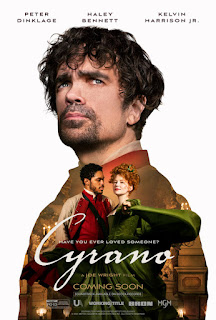
CYRANO

 Peter Dinklage     Helen Bennett     Kelvin Harrison, Jr.     Ben Mendelsohn


            Cyrano is a musical in which a princess, Roxanne (Bennett), is pining for love, to which her lady in waiting argues that “Love doesn’t last; what lasts is compromise and sacrifice.”  (She means that Roxanne should be looking out for her economic welfare over love considerations), which goes right over the beautiful young woman’s head.  Roxanne (Bennett) sings back that she never wants to marry unless she can find someone to love.  Her current suitor, the Duke De Guiche (Mendelsohn) could indeed be her future, but Roxanne loathes him, and only sees him for what she can get from him (e.g., theater tickets).

            What Roxanne doesn’t know is that her friend since childhood, Cyrano (Dinklage), has always loved her, but thinks that she will simply laugh at him for thinking she could fall in love with such a short man.  The story develops from there, such that the man Roxanne is attracted to (from just a glance) is Christian (Harrison), a handsome guard under Cyrano’s command.  The two exchange one glance from afar and both literally fall in love at first sight (or so it seems).

            When Roxanne confesses to her friend Cyrano her love for Christian, who has just been recruited into the guard, she begs Cyrano to mentor and protect her love.  Since he cannot deny Roxanne anything, he promises to do so, which puts him into a serious bind between his own interest and what he has promised.  This bind leads to his writing love letters for Christian to send as his own to Roxanne.

            It was serendipity that scheduled Houston critics to see Spielberg’s West Side Story the night before Cyrano, giving us the opportunity to contrast the two love stories.  And what a difference; where West Side Story, despite its performance value (and my usual admiration for Spielberg), seemed to me to be a tiresome, dated, story of machismo, Joe Wright’s Cyrano makes an elegiac tribute to a man in an older period piece (17th Century), for whom compromise and sacrifice become very real to him, despite his acclaimed swordsmanship.

            Sprinkled throughout the drama are bits of humor (Cyrano’s claim that “Halloween is my favorite holiday” after he has been called a freak, statements like “Her imperfections are perfect”), insightful observations (a narcissistic young woman singing, “I need more”), the non-glorification of fighting—even in the case of war), and demonstrations of true love (seen in Cyrano’s letters, soldiers’ letters home, and the final scene).

            Screenwriter Erica Schmidt is the one who took a different view of Cyrano the character by focusing not on his nose, but making him a dwarf mocked for his stature, and one who believes no woman could love him as he is.  (There is tenderness in this concept in that Schmidt is married to Dinklage, and she wrote the part specifically for him.)

            Peter Dinklage has long been one of my favorite actors, and it is high time he gets an Academy award for his performance as lead in a major motion picture.  He has numerous other awards to count, but I think it’s time his nominations and awards for “Most Promising Actor” in The Station Agent (2004) and supporting actor for Game of Thrones and Three Billboards Outside Ebbing, Missouri  be followed up with more than a nod from the Academy—for his acting.  Admittedly, singing is not his strong suit, but his resonant bass still pleases.

            Joe Wright’s previous films (e.g., Pride and Prejudice, Atonement, Darkest Hour) are testament to his talent in the art and craft of filmmaking.  Elements contributing to his success in Cyrano include Aaron and Bryce Dessner’s music, Seamus McGarvey’s cinematography, and Sarah Greenwood’s production design, some of whom have collaborated with Wright on other projects.


Cyrano, with the swagger and expert swordplay of Tyrion (Dinklage) in Game of Thrones has a much bigger heart and compassion to go with his more macho qualities.  He is a truly admirable soldier in this production, but as skilled in the art of language as he is in wielding a sword.


Grade:  A                              By Donna R. Copeland

Wednesday, December 8, 2021

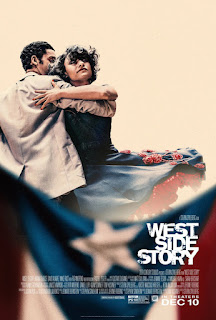
WEST SIDE STORY

 Ansel Elgort     Rachel Zegler     Corey Stoll     Rita Moreno     

Ariana DeBose     David Alvarez     Mike Faist


            West Side Story (1961) is beloved among American cinephiles, but I was surprised that Steven Spielberg would pick it up for a 2021 remake.  It has been highly praised as a Broadway show and 1961 movie (Robert Wiseman, director), so a remake is rather puzzling.  Beyond that factor, with as much racial unrest and frank hatred going on in our country now, I have some doubts about a major film production—even though one I think is meant to make a statement about the inadvisability of violence—spending so much of the movie on machismo and racism before the “lesson” comes through at the very end.

Spielberg and his screenwriter Tony Kushner have kept the original story itself pretty much intact, except for some tweaking of the plot (e.g., inserting a clearly mixed gender character as opposed to a tomboy) and casting actors (except for Rachel Zegler) way beyond the teenage years.  I understand Spielberg was committed to cast Latin actors as much as possible for those roles, so perhaps he can be excused for not attending so well to the age factor.  But mismatching the ages of the actors and their characters is unnecessarily common in movies today, because age is so influential in defining who someone is; and beyond that, there are scores of talented young actors who could be in those roles.  Movies like West Side Story would be much more plausible to me if I looked up and saw teenagers; whereas, seeing late 20’s-30’s year-old actors behaving the same way seems a bit ludicrous.

Having stated what I see as drawbacks, I can say the production in terms of design (Adam Stockhausen), music (Leonard Bernstein, Stephen Sondheim), choreography (Jerome Robbins), and cinematography (Janusz Kaminski) are well done and entertaining.  The acting is laudable for the most part, especially Rachel Zegler as Maria and the iconic Rita Moreno as Valentina (of interest is that she was in both the Broadway show and the 1961 film production of West Side Story).  The quality of Ansel Elgort’s singing as Tony was a pleasant surprise to me, but, somehow, he seemed out of place.  It could be that he was miscast or perhaps the chemistry between him and Zegler didn’t quite come through.  

Overall, the extended macho scenes in Spielberg’s 2021 West Side Story are so off-putting, by the end of the overly long movie (over 2½ hours) the viewer is eager to leave, which makes short shrift of the truly heart-rending scenes at the end.


West Side Story 2021 is nostalgic for those enamored of the 1961 version, but considering current tensions about race and immigration, it gives us a sense of its being dated.


Grade:  C                              By Donna R. Copeland

Friday, November 12, 2021

TICK, TICK...BOOM!

Andrew Garfield     Alexandra Shipp     Robin de Jesus     Vanessa Hudgens

Joshua Henry     Bradley Whitford     Jonathan Mark Sherman


Jonathan Larson, the creator of the hit musical “Rent” (which earned Pulitzer and Tony awards) is the subject of this film as he was writing one of its predecessors.  He is young—not yet 30—but wants to set the Broadway world on fire with his musicals.  He captures the interest of one who turned out to be his long-time mentor Stephen Sondheim (here played on note by Bradley Whitford), and one of the humorous segments of the film is Sondheim and a colleague critiquing one of Larson’s first musicals.  It’s funny because the colleague seems to want to trash it, but after Sondheim gives his opinion, the man agrees with him in a roundabout way.  (A wonderful rendition of doublespeak.)

Tick, Tick…Boom! canvasses a wide range of subjects—writer’s block, homophobia and the AIDS epidemic, the tension between art and corporate concerns, and on a more personal level the tension and pulls between professional life and human connections—all of which were highlights in Larson’s life. These subjects are the “meat” of the production.

I found the story more engaging than the music, especially in the beginning, which is frenetic and hyper in the partying mode.  At the middle point of the drama and towards the end, music and story become more inspirational.  The duet of Susan (Shipp), Larson’s neglected girlfriend and Karessa (Hudgens), one of Larson’s main characters/singers, sing about Jon’s struggle in writing the most important song in the work; it’s a stand-out, especially touching and beautiful.  I also found the songs of Larson and de Jesus at the end singing about AIDs just as beautiful and moving.

Andrew Garfield may not be the most appealing star of a musical, but his performance here proves his talent.  Shipps’ and Hudgens’ voices complement each other and express well the emotions their characters are experiencing.  The entire ensemble of musicians makes this musical vibrate.

Another strength of Tick, Tick…Boom! Is the cinematography of Alice Brooks.  She inserts a number of shots that are humorous and inspiring, such as that of Jon at his lowest encountering the “30” at the bottom of the pool (reminding him of his impending age) and swiping it into a treble clef, just what he needed for inspiration to write the most important song in his current production.  There are numerous creatively rendered shots that enhance this production 

Tick, Tick in the title refers to the ticking of time, that it is always there to remind us of the finiteness of life and relationships.  I think the film did a great job of reminding us of that and encouraging us to ponder it a bit.  And to emphasize the point, Jon’s agent tells him after the success of the Tick, Tick...Boom! workshop that his next job is to start writing his next show immediately.  No rest for the weary!

Tragically, that tick tick of the clock was a knell for Jonathan Larson.  He had an aortic aneurysm that killed him suddenly at age 35.  Our loss for sure.


Tick, Tick…and may there be a Boom...if you're lucky!


Grade:  B                                                      By Donna R. Copeland


Thursday, September 23, 2021

DEAR EVAN HANSEN

Bill Platt     Julianne Moore     Kaitlyn Dever     Amy Adams     Nik Dodani     Danny Pino 


            The first song, “On the outside always looking in”, captures the nerdiness of its main character Evan, appealingly rendered by Ben Platt.  Your heart aches for him when he wants to express himself, but the words just won’t come out.  He seems to be without a friend in the world, except maybe one who denies it, saying he and Evan are only “family friends.”  Evan is attracted to a girl named Zoe (Dever), who is hopelessly beyond him and he is briefly bullied by her brother who absconds with a print-out of Evan’s and never gives it back.

            The page is found still in his pocket by his parents after his suicide, which sets up a whole chain of events in which people “see what they want to see.”  In his desperation, Evan—with the best of intentions (another theme of the film)—tries to explain the note to the parents, but not wanting to distress them further, goes along with their assumption that the note was written by Connor, their son, whom they would like to believe that Evan was their son’s only friend.

            “Oh, what a tangled web we weave when first we practice to deceive”, said Shakespeare.  The film brilliantly demonstrates this human effort, even given Evan’s best of intentions. 

            It’s something of a surprise (and a creative insertion of the filmmakers) when Evan bursts into song whenever he is in straits to explain himself.  In song, the words come, and he is able to convey his thoughts eloquently.  There is one hitch—his efforts to please the listener and tell them what they want to hear—is going to get him into a heap of trouble.  Trouble that, in the end, makes the whole comedy a life learning experience for him.

            There are many clever layers in this story, one being that when Evan tells Zoe in song what her brother Connor said about her, he is actually describing all his own memories and impressions of her.  Another is the (slightly creepy) process where Connor’s family becomes so attached to Evan he becomes a surrogate son, a replacement for the one they lost.

            Where all the characters except Evan’s mother (Moore) (whom the filmmakers wisely always keep grounded) get caught up in the delusion, the filmmakers (writer Steven Levenson and director Stephen Chbosky) keep their sensibilities as an anchor, the most important being the underlying messages of substance they wish to convey.

            The actors are exceedingly well cast (except for my usual complaint of having older actors play high school students), and along with Platt, Julienne Moore, Kaitlyn Dever, Amy Adams, Nik Dodani, and Danny Pino are excellent.

            Dear Evan Hansen should appeal to a broad audience:  the younger set who may be experiencing loneliness and not feeling a part of the group, parents of teenagers, and those of us who have observed family dynamics similar to those shown in the film.  

            One implication in the film troubled me, which was that it’s “normal” for teenagers to be taking psychotropic medication.  One character was reassuring another about how “everybody” is taking it but hiding the fact.  I looked online and found one study showing that 23.3% of undergraduate students are taking prescribed psychiatric medication (https://www.browndailyherald.com/2018/04/26/23-percent-students-prescribed-mental-health-medication/).  The statistic for high school students is likely to be smaller; nevertheless, I wonder if we are becoming a society where individuals think they cannot manage life without chemical help.


To all the lonely people in the world, Hear! Hear!  This is a film that brilliantly shows us that there may be a lot of strength and character underneath the “withdrawn” or nerdy person.


Grade:  B                                          By Donna R. Copeland


Thursday, August 5, 2021

ANNETTE

 Adam Driver     Marion Cotilliard     Simon Helberg


            Unless they’ve already heard a significant amount about it, Annette is likely to take viewers by surprise.  It’s surreal in its drama and characterization; audiences interact  in unison and sometimes in song with the comedian; music by the pop and rock duo, the Sparks brothers (who are the writers as well) is quirky in their well-known style; and the whole production is unlike almost any of the American musicals.  

            Henry (Driver) and Ann (Cotilliard) fall madly in love shortly after meeting.  It’s an unlikely pairing in that he is a stand-up comedian called “Ape God” and she is an opera singer.  His routines are odd with a mixture of subjects that are meant to shock the audience, although there are always some who laugh.  One of the first signs of the significance of his feelings are his many references to Ann’s popularity and that in her roles she often dies in the end.  Very soon after their meeting, Ann is pregnant, and it looks like they will be happily making their way into a conventional family.  The birth of the child is remarkable and funny, in a way, in that it is accompanied by the singing of the doctor and nurses…and Henry.

            But things happen.  Unusual things.  And then more unusual things.  We wonder if this romantic unit will manage to survive.  

            The actors are well cast, and Cotilliard has a beautiful, pure voice that is soothing when the action is rough.  She is also a fine actor.  Adam Driver portrays his character in his usual convincing way; he is also a fine actor, and although it is clear he is not a trained singer, his voice is acceptable, using mostly a recitative style effectively.

            The Sparks’ music is sometimes lyrical—especially when the chorus is commenting on the drama—pointed in its references, and droll at other times.  Ron and Russell Mael have done a remarkable job in designing a plot with music that is full of surprises and suspense, along with the entertaining quirkiness.  By the end, references made in the beginning make sense in retrospect, with life lessons learned.

            Leos Carax (best known for Holy Motors) has taken the Sparks’ material and directed the production with sensitivity and an eye for timing and successfully producing an unconventional movie that, in the end, has substance.  It is slow at times, and some editing and shortening would have improved it.

            Annette is not a film for everyone, but for those of us appreciating the quirky and unusual, it quite satisfies.


An unlikely pairing of an opera singer with a droll comedian that somehow works.


Grade:  B                              By Donna R. Copeland


Thursday, June 10, 2021

IN THE HEIGHTS

 Anthony Ramos     Corey Hawkins     Melissa Barrera     Leslie Grace     Olga Merediz

Jimmy Smits     Daphne Rubin-Vega     Stephanie Beatriz     Gregory Diaz IV


            Washington Heights in New York City used to be an Italian neighborhood, but now it is filled with Latinos from Puerto Rico, Santo Domingo, Cuba—you name it—all Spanish-speaking.  Creator, producer, and composer Lin Manuel Miranda is from Puerto Rico, and gives a moving—sometimes playful and funny—account of the immigrant experience.  Everyone seems to be on the move constantly, whether to go back home (listening to “island memories”) or stay, or even move across town, or at least to move up in life.  At times, characters pause and reflect on the present and the need to appreciate the things they have right now.  But hopes and dreams (sueñitos) make up the underlying theme for all, along with finding a sense of belonging, finding one’s place.

            Most of the film is loud and frenetic with hip hop, rap, and salsa music and dance going full blast.  All of it is enjoyable (if a little loud and hyper-frenetic), especially the dancing, choreographed by Christopher Scott.  Characters dance and sing everywhere—in the ballroom, on the street, in a tiny apartment.  Woven throughout are vignettes showing conflicts in love, business, and immigrant status.  (Lack of resident documentation for education even gets a shout-out.)

            At center stage is Usnavi (Ramos—a favorite of Miranda), a bodega owner with dreams of going back to Santo Domingo and rebuilding his family’s property destroyed in a storm.  He is shy and must rely on his much bolder assistant Sonny (Diaz) to score him a date with favorite customer Vanessa (Barrera), an aspiring fashion designer supporting herself by working at a beauty shop—she hopes temporarily.  They have an off-and-on romance with difficulties trusting themselves and each other.

            A role sure to be a hit with audiences is Abuela Claudia (Merediz) everyone’s grandmother.  She’s very different from the popular grandma in last year’s Minari, played by award-winning Youn Yuh-jung, being much more like most grandmothers in the U.S., indulgent and religious (i.e., Christian).

            Other entertaining connections involve Nina (Grace), just back from her first year at Stanford University, whose enduring love is Benny (Hawkins).  The issue here is with Nina’s father Kevin (Smits) who is insisting Nina return to Stanford, despite a difficult year facing discrimination and the absence of the community support she is used to having in her hometown of the Heights and her worry about the tuition payments her father is having trouble making.

            The production is superb, and director Jon M. Chu (Crazy Rich Asians)—like Miranda, sensitive to cultural distinctions—ably pulls together all the elements in showing us an entertaining, insightful look at a cohesive group of immigrants living in the U.S.  Alice Brooks’ cinematography captures so well the whirling dancers—even sometimes boogying up a building wall—as well as the intimate moments in small settings.  The colorful and eye-catching costumes by Mitchell Travers add another essential art to the production that helps set it off.  It’s a bit long—two hours plus—and some scenes could have been condensed, but interest is sustained throughout.

            In the Heights was a hit as an off-Broadway, then Broadway show, and this film is likely to be just as well received, especially by the younger set and immigrants from all over.  Those viewers will be able to identify with the challenges and everyday experiences of these realistically portrayed characters, along with being optimally entertained


A boisterous good time sprinkled with a little heartbreak and true love is in store for viewers of this fine production.


Grade:  A-                             By Donna R. Copeland


Thursday, November 19, 2020

CHRISTMAS ON THE SQUARE

Dolly Parton     Christine Baranski     Josh Segarra     Mary Lane Haskell    Selah Kimbro Jones

Treat Williams     Jennifer Lewis     Jeanine Mason


     Maybe, partly, with all that is worrisome going on in our world today, I wasn’t quite in the spirit of Christmas when I viewed Christmas on the Square.  But as much as I’ve always loved Dolly Parton, there is just too much sweetness in this movie.  The music, choreography, sets, and acting are all first-rate, but the predictable script by Maria S. Schlatter pulls at the heartstrings so often, and the emphasis on angels and miracles is so fantastical, I found it a bit cloying. It is possible that more conventionally religious people than I could find it moving and inspiring.

     The main character Regina (Baranski) is shown to be a real witch, always disgruntled and dismissive of others with no nostalgia for her hometown or empathy for its residents.  She is even rude to her lifelong best friend Margeline (Lewis).  After her father’s death, Regina buys the town and looks to make a neat profit by selling it to the Chita Mall (cheat ‘em all?) to develop the biggest and the best shopping haven.  To add insult to injury the residents are all to be evicted on Christmas Eve.  “Life is not a fairy tale”, Regina sings with a new acquaintance who, unbeknownst to Regina, will be a major instrument in the alteration of her world view.

     Moreover, what she doesn’t realize is that there is an angel (Parton) and an angel-in-training (Mason) who are behind the scenes manipulating her to change—for the good, of course!  

     In that sense, the film makes some solid points in modeling encouragement and forgiveness toward others, and in telling a back-story that explains how Regina came to be the person she is.  Moreover, to its credit, the wide diversity of the cast expands on the principle of tolerance.  

Dolly sings often in the story, starting out as a humble figure on the square with a box labeled “Change” (a fitting theme of the film) and validating her vocal fame. Although not known as a singer, Baranski does a very credible, lyrical job in singing her role, and her acting skill for which she is known, is very apparent.  Duets of the pastor (Segarra) and his wife (Haskell) and their solos highlight their musical assets.  

     A highlight of the film for me is the conversation between Regina and Violet (Jones), a child bartender (don’t worry; it’s reasonably explained).  The child is shown to be unusually perceptive (as children are known to be) and wise beyond her years, as she notes in questions about her role as a bartender.  The biggest delight of the movie for me is the conversation the two have, in which the script is strong, and the rapport between the two actors so strong and touching, one is aware of two talented actors at their best.  Not surprising for Baranski, of course, but impressive where young Selah Kimbro Jones is concerned. I can hardly wait to see her in more films.

     So, my review is mixed, as the movie is likely to be a hit among families (at least those who are Christian) looking for an uplifting movie and others who maintain a wish/belief in miracles.  For those who are skeptical or take a dim view of the traditional “Christmas movie”, you probably won’t be attracted to it.  I’m not sure how people of very different religions will regard it.


A movie for those in the Christmas spirit who revel in the magic of the season.  It may not be apt for those of different faiths or those with a more nonsectarian bent.


Grade:  C                                    By Donna R. Copeland

Thursday, October 15, 2020

DAVID BYRNE'S AMERICAN UTOPIA


     This is a (truly) feel-good musical.  It’s David Byrne’s way of playing a small part in bringing together a country fractured by politics, the pandemic, and social unrest.  The production is beautifully done, blending together meaningful lyrics, interesting music with ear-catching sound effects, choreography by Annie-B Parson that resembles a kaleidoscope, sophisticated production design by Alex Timbers and a rhapsodic spirit.  It’s so creative throughout, the time flashes by as you try to soak in all the elements.  

     All this is with the backdrop of muted colors—mostly shades of gray—and everyone barefoot.  Aptly, it shows children’s drawings first (going back to our roots), then David Byrne holds up one of those brain models you’ve probably only seen in college classes.  He points out the part that survives even when it is disconnected from the other parts, and highlights those parts that provide clarity or confusion, parts that process sound, and those related to hallucinations.  He observes that babies’ brains have millions of connections, but as we grow, only those that are meaningful to our experience remain, that place where the world makes sense. He will come back to referencing the ethos of America and our ways of changing and making sense of life as the show goes on.

     In his songs, David Byrne attends to the universal experiences of loneliness, awkwardness, feelings of not belonging, love for people, aspirations, senselessness, displacement, violence, and much more.  He has songs about the experience of soaring along and then suddenly wondering, “How did I get here?”  And afterwards, realizations that “it’s the same as it ever was.”  So…what are we to do? His answer has to do with valuing other people, dancing, being sensitive to what is around us, and being alert to possible dangers.  

     There is a topical, very moving number toward the end—Janelle Monae’s “Hell You Talmabout”, in which the singers repeat the names of blacks Emmet Till (1955), Eric Garner (2014) and others more recently killed at the hands of the police. But many oldie favorites of Byrne’s songs are sprinkled throughout.

     American Utopia is a beautiful collaboration between Spike Lee and David Byrne in converting Byrne’s Broadway stage show (which had to stop performing live when the pandemic hit) into a movie whose songs—some old, some new—continue to resound in your brain long after the ending.  The same happens with the many different moods brought up by the production.


A musical rare in its encompassing so many elements of human existence, particularly in these troubling times, ultimately leading to a sense of healing and peace.


Grade:  A                                    By Donna R. Copeland

Wednesday, November 21, 2018

THE BALLAD OF BUSTER SCRUGGS

Liam Neeson     James Franco     Tim Blake Nelson     Tom Waits     Zoe Kazan     Grainger Hines
Harry Melling     Brendan Gleeson     Jonjo O’Neill     Chelcie Ross     Tyne Daly     Saul Rubinek


      Ethan and Joel Coen have chosen to produce a western anthology containing six stories for their latest film.  Most of the main characters in each are loners, and there is at least one death in every story, but there are surprises in every one, particularly for the victims.  Characteristic of the Coens as well, humor—even if it’s sick—pops up from time to time. The music by Carter Burwell and cinematography by Bruno Delbonnel increase the artistic quality of the western stories significantly.
     In the first story titled “The Ballad of Buster Scruggs”, Tim Blake Nelson is Scruggs, a singing cowboy, who receives a dare everywhere he goes.  He’s a sharp shooter who can even hit his target looking backward through a handheld mirror—which doesn’t exactly jive with his crooning talents.
     In “Near Algodones”, Cowboy (Franco) looks up to see an isolated bank in Tucumcari, New Mexico, thinking it will be an easy target, especially with only one old man as a single teller.
     In “Meal Ticket”, Impresario (Neeson) carries a paraplegic “Thespian orator” (Melling) through western towns to deliver poems and addresses based on the Bible and Abraham Lincoln’s speeches to the local townspeople.  The two support themselves by taking up collections at the end of each performance.  Then, the impresario discovers that a chicken might be just as entertaining.
     The next two stories are the best.  In “All Gold Canyon”, Tom Waits is a prospector panning for gold.  He mumbles constantly—either to his horse or to a deity, or someone else, not sure which—but after panning doggedly for gold, he finds a mother lode.  But…someone has been following him all this time and sees what he has discovered.
      In “The Gal Who Got Rattled”, Alice (Kazan) and her brother are in a wagon train headed for Oregon, where he has a business opportunity and the hope that his partner will want to marry Alice.  Unexpected events occur, which means that Alice is on her own and must make decisions for herself.
     Finally, in “The Mortal Remains” five travelers are in a stagecoach headed for Ft. Morgan.  It’s a motley group: Two bounty hunters, a French gambler, the wife of a minister, and a trapper.  They have rather tedious arguments about humankind (“There are two types, hale and frail”, “No, there are the upright and the sinners”). The trapper says he has only one kind, the dead, “but they’re different…” he allows.  The fears of death among three in the group are readily apparent when it’s time to stop, and the “bounty” of the bounty hunters is carried out in a bag and inside and up the stairs.  They have to force themselves to go inside.   
     The “surprised by death” theme is one thing that connects all the stories, except for the last one in which we’re left with not being sure whether or not the three passengers have something to fear.  At any rate, death is on their minds.  And, by the way, the Coen meanings/points/connections between the stories are not obvious in the least.  

More quirky, thoughtful, humorous tales from the Coen brothers.

Grade:  B                                    By Donna R. Copeland

Thursday, December 21, 2017

THE GREATEST SHOWMAN

Hugh Jackman     Michelle Williams     Zac Efron     Rebecca Ferguson     Paul Sparks     Zendaya


    This is about P.T. Barnum’s early years in the beginnings of his productions.  It shows him as a young underprivileged boy needing to scramble even to feed himself, but with such an optimistic outlook, you know that in the glory days of 19th Century America, he is likely to succeed.  He’s even able to win the heart of Charity Hallett (Williams), to the horror of her wealthy parents. 
    As an entrepaneur, Barnum (Jackman) starts with purchasing a wax museum of historical figures, but moves on to real people who are distinguished by their unusual appearance (height, weight, etc.) or identity (gender race), then adds live performances, and eventually renames his production a circus.  Barnum is an open-minded, accepting person and is shocked when the circus elicits strong criticism and outright demonstrations from the public, some objecting on the basis of exploitation of the performers, and some because of frank prejudice against them. 
     But with the help of his production manager Phillip Carlyle (Efron), Barnum perseveres, and even engages the legendary Jenny Lind (Rebecca Ferguson), known for having “the voice of a nightingale” for a contracted number of appearances.  The production becomes a huge success, and by this time, he lives with his wife and two daughters in a mansion.  Trouble begins to appear when he makes plans to go on tour, but he doesn’t anticipate the furor in mainstream America against what they would call “freaks”, the downturn in the economy, and disagreements with Lind.  Soon, Barnum is in the deepest trouble he has ever been in.
     This is a musical with lyric tunes and choreographed dancing.  The stars Jackman, Williams, Efron and Ferguson have beautiful voices, and the music is lyrical with catchy tunes by John Debney, Benj Pasek, Justin Paul, and Joseph Trapanese, two of whom (Pasek and Paul) composed the lyrics for La La Land.  Hugh Jackman and Michelle Williams are accomplished actors who manage their roles very well, as do Zac Efron and Rebecca Ferguson.
     The production has been criticized for giving a rather white-washed view of Barnum.  I gather from a cursory reading on the internet that he was a very complex person with both an admirable and questionable history.  He was a talented, convincing salesman—as depicted in the film—but sometimes went beyond strict truthfulness.  Business and making money seemed of paramount importance, and he was successful in this; but he was also an author, publisher, and philanthropist, giving large donations to Tufts University, property for a city park, and while mayor of Bridgeport, CT, he helped to improve the water supply and install gas lights in the streets.  In defense of his heavy-handed marketing, he said, “I don’t believe in duping the public, but I believe in first attracting then pleasing them.”  Although he did use black-faced minstrels in his shows—not uncommon for the time—while he was in the Connecticut legislature, he defended the 13th Amendment to the Constitution and advocated politically against slavery. 
     I think critics should keep in mind that The Greatest Showman is not intended to be a comprehensive look at P. T. Barnum’s life, but to offer an uplifting musical that highlights his positive attitude and showmanship, and his exemplification of the American spirit and ingenuity.

A musical account of the birth of showmanship in the form of P. T. Barnum.

Grade:  B                                    By Donna R. Copeland


Wednesday, November 22, 2017

COCO

Voices of:  Anthony Gonzalez   Gael Garcia Bernal   Benjamin Bratt   Edward James Olmos


     Disney/Pixar’s colorful, entertaining animation will delight children and adults, which I inferred while watching the screening and hearing the applause at the end.  Production design by Harley Jessup is rich in detail and captures Mexican lore about the land of the dead.  The story by Lee Unkrich and his fellow writers has emotional depth that is understandable to children and is meaningful for adults, and carries a strong message:  “Never underestimate the power of music.”  Michael Giacchino’s score fits the mood and culture perfectly, employing both vocal and instrumental numbers.  The film is reminiscent of Jorge Gutierrez’s and Guillermo del Toro’s The Book of Life.
     The story is about young Miguel (Gonzalez) growing up in a multi-generation close-knit family that, for some reason, has forbidden music of any kind.  This presents a big problem for Miguel, in that music is “in his blood”, so to speak.  He feels a special kinship with Ernesto de la Cruz (Bratt), reportedly the most famous musician of the town, and aspires to carry on his tradition.  His family is horrified, but don’t explain, except to say that great grandmother’s father abandoned his family to go on the road and perform his music.  To support herself and her children, his wife began a successful shoe business, which everyone is expected to work in after they are grown, and forbids even the mention of music ever after.
     In the meantime, on Dia de los Muertos (Day of the Dead), Miguel is accidently transported into the Land of the Dead, where he encounters some of his ancestors, as well as de la Cruz himself (who was killed by a huge bell crashing down upon him).  By this time, Miguel is convinced the man is his great great grandfather, and seeks his help in becoming a musician.  In the process, and through Miguel’s acquaintance with a kindly dead man named Hector (Bernal), he discovers the source of his family’s age-old tradition of rejecting music.  In the process, he also transcends his antagonism toward family, and comes to see the inestimable value of it.
     This film is about staying connected with family in a positive way through photographs and by remembering and telling stories.  In the Mexican tradition, that is how the dead “stay alive” by living in the hearts and minds of the survivors.

This animation will transport you to the Land of the Dead and its mysterious, uplifting ways.

Grade:  A                                    By Donna R. Copeland

Monday, November 14, 2016

LA LA LAND

Ryan Gosling     Emma Stone     J.K. Simmons     John Legend     Rosemarie DeWitt     Finn Wittrock


          Would you like to visit an adult fantasyland for a couple of hours?  This movie will take you there with its entertaining and still meaningful script (by Director Damien Chazelle), its captivating, artistically presented cinematography by Linus Sandgren, songs and score composed and orchestrated by Justin Hurwitz, and two very fine actors (Gosling and Stone) who can sing and dance up a storm as well as act.   The talent going into making the film is truly impressive.  It is mostly light entertainment, but makes insightful points about choosing a career and whether or not to stick with original plans.  It also represents a contemporary dilemma for couples whose jobs take them in opposite directions.  I loved the playful ending’s toying with us by presenting alternatives from which we can choose.
        Sebastian (Gosling) and Mia (Stone) seem destined to meet, after a hostile encounter on the jammed freeway, a chance meeting in a club, and a party.  They spar with one another, then dance together on a hilltop overlooking the twinkling lights of Los Angeles, and before long, they’re ambivalently hooked.  I say ambivalent because their first date to a classic movie, Rebel without a Cause, is just “for research.” 
        At this point, Sebastian is a struggling jazz pianist who takes a purist stance about the genre, and is finding it hard to get and keep a job.  Mia goes to one disheartening audition after another, in one of which the producer interrupts a gripping emotional sequence to take a phone call, then dismisses her.  (I understand this was based on an experience Gosling actually had.)
       As their romance heats up, both get career opportunities.  Sebastian is invited to join a combo run by his old college friend Keith (Legend), and Mia writes a one-woman screenplay.  But after a time, they find they’re not spending much time together, primarily because Sebastian has joined the combo and is often away touring.  They have arguments and misunderstandings, although during the course of these, each one provides valuable counsel to the other.  She encourages him to follow his life’s dream of owning his own jazz club; he boosts her confidence by encouraging her to continue to pursue writing and acting. 
    We never know how things are going to turn out, but throughout the story their intermittent  songs and dances are electric (choreography is by Mandy Moore).  In these onstage performances, Gosling and Stone are so smooth they appear to have worked together for years, but this is only their third time to act together, and the first time in a musical. 
     And BTW, that's Gosling actually playing the piano; not a double or CGI.  

La La Land is magical in its fantasy and in the artistry of all involved in the production.

Grade:  A                                    By Donna R. Copeland