Showing posts with label Jennifer Lawrence. Show all posts

Wednesday, December 8, 2021

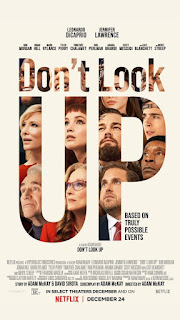
DON'T LOOK UP

 Leonardo DiCaprio     Jennifer Lawrence     Rob Morgan     Jonah Hill     Mark Rylance

Tyler Perry     Timothee Chalamet     Cate Blanchett     Meryl Streep     Ron Perlman


            In the beginning when astronomer Dr. Randall Mindy (DiCaprio) and his graduate student Kate (Lawrence) first discover a “planet destroying comet” headed for Earth they attempt to inform the proper authorities and American people that the country has only six months to get ready for it.  They’re wanting everyone to look up and see the moving light with a tail and understand it is coming our way.  The movie gets its title from those not wanting to accept that a comet is on its way and very dangerous; when it appears to the naked eye in the sky some advise others, “Don’t look up.”

         Well, the movie is a very funny parody about our political times, shining its light on climate change deniers, right-wingers, Fox News, the media’s exploitation of trivialities and current pop interests over serious news, and prominent Republicans who have their own ethics and their own interests at heart.  Topping the list is the President (Streep) with long blonde hair and a primary interest in getting re-elected [her empty-headed son Jason (Hill) serves as her Chief of Staff].  As expected, the President and her “scientific” appointees want to keep the news quiet and just “sit on it” for a while (i.e., until after the mid-terms).  DiCaprio has observed that “Adam [McKay] has woven an incredibly timely message about society, how we communicate, our current priorities, and the climate crisis into an absurdly funny yet important movie."  https://www.elle.com/culture/movies-tv/a37512771/dont-look-up-news-cast-spoilers-date/

       Upon hearing the news, the administration’s reaction and its influence spreads and influences those who similarly want to ignore science and scientists, ridicule them, and even become very nasty toward them on social media. The two scientists’ media advisors tell them to “keep it simple—no math”, to which Dr. Mindy replies, “But it is math!” Clearly, because he is a male and speaks a language many can’t/won’t understand, Dr. Mindy is made a darling; whereas Kate—younger, more articulate in plain language and more in touch with her emotions—becomes a pariah.  And gets arrested by the FBI more than once.

            Even the sexual boundary issues are brought into play, with a sensuous “Daily Rip” TV show host, Brie (Blanchett) seducing Randall and promoting him so long as he does her bidding.  (Her show with co-host, Jack Bremmer (Perry) is clearly a reference to “Fox and Friends” on Fox News.)   In Kate’s circle, the men are aware of the Me Too movement, such as one asking politely if he may touch Kate’s hair in a “nonsexual manner.”  These are anti-war anti-violence protesters who are gentle and respectful of women.  (The currently adored Chalamet plays one of them.)  

            The cast is huge and full of some of our best actors who are at the top of their game.  DiCaprio is almost unrecognizable in his slightly befuddled scientist mode.  It’s good to see Jennifer Lawrence back in action after a brief hiatus, and she plays the fiery young scientist most convincingly.  It’s too bad the writers had both scientists becoming uncharacteristically (for scientists) hysterical and verbally combative at times.  It undermined their believability in a significant way.

            A scene-stealer is Mark Rylance in his most surprising role:  that of an owner of a tech (phone) company who sees himself as a scientist because his company uses algorithms.  He comes across as an odd kind of person, but is a large donor to President Orlean’s campaign, so has her ear.  He convinces her of his alternative plan to deal with the comet, and we see how that works out.

            Entertaining is Ariana Grande’s performance as a pop star whose love life steals away the public’s attention from the impending danger to the outcome of her current romance.  It’s still another comment about the current attention span and the public’s and media’s focus on their idols.  Other actors who should be acknowledged are Rob Morgan as a Black scientist and Ron Perlman as the Administration’s willing sacrificial lamb (who didn’t have to serve when the mission he was on was aborted) but who nevertheless saw himself as a fighter and a hero.

            Adam McKay has had a significant role in movie productions including The Big Short and Vice, and the current TV series “Succession”, but Don’t Look Up seems to be a major shift into satirical parody.  He clearly has his finger on the times, and doesn’t mind at all skewering others when apt.  This is a “feel good” movie for those of us more politically liberal and concerned about the future of our democracy.  It describes so well the world we live in with all its puzzlements and outrageous people and behaviors.

            Don’t Look Up refers to the time when the deniers are the most desperate in wanting people to deny reality.


Don’t Look Up:  A must-see for everyone now living in a most perplexing age as far as people are concerned, but where science is concerned everything is quite clear.


Grade:  A-                             By Donna R. Copeland

Wednesday, June 5, 2019

DARK PHOENIX

Sophie Turner     Jennifer Lawrence     James McAvoy     Michael Fassbender
Nicholas Hoult     Tye Sheridan     Kodie Smit-McPhee    Jessica Chastain


     Enter the world of super powers where the X-Men need only concentrate—perhaps with furrowed brows and taut faces—and the most formidable foe or metal structure can be violently repelled or disintegrated into a puff of smoke.  When you get a whole cast with these powers it can be dizzying, but that doesn’t keep you from being engaged in the story.
Jean is a child in the back seat of her parents’ car tooling down the highway, complaining about the music they’re listening to.  Suddenly she’s in a hospital asking where her parents are. Dr. Charles Xavier (McAvoy) appears and gently verifies her fears that her parents are dead.  It will be OK; Dr. Xavier has a school that might be just right for her, since she is “special” (which she scoffs at). But seriously, he says, it’s a place where children are taught to take pride in their differentness.  It’s clear from this short introduction that Jean has realized that she is different, and can harm others, so despite her misgivings—which voices later on—she agrees to enroll in the school.
     That’s Jean’s childhood; now she is almost grown up (played by Sophie Turner) and has joined the Xavier’s X-Men, albeit still in training.  She’s chosen to go with the group to rescue the NASA space flight of Endeavor, which has run into trouble.  During this mission, she is asked to do a heroic save in the last few seconds, and it’s apparent when she barely escapes with her life that she is changed.  That is, her powers are much stronger.   
     How this happened is a puzzle, although another character later on explains that “it” was given to her for a specific purpose.  The rest of the story is about these powers and the havoc they create for Jean, along with anyone around her.  The story hearkens back to Dr. Xavier’s when he first met Jean; that is, that such “gifts” to someone can be used for good or ill.  The person receiving them can make the decision as to how to exert them.  Although Dr. Xavier will be discredited from time to time, many of his principles will come back to Jean when she is in dire turmoil and pulled in two directions.
     Directed and co-written by Simon Kinberg, who was a producer on previous X-men films (X-Men:  Apocalypse, X-Men:  Days of Future Past, X-Men:  First Class), the film moves along at a fast clip, doesn’t overstay its welcome (less than two hours long), and incorporates substantive moral/ethical issues and emotional truths into an engaging story.  That is, it depicts remorse for mistakes, tensions around the use of power, the importance of “family”—however constituted—and the construction of an identity that “fits.”  
     Following her “Game of Thrones” success as a girl/woman undergoing numerous transformations, Sophie Turner proves she is ready for big-time movies and a starring role.  Aided by creative special effects, as Jean she is transformed into a “phoenix” (mythologically, a bird that regenerates) with powers that overwhelm her at first until she can figure them out.  Here, her upbringing—such as it was—will guide her in making decisions about who she wants to be.  Turner personifies these subtleties in good and evil to a tee.
     An unnamed character, a deliciously evil being without a soul and preoccupied with a quest for power, then appears to try to swing the odds.  She has in mind to use Jean to resurrect the power of a race in decline.  Jean has been a surprise all along, so we wonder what she will do…
     Fine casting strengthens this film’s success in storytelling.  James McAvoy embodies the person who has achieved acclaim but has to come to terms with mistakes he’s made.  The remorse shown is palpable.  Michael Fassbender’s initial befuddlement and subsequent resolve helps keep the tension at an optimum level, and supporting actors, Nicholas Hoult, Tye Sheridan, and Kodie-Smit-McPhee contribute significantly to the drama.
     Although knowledge of previous X-Men films will help in making sense of this rendition, it’s not a strict necessity, except perhaps in identifying the characters.

An exciting journey into the X-Men universe, with women holding their own—even starring.

Grade:  A                                    By Donna R. Copeland

Thursday, March 1, 2018

RED SPARROW

Jennifer Lawrence     Joel Edgerton     Matthias Schoenaerts     Charlotte Rampling
Mary-Louise Parker     Jeremy Irons


      A spy story can be a perfect thriller, especially when double-dealing is a part of it.  Red Sparrow refers to a Russian intelligence operation that trained young recruits how to extract information from targets by engaging them, giving them what they want, and gradually building trust. 
     The problem here is that young Dominika (Lawrence) a Bolshoi ballet dancer, has her career abruptly curtailed when her leg is injured permanently.  Dominika is desperate now, because the Boishoi pays for her rent and her mother’s medical care.  Forthwith, her Uncle Vanya (Schoenaerts) offers her a role in the Russian state security, where he has a high position.  “There are no accidents”, he declares ominously, making you wonder how Dominika’s leg injury came about.  He is frank about the kind of commitment it will take on her part, and reminds her that she doesn’t really have other prospects for taking care of herself and her mother.
     Vanya initially gives her a cryptic assignment, where she does very well; however, there is another agenda of which she is unaware.  She is very successful until…  Now, she has witnessed something that makes her dangerous, which gives Vanya additional leverage, which he uses by having her enroll in a special training program on the psychological manipulation of others.  Here, she is advised on principles such as to “forget sentimental morality”, given instruction about guns and shooting, and picking locks.  “Innure yourself to what you find repellant.”  “Learn to love on command.” Basically, the ends justify whatever means they need to use. 
     This is a time when the Cold War between the U.S. and Russia is still continuing.  On the American side, one of its CIA agents makes an error in judgment, and is sent home from Moscow.  Nash (Edgerton) is a dedicated operative who has spent years cultivating a source.  His burning desire to get back in the field is to hold onto this source, who won’t talk to anyone else. 
     One of the delightful intrigues in this film is to see how each side has more than an inkling as to what the other side is doing.  This means, of course, that Dominika and Nash will cross paths.  But I won’t give any spoilers as to how and how many times this comes about, but it is one of the most entertaining aspects of the film.
     Francis Lawrence has directed the Red Sparrow in an optimal way for this type of film, in which the viewer is challenged to figure out what is going on at every step, even to the ending of the story.  I think the standout actor is Schoenaerts, who has an uncanny resemblance to Vladimir Putin, which is enhanced by the actor’s skill in portraying Putin’s mannerisms and persuasive ways of reasoning.  He can be truly intimidating and terrifying.  Jennifer Lawrence and Joel Edgerton are skilled actors who always bring their characters to life, but in this instance, charisma between the two was slightly amiss.  Of course, Charlotte Rampling as the “Matron” is intimidating and precise in her dispassionate “teach by the book” approach to training in unorthodox(?) techniques.  Additional supporting actors who enhance the quality of the film include Jeremy Irons and CiarĂ¡n Hinds as Russian security agents, Joely Richardson as Dominika’s mother, and Mary-Louise Parker as an informer.
     This is a spy story that will not disappoint.  I have an objection to the level of violence and torture portrayed (from which everyone seems to recover miraculously), and wish that filmmakers would see that it is not really necessary.

A spy’s creed:  “Everyone is a puzzle of need.  Give him what he wants, and he will be yours.”

Grade:  B+                                    By Donna R. Copeland

Thursday, September 14, 2017

mother!

Jennifer Lawrence     Javier Bardem     Ed Harris     Michelle Pfeiffer    
Brian Gleeson     Domhnall Gleeson     Kristen Wiig


      mother! could be seen as an allegory, one about an artist’s insatiable need for love and admiration.  The story begins in an ordinary way, with a young couple, played by Jennifer Lawrence and Javier Bardem (they’re never given names, nor are any of the characters, making it seem even more like an allegory), living in what looks like an idyllic setting, a romantic old house belonging to his family they are refurbishing—well, actually she’s refurbishing it; he is a serious poet with strict boundaries around his writing room. 
     Home invasion #1 occurs when a man (Harris) suddenly appears at the door, and the poet invites him in, clearly delighting in what he says about the poet’s work.  Sometime after, another visitor arrives, and she turns out to be the man’s wife (Pfeiffer).  Ignoring his wife’s cautions, the poet magnanimously tells them they can stay as long as they please, also ignoring their sense of entitlement and bad behavior as guests.  After two sons of the guests (B Gleeson and D Gleeson) arrive, the family has a major dispute about a will that devolves into a trip to the hospital for one of them.
     After these guests leave, the poet and his wife have a period of blissful retreat, during which she gets pregnant and he finishes a major work.  She is so happy and hopeful, and he seems genuinely pleased.  Then home invasion #2 occurs after his book is published; hordes of fans, along with the publisher (Wiig) arrive to celebrate.  The mayhem is captured in many scenes to come.
     All the while, the house gives off creepy sounds and groans as if it were a character itself; blood stains appear and travel/transform with pungent meaning.  Occult signs and portents are everywhere.  Aronofsky seems to be making a major point about stardom and fandom, how they feed off one another, and how they can go out of control. 
     I’m a fan of Aranofsky, and like the idea of showing so graphically how artist and fan are so reciprocal, how the artist can be seduced at whatever cost, and how the mob mentality of fans seems to have no limits.  But in this film, I think he went over the top in prolonging the invasion scenes so that they take over the movie.  This gets tedious very quickly.  I did get a huge kick out of seeing the fans literally interpret the poet’s words to mean that when he says “share”, that entitles them to have what is his.
     Clearly, Jennifer Lawrence and Javier Bardem pulled out all the stops in their performances.  And Ed Harris and Michelle Pfeiffer, with their relatives (the Gleesons), are able to add a touch of the comedic to offset the horrors.  I wish Wiig’s appearances had been highlighted more, as she is so camera-grabbing in the brief times we see her.

Ah, yes, one of the successful artist’s challenges is managing fandom.

Grade:  C+                                    By Donna R. Copeland

Tuesday, December 20, 2016

PASSENGERS

Jennifer Lawrence     Chris Pratt     Michael Sheen     Laurence Fishburne     Andy Garcia


          The movie opens with the majestic golden space ship Avalon gliding through space with a canopy of stars all around and asteroids flying by.  We don’t know it yet, but it will be 90 years before its arrival on Homestead II, the planet waiting to be populated by the 5,000 passengers aboard who are seeking a new beginning in life.  They are all asleep in glass cocoons, “in hibernation”, until four months before the planned arrival.  But if this film makes one eminent point clear, it is how challenging it is to imagine and plan for all possible eventualities in a complex organization.
          It seems like every circumstance has been anticipated and planned for.  The ship is equipped with all replaceable parts, and computers solve just about every problem that arises.  There’s also a library with manuals seemingly covering every operation.  Ah, but something mysterious is about to take place:  One passenger is awakened 90 years too soon.
          Try to imagine waking up in a sleek, ultra-modern ship with absolutely no one around.  Voices of robots speak to you, but are obviously not programmed to answer the all-important question of “Why am I awake?”  Your memory is fine, and you well remember signing up for the journey, but gradually it dawns on you that you are way too early.  Fortunately, Jim Preston (Pratt) is a mechanical engineer who has the skills to explore the ship and figure out how to push the buttons that will provide food and other necessities.  But he has no idea why he is awake.
         Time goes by, and Jim’s one social salvation is the android bartender Arthur (Sheen)—always cheerful, chatty, and attentive—but still robotic, unlike the AI Ava in Ex Machina, who has the ability to reason.   So Jim gets very lonely, even desperate.  He gets curious about the other passengers and starts reading up on one, Aurora Lane (Lawrence).
        Norwegian director Morton Tyldum knows how to portray intrigue, as in his previous films, Headhunters and The Imitation Game.  Both are nuanced and pace the story well for thrillers, as he does in Passengers.  He, and in this case with writer Jon Spaihts, illustrates so well human reactions in confronting these kinds of dilemmas.  When Jim wakes up, we are there with him in his disorientation; when one character experiences extreme betrayal, we feel it; when there are progressive malfunctions on the ship, we’re mystified and on edge.
        All this is supported and enhanced by the noteworthy performance of the two lead actors, Chris Pratt and Jennifer Lawrence.  He evinces befuddlement, abhorrent reaction, left-brain problem solving, boyishness, and tenderness in just the right degrees.  And Lawrence is a consummately skilled actress bringing wide dimension to every character she portrays.  She can be flirty, puzzled, or assertive in taking charge, and just as well show the thrusting pangs and anguish of having been betrayed or of deep emotional involvement. 
        It’s too bad that reviewers are giving away much of the plot that makes Passengers exciting.  I liked that we didn’t know the reason for Jim’s waking up early until two-thirds of the way through the story or how it came about that Aurora was awake.  Isn’t it ironic that studios confiscate phones before a screening to guard against divulging the plot, and then critics come out with key points on opening day or before? 
          This is a harrowing journey that puts us in a strange milieu where we wonder what we would do in similar circumstances.

A thrilling space adventure that shows humans forced to cope with unanticipated events.

Grade:  B                                    By Donna R. Copeland

Thursday, December 24, 2015

JOY

Jennifer Lawrence   Bradley Cooper   Robert De Niro   Virginia Madsen   Isabella Rossellini   Diane Ladd   Edgar Ramirez   Elisabeth Rohm


            David O. Russell knows families, and in Joy he portrays them once again in all their glory—and shortcomings.  He wrote the script based partly on a true story by Annie Mumolo about a young housewife who was creative and resourceful from childhood.  Her grandmother predicted she would soar to great heights someday, although the journey would be challenging.  In young adulthood with a divorced husband still at home, two kids, a grandmother, and resident parents who are divorced, Joy (Lawrence) is the mainstay for all of them.  When it is clear she will need to support everyone financially as well as emotionally, she invents a handy “Miracle Mop” that doesn’t have to be wrung out by hand and can be thrown into the washer to clean it for the next room.  In addition to showing what happens across time in the family, the film shows the development of this remarkable woman from a simple housewife to an astute but compassionate businesswoman.
            Russell goes a bit over the top in depicting this motley group, with a helpless mother (Madsen) who stays in bed and watches TV, a father (De Niro) who lacks the sharpness to run his own auto shop business and needs a woman to support him, and an ex-husband (Rodriguez), a club singer who can’t seem to get a place of his own, and a competitive half-sister (Rohm) who is rather a dim bulb.  They are all dependent on Joy and continually interrupt her for something they need.  She does have support from her grandmother (Ladd) and her kids, whose expressions always indicate that they are clearly understanding their mother and what is going on around them.  I always appreciate Russell’s respect for children’s perceptiveness and wisdom.
            Family members contribute to the comedy in Joy (and there are dozens of funny moments), but the serious, more in-depth and fascinating aspect of the drama is Joy’s transformation across time, giving credence to her grandmother’s predictions and encouragement and her early creativity and intelligence (valedictorian of her graduating class).  Without anyone to show her the way, Joy has to try to sell her own product on television’s QVC, out-maneuver contractors who try to cheat her, and somehow secure the patent she needs for her own invention.  Bradley Cooper, a staple in any Russell-Lawrence film has the role of a supportive executive at QVC who gives her a second chance when the first attempt fails.
            Danny Elfman’s music meshes artistically with the 1980’s culture and the mood of each scene, helping to carry it along its lyrical way.  Similarly, Linus Sandgren’s cinematography is ordered and sharp in the chaos of the story, helping to convey mood and spirit.  Or starkness, as when we see Joy in a bare, austere hotel room confronting a man she has never seen before to negotiate a settlement. 
            Jennifer Lawrence and David O. Russell seem to have a special synchronicity in their work together (and Bradley Cooper fits in seamlessly here, although he has a small role), and it shows in the quality of the films they make.  The supporting cast couldn’t be better, especially Robert De Niro, Virginia Madsen, and Edgar Ramirez.  But the topper is Isabella Rossellini, the wealthy widow who stands to lose everything she has by investing in this crazy family.  Rossellini brings such authenticity to the role you could swear she must have lived some aspect of it.

Joy—a joy to see—except when it’s sad and exasperating, and even then it’s entertaining.

Grade:  A-                                    By Donna R. Copeland

Friday, November 20, 2015

THE HUNGER GAMES: MOCKINGJAY, PART 2

Jennifer Lawrence   Josh Hutcherson   Liam Hemsworth   Woody Harrelson   Donald Sutherland   Julianne Moore   Elizabeth Banks   Stanley Tucci, Philip Seymour Hoffman


          Mockingjay Part 2 is a fitting and tender ending to the Hunger Games series based on Suzanne Collins’ books.  Most of Part 2 is very dark, and we lose key people during the battle to undermine the Capitol and get rid of President Snow (Sutherland).  The rebels, led by Alma Coin (Moore) with Katniss Everdeen (Lawrence) as a figurehead, hope to establish a free state in which democracy is the rule.  Peeta (Hutcherson), whose mind got jumbled when he was captured by Snow, is angry and paranoid about Katniss, but with the support of the core group will gradually get things sorted out.
      Pursued by Snow’s troops and risking their lives avoiding pockets of embedded weapons throughout the city, Katniss and her group make their way to the Capitol to achieve their mission, forging the underground sewer system and hiding out in the Hunger Games’ former stylist Tigris’ lair for a short rest, they receive the announcement from Snow that the city is to be evacuated to the Capitol where they will receive food, clothing, and health care.  This seems like a perfect opportunity to get to the capital by disguising themselves in Tigris’ store of clothes, and they make their way in the midst of the crowds.
      Although they are still guarded and afraid, the group forges on, but sabotage and betrayals are still ahead.  Who will survive, and will they be able to accomplish their mission?
Director Francis Lawrence and screenplay writers Peter Craig and Danny Strong improved this production as compared to part 1; however, neither holds up to the exciting, creative work done with Catching Fire.  For some reason (and acknowledging that I have not read Collins’ books), Katniss is much more passive in 2 and 3 than she was in Catching Fire, where she was like a ball of fire.  I prefer the more heroic, three-dimensional version of her in the first installment.
        Lawrence is a fine actress and performs at her best here, given the script.  Hutcherson and Hemsworth, rival suitors for her affections, are also very good, and have a discussion about their rivalry, unaware that she is listening to them.  It is a sweet, heartfelt moment, and one of the only scenes where humor comes into play. 
        Brief glimpses of Harrelson, Sutherland, Moore, Banks, and Tucci are rewarding to see, artfully playing the significant characters we’ve come to know.  It was bittersweet to see the late Philip Seymour Hoffman looking as if he had just acted out his part.  How we miss him!

A fitting conclusion to a popular series of fantasy fiction.

Grade:  C By Donna R. Copeland