Showing posts with label Meryl Streep. Show all posts

Wednesday, December 8, 2021

DON'T LOOK UP

 Leonardo DiCaprio     Jennifer Lawrence     Rob Morgan     Jonah Hill     Mark Rylance

Tyler Perry     Timothee Chalamet     Cate Blanchett     Meryl Streep     Ron Perlman
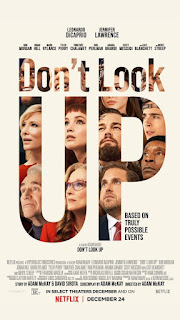


            In the beginning when astronomer Dr. Randall Mindy (DiCaprio) and his graduate student Kate (Lawrence) first discover a “planet destroying comet” headed for Earth they attempt to inform the proper authorities and American people that the country has only six months to get ready for it.  They’re wanting everyone to look up and see the moving light with a tail and understand it is coming our way.  The movie gets its title from those not wanting to accept that a comet is on its way and very dangerous; when it appears to the naked eye in the sky some advise others, “Don’t look up.”

         Well, the movie is a very funny parody about our political times, shining its light on climate change deniers, right-wingers, Fox News, the media’s exploitation of trivialities and current pop interests over serious news, and prominent Republicans who have their own ethics and their own interests at heart.  Topping the list is the President (Streep) with long blonde hair and a primary interest in getting re-elected [her empty-headed son Jason (Hill) serves as her Chief of Staff].  As expected, the President and her “scientific” appointees want to keep the news quiet and just “sit on it” for a while (i.e., until after the mid-terms).  DiCaprio has observed that “Adam [McKay] has woven an incredibly timely message about society, how we communicate, our current priorities, and the climate crisis into an absurdly funny yet important movie."  https://www.elle.com/culture/movies-tv/a37512771/dont-look-up-news-cast-spoilers-date/

       Upon hearing the news, the administration’s reaction and its influence spreads and influences those who similarly want to ignore science and scientists, ridicule them, and even become very nasty toward them on social media. The two scientists’ media advisors tell them to “keep it simple—no math”, to which Dr. Mindy replies, “But it is math!” Clearly, because he is a male and speaks a language many can’t/won’t understand, Dr. Mindy is made a darling; whereas Kate—younger, more articulate in plain language and more in touch with her emotions—becomes a pariah.  And gets arrested by the FBI more than once.

            Even the sexual boundary issues are brought into play, with a sensuous “Daily Rip” TV show host, Brie (Blanchett) seducing Randall and promoting him so long as he does her bidding.  (Her show with co-host, Jack Bremmer (Perry) is clearly a reference to “Fox and Friends” on Fox News.)   In Kate’s circle, the men are aware of the Me Too movement, such as one asking politely if he may touch Kate’s hair in a “nonsexual manner.”  These are anti-war anti-violence protesters who are gentle and respectful of women.  (The currently adored Chalamet plays one of them.)  

            The cast is huge and full of some of our best actors who are at the top of their game.  DiCaprio is almost unrecognizable in his slightly befuddled scientist mode.  It’s good to see Jennifer Lawrence back in action after a brief hiatus, and she plays the fiery young scientist most convincingly.  It’s too bad the writers had both scientists becoming uncharacteristically (for scientists) hysterical and verbally combative at times.  It undermined their believability in a significant way.

            A scene-stealer is Mark Rylance in his most surprising role:  that of an owner of a tech (phone) company who sees himself as a scientist because his company uses algorithms.  He comes across as an odd kind of person, but is a large donor to President Orlean’s campaign, so has her ear.  He convinces her of his alternative plan to deal with the comet, and we see how that works out.

            Entertaining is Ariana Grande’s performance as a pop star whose love life steals away the public’s attention from the impending danger to the outcome of her current romance.  It’s still another comment about the current attention span and the public’s and media’s focus on their idols.  Other actors who should be acknowledged are Rob Morgan as a Black scientist and Ron Perlman as the Administration’s willing sacrificial lamb (who didn’t have to serve when the mission he was on was aborted) but who nevertheless saw himself as a fighter and a hero.

            Adam McKay has had a significant role in movie productions including The Big Short and Vice, and the current TV series “Succession”, but Don’t Look Up seems to be a major shift into satirical parody.  He clearly has his finger on the times, and doesn’t mind at all skewering others when apt.  This is a “feel good” movie for those of us more politically liberal and concerned about the future of our democracy.  It describes so well the world we live in with all its puzzlements and outrageous people and behaviors.

            Don’t Look Up refers to the time when the deniers are the most desperate in wanting people to deny reality.


Don’t Look Up:  A must-see for everyone now living in a most perplexing age as far as people are concerned, but where science is concerned everything is quite clear.


Grade:  A-                             By Donna R. Copeland

Tuesday, December 24, 2019

LITTLE WOMEN

Saoirse Ronan     Emma Watson     Florence Pugh     Eliza Scanlon     Laura Dern
Timothee Chalamet     Tracy Letts     Bob Odenkirk     Chris Cooper     James Norton     Meryl Streep


     Greta Gerwig updates this traditional story based on Louisa May Alcott’s book for girls by emphasizing the March girls’ ambitions, particularly those that depart from the standard get-married-have children tale.  Most notable are the lines inspired by Gerwig’s conversation with Meryl Streep, who plays Aunt March in the film, during first conceptualizations of the film.  The lines are spoken by Amy March (Pugh), the youngest sister, complaining about women not having rights—they can’t own anything; if they leave a marriage, even property they had before marriage, even their children, would belong to the husband.
     Much of the film, however, adheres to Alcott’s novels.  Four sisters are being brought up by their mother while their father is serving as a chaplain during the Civil War.  Marmee (Hurd) is a strong female model for them, managing—with the help of the two older daughters Jo (Ronan) and Meg (Watson)—financially, and beyond that, instilling strong values (helping the sick and the poor, with a strong commitment to forgiveness) in her daughters.  
     The family reflects the temper of the times, particularly where women are concerned. What makes the story most interesting are the differences in personality and temperament among the four sisters, and how these play out with family and friends.  Jo departs most from the norm by pursuing independence at almost any cost, Meg by marrying for love over “prospects”, Beth (Scanlon) by her musical ability, and artistic Amy at first by her self-entitlement and later by her practicality. 
     A bonus in this rendition of Little Women comes at the end when Jo is clearly taking charge of her career by cannily negotiating with the editor Mr. Dashwood (Letts) on a cash advancement, copyright, and share of the profits.  (Although she does have to make one major compromise so that the story ending will sell.)
     Yorick Le Saux’s cinematography with its warm, bright palette and vividness of interior and outside scenes contributes majorly to the production, helping to give it soul, along with the pleasant, era-capturing score of Alexandre Desplat. Saoirse Ronan’s performance is exemplary, attaining the promise of her work in HannaBrooklyn, and Atonement, and being a major force in capturing our attention.  She is well supported by Emma Watson, Florence Pugh, Eliza Scanlen, and Laura Dern as sisters and mother.  As love interest to more than one sister, Timothee Chalamet glitters as an honorable heartthrob not just for the sisters, but for some audience members as well.  It is a treat to see Tracy Letts playing the discerning publisher with a soft heart, following on his bombastic performance as Ford in Ford v Ferrari. Likewise, seeing Chris Cooper as a benevolent, wealthy Mr. Laurence after the revolting father he played in A Beautiful Day in the Neighborhood is refreshing.  Finally, Meryl Streep proves her value once again in playing a rich dowager who is bound to the past.
     Perhaps because I personally was never an impassioned devotee of Little Women, I’m not enthralled with Greta Gerwig’s remake of the classical tale.  Interesting and entertaining as it is, it makes me question remakes in general. That is, this tale has been told on stage, on television, and in film almost continuously since 1933.  This version, although set in the 19thcentury, is meant to capture the sentiments of today.  And it does, with flair to a great extent.  I just have a problem with telling a story already well told.

19thCentury women being little women—already a tale well told.

Grade:  B                        By Donna R. Copeland


Thursday, December 20, 2018

MARY POPPINS RETURNS

Emily Blunt     Dick Van Dyke     Meryl Streep     Angela Lansbury     Emily Mortimer
Colin Firth     Lin-Manuel Miranda     Ben Wishaw     Julia Walters


     Everything is coming apart at the seams in the Banks household; Mr. Michael Banks is grieving for his wife, and is having a hard time managing without her. Their three children are remarkably responsible, but they are just children, and the housekeeper/cook is losing her grip as well.  Michael’s sister Jane comes by from time to time and does what she can to bolster things up, but a major threat looms with the possibility that the house Michael and Jane grew up in will be repossessed by the bank after Michael missed three payments. 
     Yes, it seems like the perfect time for Mary Poppins to drift down on her umbrella and pop in (sorry—couldn’t resist the pun).  It happens magically—as do many things having to do with the nanny—when young Georgie chases after a kite and it keeps rising with him attached. Jack, the town lamplighter, is helping Georgie pull the string with all his might to bring the kite down, when who should appear down through the clouds but Mary herself.
     Now, the three children don’t know who she is, as she was the nanny for their father and Aunt Jane when they were kids.  And when they learn that she has come to be a nanny for them—humpf!—these responsible children, especially the two older ones, can’t see the need. Michael is troubled because he can’t see how they’ll be able to afford her, but Jane—often the voice of reason—advises him to welcome her.
     Of course, it doesn’t take long for Mary Poppins to exert her authority and magic (just what the family needs). She wows them with a few things, but wins them over with a thrilling and beautiful sequence where she prepares a wondrous bubble bath with all kinds of beach-type things thrown into the bubbles then shoves each child in for their bath.  She follows, and we are treated to some of what Disney does best: a colorful fantastical trip down into the ocean filled with exotic marine life.  This is the kind of nanny to have.
     All sorts of intrigues, emergencies, and close calls follow, and it’s touch-and-go until the very end.  Director/producer Rob Marshall’s follow-up to the 1964 production of Mary Poppins is largely successful in sustaining the Poppins and Disney brands, being entertaining for children and adults, and achieving a mixture of fancy, excitement, and human values.  
     Emily Blunt has received a lot of advance press about her Mary Poppins role, and she comes across splendidly.  Contrast her role here and of that in A Quiet PlaceEdge of Tomorrow, and Sicario, for example, to appreciate the full range of this actress’s talent.  Her acting here is as praiseworthy as in other films; however, as good as her voice is, she is not up to Julie Andrews’ first Mary Poppins (1964), and that is a slight detraction.  In a similar, but different way, Lin Manuel Miranda’s voice, while very fine and engaging, doesn’t quite mesh; although I think this has more to do with the composers’ (Marc Shaiman, Scott Wittman) work than as a function of his voice and skill.  When he sings in rap—which he is known for, and which I presume he has contributed to the material—he is his usual fine performer.  (I dearly loved hearing his British accent.)  Overall, I think the score lacks the pizzazz of the 1964 version.  When Blunt and Miranda sing together, they almost rescue the whole score.
     A standout here is Meryl Streep as Topsy; she can immerse herself into a role so completely it’s hard to find Streep in it.  The sequence with her is one of the most entertaining in the film, and brings up important points for both children and adults about perspective. 
     Other instructive sequences for children include ways to think about and deal with the loss of a loved one, the message that even if one is a child he/she can be helpful to adults, and the optimistic idea that things that may seem impossible can actually be accomplished.
Cameo performances by Dick Van Dyke (reprised from the first rendition), Angela Lansbury, and Colin Firth are entertaining and engaging.  

An updated version of the Mary Poppins story that largely succeeds.

Grade:  B                                    By Donna R. Copeland

Wednesday, December 27, 2017

THE POST

Meryl Streep     Tom Hanks     Matthew Rhys     Sarah Paulson     Bob Odenkirk    
Tracy Letts     Bradley Whitford     Bruce Greenwood     Alison Brie


     Steven Spielberg’s production of The Post, based on true events and smartly written by Elizabeth Hannah and Josh Singer (Spotlight, The Fifth Estate), is as exciting and tension filled as a good mystery story.  (I was glad I knew how everything turned out, so I could relax a bit.)  It’s about the time Daniel Ellsberg, a military analyst employed by the Rand Corporation, released classified information to the New York Times, and then to the Washington Post, about the complicity of four U.S. Presidents (Truman, Eisenhower, Kennedy, Nixon) and their administrations in covering up significant U.S. operations during the Viet Nam War. 
    The Post refers to the Washington Post newspaper, which obtained classified documents after the New York Times broke the story.  The dilemma Publisher Katherine Graham (Streep) and Editor Ben Bradlee (Hanks) face after the government has already initiated legal action against the Times, is whether to publish information that came to them from the same source, Daniel Ellsberg (Rhys).  These are papers reporting on a study requested by the Secretary of Defense, Robert McNamara (Greenwood) about the progress of the Viet Nam War from 1945-1967, and document the U.S. Government’s complicity in covert operations, rigging elections, and lying to the Geneva Convention, and then covering it up, essentially lying to the American people about the Viet Nam War.  Most egregious of all, is its sending young servicemen into battle for a war they knew couldn’t be won.
     There are numerous aspects of the story that the filmmakers highlight, which are relevant today.  First and foremost is the issue of the need for government secrecy versus freedom of speech.  At the time, President Nixon was so incensed about the actions of the New York Times, he sought legal action against it.  Some of the more clever scenes in The Post are views through the Oval Office windows of Nixon talking on the phone and making his threats. 
     Another theme I appreciated is a picture of how women were regarded during that era, and another of the film’s highlights is how Katherine Graham is treated by men, even though she is the wealthy publisher of a major newspaper.  Her editor somewhat grudgingly gives her respect, as does Defense Secretary Robert McNamara who is a personal friend, but others clearly think she is out of her element in making major decisions, when—in fact and in retrospect—she is highly qualified.  When push comes to shove, she and Ben Bradlee are shown to be brave and heroic at considerable personal risk.
     Steven Spielberg directs a masterful work based on a true story, but with the intrigue and excitement of a fictional drama.  The cast is outstanding, highlighted by Meryl Streep as Katherine Graham and Tom Hanks as Ben Bradlee.  Their conversations are as enlightening as they are interesting.  Bob Odenkirk, Tracy Letts, Bruce Greenwood, and Matthew Rhys providing superb acting support.  Sarah Paulson as McNamara’s (Greenwood) wife shines in her argument to her husband about the greater bravery shown by Graham at a time when he is feeling besieged.  It was rewarding later to see that he listened to her and at a later time gave Graham credit.

Get informed about a critical event in U.S. history while enjoying an exciting drama.

Grade:  A                                                By Donna R. Copeland

Friday, August 12, 2016

FLORENCE FOSTER JENKINS

Meryl Streep     Hugh Grant     Simon Helberg


              Stephen Frears has created a farce about a woman who is tone-deaf, but imagines she can sing beautifully—something someone might see on television’s “The Voice”, actually.  But the difference here is that thousands are taking part in her delusion in a folie à deux-mille.  Granted, at one concert it requires a brassy woman from Brooklyn to whistle at everyone who’s laughing, and make them shush and listen with respect.  This is one of the finest moments in the movie when she makes clear what the film is about:  That matching Florence’s own generosity and warm-heartedness should be returned in full.  This film is based on a true story in which a wealthy woman insists on giving concerts when she has no talent.  But she was surrounded by her people—some who were sycophants and some who genuinely cared for her—and we’re told at the end of the film that the recordings made by Foster Jenkins are some of the most requested from the Carnegie Hall Archives.  So the woman’s popularity is not made up.  I think this is the only instance in movies I’ve seen that generosity and warm-heartedness trumps critical opinion and analysis.  (Bravo! Florence Foster Jenkins!)
         For someone who can really sing, pulling off an off-key performance must be extremely difficult, but of course the ever-talented Meryl Streep has no problem.  As Florence, she screeches, whinnies, and groans like the worst of them (bad singers)—all with an earnest face and magnanimous heart.  I understand from one of her interviews that she actually had to learn to sing the arias the right way before she began to sing them purposefully off key.  She and Hugh Grant make a loving pair in a union with perhaps the same level of denial that is shown toward her voice:  Of course, it’s perfect!  They play the two characters like the old pros they are.
              Almost as much of a star in this film as Streep is Simon Helberg, who plays the role of pianist for Foster Jenkins.  His facial expressions are something to behold, from the time he first hears Florence sing to the end when disbelief and feeling aghast evolves into surrender and love.  We laugh at his horror about as much as we laugh at Streep’s voice.
        Earlier this year, I saw another rendition of the Florence Foster Jenkins story (Marguerite, a French-Czech-Belgium production directed by Xavier Giannoli and starring Catherine Frot.)  Frears has clearly gone for more of a comedic touch—a hearty laugh compared with Giannoli’s smile.  I like both treatments—they make for interesting contrasts—but in both I wearied of listening to the grating sounds that come from the actress’s voices.  Is there anything worse than bad singing of operatic arias? 

Allow yourself to be drawn into a delusion.

Grade:  B                                    By Donna R. Copeland

Monday, October 27, 2014

THE HOMESMAN

Tommy Lee Jones     Hilary Swank     Grace Gummer     Miranda Otto    
Sonja Richter     Meryl Streep     John Lithgow     James Spader


     The Homesman is not your typical western movie; it has more to do with human psychology and sociology, and what sometimes happens to those who are under stress and ill-equipped to manage.  Mary Bee Cuddy (Hilary Swank) is apparently not one of these; she farms a homestead on her own, maintains her house, goes to church, does her Christian duty, and plays the piano.  When she doesn’t have a physical piano, she fingers a cloth keyboard and sings.  When three women in the congregation lose their minds, she volunteers to take them east to Iowa so their families can take care of them.  When two women protest that as a woman she should not take on the task, the minister (John Lithgow) says she is “as good a man as any man hereabouts.”
     She is nervous about transporting them in a wagon across the prairie, however, and when she comes upon a man (Tommy Lee Jones) hanging from a tree, she agrees to cut him down if he will help her take the women east to their families.  He agrees only out of desperation; he is not ready to die.
     The women are indeed psychotic; one has to be tied down because she attacks whoever is in sight.  They seem to have been driven crazy for various reasons, such as losing children to disease, but the film does not always clarify their histories.  We’re introduced to them rapidly in the beginning without much explanation—which I see as a weakness in the exposition. 
     At any rate, the women are loaded onto a makeshift wagon that can be locked from the outside, and Mary Bee Cuddy and “George Briggs”—a name he decides to call himself—take the reins of the horses and head out.  You can imagine (I actually had a hard time of it) some of the issues they would encounter along the way (a runaway, Indians, snow), let alone hygiene (one of the woman has to be held and told to pee), food preparation, sleeping arrangements, etc.  As expected, Cuddy and Briggs will have major disagreements along the way to establish dominance.  The resolution of their conflicts and the outcome of their destination is one of the perhaps unique and surprising endings of a western genre film.
     The Homesman is well directed by Tommy Lee Jones, and the cinematography by Rodrigo Prieto is exquisite.  The main actors (Jones, Swank, Lithgow, Spader, and Streep) are some of the best and shine in their roles.  Jones has a couple of song and dance routines that are totally out of his usual character presentations and are a hoot—although you may not be able to understand the lyrics; it’s enough to watch him dance and shout.    Swank easily conveys Cuddy’s strengths, and is able to elicit sympathy—maybe even pity—from the audience during her times of weakness.  Spader and Streep have only cameo roles, but are powerful in the brief time they are on screen.  The actresses portraying the psychotic women (Grace Gummer, Sonja Richter, and Miranda Otto) capture their distresses perfectly.
     The Homesman is not likely to be a film for everyone; I had mixed feelings about it when I left the theater—presumably because of some of the more depressing, hopeless scenes, as well as a rather surprising ending.  In addition, I think one character in particular is not consistent across time with how she is presented initially—not that I’m saying people don’t change, only that how this character is presented in the beginning does not plausibly lead to what happens later.  Not so with Briggs or the psychotic women, all of whose personalities are entirely consistent with their characters throughout. 

Not a homespun tale.

Grade:  B-                        By Donna R. Copeland

Friday, October 25, 2013

AUGUST: OSAGE COUNTY

Meryl Streep     Julia Roberts     Chris Cooper     Margo Martindale     Ewan McGregor     Sam Shepard 
Julianne Nicholson     Benedict Cumberbatch     Juliette Lewis     Abigail Breslin


       August:  Osage County is a rip roarin’ study of a family in Oklahoma that is perpetually on a tinderbox.  The slightest disagreement can erupt into a major battle, and the only way they see to keep the lid on is to hide all their secrets.  Of course, this is a strategy that always fails, but like the good neurotics they are, they keep using it, thinking it will work.  As the story proceeds, we learn that the cruel parenting we witness stems from troubled childhoods, and we see it spread like an infection from parent to child across generations.  As each secret is uncovered, it has an explosive effect on all involved.
     On a more elegant note, the ensemble cast is a study in streamlined acting that continually hums along as if they had worked together for years and filled out every detail.  At the center of the story—and the cast—is the consummate award-winning actress Meryl Streep, who plays the damaged matriarch in a family with three grown daughters who have come home to “comfort” their mother after a crisis.  Her sister is present as well, with her husband and son in tow.  Present as well is the recently hired cook/housekeeper who is a beacon of sanity in the dysfunctional, turbulent group.
     The screenwriter Tracy Letts (Killer Joe) has based the script on his play with the same title, which premiered on Broadway in 2008.  The transition from stage to screen is not always smooth, but Letts has achieved it without a hitch.  Most of the action takes place in the family home, a beautifully landscaped colonial mansion in the countryside near a lake, or in the cars of the arriving family members.  Clues about the underlying conflicts are seen from the beginning in the interactions between Violet (Streep) and her husband Beverly (Sam Shepard), followed by the arriving sister Mattie (Margo Martindale) and husband Charles (Chris Cooper) and each of the daughters’ families.  In the process of the unfolding drama, the viewer experiences the trapped feeling that each of the characters suffers from; at one point, a character says to another who is running away, “Where are you going?  There is no place to go!”  And we feel trapped as well because the action is so powerful.  Also because, in a larger sense, we identify with the fact that we are always a part of the family to which we belong; there is not ever, really, any escape. 
     John Wells, the director, has performed his function of creating a work of art from all the components of the film, with the actors and other crew, such as the cinematographer Adriano Goldman and musician Gustavo Santaolalla, whose work illuminates the ongoing drama. 

Clearly August:  Osage Country will be prominent in the upcoming award circuit soon to take place.


Grade:  A                                   By Donna R. Copeland