Showing posts with label Ben Mendelsohn. Show all posts

Thursday, December 30, 2021

CYRANO

 Peter Dinklage     Helen Bennett     Kelvin Harrison, Jr.     Ben Mendelsohn
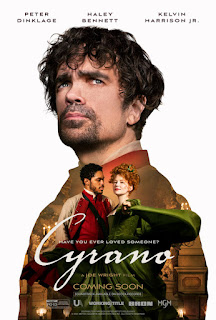

            Cyrano is a musical in which a princess, Roxanne (Bennett), is pining for love, to which her lady in waiting argues that “Love doesn’t last; what lasts is compromise and sacrifice.”  (She means that Roxanne should be looking out for her economic welfare over love considerations), which goes right over the beautiful young woman’s head.  Roxanne (Bennett) sings back that she never wants to marry unless she can find someone to love.  Her current suitor, the Duke De Guiche (Mendelsohn) could indeed be her future, but Roxanne loathes him, and only sees him for what she can get from him (e.g., theater tickets).

            What Roxanne doesn’t know is that her friend since childhood, Cyrano (Dinklage), has always loved her, but thinks that she will simply laugh at him for thinking she could fall in love with such a short man.  The story develops from there, such that the man Roxanne is attracted to (from just a glance) is Christian (Harrison), a handsome guard under Cyrano’s command.  The two exchange one glance from afar and both literally fall in love at first sight (or so it seems).

            When Roxanne confesses to her friend Cyrano her love for Christian, who has just been recruited into the guard, she begs Cyrano to mentor and protect her love.  Since he cannot deny Roxanne anything, he promises to do so, which puts him into a serious bind between his own interest and what he has promised.  This bind leads to his writing love letters for Christian to send as his own to Roxanne.

            It was serendipity that scheduled Houston critics to see Spielberg’s West Side Story the night before Cyrano, giving us the opportunity to contrast the two love stories.  And what a difference; where West Side Story, despite its performance value (and my usual admiration for Spielberg), seemed to me to be a tiresome, dated, story of machismo, Joe Wright’s Cyrano makes an elegiac tribute to a man in an older period piece (17th Century), for whom compromise and sacrifice become very real to him, despite his acclaimed swordsmanship.

            Sprinkled throughout the drama are bits of humor (Cyrano’s claim that “Halloween is my favorite holiday” after he has been called a freak, statements like “Her imperfections are perfect”), insightful observations (a narcissistic young woman singing, “I need more”), the non-glorification of fighting—even in the case of war), and demonstrations of true love (seen in Cyrano’s letters, soldiers’ letters home, and the final scene).

            Screenwriter Erica Schmidt is the one who took a different view of Cyrano the character by focusing not on his nose, but making him a dwarf mocked for his stature, and one who believes no woman could love him as he is.  (There is tenderness in this concept in that Schmidt is married to Dinklage, and she wrote the part specifically for him.)

            Peter Dinklage has long been one of my favorite actors, and it is high time he gets an Academy award for his performance as lead in a major motion picture.  He has numerous other awards to count, but I think it’s time his nominations and awards for “Most Promising Actor” in The Station Agent (2004) and supporting actor for Game of Thrones and Three Billboards Outside Ebbing, Missouri  be followed up with more than a nod from the Academy—for his acting.  Admittedly, singing is not his strong suit, but his resonant bass still pleases.

            Joe Wright’s previous films (e.g., Pride and Prejudice, Atonement, Darkest Hour) are testament to his talent in the art and craft of filmmaking.  Elements contributing to his success in Cyrano include Aaron and Bryce Dessner’s music, Seamus McGarvey’s cinematography, and Sarah Greenwood’s production design, some of whom have collaborated with Wright on other projects.


Cyrano, with the swagger and expert swordplay of Tyrion (Dinklage) in Game of Thrones has a much bigger heart and compassion to go with his more macho qualities.  He is a truly admirable soldier in this production, but as skilled in the art of language as he is in wielding a sword.


Grade:  A                              By Donna R. Copeland

Thursday, June 18, 2020

BABYTEETH

Eliza Scanlen     Toby Wallace     Ben Mendelsohn     Essie Davis


     This romanticized fabrication of the cancer experience is likely to dismay those who have actually gone through it—especially when the patient is a child.  As someone who worked in a cancer center in Pediatrics as a psychologist for almost 25 years, I found little in the film that resembles any of the hundreds of families I encountered.  
     The backdrop of the film features a family (clearly made up by filmmakers) in which the father Henry (Mendelsohn) is a psychiatrist, the mother Anna (Davis) a musician, and the daughter Milla (Davis) a quirky teenager with cancer. (This is only revealed after a time.)  She chances upon Moses (Wallace) at the train station when she is in some kind of stupor and doesn’t board with her classmates.  Moses has just almost run over her trying to make his train, but she is in a daze.  (No indication as to why.)  He is doing some kind of stretch on the platform when she comes to and he speaks to her.  (Ding ding ding, you should hear the bells sounding.)  
     They speak briefly, and the connection is made (if you believe in fate).  Milla (not one of the in-group in her high school) is smitten at first glance.  What develops is an unlikely story about Milla bringing home this drug dealer who exploits her attraction to him (he from a home that he has been kicked out of) to take advantage of her family who is well off.  But he is not a clear-cut sociopath.  During the course of the story, he often makes sense more than almost anyone else, and clearly matures in due course.
     The film goes into detail in describing the parents.  Henry is a pill-pushing psychiatrist who has little regard for psychotherapy and is easily distracted during his practice.  (Moreover, as a clear-cut ethical violation, he treats his wife in his practice.)  As a result of his prescriptions (the recommended dosage of which she ignores), Anna has become a pill-popping zombie at times.  At one point, Anna states, “This is the worst possible parenting I can imagine”, and I agree.  The parents’ clearly stated pronouncements are never followed up, and they often come across as helpless in the face of life in general.  An example is when Milla goes missing one night, it is ludicrous to see Anna canvassing the city with a picture of her, asking if pedestrians she sees on the street have seen her.
     Milla is portrayed as a cheeky teenager who mostly has a clear idea of what she wants, but is often flummoxed by her parents.  Something in her recognizes what stability Moses has to offer—despite his background—and she clings to him as a lifeboat in a storm. She is realistically portrayed as a thoughtful, sensitive teenager who is trying to make her way despite her parents.
     The whole story of this film seems so made up with unlikely and unconvincing attachments and events, I could not take it seriously.  The actors do a fine job—particularly Eliza Scanlen and Toby Wallace as the young couple—and serve as the strongest features of the film. Ben Mendelsohn has a succession of fine acting roles, but this script doesn’t allow him to exercise the same talent.  Essie Davis as the convincing heroine in Babadookalso gets little here to show off her talent.
     An example of looseness in the integrity of Babyteeth are insensible titles of sections, the whole of which offer little clue to the scenes that follow, including:  Insomnia, Breakthrough, A Little Bit High, Nausea, Fuck this, Romance (part I and II), The Shower Routine, Sleeptalking, Seasons Greetings, What the dead said to Milla, Everyone Was Invited, A Beautiful Morning, and The Beach.
     Although Babyteeth has been well received by critics, I cannot think of anyone I know who would want to see this movie.

A fantastical tale of a teenager with cancer.  No, the ending does not redeem it.

Grade:  D                                    By Donna R. Copeland


Tuesday, December 24, 2019

SPIES IN DISGUISE

Voices of:  Karen Gillan     Rachel Brosnahan     Tom Holland     Will Smith
Rashida Jones     Ben Mendelsohn     Reba McEntire     DJ Khaled     Masi Oka


     This is a high-tech animation that the kids in the audience found at the screening I attended to be great fun.  There are the obligatory scenes of puke, poop, and pee; but the story has substance in pitting a nerdy little peace-loving scientist against a macho master spy who always insists on doing his jobs alone and “fighting fire with fire.”  The scientist Walter’s (Holland) response to that is, “Then we all get burned.” Writers Brad Copeland and Lloyd Taylor have inserted segments that make you chuckle and sometimes laugh out loud when the character Walter uses scientific lingo that few would understand—least of all, Lance Sterling (Smith)—like “spectral analysis” and “thermography”, and “exothermic reaction.”  Walter always explains what he is doing, and he comes up with ingenious inventions to get Lance out of trouble:  a robotic hand (which has gone missing!), glitter that obscures the visual field, and then produces serotonin when the field clears and kittens appear, making the gnarliest of bad guys go, “Aw…” There’s even something that produces a giant hug that envelops the bad guy and traps him in its bubble.
     The gist of the plot is that the young budding scientist is encouraged by his mother to be himself, and reassures him that they are a team and she will always have his back.  He takes these lessons to heart, and is more than puzzled when his path crosses that of ace spy Lance Sterling, who has a habit of dismissing everyone as beneath him. Because he doesn’t really see anyone besides himself, he misses young Walter’s gifted talents and actively tries to swat him away like a fly.
But there is something that will haunt Lance when he discovers someone has stolen an asset from him, and is even passing himself off as Lance, damaging his reputation.
     The film has a number of good points, especially the one in which children will see Walter’s persistence in the face of dismissal and discouragement, his maintaining his integrity throughout, and ultimately becomes a hero for his intelligence and creativity.  Also helpful for children is for them to witness Lance’s transformation from an over-confident narcissist to someone who is reduced to a pigeon (a pigeon?? Yes!!) and learning that other beings have phenomenal skills too, and that they know how to function in a team.
     Voices of actors like Tom Holland, Will Smith, and Ben Mendelsohn (playing the bad guy) bring excitement and verisimilitude to the story, backed up by the talents of Brosnahan, Jones, McEntire, Khaled, and Oka.  Music by Theodore Shapiro adds much to the drama and humor of Spies in Disguise.

Spies in Disguise is entertaining, and a great film for kids to see.

Grade:  A                                    By Donna R. Copeland

Thursday, October 31, 2019

THE KING

Timothee Chalamet     Joel Edgerton     Robert Pattinson     Ben Mendelsohn     Thomasin McKenzie    Lily-Rose Depp


     The King presents an interesting picture of King Henry V of England I in the early part of the 15thCentury.  The script, co-written by Joel Edgerton and director David Michod, draws some from history, more from Shakespeare’s plays, Henry IV and Henry V, and then elaborates on all sources.  The viewer should regard it as primarily a dramatization only loosely drawn from history and Shakespeare.
     As it turns out, the filmmakers have rewritten their sources to create a story about a “reluctant prince” who has major conflicts with his father, King Henry IV (Mendelsohn) about the constant wars the father has waged.  Henry V (Chalamet) is presented first as a playboy who has no desire to be a king, and doesn’t even want to attend to his ailing father. 
     It’s a bit of a stretch that such a person could suddenly turn into an admirable figure as he does in the film, but that’s the drama of it.  After the sudden change, Henry is shown to be a skilled and ferocious opponent in swordplay, a man who is astute and listens carefully to arguments presented to him, and makes shrewd decisions based upon his deductions.  He is not susceptible to indignations purposed upon him by others; he can take decisive, even ruthless, action when he suspects someone is lying or outright betraying him; and he keeps a cool head in negotiations with opponents.  Of course, he is also very handsome and appealing.
     The way Henry V becomes king is his take-charge stance after his father has chosen second son Thomas as his successor, someone who seems not to be a match for his brother, either intellectually or physically.  Henry tries to save him and avoid another war, but Thomas is recalcitrant, and after a series of events and time, the reluctant Henry becomes king.
     The rest of the story is about Henry’s being drawn into war, despite all his efforts against it, his need to identify those around him he can trust, and resorting to finding his old friend and caretaker John Falstaff (Edgerton) to be his primary advisor and strategist (especially in war) and supporter.
     The French don’t come across very well in this story; both the dauphin (Pattinson) and his father, King Charles VI, are disdainful and insolent toward Henry, refusing to go along with the ways he presents to avoid war.  Although they are partially redeemed by their eloquent--rather audacious—princess Catherine (Depp) who stands up to Henry in a very entertaining contretemps.  
     The craft of The King is admirable in Michod’s direction, the music (Nicholas Britell) and the cinematography (Adam Arkapaw), and the actors capture their roles well for the most part, especially Chalamet, Edgerton, McKenzie, and Depp.  Editing (Peter Sciberras) can be faulted for extending the battle scene far too long in a movie that is already over two hours in length. The scenes are effective in showing the bloodiness, muck, and brutality, but become tiring halfway through.
     I liked the Michod and Edgerton’s elaboration on historical events to present a character who is admirable in so many ways, trying to achieve peaceful resolutions, but mindful of counteracting forces.  This Henry V is someone we can admire, but viewers should not go with the expectation of seeing a production up to the level of a play by Shakespeare.

Henry V is an entertaining take-off of Shakespeare’s version, this one having a message of peace and the value of unity.

Grade:  C+                                                By Donna R Copeland

Thursday, March 29, 2018

READY PLAYER ONE

Tye Sheridan     Olivia Cooke     Ben Mendelsohn     Lena Waithe     
T. J. Miller     Simon Pegg     Mark Rylance
Philip Zhao     Win Morisaki     Hannah John-Kamen


      Are you ready for the world of 2045?  Steven Spielberg’s vision is that everyone will be so absorbed in virtual reality (VR) games they’ll be spending most of their time there, rather than in the work-a-day real world.  We get a striking picture of how that will be by watching Ready Player One.  Unfortunately (for me), most of the action is like a video game with car chases, fights, and wars.  But there is a story underlying all the racing around, plotting, and attempts to figure out a master gamer’s clues leading to a lot of money and ownership of the Oasis, the ultimate gaming organization of the time.
    Humble Wade Waits (Sheridan) lives in the “Stacks”, a slum in Columbus, Ohio, consisting of house trailers (rather then apartments or condos) stacked upon one another (a visual masterpiece reminding of the favelas up a mountainside above Rio de Janeiro, Brazil), and right away we get to watch him traverse down to the street level by jumping, leaping over balconies, and sliding down a rope.  Wade’s parents died, and he lives with his sister Alice (Susan Lynch) and her current boyfriend, an abusing lout. 
     Now, Wade has an avatar, Parzival, and he is hell-bent on solving the riddles left by the mischievous creator and owner of Oasis, Halliday (Rylance), who—by the way—has died.  But whoever solves his riddles for three keys will become rich and gain the power of ownership of Oasis. 
     Parzival manages to develop a kinship with other avatars, and they form a party of five:  Wade/Parvizal, Samantha/Art3mis (Cooke), Aech/Helen (Aech), Sho (Zhao), and Daito (Morisaki), working together to find the keys; but they are thwarted by the unsavory giant corporation led by Sorrento (Mendelsohn) and his minions, foremost of which are I-ROk (Miller) and F’Nale Zandor (John-Kamen).
    A matching of wits and devices follows, with the occasional appearance of Halliday/Anorak making the keys available as they are won.  Sorrento has developed a corrupt organization that is determined to out-smart anyone else in vying for the keys by hook or by crook—mostly crook.  The scenes switch back and forth between the virtual reality and real worlds, which becomes frightening when you realize that what happens in VR can affect people and events in the real world. 
     The story is engaging, acted out so well by the two leads, Sheridan and Cooke.  It was rewarding to see them as a real team, with one and then the other taking on a critical role in saving each other.  Usually, it’s Art3mis who is the quick wit figuring out the clues after Parzival’s initial win.  It’s nice to see the breaking of stereotypes in this and in their personalities, with the Cooke character being sharp and canny, and the Sheridan character being more naïve, but still solid in values and character.  Ben Mendelsohn is perfect as the charming, conniving villain Sorrento.  Other noteworthy performances were rendered by Lena Waithe, T.J. Miller, Hannah John-Kamen, Philip Zhao, Win Morisaki, and Simon Pegg.
     This is fairly typical Spielberg with impressive production, substantive story, and well-defined characters.  It’s fascinating (and humorous) as well in its multiple references to other films (not necessarily Spielberg’s), and it does a good job in having appeal for both younger (technology, videogames) and older audiences (references to other films).  Janusz Kaminski’s cinematography, Alan Silvestri’s music, and Adam Stockhausen’s production design make this a first-rate production.
     As much as I loved watching this film, it is primarily aimed toward fantasy enthusiasts who will revel in the special effects and references to previous iconic films.

Catch a futuristic ride into the world of virtual reality where “you can be anything you want to be.”

Grade:  B+                                                By Donna R. Copeland

Thursday, October 8, 2015

MISSISSIPPI GRIND

Ben Mendelsohn     Ryan Reynolds     Sienna Miller     Alfre Woodard
          There’s an unusual quality to Mississippi Grind; it keeps you thinking that something major is going to happen, but it never does, really.  Things just go along in the same way, with nothing much changing—certainly not the two main characters.  There are little surprises in the way characters might react, but not in any significant way, and these are often inconsistent with the reactors’ personality.  Gerry (Mendelsohn) is a compulsive gambler and small town crook in Iowa.  He meets Curtis (Reynolds) who is passing through town at a poker game.  They strike up a friendship that is mystifying since there doesn’t seem to be any meaningful connection between them.  They both love gambling, but their styles are different, and Curtis’s is much more mature.  Lying does come easily for both, though.
          The very superstitious Gerry gets it into his head that Curtis is his “lucky charm” and that the two of them should go on a gambling trip together, so they head down the Mississippi River to New Orleans for a big poker game, going through St. Louis and Memphis, taking a detour to Little Rock, then when that doesn’t turn out so well, they continue on their route to New Orleans.  All the while, we are privy to their winnings and losses (the latter mostly Gerry’s), transitory relationships with women, and petty shenanigans. 
          About the only times the movie seems to have substance is when the two men have heart-to-heart talks with Curtis trying to talk sense into Gerry, and Gerry owning up to some of his failings.  Brief scenes with an ex-wife and mother do a good job in shedding light on how the two men came to be the way they are.  It also paints a clear (sordid) picture of gambling addiction, and how compelled those who have it the worst remain in its thrall.  They rely on magical thinking, lie about their losses, and always believe that the next bet will be the big win.  Aptly, there is a vivid rainbow scene in the opening frame, and rainbows crop up again from time to time as a metaphor. 
        The strongest asset of the film is the acting skill of Mendelsohn and Reynolds, the former capturing the sleaze and is the epitome of a compulsive gambler and shyster and the latter smooth, charming, and intelligent—but also prey to the gambling habit.  Another strong point is the bluesy music (Scott Bomar) that identifies place so exquisitely.
         On the other hand, I felt that much of the story simply doesn’t make sense, particularly why Curtis would stay with Gerry for so long.  Curtis is a drifter, and clearly gets annoyed and impatient with Gerry, so what is there that makes him loyal to him?  Two unexpected events at the end don’t make sense the way the story and the characters have been drawn.  They imply there has been both vindication and rehabilitation, but there is nothing that has happened before that would support either.

A tedious road movie with gamblers.

Grade:  C                        By Donna R. Copeland