Showing posts with label Tye Sheridan. Show all posts

Thursday, December 23, 2021

THE TENDER BAR

 Ben Affleck     Tye Sheridan     Christopher Lloyd     Lili Rabe     Daniel Ranieri     Brianna Middleton
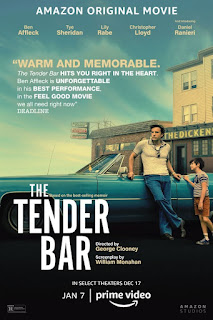
            The bar featured in the story is called Dickens; presumably, the one in this film called The Tender Barrefers to the tender care a fatherless boy had as he hung out there with his Uncle Charlie (Affleck), the bartender and his pals, an assortment of father figures who turned out to be immensely helpful to him.  The film is based on a memoir by J. R. Moehringer about his own growing up years.  

            J.R. (Ranieri as the younger, Sheridan as the older) is an appealing kid, open and eager to learn everything he can about life from the real world as well as from books.  His father only appears occasionally as an obnoxious man, but his mother has high aspirations for him, planning on his eventually attending Harvard or Yale.  Her father (Lloyd) is irascible in his old age but has an intellectual background and his Uncle Charlie (Affleck) is clearly very bright, even though he works as a bartender.  Both men are an interesting mix of reverence and irreverence toward humanity, education, and achievement.  

            J.R. soaks all this up, receiving constant axioms from Uncle Charlie on how to be a man.  But he always treats J.R. with respect and generosity.  You get the impression he is as glad to have a son-figure as to be a father-figure to J.R.  He and his bar buddies couldn’t be more pleased when J.R. is indeed accepted to be a student at Yale University.

            A love interest for J.R. is someone he falls deeply for at Yale, Sidney (Middleton), an attractive, rather mysterious, and evanescent young woman, who seems to regard him with some degree of bemusement, but their relationship lasts during the college years.

            After graduation, J.R. comes to a crossroads in his life when he has to commit to his lifelong dream of being a writer.  It’s at this time he realizes it’s a calling.

            The Tender Bar is a low-key account of a middle-class child coming of age at a time when any number of paths are open to him.  It’s interesting to see the influences around him, the formative events in his life, and how personal relationships have shaped him.

            Ben Affleck seems to me to be the main star here, with his quirky, friendly style that captures the bartender role.  Although Tye Sheridan, as good an actor as he is, is miscast for this particular role.  Ranieri as the engaging younger character seems to fit perfectly.  George Clooney’s directing history is far less illustrious than his acting career.  He had a good run with Good Night, and Good Luck (2005), but his attempts since then, except for The Ides of March have not been stellar.  

            Part of the misjudgment here may lie in the script and/or the choice of story.  It wouldn’t have to be high drama, but I found myself wanting more than the prosaic.  No character is especially complex, and most of the story is expected.  Even the title could have been improved by calling it The Dickens.


Despite The Tender Bar’s fine cast, this story ends up being rather prosaic.


Grade:  C                              By Donna R. Copeland


Thursday, September 9, 2021

THE CARD COUNTER

 Oscar Isaac     Willem Dafoe     Tye Sheridan     Tiffany Haddish


            I have heard that counting and keeping track of cards in games can help you win; and William Tell (Isaac) demonstrates this both in a simple card trick and in a fascinating story with themes of punishment and expiation—and their limits.  Writer/director Paul Schrader is a master of nuance and suspense, with engaging characters, richly metaphorical settings (Ashley Fenton), music complementary to the script (Robert Levon Been, Giancarlo Vulcano), and provocative cinematography (Alexander Dynan).

            Tell is a card shark who likes to keep a low profile after stints in the military and prison.  He has developed a systematic lifestyle that reflects his approach to cards—astute observation, discipline, the compulsive need to hide, and a solitary existence.  He meets a woman who calls herself La Linda (Hadish) and once she learns how good he is, wants to “back” him (finding wealthy clients interested in betting on him).  She appears to be the sole lightness in his life, but he still holds her at bay.

            After one of his games, he is passed a note from a bystander wanting him to give him a call, which he does.  This is Cirk (Sheridan), the son of an old acquaintance in the military.  Cirk has a proposal that seems not to interest Tell as much as the young man’s life story, which relates to the theme of punishment/expiation.  Tell has some ideas about how he can expiate himself of some of his past for which he was punished, but for which he has not forgiven himself.

            As with his previous film, First Reformed, in which a pastor is trying to work through PTSD after a war experience, Schrader poses circumstances that force the viewer to contemplate psychological stressors, current issues like war, and—above all—personal responsibility for actions in the past.  That is, it’s about war and about its after-effects and how those involved deal with them.  First Reformed deals with one person’s struggle; The Card Counter deals with the second generation’s struggle as well.

            The lead actors are supremely fitted to their roles.  Isaac’s ability to convince us of the depth of Tell’s story is key to the well written plot.  Tiffany Hadish provides (needed) respite from the gruesome details of Tell’s and Cirk’s accounts.  And she once again proves her acting abilities.  Tye Sheridan pulls off the hard-to-engage teenager with a singular passion and not much ambition.  Tiffany Hadish has evolved from her comedy roots in Like a Boss and Girls Trip to being a serious pivotal character in this film.  Willem Dafoe expertly shows us a jaded, exploitative figure who has no qualms about exploiting others under his control in the most weaseled of ways, even to the end.

            The psychological authenticity of Paul Schrader’s films always amazes me.  He is clearly attuned to personal transformations with myriad motivations that are not always clear, even to the person, much less those observing him/her.  The arc of transformation is similar in this film to that in First Reformed.   It involves something like “original” to something that is an outgrowth of itself after encountering real-life experiences.

            There are small wry touches of inspiration and humor that might go unnoticed, such as William (Bill) saying to Cirk, “You live like this?” (a messy room) and Cirk saying to Bill, “You live like this?” (a compulsively neat room).  Or La Linda taking Bill out  to a “city on fire”, which means walking through a labyrinth of bright lights, possibly as a metaphor for the potential of card winnings—dreams—and then, reality.


An intricately “wired” account of the psychological transformation of individuals as a consequence of their experiences.


Grade:  A                  By Donna R. Copeland

Thursday, March 29, 2018

READY PLAYER ONE

Tye Sheridan     Olivia Cooke     Ben Mendelsohn     Lena Waithe     
T. J. Miller     Simon Pegg     Mark Rylance
Philip Zhao     Win Morisaki     Hannah John-Kamen


      Are you ready for the world of 2045?  Steven Spielberg’s vision is that everyone will be so absorbed in virtual reality (VR) games they’ll be spending most of their time there, rather than in the work-a-day real world.  We get a striking picture of how that will be by watching Ready Player One.  Unfortunately (for me), most of the action is like a video game with car chases, fights, and wars.  But there is a story underlying all the racing around, plotting, and attempts to figure out a master gamer’s clues leading to a lot of money and ownership of the Oasis, the ultimate gaming organization of the time.
    Humble Wade Waits (Sheridan) lives in the “Stacks”, a slum in Columbus, Ohio, consisting of house trailers (rather then apartments or condos) stacked upon one another (a visual masterpiece reminding of the favelas up a mountainside above Rio de Janeiro, Brazil), and right away we get to watch him traverse down to the street level by jumping, leaping over balconies, and sliding down a rope.  Wade’s parents died, and he lives with his sister Alice (Susan Lynch) and her current boyfriend, an abusing lout. 
     Now, Wade has an avatar, Parzival, and he is hell-bent on solving the riddles left by the mischievous creator and owner of Oasis, Halliday (Rylance), who—by the way—has died.  But whoever solves his riddles for three keys will become rich and gain the power of ownership of Oasis. 
     Parzival manages to develop a kinship with other avatars, and they form a party of five:  Wade/Parvizal, Samantha/Art3mis (Cooke), Aech/Helen (Aech), Sho (Zhao), and Daito (Morisaki), working together to find the keys; but they are thwarted by the unsavory giant corporation led by Sorrento (Mendelsohn) and his minions, foremost of which are I-ROk (Miller) and F’Nale Zandor (John-Kamen).
    A matching of wits and devices follows, with the occasional appearance of Halliday/Anorak making the keys available as they are won.  Sorrento has developed a corrupt organization that is determined to out-smart anyone else in vying for the keys by hook or by crook—mostly crook.  The scenes switch back and forth between the virtual reality and real worlds, which becomes frightening when you realize that what happens in VR can affect people and events in the real world. 
     The story is engaging, acted out so well by the two leads, Sheridan and Cooke.  It was rewarding to see them as a real team, with one and then the other taking on a critical role in saving each other.  Usually, it’s Art3mis who is the quick wit figuring out the clues after Parzival’s initial win.  It’s nice to see the breaking of stereotypes in this and in their personalities, with the Cooke character being sharp and canny, and the Sheridan character being more naïve, but still solid in values and character.  Ben Mendelsohn is perfect as the charming, conniving villain Sorrento.  Other noteworthy performances were rendered by Lena Waithe, T.J. Miller, Hannah John-Kamen, Philip Zhao, Win Morisaki, and Simon Pegg.
     This is fairly typical Spielberg with impressive production, substantive story, and well-defined characters.  It’s fascinating (and humorous) as well in its multiple references to other films (not necessarily Spielberg’s), and it does a good job in having appeal for both younger (technology, videogames) and older audiences (references to other films).  Janusz Kaminski’s cinematography, Alan Silvestri’s music, and Adam Stockhausen’s production design make this a first-rate production.
     As much as I loved watching this film, it is primarily aimed toward fantasy enthusiasts who will revel in the special effects and references to previous iconic films.

Catch a futuristic ride into the world of virtual reality where “you can be anything you want to be.”

Grade:  B+                                                By Donna R. Copeland

Sunday, November 1, 2015

LAST DAYS IN THE DESERT

Ewan McGregor     Ciaran Hinds     Tye Sheridan     Aylet Zurer


          Writer/Director Rodrigo Garcia’s intention in Last Days in the Desert is to be true to the sparse New Testament account and flesh it out with his own fantasies.  He wanted to present a picture that is different from the one in the Bible which results in a surreal, highly symbolic work.  He explained this in a Q&A after the screening of the film at the Austin Film Festival.  To depict Jesus as the human who has gone into the desert to fast, meditate, and pray, he shows him in double images, one to represent Jesus and the other the devil tempting him, which could also be seen as the ego and the id (conscious and unconscious). These two argue with each other (just as we do when we’re ambivalent about what to do), demonstrating the human Jesus’ doubts, his anger, and his own ambivalence.  Garcia does make the two images slightly different in appearance—for instance, the devil image has an earring dangling off his left ear.
          A strong father-son theme runs throughout the story, beginning with Jesus praying, “Father, where are you?”  “Speak to me.”  As he wanders in the desert, he comes across a family residing there, a father (Hinds), his ill wife, and their son (McGregor), and gets drawn into their conflict, which is one primarily of father vs. son, with the mother taking the side of the son who wants to leave the desert and make his way in the city of Jerusalem, a place the father regards as evil.  The father wants him to finish the house, which has already been started, and remain in the desert.  Jesus spends the night and intends to be on his way, but turns back to help in building the house.  This gives the father and the son—and to some extent, the mother—a chance to tell the holy man their sides of the conflict. 
         Garcia places wonderful symbolic images throughout the film, which heightens interest in a relatively slow-moving drama.  For instance, once, Jesus is pulling twigs out of his hair and suddenly breaks into helpless laughter.  (Irony:  it foretells the crown of thorns that will be placed on his head.)  Another time, when Jesus is around a campfire with the family, and they offer him something to eat, he declines in order to maintain his fast.  The son observes, “She (his mother) wants to eat but can’t; he can eat, but won’t.”  Another time, they have a disagreement about the meaning of a shooting star. 
        The picture is well cast, with McGregor giving one of the best performances in a very active career sprinkled with numerous nominations and awards.  Here, he transitions back and forth between Jesus and the devil, shows wise counsel with the father and son, and conveys the burden he faces in being the Son of God.  Ciaran Hinds can be depended upon to give solid performances in whatever role he plays and to receive awards for the TV series, “Game of Thrones” and “Rome”, and the films, Tinker, Tailor, Soldier, Spy and The Eclipse.   Young Tye Sheridan started his career and received good marks in major films—The Tree of Life, Mud, and Joe—and lives up to those in Last Days in the Desert as a somewhat sullen, resentful teenager who obeys his parents but seethes underneath the whole time.  He vacillates between feelings of anger and doubt and strong pronouncements that he has been a good son. 
        The supreme cinematographer Emmanuel Lubezki filmed Last Days in the Desert in the unusual, gorgeous Anza Borreo Desert outside of San Diego, which has an interesting pleated appearance in its rocky, reddish hills barren of vegetation except small shrubs.   He brings out the troubled features of the players, captures the light and color variations of the desert, and follows the, sometimes, frightful occurrences artfully.  The music of Danny Bensi and Saunder Jurriaans is modern to reflect the surreal quality of the film in its isolated setting and the characters’ turmoil, which blends well with the dramatic and visual elements.

A meditative film worthy of multiple viewings to reflect on its teachings.

Grade:  A                                    By Donna R. Copeland

Thursday, July 23, 2015

THE STANFORD PRISON EXPERIMENT

Billy Crudup     Ezra Miller     Tye Sheridan     Thomas Mann     Michael Angarano     Olivia Thirlby


The Stanford Prison Experiment is a docudrama about a well publicized research project conducted at Stanford University by psychologist Philip Zimbardo attempting to show that the environment in prison shapes guards’ and prisoners’ behavior more than their dispositions or past experiences.  The film, directed by Kyle Patrick Alvarez with script written by Tim Talbott, is based on Zimbardo’s 2007 book, The Lucifer Effect.  Zimbardo saw this research as a follow-up to a study in the previous decade by another psychologist, Stanley Milgram, who showed that subjects would comply with an authority figure even to the point of increasing shocks to other subjects to lethal levels when instructed to do so by the research observer.  (The person pressing the button was unaware he/she was not actually delivering a shock.)  The point in both studies was that authority figures and the institutional environment wield a considerable degree of influence over an individual’s behavior. 
           Undergraduate students at Stanford were recruited for a psychological study of the effects of the prison environment on prisoners and guards and paid $15 a day for their participation.  They were only superficially screened for psychological problems, criminal background, or medical problems.  Nine students and one alternate were randomly assigned to be guards, and the same number for the prisoners. 
         To test his hypothesis of inherent characteristics of the participants determining behavior, Zimbardo instructed the guards to foster disorientation, depersonalization, and loss of identity.  This was done by having them arrested in their homes, strip searched, put in dresses and stocking caps, given numbers for their names, and chains put around one of their ankles—all done in order to make the prisoners feel powerless.  To reinforce this, guards were put in standard khaki garb, given mirrored sunglasses to avoid eye contact with the prisoners and wooden batons.  They were instructed not to hit or harm the prisoners in any way.
            The experiment was conducted in a building on campus, with offices converted into cells and using the hall for dining.   The prisoners were to stay in their cells day and night for the duration, except when they were eating, and then they couldn’t talk to one another. 
Early on, within a day or so, the guards—who were told they would be observed by research staff at all times—began using abusive tactics, including hitting and psychological torture.   Even when this was brought to Zimbardo’s attention, he frequently chose not to intervene or he would make promises to the prisoners that he had no intention of keeping.  Any act of rebellion on the part of the prisoners was met with harsh punishment, such as taking away their beds and giving them a bucket for toileting but not allowing it to be emptied. 
            In a short amount of time, some of the prisoners started to fall apart, and ask to leave the study.  It was determined later that not only had 1/3 of the guards resorted to sadistic behaviors, Zimbardo acknowledged that even he had lost his objectivity.  When an observer who came on the scene toward the end of the first week, deemed the experiment as unethical, Zimbardo was convinced to end the research on the sixth of the planned 14 days. 
          In retrospect, Zimbardo concluded that his expectation that the study would prove that, under certain conditions, even good people might behave badly was met.  He subsequently testified as an expert witness in the court martial of one of the Abu Ghraib guards that the man’s behavior was a function of the system, as opposed to his being a “bad apple”, as the government claimed.
           Criticisms of the Zimbardo study include a small sample size, a biased selection of the participants (all white middle class young men), and my own thought that the research staff and guards acting as if the “prisoners” had actually committed and been convicted of crimes, invalidates the study.  Additionally, no personality measures were administered or background information of the participants was obtained.  Without this information, the conclusion that it was the environment that brought out sadistic behavior is weak.
           To me, this is a horrific film to watch; the cruelty and unjustified behavior on the part of the guards made me take a number of breaks during the screening (I watched it at home via a link).  This made me question why the film was made at all; it’s an example of what not to do when people have power over others.  There is a well-known, accepted principle in psychology that to improve people’s behavior it’s more effective to model good leadership than to show poor/bad/evil modeling. 
           Unfortunately, there is no explanation of the study results at the end of the film by Dr. Philip Zimbardo.  I doubt the general public will be able to come away with a clear understanding of the rationale of the work or Zimbardo’s interpretation of it.  This would have greatly enhanced the film, and provide give an illuminating picture of the Abu Graib phenomenon that would be helpful.  
          As far as the film, the actors do a fine job in depicting the characters in the study.  Billy Crudup is especially noteworthy as Zibardo.

Viewer beware.

Grade:  D                                    By Donna R. Copeland

Wednesday, March 18, 2015

ENTERTAINMENT

  Gregg Turkington     John C. Reilly     Tye Sheridan     Dean Stockwell     Michael Cera


-->
Entertainment is a continuation of the Christopher Guest/Andy Kauffman movies where everyday activities and conversations are held, but with no particular logical sequencing and with a heavy dose of whatever disgusting, repellant images the filmmakers can think up (particularly those having to do with sexual and other bodily functions).  This one is written by the lead actor, Gregg Turkington, and directed by Rick Alverson.
The loose setup is that Turkington is an “entertainer” in low-life clubs or bars across the country.  In addition, some of the action takes place out in the California desert, sometimes on a table and/or chairs sitting in the sand, perhaps at a correctional center, perhaps on a tour with a tour guide, although Turkington usually wanders off to do his own thing.  The “entertainment” seems to be an exploration of just what people will laugh at, and laugh they do, particularly when pain or disgusting images are involved. 
      Turkington hires temps to perform with him, like Frank (Stockwell) and Eddie (Sheridan), one dressed as a clown and jumping up on tables taunting the audience, and one miming masturbation and defecation.  Much of the time, particularly in the beginning, it was only members of the audience in the film who were chuckling.  At one point, Gregg’s cousin John (Reilly) attends, wanting to support him and give helpful advice, but he ends up criticizing The Comedian (Turkington) instead.  To me, Reilly is about the only character I come close to chuckling at because of his usual droll style, slightly masked critical observation, and quirky logic.  For instance, here he associates a reference to Liza Minnelli with the movie The Wizard of Oz.  Then he says, “And what was that song my mother used to always cry at?”  Whereupon, he breaks out into song…but it’s “Away in a Manger.”  At other points, characters burst into out-of-tune songs, and these are funny parts as well.  But for the most
part, this film repelled me.
      Entertainment is for those who take to ribald comedy, but for most of us, it’s boring and a turn-off.

Skip this.

Grade:  D By Donna R. Copeland