Thursday, December 30, 2021

MEMORIA

 Tilda Swinton     Jeanne Balibar     Elkin Diaz     Juan Pablo Urrego     Daniel Gimenez Cacho


            The biography of writer/director of Memoria, Apichatpong Weerasethakul, gives clues as to what his films will be about.  Born in Thailand (and still residing there) as the son of two doctors, he studied at the School of Art Institute of Chicago, worked as an architect and multimedia artist, and is now known as a creator of experimental and independent films.  He is a favorite of the Cannes crowd, having won the Palm d’Or for Uncle Boonmee Who Can Recall His Past Lives (2010) and receiving nominations or wins at Cannes for five other films since 2002. 

            Reflective of his Thai background, he believes ghosts and spirits are all around us and communicate with us if we stop and listen.  In an interview by Hannah Ellis-Petersen of the Guardian, Weerasethakul says, “Even though I approach the world scientifically, I cannot shake off the feeling of having spirits around…I feel that when I’m with the green landscape I can always communicate with the trees, with the memory of the jungle and also with myself” [https://www.theguardian.com/film/2018/oct/24/the-man-with-the-exploding-head-the-director-inspired-by-his-medical-condition] Elements like these are inserted into the Memoria script in which main character Jessica (winningly played by Swinton), a Scotswoman living in Colombia with a flower business, encounters strange events when she goes to visit her sister Agnes (Balibar), an anthropologist living nearby.  

            First, Jessica is awakened by a loud boom in the middle of the night just before she goes to visit Agnes who is in the hospital.  This has such a profound effect on her, she seeks out a specialist in sound effects, Hernan (Urrego), and works with him to reproduce the sound in her memory.  

            This seems to create something of a dream-like state in her as she wanders through the city with long periods of looking at architecture, listening to sounds, and periodically hearing the same loud boom she heard earlier.  One does get the impression it is trying to communicate with her, and she may find the answer in the countryside when she is beside a babbling brook striking an odd pose when someone says, “Are you all right?”  This is an older Hernan (Diaz) who lives happily isolated from others and has the kind of wisdom Jessica is seeking.   

            Their encounter is laden with meaning and the intertwining of their memories of childhood.  This Hernan is so different from the younger Hernan excited by new things, playing in a punk rock band, and being an expert in sound effects.  Older Hernan is steadfast in his commitment to ancient ways of thinking, firmly believes he can hear stories from the rocks and other natural elements around him.  He and Jessica reminisce

about their childhood and infancy and find that their memories mesh together in mysterious ways.

            The viewer needs to be prepared for long takes when Weerasethakul and his protagonists contemplate architecture, landscape, physical wellbeing, and memories.  Some may find it entirely too slow, but those interested in philosophy and mystery and their fascinations will find this a beautiful, atmospheric film.

            It seems to me that Jessica’s visits with Agnes in the hospital and her interactions with her and her husband Juan (Cacho) are extraneous and only props for Jessica’s story to play out.  I can understand the director’s wanting to prolong takes of architecture and hospitals because of his background and interest; however, I think these could easily be shortened in the interest of a more cohesive film.


Journey into the realm of the surreal when memories of two entirely different people from different backgrounds intertwine.


Grade:  B                              By Donna R. Copeland

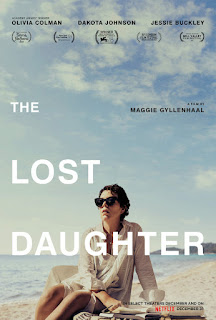
THE LOST DAUGHTER

 Olivia Colman     Dakota Johnson     Peter Skarsgaard     Jessie Buckley

Paul Mescal     Ed Harris


            We meet Leda (Colman) as she is arriving in a small coastal town in southern Italy for a vacation.  We find out later that her two daughters have gone to live with their father, and as a writer and English professor, she is looking forward to some quiet time to write.  But she does not anticipate getting involved with other people on holiday and her own festering conflicts long unresolved.

            On the noisy beach, Leda begins to observe families.  Although a number of people approach her with friendliness—Will (Mescal) the resort attendant, Lyle (Harris), and various others—she responds warmly but seems to keep them at a distance.  She becomes intrigued in observing a mother (Nina, played by Johnson) and her daughter Bianca, being reminded of her own ambivalence in mothering her children.  And Bianca seems to be annoying to Leda at first, but when the child goes missing, it is Leda who finds her and returns her to her parents.

            There are many flashbacks to Leda’s younger years when she was married and a young mother.  A proven actress Jessie Buckley captures the personality of the younger Leda, and we see her in sometimes playful and always creative, sometimes trying, interludes where her ambivalence about the responsibilities of motherhood is obvious.  But these seemingly trifling moments become significant factors later on when she acts on her impulses to develop a relationship with a Professor Hardy (Skarsgaard) who praises her work in glowing terms.

            This is Maggie Gyllenhaal’s debut in directing a feature film, and she is likely to receive commendations for her work.  The story line is finely modulated, the cast well chosen, and the subject of the film in terms of women managing family and career is topical.   But the emphasis on the ambivalence of motherhood is rather unusual in films, especially one done with a sympathetic attitude.  As we come to know Leda and develop some understanding of why she does what she does, her actions become more understandable.

            The pairing of the younger Leda actress Jessie Buckley with the older Leda, Olivia Colman, is one of the strong points of the film.  Buckley shows herself able to be paired with the experienced and renowned actress Colman.  Also, the film touches on many issues affecting women—and specifically actresses—today. 


A slightly disturbing take on an outwardly successful woman’s past and present experiences that may or may not make her understandable in today’s light.


Grade:  B                              By Donna R. Copeland

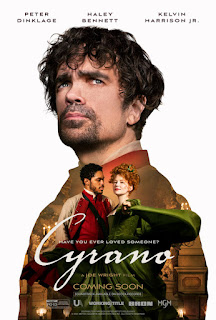
CYRANO

 Peter Dinklage     Helen Bennett     Kelvin Harrison, Jr.     Ben Mendelsohn


            Cyrano is a musical in which a princess, Roxanne (Bennett), is pining for love, to which her lady in waiting argues that “Love doesn’t last; what lasts is compromise and sacrifice.”  (She means that Roxanne should be looking out for her economic welfare over love considerations), which goes right over the beautiful young woman’s head.  Roxanne (Bennett) sings back that she never wants to marry unless she can find someone to love.  Her current suitor, the Duke De Guiche (Mendelsohn) could indeed be her future, but Roxanne loathes him, and only sees him for what she can get from him (e.g., theater tickets).

            What Roxanne doesn’t know is that her friend since childhood, Cyrano (Dinklage), has always loved her, but thinks that she will simply laugh at him for thinking she could fall in love with such a short man.  The story develops from there, such that the man Roxanne is attracted to (from just a glance) is Christian (Harrison), a handsome guard under Cyrano’s command.  The two exchange one glance from afar and both literally fall in love at first sight (or so it seems).

            When Roxanne confesses to her friend Cyrano her love for Christian, who has just been recruited into the guard, she begs Cyrano to mentor and protect her love.  Since he cannot deny Roxanne anything, he promises to do so, which puts him into a serious bind between his own interest and what he has promised.  This bind leads to his writing love letters for Christian to send as his own to Roxanne.

            It was serendipity that scheduled Houston critics to see Spielberg’s West Side Story the night before Cyrano, giving us the opportunity to contrast the two love stories.  And what a difference; where West Side Story, despite its performance value (and my usual admiration for Spielberg), seemed to me to be a tiresome, dated, story of machismo, Joe Wright’s Cyrano makes an elegiac tribute to a man in an older period piece (17th Century), for whom compromise and sacrifice become very real to him, despite his acclaimed swordsmanship.

            Sprinkled throughout the drama are bits of humor (Cyrano’s claim that “Halloween is my favorite holiday” after he has been called a freak, statements like “Her imperfections are perfect”), insightful observations (a narcissistic young woman singing, “I need more”), the non-glorification of fighting—even in the case of war), and demonstrations of true love (seen in Cyrano’s letters, soldiers’ letters home, and the final scene).

            Screenwriter Erica Schmidt is the one who took a different view of Cyrano the character by focusing not on his nose, but making him a dwarf mocked for his stature, and one who believes no woman could love him as he is.  (There is tenderness in this concept in that Schmidt is married to Dinklage, and she wrote the part specifically for him.)

            Peter Dinklage has long been one of my favorite actors, and it is high time he gets an Academy award for his performance as lead in a major motion picture.  He has numerous other awards to count, but I think it’s time his nominations and awards for “Most Promising Actor” in The Station Agent (2004) and supporting actor for Game of Thrones and Three Billboards Outside Ebbing, Missouri  be followed up with more than a nod from the Academy—for his acting.  Admittedly, singing is not his strong suit, but his resonant bass still pleases.

            Joe Wright’s previous films (e.g., Pride and Prejudice, Atonement, Darkest Hour) are testament to his talent in the art and craft of filmmaking.  Elements contributing to his success in Cyrano include Aaron and Bryce Dessner’s music, Seamus McGarvey’s cinematography, and Sarah Greenwood’s production design, some of whom have collaborated with Wright on other projects.


Cyrano, with the swagger and expert swordplay of Tyrion (Dinklage) in Game of Thrones has a much bigger heart and compassion to go with his more macho qualities.  He is a truly admirable soldier in this production, but as skilled in the art of language as he is in wielding a sword.


Grade:  A                              By Donna R. Copeland

Saturday, December 25, 2021

BEST OF 2021

  • Dune – (Denis Villeneuve). Interplanetary competitions in an epochal battle for the good.

  • The Power of the Dog – UK (Jane Campion). A new wife and son must adapt to ranch life.

  • Belfast – UK (Kenneth Branagh). Irish families trapped in the violence of the “Troubles.”

  • King Richard – (Reinaldo Marcus Green). Venus and Serena Williams coached by their father.

  • Cyrano – (Joe Wright). A musical about a bond that develops between an unlikely couple.

  • Licorice Pizza - UK (Paul Thomas Anderson). An unusual love story with charm and wit.

  • Parallel Mothers – Spain (Pedro Almodovar). About two unwed mothers giving birth.

  • Don’t Look Up – (Adam McKay). A comet racing toward earth creates havoc in the U.S.

  • Drive My Car – Japan (Ryusuke Hamaguchi). An actor/director must manage personal events.

  • Riders of Justice – Denmark (Anders Thomas Jensen). A madcap drama and a thriller.

Thursday, December 23, 2021

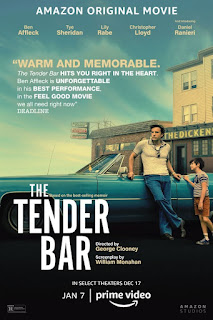
THE TENDER BAR

 Ben Affleck     Tye Sheridan     Christopher Lloyd     Lili Rabe     Daniel Ranieri     Brianna Middleton

            The bar featured in the story is called Dickens; presumably, the one in this film called The Tender Barrefers to the tender care a fatherless boy had as he hung out there with his Uncle Charlie (Affleck), the bartender and his pals, an assortment of father figures who turned out to be immensely helpful to him.  The film is based on a memoir by J. R. Moehringer about his own growing up years.  

            J.R. (Ranieri as the younger, Sheridan as the older) is an appealing kid, open and eager to learn everything he can about life from the real world as well as from books.  His father only appears occasionally as an obnoxious man, but his mother has high aspirations for him, planning on his eventually attending Harvard or Yale.  Her father (Lloyd) is irascible in his old age but has an intellectual background and his Uncle Charlie (Affleck) is clearly very bright, even though he works as a bartender.  Both men are an interesting mix of reverence and irreverence toward humanity, education, and achievement.  

            J.R. soaks all this up, receiving constant axioms from Uncle Charlie on how to be a man.  But he always treats J.R. with respect and generosity.  You get the impression he is as glad to have a son-figure as to be a father-figure to J.R.  He and his bar buddies couldn’t be more pleased when J.R. is indeed accepted to be a student at Yale University.

            A love interest for J.R. is someone he falls deeply for at Yale, Sidney (Middleton), an attractive, rather mysterious, and evanescent young woman, who seems to regard him with some degree of bemusement, but their relationship lasts during the college years.

            After graduation, J.R. comes to a crossroads in his life when he has to commit to his lifelong dream of being a writer.  It’s at this time he realizes it’s a calling.

            The Tender Bar is a low-key account of a middle-class child coming of age at a time when any number of paths are open to him.  It’s interesting to see the influences around him, the formative events in his life, and how personal relationships have shaped him.

            Ben Affleck seems to me to be the main star here, with his quirky, friendly style that captures the bartender role.  Although Tye Sheridan, as good an actor as he is, is miscast for this particular role.  Ranieri as the engaging younger character seems to fit perfectly.  George Clooney’s directing history is far less illustrious than his acting career.  He had a good run with Good Night, and Good Luck (2005), but his attempts since then, except for The Ides of March have not been stellar.  

            Part of the misjudgment here may lie in the script and/or the choice of story.  It wouldn’t have to be high drama, but I found myself wanting more than the prosaic.  No character is especially complex, and most of the story is expected.  Even the title could have been improved by calling it The Dickens.


Despite The Tender Bar’s fine cast, this story ends up being rather prosaic.


Grade:  C                              By Donna R. Copeland


THE KING'S MAN

 Ralph Fiennes     Gemma Arterton     Rhys Ifans     Djimon Hounsou     Tom Hollander

Matthew Goode     Harris Dickinson     Charles Dance     Daniel Bruhl


This third Kingsman movie in the series is to serve as a prequel to the first two:  Kingsman:  The Secret Service (2014) and Kingsman:  The Golden Circle (2017).  It’s all about how a private secret service got formed in Great Britain and who was behind it.  The Kingsman films are based on a comic book series by Mark Millar and David Gibbons.  The first film, was more positively received than the second. 

In this current version, the title The King’s Man implies something different from the previous two films.  The King’s Man (presumably referring to the duke of Oxford (Fiennes), is someone with meritorious service having a change of heart after a number of successful battles, and now wanting to work toward peace as opposed to proving his manhood (over and over) by military feats.  It was his wife’s dying wish that he would not lead their son Conrad into battle.  After meritorious military service, he quite readily accedes to her and promises that Conrad will never go to war.

This promise is the crux of the film in that as the years go by and Conrad (Dickinson) grows up admiring his father’s service, he wants to follow in his footsteps.  What ensues is an account of times when the father stands in his way and other times when Conrad insists on making his own choices.  

The film is good (and humorous) in showing political intrigue (The Kaiser of Germany, Nicholas, Tsar of Russia, and King George—all descendants of Queen Victoria—comprising a triple competition) and the uncertainty of outcomes in both dramatic and personal costs.  Ralph Fiennes’ performance is the best part of the film.

The many sword plays and cliff-side terrors can be exciting, but because of their length, tend to make the viewer lose focus.  Some are remarkably choreographed—particularly the ones showing sword fights between whirling dervishes on tabletops—which provide entertainment in themselves.

King’s Man has its appeal in the quality of the production and the actors, but the film sags from the writers’ not apparently having a clear vision of what they wanted to express.  When the fights seem to go on interminably, it seems like the director Matthew Vaughn has gotten distracted by the action and doesn’t realize he needs to move on. 


Swashbuckling during the outbreak of WWI in a mix of tongue-in-cheek humor, serious aggression, and emotional upset .


Grade:  C                              By Donna R. Copeland

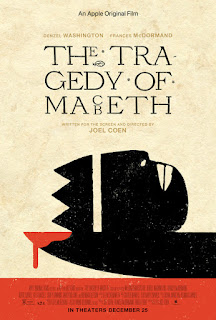
THE TRAGEDY OF MACBETH

 Denzel Washington     Frances McDormand     Corey Hawkins     

Brendan Gleeson     Bertie Carvel     Harry Melling     Kathryn Hunter


            It’s somewhat curious to me that the famed director Joel Coen (usually with his brother Ethan, but not this time) would choose to film a Shakespeare play.  We don’t seem to be in the right climate for that now, but I read that his wife Frances McDormand had for some time wanted him to direct the Macbeth play.  When he finally decided to do it, it was to make a film of it, although it was important to him to maintain a sense of the play.

            The two lead actors McDormand (Macbeth’s wife) and Denzel Washington (Macbeth) have both had experience acting in Shakespearean plays, and their renditions of the cadence and verse of the familiar lines appear natural and authentic.  Their performances here are award-worthy.  Roles played by the supporting actors (Corey Hawkins, Brendan Gleeson Harry Melling, and Bertie Carvel) are strong as well.  The cast and the special effects are the most appealing aspects of the film, a testament to Joel Coen’s direction and production abilities.

            The film is black and white, contributing to the intended qualities of starkness and eeriness.  When the witches—especially Hecate (Kathryn Hunter)—foretell the future, special effects add emphasis most effectively.  Hunter is such a wonder in contorting her body into seemingly impossible positions, it almost distracts from her prophesies.  But clearly Macbeth remains captivated and convinced that she is telling the truth, that he will one day be king of Scotland.  When he is in doubt, he evokes these spirits to reassure him, although of course he does not fully comprehend what the prophecies actually say.

Essential to the production was Stefan Dechant’s production design.  He and cinematographer Bruno Delbonnel created dark, foggy scenes outside and indoors that reflected the required mysteriousness and drama in the plot.  Likewise, Carter Burwell’s musical score with a mix of medieval and modern music sounds fit with all the different moods and auras of the film.

I was not excited to see a Shakespearean drama, but as I started watching and getting into TheTragedy of Macbeth, I began to be engrossed.  Surprising were the little thrills I got when some familiar quote appeared, and I realized that although I recognized them as Shakespeare, I had forgotten they came from this particular play.  Seeing them in context was especially pleasing.  I was also charmed by the language at times, such as “Let us not be dainty of leave taking” when two actors realize they need to disappear post-haste.


Shakespeare is not to everyone’s taste, but for those who still relish it, this impressive production of The Tragedy of Macbeth will surely please.


Grade:  A                              By Donna R. Copeland