Showing posts with label George Clooney. Show all posts

Thursday, December 23, 2021

THE TENDER BAR

 Ben Affleck     Tye Sheridan     Christopher Lloyd     Lili Rabe     Daniel Ranieri     Brianna Middleton
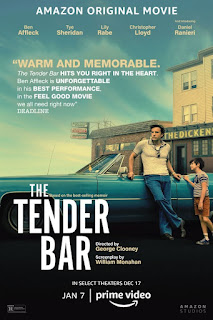
            The bar featured in the story is called Dickens; presumably, the one in this film called The Tender Barrefers to the tender care a fatherless boy had as he hung out there with his Uncle Charlie (Affleck), the bartender and his pals, an assortment of father figures who turned out to be immensely helpful to him.  The film is based on a memoir by J. R. Moehringer about his own growing up years.  

            J.R. (Ranieri as the younger, Sheridan as the older) is an appealing kid, open and eager to learn everything he can about life from the real world as well as from books.  His father only appears occasionally as an obnoxious man, but his mother has high aspirations for him, planning on his eventually attending Harvard or Yale.  Her father (Lloyd) is irascible in his old age but has an intellectual background and his Uncle Charlie (Affleck) is clearly very bright, even though he works as a bartender.  Both men are an interesting mix of reverence and irreverence toward humanity, education, and achievement.  

            J.R. soaks all this up, receiving constant axioms from Uncle Charlie on how to be a man.  But he always treats J.R. with respect and generosity.  You get the impression he is as glad to have a son-figure as to be a father-figure to J.R.  He and his bar buddies couldn’t be more pleased when J.R. is indeed accepted to be a student at Yale University.

            A love interest for J.R. is someone he falls deeply for at Yale, Sidney (Middleton), an attractive, rather mysterious, and evanescent young woman, who seems to regard him with some degree of bemusement, but their relationship lasts during the college years.

            After graduation, J.R. comes to a crossroads in his life when he has to commit to his lifelong dream of being a writer.  It’s at this time he realizes it’s a calling.

            The Tender Bar is a low-key account of a middle-class child coming of age at a time when any number of paths are open to him.  It’s interesting to see the influences around him, the formative events in his life, and how personal relationships have shaped him.

            Ben Affleck seems to me to be the main star here, with his quirky, friendly style that captures the bartender role.  Although Tye Sheridan, as good an actor as he is, is miscast for this particular role.  Ranieri as the engaging younger character seems to fit perfectly.  George Clooney’s directing history is far less illustrious than his acting career.  He had a good run with Good Night, and Good Luck (2005), but his attempts since then, except for The Ides of March have not been stellar.  

            Part of the misjudgment here may lie in the script and/or the choice of story.  It wouldn’t have to be high drama, but I found myself wanting more than the prosaic.  No character is especially complex, and most of the story is expected.  Even the title could have been improved by calling it The Dickens.


Despite The Tender Bar’s fine cast, this story ends up being rather prosaic.


Grade:  C                              By Donna R. Copeland


Wednesday, October 25, 2017

SUBURBICON

Matt Damon     Julianne Moore     Oscar Isaac     Noah Jupe


     Suburbicon is like round 2 of the Coen Brothers’ Blood Simple, lots of gore and misfires, and most everyone being unscrupulous and/or not very bright to the degree it makes us laugh, no matter how much gore.  In this case, at least the kid Nicky (Jupe)—whom no one ever listens to—has some smarts and ability to plan ahead. 
     Right from the beginning, the story is a bit confusing and we have to look twice at two of the characters, then we learn they’re twin sisters, and it takes a few scenes before we know who is who.  That’s a bit disorienting.  The script is good (writers, the Coens, director Clooney, Grant Heslov) in doling out key facts gradually, upping the suspense and requiring the viewer to play the role of detective.  But it also calls upon us to decipher the sociological messages contained in it.
     The horror begins when two men come into the Lodges’ home one evening and hold them hostage.   Gardner (Damon) looks terrified, but seems incapable of putting up any resistance.  Soon, he, both sisters, and Nicky are tied up and put to sleep by holding a cloth (soaked with chloroform?) over their noses.  The family situation changes after that, with Gardner’s sister-in-law Maggie (Moore) assuming more of a maternal role.
     Threats to the Lodge family continue, and we get clues as to what the source of the problem is, but simultaneously there is a curious theme of prejudice against a black family, the Meyers, who have moved into Suburbicon, right next to the Lodges.  The Lodges have no problem with this, and even encourage Nicky to make friends with their son; but the rest of Suburbicon is outraged. 
     What proceeds is the simultaneous undoing of the Lodge family and destructive rioting against the Meyers family next door.  The only sense of this juxtaposition that I can make is that it’s a contrast between culpability and innocence.  The Meyers have done nothing wrong and are being persecuted; whereas there is rampant dishonesty and cruelty in the Lodge family, extending to virtually all of Suburbicon.  In fact, the thrust of the story may be to refute the common belief that most crimes are committed by people of color; whereas, the story here is that every white person, except for the child, is corrupt in some respect.  Two families in the city suffer, but for very different reasons.
     The three main actors, Damon, Moore, and Isaac live up to their reputations as fine actors; I would give an edge to Isaac, who lights up the plot when he is on and who shows considerable power in evoking his character.  Mention should go to the child actor Noah Jupe, whose face conveys all the profound confusion, fear, and resolve Nicky is experiencing, as well as the child-like openness to new friendships. 
     Suburbicon, directed by George Clooney, may not have the look of black film noir which so many expected, but I think it points to a major problem in this country, the deterioration of values in many segments of our society and the unjust scapegoating of a minority.  Clooney has transfigured a Coen script to make it more sociologically relevant today.  Unfortunately, the message is not as clear as it should be.

A stark contrast between white-against-white crime and white-against-black crime, one more culpable than the other.

Grade:  B+                                    By Donna R. Copeland

Wednesday, February 3, 2016

HAIL, CAESAR!

Josh Brolin   George Clooney   Alden Ehrenreich   Ralph Fiennes   Tilda Swinton   Frances McDormand   Scarlett Johansson   Channing Tatum


           When the Coen Brothers are having fun, we’re having fun.  And I can just imagine how the whole crew of Hail Caesar! had loads of good times making this film.  As a matter of fact, Roger Deakins, the DP, mentioned that in an interview.  The Coens let their imaginations run wild here, and managed to successfully throw in all kinds of references to movies (mostly), philosophy, politics, history, and American culture, spoofing all.
          The central figure is the beleaguered “fixer” at Capitol Pictures in Hollywood, Eddie Mannix (Brolin), whose long days are spent putting out fires on the multiple sets of films like Hail Caesar!, On Wings as Eagles, Merrily We Dance, and Lazy Ole Moon (Coens came up with the titles, of course).  In addition, Mannix tries hard to pay attention to his family, consider a lucrative offer, and go to Catholic confession frequently. 
           One of his dilemmas now is that his most famous star, Baird Whitlock (Clooney), has gone missing.  A little sleuthing and a phone call reveals that Baird has been kidnapped and the culprits are asking for $100K ransom money.  This is not much of a problem—demonstrating how cash was like play money in Hollywood in the ‘50s—but who is responsible is a testament to the Coens’ wit and fancy in even dreaming it up, but also in its touching a bit on reality.  It’s a motley crew of disgruntled writers and left-leaning professors in a “study group” (I won’t say more).  When the actor comes to after being drugged and learns of the plot, he asks to have a share of the spoils, but the professors quickly say that that would be unethical; ransom money is not for the victim! 
         I thought Brolin and Clooney would be stand-outs, and Brolin is a perfect fit for his part; however, as good an actor as Clooney is, it was difficult to see his character without seeing the Clooney persona, despite his always being in ancient Roman garb.  A surprising standout is the aw-shucks Southern cowboy played by Alden Ehrenreich as Hobie Doyle.  Hobie can stand on his head while riding a galloping horse, do lasso tricks, and sing.  He has a little trouble with the verbal part of acting, but with a little coaching, his timing in saying, “It’s…complicated” is perfect.  And it turns out that he is much smarter than he sounds, but always sincere and honest.
         The film is more like a revue with little vignettes, always light and entertaining and lovely to look at.  Shining in their parts are Scarlett Johansson, Frances McDormand, Tilda Swinton, Channing Tatum, Ralph Fiennes, and Jonah Hill.
         With the Coens, Cinematographer Roger Deakins and Composer Composer Carter Burwell round out this supremely talented filmmaking team

Sit back, chuckle, wonder, and be entertained in Hail, Caesar!


Grade:  A                                                  By Donna R. Copeland

Tuesday, May 19, 2015

TOMORROWLAND

George Clooney     Britt Robertson     Raffey Cassidy     Hugh Laurie     Thomas Robinson


Hold onto your hats.  Tomorrowland is a wild ride across space and time and with some of the fanciest futuristic gadgets you could imagine.  It’s a modern-day fairy tale.  Special effects abound, coming from Director Brad Bird’s playful imagination, and, with co-writers Damon Lindelof and Jeff Jensen, an exciting and meaningful script.  It’s a bit slow to get started with scientist Frank Walker (Clooney) trying to introduce it and sidekick Casey (Robertson) continually interrupting.  He does manage to get across that the film will be addressing a future that can be scary at times…ah…Tomorrowland. 
Next, there is an interlude that seems not to fit, but will make sense later.  It’s about a young boy named Frank (Robinson) trekking to the 1964 World’s Fair lugging a jet pack he has invented in a canvas bag.  He plops it down in front of a man at a conference table, Nix (Laurie), who is skeptical and probes Frank with questions about it,  eventually discouraging the boy and sending him away.  A young girl appears about this time and befriends Frank, giving him a special pin that will give him some pretty fantastic adventures.  The viewer just doesn’t know what all this means yet.
The main part of the story begins with Casey as a precocious teenager whose father is an engineer at NASA and is just about to be laid off because the space program is getting cut back.  (It occurred to me that the movie is, perhaps, a pitch for the resumption of a more comprehensive U.S. space program.)  Casey tries to help her father by doing a little sabotage at the NASA demolition site in order to postpone as long as possible its demise and prolong her father’s job.  This brings her to the attention of a mysterious robot-girl, Athena, (Raffey Cassidy), who “recruits” her into a major effort to save the planet by planting in her belongings a mysterious pin that looks exactly like the one given to Frank.
When Casey touches the pin, she is transported instantly to another place.  This is exciting, but puzzling as well, of course; then she finds that people (really, robots) are pursuing her, some to do harm, but one, Athena, swears she is trying to help her.  It’s difficult for Athena to get Casey to follow her, partly because of Casey’s incessant questioning.  Finally, Athena dumps her off at Walker’s house; however, Walker wants nothing to do with her and slams the door in her face.  But Casey has gleaned enough information to arouse her curiosity, and she does everything she can to get inside the house and get Frank to show her whatever Athena was telling her about.
When she does manage it, exasperating Frank, she finds his house is truly a wonder to behold with all kinds of monitors, cameras, scientific equipment, and booby traps (traps for relentless pursuers).  From this time forward, we’re treated to major space travel to another dimension, hair-raising brushes with robots in pursuit, and meeting up with a villain.  I especially like the manner in which the film respects children, showing their natural affinity for electronics, and the importance of adults listening to their dreams.  It’s also an exhortation to go toward the light and hope rather than lapsing into darkness and despair.
All this is not just in fun; the film has a serious message about the trouble our planet is in, and the critical need for all of us to do whatever we can to save it.  Will it foster motivation in that direction?  I hope so!  I think it will go over the heads of very young kids—not only in terms of this message, but also in figuring out what’s going on in the story.  A child (sounding like age three or four, kept asking his mother, “What happened?”  “What was that?”  So I recommend Tomorrowland only for children from seven to nine up.

A fantastical journey across time and space.

Grade:  A-                          By Donna R. Copeland