Showing posts with label drama. Show all posts

Thursday, July 14, 2022

MRS. HARRIS GOES TO PARIS

 Lesley Manville     Isabelle Huppert     Lucas Bravo     Ellen Thomas

Jason Isaacs     Anna Chancellor     Alba Baptista     Rose Williams


            This is a feel-good movie through and through, although rather pie-in-the sky.  I gather the point of the story is that kindness begets kindness from a London dance hall to the House of Dior in Paris…except when it doesn’t.

            Mrs. Ada Harris (played superbly by Lesley Manville) is a kindly, sparkly cleaning woman who gets a glimpse of a Dior gown at Lady Dant’s (Chancellor), one of her wealthy employers.  Another theme of the drama is about one’s dreams and the importance of following them through to reality.  With something more than a mere glimpse of the dress, Mrs. Harris envisions herself wearing it, which brings on dreams of being able to buy such a work of art.  She immediately takes on extra work and devises other ways to earn enough to go to Paris to achieve her dream.

            This will be no easy challenge, and Mrs. Harris runs into many obstacles as well as the kindness of others to achieve her goal.  Just getting her foot in the door of the Dior establishment will be one of her biggest discouragements.  Obstacle is personified by the intimidating directress Mrs. Colbert (Huppert), the woman behind the success of Dior himself, along with snobby self-entitled wealthy clients who disdain her being in their midst. 

            The creators of Mrs. Harris are clearly in sympathy with workers who are exploited by their employers, so that theme is woven into the action as well.  With all the varied issues at hand, Director Anthony Fabian with three co-writers (including the author of the novel on which it is based, Paul Gallico) are successful in meshing together all these themes to create an entertaining story.  To do this, they have included many coincidental meetings and unlikely stories of generosity, but the uplifting messages can be inspiring, even the part about Sartre and Existentialism.

            The two well-known actresses Manville and Huppert are again remarkable in capturing the essences of their characters and sustaining the most entertaining aspects of the drama.  Strong support is provided by Lucas Bravo as Dior’s accountant and Ellen Thomas as Ada’s faithful friend back in London.   


For a light, sometimes very funny, movie experience, Mrs. Harris Goes to Paris will surely entertain those who have even a passing interest in haute couture. 


Grade:  B                              By Donna R. Copeland

Wednesday, July 13, 2022

WHERE THE CRAWDADS SING

 Daisy Edgar Jones     Taylor John Smith     David Strathairn

Michael Hyatt     Sterling Macer, Jr.     Harris Dickinson


            A beautifully rendered film about a remarkable child abandoned by her family and growing up alone in a shack in the marshland of North Carolina.  Isolated from most of the town of Barkley Cove, she is called “the marsh girl” by townspeople who make up all kinds of negative stories about her.  

            There are kindly people who help Kya (Jones), like young Tate (Smith) who is a friend of her brother’s and has seen her in the marshes.  As a teenager he offers to teach her to read.  Also, the black couple, Mabel (Hyatt) and Jumpin (Macer) who own a small grocery seem to understand that she is abandoned and help her in dignified ways.  But most of the people in the town regard her with suspicion and make fun of her.  

            So when swaggering young hotshot Chase Andrews (Dickinson), whom Kya had had a brief affair with turns up dead, Kya becomes the prime suspect in his murder.  

            The film is well paced, leisurely giving a detailed picture of Kya’s family and early life showing how she became so independent and merged with the natural environment surrounding her.  So knowledgeable about birds and the animals she comes to know so well, Kya becomes an illustrator, thanks to the encouragement of her friend Tate, her first love.

            When the tale transitions to the mystery of Chase’s death, the pace quickens and we see more of the cruelty Kya experienced with her family and the keen disappointments she suffers when key people let her down.  Balancing this heartbreak is the kindly retired attorney Tom Milton (Strathairn) who has generously taken on the task of defending her against the murder charge. 

            Big plusses in this maximally engaging film are the acting, the writing, the directing, the music, and the cinematography.  Daisy Edgar Jones, Taylor John Smith, and David Strathairn are captivating in their portrayal of the three lead roles, solidly backed up by Michael Hyatt and Sterling Macer, Jr.  Harris Dickinson embodies the less appealing Chase most convincingly.

            The direction by Olivia Newman shows her talent in adapting the popular novel by Delia Owens into a film that captures the audience’s full attention throughout.  The 2+ hour film sped by.  Music by Mychael Danna lives up to his previous award-worthy compositions in Life of Pi, Moneyball, and Little Miss Sunshine.  Although the film is supposed to take place in North Carolina, it was actually filmed in Louisiana, but Polly Morgan’s lush cinematography fools you into thinking it is North Carolina, especially when you see Kya running through the brush hiding from those trying to find her.

            This is a tender and heartstrings-puller love story, an example of female child pluckiness, an absorbing murder mystery and trial, and a commentary of pride and prejudice of the type found in small communities even today.

            It should be noted that Reese Witherspoon is one of the producers.  Release was postponed at one point following an ABC news-magazine show Turning Point and articles in The New Yorker and Atlantic magazines, casting some suspicion on prior activities of the author of the book, Delia Owens and her husband Mark.


Go to Where the Crawdads Sing to find a gripping story of valor, discovery, and delight.


Grade:  A                              By Donna R. Copeland


Wednesday, June 8, 2022

GOOD LUCK TO YOU, LEO GRANDE

 Emma Thompson     Daryl McCormack

            This is a fun and surprising movie about sex work that comes across as genuine in ways one wouldn’t expect.  Yes, it has a lot of laugh-out-loud humor—which is good, since many encounters are clearly awkward.  But the underlying truths and the transformation of both characters elevate the story above the purely entertaining.  

            I’m not sure how younger people will view the story.  Maybe the older woman Nancy (artfully played by Thompson) will remind them of a parent who is in their eyes strait-laced and judgmental, and it will be rewarding to see that character change in significant ways.  Or maybe they will be instantly turned off by an older woman discovering sex for the first time, despite the fact that she has grown children.  “Boring!” as covered in the story.

            For me, the film seems much like listening to a therapy session (ignoring the actual content for the most part).  The intrigue and oddity of it lies in how much the sex worker “Leo” (McCormack) sounds like a good therapist—always empathic, understanding, insightful, and reassuring.  He effectively overrides Nancy’s frequent misgivings and self-deprecations, re-focusing her attention on herself and her desires.  Never before in her life have her wishes been considered top priority.  That’s one new revelation/experience for her, but there will be many.  Most importantly, her need for control will be addressed without her realizing it until after the fact.

            A most important aspect of personal relationships is aptly addressed when like a “patient” Nancy does some sleuthing about Leo personally.  (Neither uses his/her real identity for the “sessions.”)  Leo reacts to this boundary infraction (this time not like a therapist), with outrage.  An engaging part of the movie is still very much in seeing how the characters deal with the reality of their lives.

            Thompson (as always) and McCormack as actors pull us into this story hook, line and sinker.  Both make Nancy and Leo real in ways we can envision and care about them.  She gets on the nerves from time to time, but his responses to her help us forgive her.  And you realize that that’s how things should work between people.  It’s a model for all of us to follow. 

            Something can be said about Daryl McCormick; he reminds us of Rege-Jean Page in the first season of “Bridgerton”, who became an international heart-throb before he left the show after the first season.

            Kudos to writer Katy Brand who came up with this story and to director Sophie Hyde for making it into a movie about an older woman and a younger man that has both substance and wit—not an easy thing to do!

            The film will be released on HULU on June 17, 2022.


A surprising comedy/drama that endears and has substance.  


Grade:  B                              By Donna R. Copeland


Thursday, June 2, 2022

BENEDICTION

 Peter Capaldi     Tom Blyth     Jack Lowden

Simon Russell Beale     Ben Daniels     Gemma Jones


         This is not your usual war story.  It starts out in London in 1914 with a poem about war written by Siegfried Sassoon (played by Jack Lowden as the younger and Peter Capaldi as the older), the protagonist whose life is chronicled beginning with his years as a young man when he and his brother are going off to WWI.  We see him three years later after his brother was killed and he has become at the same time a decorated British soldier and an anti-war activist, based on his “Soldier’s Declaration.” He is refusing to return to the battlefield on the basis that the conditions for peace have not been stipulated by government and the powers that be are guilty of “political errors and insincerities.”  

         He is fortunate (or unfortunate, depending on your point of view) in that a mentor with influence, Robbie Ross (Beale) sees that he is referred to a hospital for traumatized soldiers in lieu of being court martialed.  He is outraged by this “help” because he had wanted to publicize his protest.  Nevertheless, he concedes, and uses his time in a military hospital to develop more insight into himself with the help of therapist Dr. Rivers (well characterized by the script and performed by Daniels).  

         The plot takes a turn after Sassoon is discharged from the army and focuses on his life thereafter when he has acknowledged his attraction to men and becomes involved in ambivalent relationships with a number of them when, after a particularly painful period, he decides to marry a woman, Hester Gatty (Jones).

         Writer/Director Terence Davies has created a moving and interesting work on the life of the poet Siegfried Sassoon, although he has chosen not to adhere strictly to historical accuracy.  Presumably his interest was more in the direction of illustrating the lives of homosexual men during that period of time not only in the military but in everyday social life as well.  And perhaps just as much to validate anti-war sentiments. His depiction captures the passion against war and the advocacy for freedom of identity, which could be seen as related causes.

         Jack Lowden seems perfectly cast in the starring role, showing the interiority of the main character with subtle charm on the outside and depth of feeling on the inside, most particularly captured in the last scene.  Peter Capaldi as the older Sassoon with obvious bitterness and closed off emotions is aptly personified.  All the cast members are well chosen and help to give us a poignant impression of the people in Sassoon’s life.


An unusual war story that depicts international struggles mirroring internal conflicts.


Grade:  B                    By Donna R. Copeland
Thursday, May 19, 2022

MEN

 Jessie Buckley     Rory Kinnear     Paapa Essiedu     Zac Rothera-Oxley     Gayle Rankin

         Alex Garland (Ex Machina, Annihilation) is a master at mixing up reality and fantasy/symbolism, making viewers think one way, then another about the characters and the story.  One must do a bit of work to make sense of his films; otherwise, they would seem to be meaningless.  

         Choral music (Geoff Burrow, Ben Salisbury) and lush cinematography (Rob Hardy) pave the way for a delightful time in a beautiful old house for Harper (Buckley) to get away and heal from the recent messy break-up with her husband James (Essiedu).

         When she arrives at the house and meets the landlord Geoffrey (Kinnear), she is taken aback with his wry humor and teasing, but he is gracious after playfully chiding her for picking an apple in the yard and eating it.  He points out that television and wi-fi are a bit iffy, gives her the one house key (“you don’t really need to lock the door”), and he’s off.

         The horror only really begins when she ventures out for a walk in the forest, delights herself playing with echoes at the entrance to a cave, but then realizes she is lost, with it starting to rain.  And was that a naked man standing in front of an abandoned building?

         There is plenty of horror after that, with the naked man, a smart-alecky kid, the vicar, an unsympathetic policeman, and so on.  Intentionally, Garland has made it appear that Harper must be psychotic, and much of what seems to happen is only in her mind.  (How many times have women been told that?)

         But stepping back and with some thought, we realize that Garland is making a statement about the relationships between men and women and the way in which women are generally regarded.  (Hasn’t Eve always been held responsible for all the ills that followed from her eating the forbidden fruit?)  All the male characters in Men (and I think Garland’s use of the plural is meaningful, in that it guides us toward the general statement he is making) end up scorning Harper and even dying (“because of her”).  

         More of the symbolism could be discussed (e.g., references to death, birth, the barely audible “Papa says so” repeated several times, the appearance of blood on hands and on the naked man), but the viewer should go to see the picture with an open mind and give free rein to one’s personal associations to the images and references.

         Men is not likely to appeal to the general audience, but for those who like to see and appreciate films considered to be “artistic”, it’s well worth seeing.  My fault of the film is that its promised intrigue in the beginning falls into something that is so heavy-handed it becomes almost meaningless in the end.  A little bit of horror is good, but too much makes me just tired.


A well-crafted drama with elements of horror that make it intriguing, but maybe there is too much of a good thing.


Grade:  B                    By Donna R. Copeland

Wednesday, May 18, 2022

DOWNTON ABBEY: A NEW ERA

 Michelle Dockery     Maggie Smith     Elizabeth McGovern     Hugh Bonneville

Penelope Wilton     Allen Leech     Joanna Frogatt     Jim Carter     Phillis Logan


            A new era, with mostly the right amount of sentimentality, joy, pain—and surprises.  The Crawley family is in a quandary about permitting a film crew to shoot a movie in their home (it’s still in the silent era), and of course—since they need money to fix the roof, they will agree.  But not without the vociferous protest from Mr. Carson (Carter), the ambivalence of Lord Grantham (Bonneviille), and the sheer delight of the starry-eyed staff, especially Daisy (Sophie McShera) and Mrs. Patmore (Lesley Nicol).  

            This proposal comes at about the same time as the news that Violet Crawley (Smith) has been bequeathed a villa in France from someone she never took seriously, and she is in turn bequeathing it to Sybbie, the child of Tom Branson (Leech) and his late wife Sybil Grantham.  It’s a delicate situation, in that the son of the mysterious man has invited the Grantham/Crawley family to come for a visit to see it for themselves.  There’s a bit of tension in that the son’s mother is not happy with the bequest.

            You can see how all this is neatly set up to provide two new scenarios for the current feature—the second movie, the first of which had followed a popular series on PBS.  Not only that, the two strains of the story will separate the skeptics who will travel to France from the Hollywood fans in the cast who will remain to see the action (pun intended).

As a devoted fan of all things “Downton Abbey”, I admire the writer Julian Fellowes’ ability to sustain our interest by managing to keep us attached to the cast and characters of the episodes and all that happens to them.  To quote a colleague of mine, who said after we saw the film, “It’s like seeing old friends again.”  Considering that Fellowes has been able to maintain enthusiasm—not only that of fans but cast as well—through six seasons on PBS Masterpiece and two follow-up movies, is surely a rare accomplishment.  

Fellowes also manages to highlight human propensities that pique our interest, such as showing that some people can never let go of jealousy, even after their beloved’s death.  Or on a more positive note, showing the beauty and elegance of a death that becomes even more meaningful after the fact.

For all my admiration, I did find some aspects of this production less than stellar.  For instance, there seemed to be a conscious effort to pair up characters, even minor ones, in a kind of matchmaking.  Although some are truly moving, some are just a little too treacly.  In addition, it seems like the filmmakers are trying too hard to bring the work into “relevance” for today’s audience, such as blurring the lines between the “upstairs” and “downstairs.”  Seeing the wait staff socializing with royalty is, I think, still a dream; not a reality (e.g., Prince Harry and Meghan of today).  

But these are minor “beefs”; I thoroughly enjoyed watching this movie.


An update on the Downton Abbey series that for true fans will delight.


Grade:  B+                            By Donna R. Copeland

Tuesday, May 17, 2022

TOP GUN: MAVERICK

Tom Cruise     Jennifer Connelly     Miles Teller     Monica Barbaro

Val Kilmer     Jon Hamm     Ed Harris     Glen Powell     Lewis Pullman

         As with many Tom Cruise movies, this one seems made for him, although he doesn’t reign supreme all the time.  In the beginning, “Maverick” gets a lot of ribbing as an “old man” from a group of young Top Gun ace recruits, and his superiors are trying to tell him that new technology is going to make him and the planes he flies obsolete.  They’re obviously wanting to get rid of him (especially after he hijacks a plane to prove a point) and finally resort to thinking they will bump him into being a teacher.  Good luck with that—he has always refused career advancements that would take him out of flying.  Hence, he has stayed a Captain.

         The plot is creative in coming up with solutions by which Maverick manages to get his way repeatedly—usually through some derring-do that his superiors must acknowledge is impressive.  Well, OK, so they give an inch, but then, he will take a mile, so to speak.

         This is a very male movie in its illustration of how men relate to one another, especially in groups.  The beginning interactions among them are filled with bravado and macho competitiveness (insufferable at times from a female point of view).  Even the female recruit must do the same to be a part of the group.  Monica Barbaro as “Phoenix” very winningly illustrates this. Authority struggles underlie most of the conflicts.  One recruit, “Rooster” (Teller), has a long-standing resentment toward Maverick for something that still bothers both of them.  We also witness the “star pupil” in “Hangman” (Powell) who seems always to have the right answers and be on the right side, and the nerdy “Bob” (Pullman) who never seems to be able to lay claim to the group.

         I do admire the writers’ (Ehren Kruger et al.) making Maverick’s ingenious flight plan for the primary mission of bombing a uranium plant a metaphor for the entire story.  To wit, expert navigation that takes risks (flying low through a narrow canyon while dodging artillery, then a steep climb to safety (hopefully) using one’s experience, skills, and basic instincts).  These skills are called upon by many pairs of characters in working through their conflicts.    

         The writers beneficially inserted bits of humor and romance periodically to offset the high tension and at times heaviness of the plot.

         Along with the script, direction by Joseph Kosinski and a fine cast help move this Top Gun a step above many action movies that seem to be primarily about special effects and thrills.   These characters really move us and are so well drawn, we want to know more about them.

         Jennifer Connelly is always a joy to see, and cameos by Ed Harris, Jon Hamm, and Val Kilmer serve the movie well.


Underneath the blaring sound and visual effects of Top Gun, there are heartwarming stories that portray real human struggles.


Grade:  B                    By Donna R. Copeland

Thursday, May 12, 2022

THE INNOCENTS

 Rakel Lenora Flottum     Flva Brynsmo Ramstad     Sam Ashraf     

Mina Yasmen Brenseth     Ellen Dorit Petersen     Morten Svartrelt


         This is a story about children, some of it distressing and some of it rewarding.  Central is Ida (Flottum), a 4-5 year-old girl living in Norway with her parents and older sister Anna (Ramstad), who is autistic and mute, although she could speak at one time.  Ida is introspective despite her young age, and not inclined to give out much information, although she appears to be very close to her mother.  

         The family has just moved to a new city for the father’s job, so Ida must get acquainted with her neighborhood.  While exploring outdoors one day, she encounters Ben (Ashraf), and he playfully shows her some of his powers in telekinesis.  She is of course impressed and tries to do it herself, but never succeeds.  Early on, he shows another side of himself—a mean side.  Still, he is nice to Ida, and she often looks on at his feats with wonder and admiration—until he goes too far one day, and she is more wary after that.

         The neighborhood is mixed race, but we don’t see much evidence of racial animosity, except once by some older boys toward Ben.  Ida often has Anna with her and is amazed when another girl named Aisha befriends them and seems to have a special connection with Anna.  She also has the power to “hear” what Ben is thinking and sets limits on him at times.

         An interesting part of the narrative is that the parents all seem unaware of the children’s powers, and the kids don’t tell them, even when their fears are raised.  Writer-director Eskil Vogt has chosen to portray the children’s world with a clear boundary between them and the adults, even when very frightening and dangerous events begin to transpire.  I find it remarkable that even when parents question their children during intimate times, the kids do not tell about the mysterious powers they’ve observed.  Why Vogt decided upon this omission is puzzling to me.  In the conversation that Ida has with her mother about this specifically, the mother only gives vague, elliptical answers.

         One strong point, though, is the portrayal of Ben’s own experience of his powers as something that bothers him, but he seems to be too young to weigh its value pro and con and resolve it to his satisfaction.  And he seems not to have access to any adult who could help him.  Much of the plot is left completely open at the end of the film.

         Rakel Lenore Flottum is amazing in her skills at such a young age.  She easily holds a central place throughout the movie and has no trouble maintaining your interest in her.  Your opinion of her fluctuates across time as she matures and learns from experience, and the fact that such a young actress is able to convey such complexity is impressive.  In a similar way, young Sam Ashraf is able to keep his face impassive at times, and on other occasions allows you to see the utter anguish his character is undergoing.  Whereas Ida and Anna’s mother and father show good insight into their children and respond to them in helpful ways—with some limitations—the two (presumably immigrant) mothers of Ben and Aisha are either unprepared for their children’s talents or are too burdened by being alone and under stresses of living to be of much help.


         The Innocents is a fine production with the subject matter treated in a novel way and primarily from the children’s point of view.  I found it to be an engaging horror story, even though distressing to watch at times.


Grade:  B                    By Donna R. Copeland

Thursday, May 5, 2022

HAPPENING

 Anamaria Vartolomei     Kaley Mottet


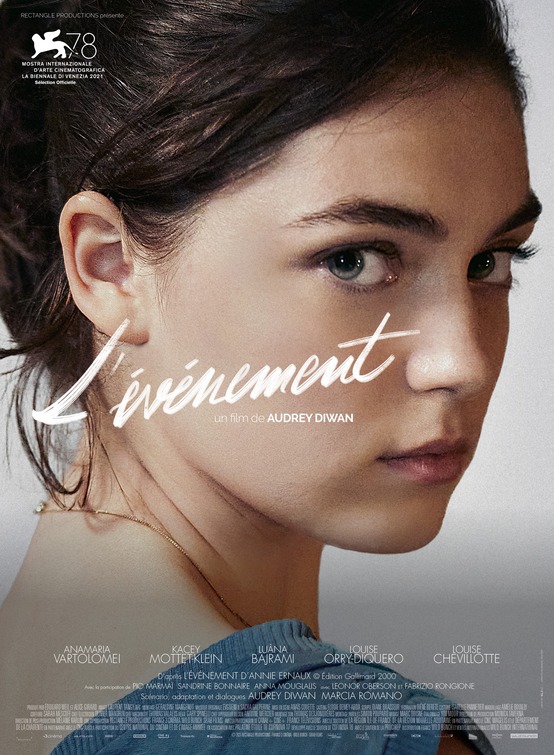
            Was it serendipity or did the French filmmakers of Happening know to release their film at this precise time in the U.S.?  Happening is something that everyone should see, given our current state of affairs in which Roe vs. Wade is likely to be overturned in the U.S.  I have to think that director Audrey Diwan (and co-writer with others including the autobiographical novelist Annie Ernaux) must have had some inkling that the topic would be coming to the forefront in our country just when their film is opening.  (I read that it so happens that Audrey Diwan was aware of the recent Texas law against abortion, which reaffirmed how topical her film is.)  The production is so well done, the viewer is in lockstep with the protagonist every step of the way, admiring the fortitude and singularity of will that it took to achieve what she did.

            The setting is France in the 1960’s when young Anne (Vartolemei), a promising student is looking toward exams that will determine whether she can go to university.  She’s such a good student, she has little of the anxiety her girlfriends show.  Her parents who own a bar/restaurant are always encouraging, and her classmates often look to her during study periods.  She is serious about school and clearly loves it, and is less interested in socializing, although she navigates in that realm very well.  Suddenly, she feels alarm when her period is late.  

            At that time, France had laws similar to those recently passed in Texas and other states prohibiting abortion and penalizing the woman and anyone who aids her in obtaining one.  We see Anne’s creativity in pursuing every avenue she can think of to assure that she will be able to continue on her path to university.  But another hallmark of the movie is to show how isolated she becomes when almost every person she turns to refuses to be involved—which is understandable because to help her would risk prosecution.

            Actress Anamaria Vartolemei, who plays Anne, has already won a Cesar and other awards for her performance.  She is one of those actors to whom your eyes are always drawn when she is in a scene.  The close-ups of her face convey a wealth of information not only about what is going through her mind, but what is going on generally.  She can be just a regular—although very bright—student, with good friends and attractiveness that catches the eye of others, especially males, or alone in a major dilemma either about what to do next or figuring out how to escape a situation.

            The beauty of the film is partly about the heroism of a woman/women in the face of threat and partly about the importance of education in an individual’s life.  When the professor confronts Anne about why her grades have fallen off and how she can justify asking for copies of the lectures she has missed—such as an illness—she replies forthrightly that it was “the illness that strikes only women and turns them into housewives.”

            Although praising the film, a British reviewer whom I respect (Peter Bradshaw of the Guardian) wrote in April, 2022, that this film is “old-fashioned in its vehement emotional message.”  Most likely, he did not know how relevant it would be in the U.S. a month later.


Facing unforeseen challenges in one’s life may be the mark of true character…if one can overcome all the obstacles thrown in the path.


Grade:  A                              By Donna R. Copeland


THE DUKE

 Jim Broadbent     Dame Helen Mirren     Fionn Whitehead

Heather Craney     Matthew Goode     Aimee Kelly     Craig Conway

            This is a strangely seductive movie, showing a British family with a rather daft though good-hearted Kempton Bunton (Broadbent), his wife Dorothy Bunton (Mirren), and younger son Jackie (Whitehead) not communicating very well with one another.  Dorothy is extremely critical of Kempton (for some good reasons), which makes him more secretive at times, and Jackie torn between taking sides with one then the other.  An older son appears about midway through, but doesn’t appear to have much in common with the rest of his rather straitlaced family.  Dorothy is especially offended by his frequent swearing.

            Much about the family is a dramatization, but the story is loosely based on an actual theft of the Goya painting entitled “The Duke of Welllington” from the National Gallery of London.  Reference is made to it in a number of plays and movies ever since.

            In the movie, Kempton is currently protesting paying the government a television license (which everyone was required to pay) since he cannot get the BBC and he feels strongly that everyone should be able to watch television as a public service.  After serving some time, he thinks he has solved the problem by taking the BBC tube out of his set.  He is not only against paying the license himself but feels strongly that everyone should receive television as a public service.  

            When the theft of the  Goya painting is in all the news, it suddenly appears in the Bunton household, with Kempton and Jackie making sure it is hidden even from the ever-cleaning Dorothy.  

            Much intrigue occurs around the painting, around Kempton’s temporary jobs, and the death of Jackie’s sister.  Towards the end, after the viewer has become more and more sympathetic to and interested in the family, there is a surprising shift, which makes the Roger Michell’s direction and screenplay by Richard Bean and Oliver Coleman impressive in its subtlety and its shift from an account of a zany man to a heart-warming story of community and care for others. 

            Jim Broadbent’s acting skills have made him a famous and favorite British actor.  Here, he makes his character so convincing one surmises that he is one with the kindly Kempton Bunton.  The same for Helen Mirren who after we so often see her now so elegantly dressed and coifed nowadays in the media we can see how easily she pulls off playing a frumpy housewife with firm opinions.  Fionn Whitehead and Matthew Goode as Kempton’s solicitor contribute to the appeal and quality of The Duke.


This is an engaging British production that pulls you in, makes you think, and have good thoughts about humankind.


Grade:  A                              By Donna R. Copeland

Thursday, April 28, 2022

7 DAYS

 Gita Reddy     Zenobia Shroff     Karan Soni     Geraldine Viswanathan

            This production executive produced by the Duplass brothers and Roshan Sethi (the latter also the director) and written by Sethi and the star Karan Soni seemed to have promise but turns out to be less interesting than expected.  I realize that I was anticipating something like The Big Sick (starring Kumal Nanjani and Zoe Kazan), a rom-com written by the two stars that speaks across cultures.  

            The idea of making a movie about matchmaking that is prodded by Indian born parents in today’s age would be a challenge for sure.  Setting the film during the recent and ongoing pandemic is likewise intriguing.  But whereas the acting in 7 Days by Karan Soni (as Ravi)  and Geraldine Viswanathan (as Rita) is really fine, the script is not so much.  Pitching a naïve, compulsive, over-achieving mama’s boy against an impulsive out-of-work, impish woman could be funny, I suppose, but their situation becomes so unlikely it strains credulity.

            I admit I did laugh out loud a few times (guess-who jokes through a locked door), but most of the time this couple spends together is not entertaining or even interesting.  I ended up having no sympathy at all for the Rita character and only a little for Karan who is such a neurotic wimp I lost respect for him, although at least his heart was in the right place.  That these two people who are so different from one another could end up together in a marriage is completely incomprehensible to me.

            I presume that 7 Days will be of interest to people whose values are still with the “old country”, but it’s doubtful many young people of today will find it something they want to watch.


Matchmaking by parents in a time of covid should be comedic, but in this case, it is not.


Grade:  D                              By Donna R. Copeland

Wednesday, April 20, 2022

THE NORTHMAN

 Alexander Skarsgard     Nicole Kidman     Claes Bang     Ethan Hawke

Anya Taylor Joy     Willem Dafoe     Bjork     Gustav Lindt


            Oh, those Vikings!  They’re a brutal lot, and Director Robert Eggers with his co-writer Sjon (a poet and novelist as well as screenwriter) have presented us with an extraordinary drama that gets into all kinds of substantive issues of the ages—war (of course!); vengeance; family belonging, loyalty, and entanglements (including incestual); romance; and more—all against the backdrop of sweeping countryside vistas, blood, and gore.

            We get a brief picture of a happy royal family—King Aurvandil (Hawke), Queen Gudrun (Kidman), and Prince Amleth (Oscar Novak the younger, Skarsgard as the older), maybe with some raising of eyebrows, but with the King making his wife and son mindful of the burden of royalty.  He starts training Amleth bigtime in warrior ways, which includes dog-type faceoffs, and making him promise he will avenge his father’s death if it comes to that.  We’re told that honor is above all the highest virtue.

            The tale goes on, pitching the viewer into the 895 A.D. Vikings world through not only the plot, but also expert cinematography (James Blaschke), production design (Craig Lathrop), music (Robin Carolan, Sebastian Gainsborough), and special effects (too many to mention) as well.  The plot transports you along making you feel as if you are there, thanks to that and all the crafts supporting it.

            Quotable quotes are sprinkled about liberally, such as, “You have the strength to break men’s bones; I have the cunning to break men’s minds” and “My earth magic will stoke the flames of your sword”, both spoken by the fetching Olga to Amleth.  Still, some metaphorical references are humorous such as the cleverly inserted “kiss my butt” action.

            The most gripping part comes when Prince Amleth is confronted with elements of the prophecy told to him as a child that at some point, he will have to make a choice between the protection of loved ones and honoring a promise.  

            This is not only a visually beautiful film, it taps into fundamental beliefs we all have about family, war, and conscience, elevating it above your regular adventure film by allowing us to experience some of those real dilemmas that many people must face even now as in the past.  Some are publicly heroic, but some are simply the everyday experience of a reality a person did not plan to encounter.

            This is an exquisitely conceived film that tells a story for the ages.


If you like adventure with intelligence and cleverness and can stand the gore, go to this movie.  You will be rewarded.


Grade:  A                              By Donna R. Copeland

Thursday, April 14, 2022

MOTHERING SUNDAY

 Odessa Young     Josh O’Connor     Colin Firth     Olivia Colman

Some Dirisu     Glenda Jackson


         A romantic tryst in a mansion on a sunny day between lovers who have been seeing each other for seven years seems like it will be a lovely story, except that it’s bittersweet; this will be their last time together because Paul (O’Connor) is getting married the next day to someone else.  Jane (Young) seems to be taking it seriously and calmly, and one wonders what is going through her mind.

    The movie is set in 1924 in Britain when class boundaries are clearly defined.  Jane is a housemaid for the Nevins, a family close to Paul’s, and it is in his parents’ manor that the two have met.  Paul is upper-class, and he is engaged to marry a childhood friend.  He and his parents, she and her parents, and the Nevins (played by Firth and Colman) are scheduled for a lunch the day before the wedding.

     The story can only be understood in the context of a time and place when class divisions were strictly maintained; for instance in today’s world it is likely that Paul would rebel against the social order, refuse to marry his betrothed, and run off with Jane, with whom he is in love.  But not then; it’s apparent even in the conversations between Jane and both of the Nevins that a prescribed social distance is maintained, and that Paul is well socialized to conform to expected social norms.

      It is clear that the story, based on a novel by Graham Swift, is about class relationships, although, unfortunately, that is not addressed specifically.  All the characters—except for the snippy bride-to-be, whom we meet only briefly—seem to accept the social order and are not inclined to question it.  I wish the film had addressed this more specifically, along with more about the background of the main characters.  Jane’s history is spelled out, but only a brief reference to the importance of picnics in Paul’s family is mentioned.  Three of the close-knit families had lost sons in the war, and it is obvious they are still grieving, but we only learn that incidentally.  There are only brief spurts of bitterness expressed by the Olivia Colman character, and it is only after some time we learn why she behaves as she does.

     Odessa Young, who carries most of the film, is beautiful to watch, both physically and observe her acting talent and skill, which has drawn much praise from her native Australia.  I hope I will be seeing her in future productions.  Josh O’Connor is in a less appealing role but lives up to his fame in portraying Prince Charles in television’s “The Crown.”  As always, I enjoyed Firth’s performance; his acting is so eloquent, he enriches every scene he’s in, conveying underlying turmoil while maintaining outward aplomb.  Olivia Colman epitomizes the bitter (as in The Lost Daughter) and grieving mother who has lost her son on the battlefield.  

      Cinematography by Jamie Ramsay is artistic in portraying love scenes with novel sequences and in certain reflections, such as a blood stain reflected on a wallpaper pattern.  Music by Morgan Kibby is exquisite in capturing the period with lovely piano music and then with more modern-age dissonance during distressing scenes.  Director Eva Husson has put all the elements together for a moving, engaging story.

        I have to complain about two characteristics which are unfortunately not unique to this film.  One is the constant scenes of cigarettes that make it obvious they’ve paid for a good part of the picture.  The other is the mixing up of times so one must figure out the time frame.  Why can’t filmmakers film their stories in chronological order?  I don’t mind a bit of reckoning back but jumbling up time frames is getting to be so annoying. 

Mothering Sunday is about an unusual Mother’s Day in 1924 when WWI is still fresh in the minds of British people and the social order still influences people’s behaviors and relationships.


Grade:  C+                                        By Donna R. Copeland