Showing posts with label Paul Dano. Show all posts

Wednesday, March 2, 2022

THE BATMAN

 Robert Pattinson     Zoe Kravitz     Paul Dano     Colin Farrell
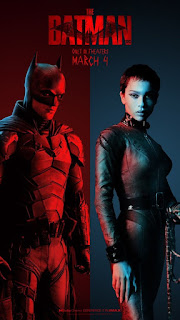
Peter Sarsgaard     Andy Serkis     Jeffrey Wright


            An eerie story with continually changing perspectives within a complex plot.  It’s especially remarkable that the musical theme throughout this action film is “Ave Maria” (part of the humor, I think).  Thankfully, in a three-hour film there is plenty of action to make the time go by quickly, especially since there are many, many characters to sort out and puzzles delivered by the Riddler to decipher.  Another entertaining aspect of the plot are numerous plays on words, such as “thumb drive” and one of the riddles being, “What does a liar do when he’s dead?...He lies still.”

            Robert Pattinson as this Batman in his second year of fighting crime convincingly portrays the mysterious, stoic figure he is known to be, even when sorely tried by The Riddler (who is targeting Gotham City residents) and fetchingly tempted by the exotic Selina Kyle (Kravitz), who is almost as fierce a fighter as Batman.  Colin Farrell is unrecognizable as a thug called The Penguin, and these fine actors are joined by Jeffrey Wright (a detective on the police force), Paul Dano (a crazed orphan grown up), Peter Sarsgaard (as a corrupt city official), Andy Serkis (in the purely dramatic role as Alfred Pennyworth), and John Turturro (in his rare portrayal of a bad guy).  

            Likewise, the crafts are well represented by Greig Fraser’s cinematography, Michael Giancchino’s music, and their colleagues in production design, sound (ah!, the effect of Batman’s ominous footsteps), costume and makeup, and special and visual effects.  Fraser has many scenes so dark it takes some work to figure out what is going on, and with some, being seen only through windows.  But stand-outs are the impressively composed shots that could stand alone as artistic productions. 

            I can say that the usual car chase that seems to be a must in this genre is present here as well, in just as much ridiculous, impossible feats as in all the others.  Two cars racing down a crowded turnpike while going against traffic and everyone in those two cars surviving goes way beyond the pale for me.

            All of these attributes (except for the car chase) are testament to Matt Reeves’ direction and co-authorship with Peter Craig.  (Bob Kane and Bill Finger are the original creators.)  Clearly these filmmakers and their associates collaborated well as a team in creating a work of art that allows us a sense of peeking in on an unfolding drama among real people that is relatable to most of our lives today.  I especially appreciated something not usually seen in this type of film—the realistic portrayal of deep emotions and conflicts (including Batman’s self doubts—which I think make the characters seem like real people to us.  Batman’s history with his family of origin and his having to sort out truth from fiction is an example of this asset.


The Batman is a combination of mystery, logical deduction, family drama, and spectacle that is likely to be entertaining to most people.


Grade:  A                              By Donna R. Copeland

Thursday, November 15, 2018

WILDLIFE

Jake Gyllenhaal     Carey Mulligan     Ed Oxenbould     Bill Camp


     After demonstrating his acting abilities in acclaimed movies (e.g., There will be Blood, Little Miss Sunshine, Love & Mercy), Paul Dano decided to try his hand at directing a movie based on a book written by Richard Ford, which brings us to Wildlife.  The book spoke to Dano, reminding him of his own experience of his parents’ separation, in which, as an only child, he was inclined less to rebel and act out, and more to try to hold everything together.  He was the responsible one, the “parent child” in psychological parlance.
     In the film, we see the family first as having just moved from Lewiston, Idaho, to Great Falls, Montana.  Joe (Oxenbould), a teenager who has felt uprooted with the move, is trying to satisfy his father’s wish for him to become a football star.  His father Jerry (Gyllenhaal) has aspirations to become a force in golf at the local club where he works.  However, he gets fired—in his own words—because he is so good with the customers.  When the club has second thoughts and wants to re-hire him, the narcissistic wound of rejection prevents him from accepting.  Instead, for some reason (visions of greatness?), he decides instead to fight forest fires raging in the nearby forests, which will take him away from the family for several months.
     Incensed, Jerry’s wife Jeanette (Mulligan), rails at him for the stupidity of his plan.  In the meantime, she has decided to ignore Jerry’s wish that she remain a housewife and has taken a job as a swimming coach.  This will introduce her to a different world from that she has been trained for and is used to, and brings her in contact with people in the town; one of her students is a wealthy widower, played by Bill Camp.
     The story is about what happens in this interim when the parents are separated, and Joe, feeling the tension between them, tries his best not to take sides and accommodate to an altered world.  But in fact, in Dano’s description, he is a “kid being kicked out into the wild [and told], “This is the real world.”  In other words, get used to it.  
     The rest of the story is about Joe’s experience of being with his mother, completely cut off from his father, and having to somehow make sense of it all.  In the role of this character, Oxenbould, a young Australian actor, perfectly captures the basic dilemma and the multiple awkward positions his mother places him in during the course of the movie.
     Problems with the film could be with the way the parents communicate with Joe. It seems to me they relate to him in ways that are unrealistic, asking his advice at strange moments (“Joe, what do you think I should do?”; “Joe, how do I look?” [for an interview or for a date], and always turning to him in moments of crisis.  I haven’t observed any parents being this blatant, but given that Dano is basing this partly on his own experience, maybe it happens.
     This is probably the “meatiest” role in Carey Mulligan’s career, and she takes to it with all she has.  She is brilliant.  Her character’s common sense arguments/putdowns of her husband’s decisions are careful not to attack him directly and personally, but clearly she conveys she is her own person and not willing to subject herself to anyone for any reason.  
     I never have enough words of praise for Jake Gyllenhaal; he inhabits all different kinds of characters in ways that are always believable.  I had a hard time at first seeing him as a passive/aggressive figure who is fiercely independent, assuming his family would be waiting for him with open arms when he returns, but of course he does just that with all the authenticity the role requires.  
     Paul Dano should be very proud of his new direction (and a script in collaboration with Zoe Kazan); he has all the makings of a good director who has an eye for the overall picture and knows characterization well enough to cast fine actors for the roles.  I congratulate him and his collaborators for a film in which a kid succeeds despite his parents’ utter disregard for him.  Let’s all hail the promise of the human spirit over adversity.

An example of how a teenager can master the challenges his family—and life—can throw at him.

Grade:  B+                                    By Donna R. Copeland 

Wednesday, June 28, 2017

OKJA

Tilda Swinton   Paul Dano   An Seo Hyun   Lily Collins   Shirley Henderson   Jake Gyllenhaal   Giancarlo Esposito

     A live pig sold for a golden replica serves as the metaphor for this film about a young girl in South Korea and her soul mate, a huge pig she’s named Okja.  Mija (Hyun) is devoted to her pet and is unaware of the contractural agreement her grandfather signed 10 years earlier.  Thinking he is doing the right thing, the grandfather is ready to return Okja to the American company who gave it to him for 10 years, in exchange for the gold piece.   But he is mistaken in thinking Mija is going to value the gold more than the pig.  His bargain illustrates how capitalist schemes can appear so appealing to naïve peoples.  When Grandfather proudly gives Mija the golden relic and she realizes what he has done, she races after the truck carrying Okja away.  In this, the film likewise illustrates the betrayal of the younger generation by the older.
     The background story is about a wealthy American family with a multi-national food tech corporation that is unmindful of its responsibility to humankind and is single-minded in its profit motive, as lived out by the Mirando twin sisters (Swinton).  Lucy, who has always seemed to be in a one-down position, has dreamed up a contest that she is sure will win over her sister and bring her respect and love from the general public.  This is done by giving poor people around the world a genetically altered pig to raise for 10 years, with the ultimate aim of having a contest as to which one could feed the most people in the world (example of genetic experimentation and conflict of interest perhaps?).  Mija’s grandfather was one of those given an animal.  In the meantime, Okja is Mija’s only companion, and has even saved her life once.
     What follows is a rather fantastical madcap story involving international travel, daring car/truck races on the highways, the involvement of animal rights advocates (Dano, et al.), the pig competition, and, ultimately, the slaughterhouse; but Mija has her head about her and extraordinary smarts, and is out to bring Okja home.
     Writer/director Bong Joon Ho (Snowpiercer, Mother) is a master at depicting dramas that pose ethical and socio-political situations for the audience to ponder, and here he makes it clear that we all have some responsibility for the state of affairs, either knowingly or by default.  That is, the grandfather is myopic as to his granddaughter’s wishes and ultimate welfare, the animal rights advocates are well intentioned but rather narrow-minded and inept, and the Mirando corporation has dual purposes topped off with petty rivalry among the owners. 

     Swinton is virtually unsurpassed in her ability to portray any character she’s presented with, and has a particular knack for odd, quirky personalities who have just enough plausibility to intrigue us.  Playing her character here and her chiding twin is entertaining in itself.  Young An Seo Hyun is captivating as a purposeful, devoted adherent to her principles.  Dano is gifted in his portrayal of appealing, sincere proponents of a cause, and he comes through here.  I was disappointed to see one of my idols, Jake Gyllenhaal, play such a buffoon role that seemed to have no purpose in this drama.  He executed it well, but I can’t see the reason for having such a character, who is shown as a self-inflated blowhard.

The purpose of this well executed film seems to be in having us contemplate where our food comes from, something we usually don’t want to do.

Grade:  A-                                    By Donna R. Copeland

Wednesday, June 29, 2016

SWISS ARMY MAN

Daniel Radcliffe     Paul Dano     Mary Elizabeth Winstead


          Swiss Army Man:  a truly bizarre film made up of idiosyncratic fantasies many of which, even so, seem familiar.  Opening the story is Hank (Dano) on a deserted beach trying to hang himself, when he looks up to see a body washed up from the sea.  He almost strangles himself getting down to see about the man (which is actually a preview of his woeful survival skills in general) and is horrified to find the young man (Radcliffe) is already dead. 
          Hank drags the body up to his campsite, sheltering in a cave when it rains and mulling over what he should do.  As time passes and his sense of isolation deepens, he starts talking to the body, voicing many of his fears and anxieties, hopes and dreams.  You’d think he was in a therapist’s office.  Perhaps, just like in a therapist’s office when the patient projects his fantasies onto the therapist, which become a reality of their own, what we see may be Hank’s fantasies or some kind of magical phenomenon wherein the dead regain life; because at one point, the body stirs, convulses, and finally, apparently, talks.  (I say perhaps, because it’s not necessarily clear what the writers/directors—Dan Kwan and Daniel Scheinert—have in mind—simply psychological projections or some kind of magical phenomenon where the dead regain life.  I’m thinking the former.)
        At any rate, Manny—we learn his name when he talks—becomes a “tool” (hence, Swiss Army Man?) for Hank to use either to overcome his weaknesses and/or lead him back to life and civilization. But more concretely, he uses Manny's stiff body as a tool as well.
         The conversations between Hank and Manny deal with fundamental, practical things like riding a bus, emotional expressions, and how to get girls, but at times they take on a more philosophical/psychological tone when the two discuss sex, death, social conformity and acceptability, and the meaning of life.  This was much more interesting to me than the boyish humor about farts, which went on far too long in the beginning.
          Probably the most delightful sequence is in the middle of the film when Hank “dresses up” in found items on the beach and constructs vehicles, etc., out of them.  Then the two do roleplay that evinces the social life that Hank always dreamed of having but could never achieve.  Much of the success of these scenes certainly belong to the actors, but production design (Jason Kisvarday), art direction (David Duarte) and set decoration (Kelsi Ephraim) should be credited as well.  Their imaginative creations are so delightful I was glad they appeared again at the very end of the film.
          The music by Andy Hull and Robert McDowell is just as incredible.  It is lyrical and perfectly apt for what is going on in every scene.  Much of the score is without instruments; instead, Hull and McDowell used their voices in creating all kinds of sounds and making it seem like the songs are coming from the characters.

       Swiss Army Man is not for everyone; it includes standard jokes that typically evoke laughs and focuses on things most people consider gross.  However, it is more than that in its portrayal of people who don’t really fit in, are highly creative, and are often rejected by society.  (Hank has obviously been brought up to hold in higher esteem what is socially expected over creativity and joie de vivre.)  These are serious points that shouldn’t be ignored.
     Like Judd Apatow and sex, the writers/directors “Daniels” have a penchant for highlighting as many of the, typically considered gross, bodily functions as they can; e.g., farting (of course), defecation, and vomiting.  And they pull in masturbation and sex in general as well.  But they are fine artists who have points to make about human psychology and social constrictions.  My wish is that reviewers would focus more on the latter than the former. 

Go beyond the farts, and appreciate the art and social commentary of this film.

Grade:  A                        By Donna R. Copeland


Wednesday, November 4, 2015

YOUTH

Michael Caine   Harvey Keitel   Rachel Weisz   Paul Dano   Jane Fonda   Alex Macqueen


          Youth is an artistic production by the poetic writer/director Paolo Sorrentino (The Great Beauty), who reminds of fellow Italian Federico Fellini in his imagery and talent for making what normally seems ugly into something of beauty and interest.  In this film, aged as well as young bodies are presented; wrinkles, potbellies, sagging breasts, gorgeous shapely figures, crippled, handsome—all are dished out liberally without photographic judgment. 
           But the film has points to make, lots of them.  Points about physical and mental aging, fathers and mothers—especially fathers—cinema vs. television, how we come to understand the world and people, desire vs. apathy, regret, fidelity, and decisions to make about endings.  All the characters seem to be in turmoil (except perhaps the meditating monk), captured eloquently by the cacophony in a cuckoo shop where a character has gone around and turned them all on at once.
          The setting is an elegant old-world hotel in Switzerland where many of its guests have been coming annually for years.  Fred (Caine), a famed orchestra leader, and Mick (Keitel), a well-known movie director, are old friends who voice much of the film’s sentiments about aging and perspectives on their own lives.  They trust each other up to a point; that is, “We only talk about the good things.”  Yet, they do explore certain regrets and disappointments and Fred desperately wants to know if Mick ever slept with a girl they both loved.  Fred’s daughter Lena (Weisz) is married to Mick’s son Julian (Ed Stoppard), which makes another bond between them.  Each is subject to pressures coming from the outside.  The Queen of England wants the reluctant and apathetic Fred to conduct his famous “Simple Songs” for Prince Philip’s birthday celebration.  Mick, ever the optimist, is trying to get his movie Testament off the ground and is waiting for its star Brenda (Fonda) to arrive and producers’  go-ahead to start filming.  He and the screenwriter still have to come up with an ending, though.
          Youth is made in the European style of slower pacing, philosophical discussions, and subtle humor, metaphors, and allusions, which make it a film well worth seeing multiple times.  It’s full of surprises as characters behave in unexpected ways, yet remains firmly grounded in reflecting real dramas. 
          Caine and Keitel are masters at what they do and keep us thoroughly captivated as they talk about their lives.  Weisz as the daughter of Caine’s character has the greatest emotionality to convey, and it’s engaging to hear her perspective of her family life growing up contrasted with her father’s.  Fonda has a wonderful cameo as an aging actress turning the tables on her director in years of films.  Since the actress is known for her smooth skin and physical fitness, it’s fascinating to see her in this role. 
          Sorrentino’s colleagues in music (David Lang) and cinematography (Luca Bigazzi) measure up to his creativity and excellence in their own specialties.  All three have produced a comprehensive production that merges the disciplines seamlessly into a work of visual and auditory art.

Go on vacation to an opulent hotel in Switzerland where you will be entertained with intelligent conversation, fascinating stories, and spectacular landscapes, all accompanied by delightful and entrancing music.

Grade:  A                        By Donna R. Copeland

Friday, March 27, 2015

LOVE & MERCY

Elizabeth Banks     John Cusack     Paul Dano     Paul Giamatti


There is so much good to say about Love & Mercy—from the script (Michael A. Lerner, Oren Moverman), to the direction (Bill Pohlad), to the acting (above), to the music (Atticus Ross) and sound, to the cinematography (Robert D. Yeoman), and the editing (Dino Jonsäter).  It’s a tight production with excellence in every frame.  Normally, I dislike jumping around in time with a story—particularly a bio-pic; but it works here to increase the viewer’s sense of the turbulent inner world of Brian Wilson. 
      Director Bill Pohlad has primarily been involved in producing rather than directing, and when Love & Mercy first started, I was annoyed by the ambiguity of not knowing whether Brian Wilson was talking to himself or to someone else, and by the blank screens with only ambiguous sounds in the background.  Having seen the film, I now think it was a good strategy to heighten the suspense, and give the audience a chance to experience the disorientation and confusion that were so much a part of Wilson’s experience and the often turbulent lives of geniuses.  Also now, after having seen his film, I hope he continues to direct, using his considerable skill in composing quality works. 
      Their roles seem to be career highlights for Banks and Cusack. Banks lovingly portrays Melinda Ledbetter, letting her passion and common sense shine through.  Her eyes can convey so much one has the sense of seeing her soul inside.  Just as probably Brian did, we trust her to be true and genuinely interested in Brian for himself.  And I reveled in a beautiful blonde being characterized as assertive and wise along with her good looks.  AND, would that all our car salespersons had her winning personality and relaxed sell!  Although Dano and Cusack look nothing alike, each is able to get into Brian’s skin so securely, we eventually ignore the differences.  They are particularly good at showing the effects of pain, drugs, and creative inspirations, along with the obvious sincerity of Brian and his ability to see the larger picture, ignoring the doubts and taunts of those surrounding him throughout the early and middle years of his life.  At first I didn’t recognize Giamatti with his 60’s hairdo/hairpiece; but his voice revealed his identity to me.  He is probably one of the greatest character actors in the business.  Here, he is an exploitative, shyster insisting on complete control, a role similar to his attorney/wrestling coach Mike Flaherty in Win Win.  That character was redeemed to some extent, whereas Gene Landy suffered fitting consequences of his actions.
      Music, editing, and sound people achieved a good balance between the music and the drama, which is not always the case with this kind of film.  Here, there are fine musical highlights of Beach Boy songs, and still plenty of intimate, as well as highly dramatic material, which presumably can be credited to composer and soundtrack expert Atticus Ross (Gone Girl).  Cinematographer Robert D. Yeoman (a favorite of Wes Anderson) makes pictures that fit so well with the story and are so artistic many of the scenes are made even more memorable.

Mercy!  Go see this lovely film!

Grade:  A             By Donna R. Copeland