Showing posts with label Jeffrey Wright. Show all posts

Wednesday, March 2, 2022

THE BATMAN

 Robert Pattinson     Zoe Kravitz     Paul Dano     Colin Farrell
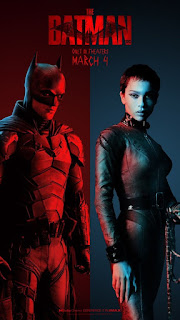
Peter Sarsgaard     Andy Serkis     Jeffrey Wright


            An eerie story with continually changing perspectives within a complex plot.  It’s especially remarkable that the musical theme throughout this action film is “Ave Maria” (part of the humor, I think).  Thankfully, in a three-hour film there is plenty of action to make the time go by quickly, especially since there are many, many characters to sort out and puzzles delivered by the Riddler to decipher.  Another entertaining aspect of the plot are numerous plays on words, such as “thumb drive” and one of the riddles being, “What does a liar do when he’s dead?...He lies still.”

            Robert Pattinson as this Batman in his second year of fighting crime convincingly portrays the mysterious, stoic figure he is known to be, even when sorely tried by The Riddler (who is targeting Gotham City residents) and fetchingly tempted by the exotic Selina Kyle (Kravitz), who is almost as fierce a fighter as Batman.  Colin Farrell is unrecognizable as a thug called The Penguin, and these fine actors are joined by Jeffrey Wright (a detective on the police force), Paul Dano (a crazed orphan grown up), Peter Sarsgaard (as a corrupt city official), Andy Serkis (in the purely dramatic role as Alfred Pennyworth), and John Turturro (in his rare portrayal of a bad guy).  

            Likewise, the crafts are well represented by Greig Fraser’s cinematography, Michael Giancchino’s music, and their colleagues in production design, sound (ah!, the effect of Batman’s ominous footsteps), costume and makeup, and special and visual effects.  Fraser has many scenes so dark it takes some work to figure out what is going on, and with some, being seen only through windows.  But stand-outs are the impressively composed shots that could stand alone as artistic productions. 

            I can say that the usual car chase that seems to be a must in this genre is present here as well, in just as much ridiculous, impossible feats as in all the others.  Two cars racing down a crowded turnpike while going against traffic and everyone in those two cars surviving goes way beyond the pale for me.

            All of these attributes (except for the car chase) are testament to Matt Reeves’ direction and co-authorship with Peter Craig.  (Bob Kane and Bill Finger are the original creators.)  Clearly these filmmakers and their associates collaborated well as a team in creating a work of art that allows us a sense of peeking in on an unfolding drama among real people that is relatable to most of our lives today.  I especially appreciated something not usually seen in this type of film—the realistic portrayal of deep emotions and conflicts (including Batman’s self doubts—which I think make the characters seem like real people to us.  Batman’s history with his family of origin and his having to sort out truth from fiction is an example of this asset.


The Batman is a combination of mystery, logical deduction, family drama, and spectacle that is likely to be entertaining to most people.


Grade:  A                              By Donna R. Copeland

Thursday, October 28, 2021

THE FRENCH DISPATCH

 Benecio del Toro     Adrien Brody     Tilda Swinton     Lea Seydoux     Frances McDormand     Timothee Chalamet

Jeffrey Wright     Bill Murray     Owen Wilson     Bob Balaban     Henry Winkler


            Wes Anderson’s stamp (wry humor, meaningful free association, characters in caricature, intrigue/mystery, curiosity, folksy drama, to name a few) is all over The French Dispatch, a group of stories about a Frenchified newspaper in Lawrence Kansas with that name owned by Arthur Howitzer, Jr., after his father, the founder of the publication died.  The first scenes of what look like a painting of a French village are captivating for both their artistry and the action figures that move within them.  The pictures represent the town of Ennui (pun intended), which has endured all kinds of crises during its existence.  We get to hear about some of those in this fanciful production.

            Another Anderson stamp is his continuing to engage actors and crew from his previous movies.  It gets to be another fun part of watching one of his films—identifying all the scores of actors who have appeared in his previous works.  Anderson puts them in completely different roles from what you would expect.  For instance, Tilda Swinton as an art curator is made up to look strikingly like Sofia Loren.  Well-known artists like cinematographer Robert D. Young and musician Alexandre Desplat are likewise regulars, playing essential roles in conveying the experiences Anderson wants you to have when viewing his films.

            The French Dispatch will not be to everyone’s taste, even for those who are fans.  Unlike his previous films, there seems to be no overarching point to this one.  It’s more like one where you just sit back and enjoy hundreds of moments in time with interesting people and situations that will somehow be recognizable to everyone.  The dialog is so sharp and fast-moving, I wished I had had a script in front of me or already read one where I could stop and savor the import of every scene.  It all goes by very fast.

            It’s curious at times to observe the dominance of women in this production.  Lea Seydoux does an exquisite rendition of a model/guard/dominatrix of an artist named Moses Rosenthal (Benecio del Toro), who is in prison for murder.  (Think of all the associations it took to come up with that image.)  Moreover, older women like Upshur ‘Maw’ Champette (Lois Smith) appear in decision-making scenes, and Lucinda Krementa (McDormand), a middle-aged writer for the Dispatch is shown in bed with young student activist Zeffirelli (Chalamet).  These encounters—like all others—are presented as droll pictures of a normal world.

            When Anderson seems to be spoofing or even criticizing things is not always clear.  For instance, he often shows characters smoking.  Now, Anderson does not smoke and thinks it’s bad for people, but he says, “It looks good on film.”  That is frequently seen in this movie, and, true, it often looks good; but there are also instances where he seems to be making some kind of point, say, about student protests or government agencies.  Maybe he’s leaving it up to the viewer to make up his/her own mind.

            As much as I love Wed Anderson films, I doubt this one will be a blockbuster.  I certainly enjoyed it and would like to see it again—maybe even read the script—but it is likely not to appeal to all Anderson fans, and certainly not to the general public.  


A quirky Wes Anderson film with a collection of stories that will only be savored by some.


Grade:  B                              By Donna R. Copeland


Thursday, October 7, 2021

NO TIME TO DIE

Daniel Craig     Ana de Armas     Rami Malek     Lea Seydoux     Ralph Fiennes

Christopher Waltz     Jeffrey Wright     Lashana Lynch     Ben Wishaw     Naomie Harris 

            Quintessential Bond with the complex plot, hair-raising chases, pretty women, and lots of booze and gadgets.  Bond (Craig)—who has “disappeared” after seeing that arch-enemy Blofeld (Waltz) is incarcerated—is found in Jamaica by his old friend, CIA officer Felix Leiter (Wright), after Bond has just unceremoniously put his girlfriend Madeleine (Seydoux) on the train because of his suspicions about her.  She is heartbroken, proclaiming her innocence, and walks down the aisle seeing him in passing windows as the train leaves the station—an eloquent graphic image—thanks to Linus Sandgren (La La Land, The Hundred-Foot Journey, American Hustle), whose photography in the film is impressive throughout.

            Leiter points out that an important scientist, Valdo Obruchev (David Dencik) (has been abducted and needs to be found to prevent a scheme that could result in the death of millions.  The plot thickens from there, with Bond having to confront forces of which he was previously unaware.  It brings him into contact with his old boss at British Secret Intelligence Service, M (Fiennes) and staff, and tensions he now encounters and must manage between the U.S. CIA and British Intelligence.  Most touchy is the fact that M has assigned another agent, female Nomi (Lynch), to be 007.  This awkward situation must be dealt with because the old 007 wants to be involved in the case because it still seems to be connected with Spectre’s Ernest Blofeld (Waltz), whom Bond had put in prison.

            The most alarming danger comes from an evil man, Llyutsifer Safin (Malek), who has a poison plan that threatens millions across the world.  Getting to him is of course a tall order, and will require cooperation among all the parties involved, including international interests.

            The film is overly long with too many implausible chases and fights—as are found in most/all action films.  But it is successful in gripping intrigues and nail-biting dilemmas.  Daniel Craig is at his best in portraying for his last time the brave strategist Bond is known to be, with the additional acquisition of personal commitment and less womanizing.  He comes across as actually gallant at times.  

            A bright spot in the deluges of combat is shown by Ana de Armas as Paloma.  She kicks a.. impressively and with a little bit of humor, giving the viewer frequent “so there!” satisfactions.  Bad guys like Blofeld and Safir send plenty of chills up the spine, both because of their physical appearances and their evil nature.  Seydoux lacks some of the glamour and keenness of mind that Bond women usually have, but Lashana Lynch, the new 007, is appealing in her level-headedness and combat skills.  Lynch attributes part of her character’s success to the contributions of Phoebe Waller-Bridge to the script.  Hans Zimmer’s music for his first Bond film adds color to the action, and has just the right number of references to music in previous Bond films, most notably, the recognizable “suspense” motif.  Billie Eilish singing the title track co-written by her and her brother Finneas O’Connell provides additional inspiration.


No Time to Die will reward fans of the Bond films with plenty of intrigue and spine-chilling tension.  


Grade:  B+                            By Donna R. Copeland


Thursday, September 12, 2019

THE GOLDFINCH

Nicole Kidman     Ansel Elgort     Oakes Fegley     Jeffrey Wright 
Luke Wilson     Sarah Paulson    Finn Wolfhard     Aneurin Barnard


     This movie is full of surprises, most of which I loved.  Above all, the characters fascinate the viewer while the rest of the cast seem to take them all in stride, a kind of lesson in acceptance.  Storytelling hits that sweet spot in which information comes through gradually, punctuated by significant details, but giving one time to savor the plot.  The central character, Theodore (beautifully rendered by Oakes Fegley playing the younger and Ansel Elgort the older Theo), reminds of “Baby” in Baby Driver (also played by Elgort), actors able to convey mystery as they become endearing and grow on their acquaintances.
     The story begins with tragedy, when Theo’s mother is missing after an explosion in New York’s Metropolitan Museum of Art.   His alcoholic father disappeared long ago, so he needs someone to take him in.  When he names the mother of a classmate whom he has befriended, as at least a temporary solution, Mrs. Barbour (Kidman) steps up to the plate and brings him to her family, which is both wealthy and dysfunctional.  She ends up really caring about him, and it looks like he may be with them for a long time.  
     But… (This story is filled with twists and turns, continually bringing up questions about coincidences versus fate/predetermination).  That juxtaposition is one of the themes of the film, coupled with questions about what is fake and what is real, both in relation to art as well as in human relationships as portrayed.  
     The movie Goldfinch is mesmerizing during Theo’s growing-up years when we observe him to be so well balanced and well behaved, managing his losses and compensating for them in healthy ways.  It gives us a realistic picture of trauma (in other characters as well as Theo), its after-effects, and how people manage it.  The characters introduced make the story come alive, such as different family members in the Barbour family, Hobie (Wright) who takes Theo under his wing and educates him about artistic furniture and reproductions, and the reappearing father (Wilson) and his girlfriend (Paulson) who whisk him off to sandy, bleak Las Vegas.  
     Unfortunately, the film loses its way and tries to become a thriller toward the end, with drug dealing, mobsters, and other unsavory characters introduced into the mix.  This is where it lost me, although I did appreciate attempts to show all the characters to be a mixture of good and bad qualities, most of which with good intentions; but the ending was just too fantastical for me to go along with it.
     For the most part, director John Crowley, the actors, cinematographer Roger Deakins and composer Trevor Gureckis have created a beautiful work of art, capturing the qualities of the Goldfinch painting and its history, while prompting us to consider different philosophies of life.

A captivating story with meaningful characters, derailed by superfluous drama seemingly “tacked on” toward the end.

Grade:  B                                    By Donna R. Copeland