Showing posts with label Kelvin Harrison. Show all posts

Thursday, December 30, 2021

CYRANO

 Peter Dinklage     Helen Bennett     Kelvin Harrison, Jr.     Ben Mendelsohn
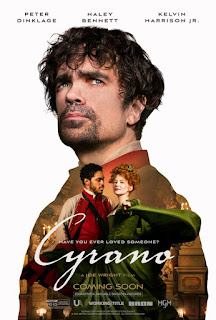

            Cyrano is a musical in which a princess, Roxanne (Bennett), is pining for love, to which her lady in waiting argues that “Love doesn’t last; what lasts is compromise and sacrifice.”  (She means that Roxanne should be looking out for her economic welfare over love considerations), which goes right over the beautiful young woman’s head.  Roxanne (Bennett) sings back that she never wants to marry unless she can find someone to love.  Her current suitor, the Duke De Guiche (Mendelsohn) could indeed be her future, but Roxanne loathes him, and only sees him for what she can get from him (e.g., theater tickets).

            What Roxanne doesn’t know is that her friend since childhood, Cyrano (Dinklage), has always loved her, but thinks that she will simply laugh at him for thinking she could fall in love with such a short man.  The story develops from there, such that the man Roxanne is attracted to (from just a glance) is Christian (Harrison), a handsome guard under Cyrano’s command.  The two exchange one glance from afar and both literally fall in love at first sight (or so it seems).

            When Roxanne confesses to her friend Cyrano her love for Christian, who has just been recruited into the guard, she begs Cyrano to mentor and protect her love.  Since he cannot deny Roxanne anything, he promises to do so, which puts him into a serious bind between his own interest and what he has promised.  This bind leads to his writing love letters for Christian to send as his own to Roxanne.

            It was serendipity that scheduled Houston critics to see Spielberg’s West Side Story the night before Cyrano, giving us the opportunity to contrast the two love stories.  And what a difference; where West Side Story, despite its performance value (and my usual admiration for Spielberg), seemed to me to be a tiresome, dated, story of machismo, Joe Wright’s Cyrano makes an elegiac tribute to a man in an older period piece (17th Century), for whom compromise and sacrifice become very real to him, despite his acclaimed swordsmanship.

            Sprinkled throughout the drama are bits of humor (Cyrano’s claim that “Halloween is my favorite holiday” after he has been called a freak, statements like “Her imperfections are perfect”), insightful observations (a narcissistic young woman singing, “I need more”), the non-glorification of fighting—even in the case of war), and demonstrations of true love (seen in Cyrano’s letters, soldiers’ letters home, and the final scene).

            Screenwriter Erica Schmidt is the one who took a different view of Cyrano the character by focusing not on his nose, but making him a dwarf mocked for his stature, and one who believes no woman could love him as he is.  (There is tenderness in this concept in that Schmidt is married to Dinklage, and she wrote the part specifically for him.)

            Peter Dinklage has long been one of my favorite actors, and it is high time he gets an Academy award for his performance as lead in a major motion picture.  He has numerous other awards to count, but I think it’s time his nominations and awards for “Most Promising Actor” in The Station Agent (2004) and supporting actor for Game of Thrones and Three Billboards Outside Ebbing, Missouri  be followed up with more than a nod from the Academy—for his acting.  Admittedly, singing is not his strong suit, but his resonant bass still pleases.

            Joe Wright’s previous films (e.g., Pride and Prejudice, Atonement, Darkest Hour) are testament to his talent in the art and craft of filmmaking.  Elements contributing to his success in Cyrano include Aaron and Bryce Dessner’s music, Seamus McGarvey’s cinematography, and Sarah Greenwood’s production design, some of whom have collaborated with Wright on other projects.


Cyrano, with the swagger and expert swordplay of Tyrion (Dinklage) in Game of Thrones has a much bigger heart and compassion to go with his more macho qualities.  He is a truly admirable soldier in this production, but as skilled in the art of language as he is in wielding a sword.


Grade:  A                              By Donna R. Copeland

Thursday, February 13, 2020

THE PHOTOGRAPH

LaKeith Stanfield     Issa Rae     Kelvin Harrison, Jr.    Chanté Adams
Rob Morgan     Lil Rel Howery     Courtney B. Vance


     The most unusual technique in this film is that the life of the mother of one of the main protagonists is highlighted in accounting for a love story that transpires years later.  It works because the mother’s personality and her decisions (advanced for the time) are so fascinating.  Christine Eames (Adams) leaves her home (and the man she loves) in New Orleans to pursue her dream of making a name for herself in photography in New York. She leaves without saying goodbye to her love, Isaac (Morgan), assuming that he will be there when she returns.
     We learn about that couple off and on in flashbacks.  But the immediate story is about Michael Block (Stanfield), a reporter for a magazine in New York, The Republic.  He is assigned to do a story about Eames, and goes to New Orleans, to interview Isaac, who talks about Christine and shows him some of her photographs.  That leads him back to the Queens Museum in New York where Mae Morton (Rae) is the assistant curator.  
     Much of the rest of the story is about Michael and Mae in a “will they or won’t they?” kind of scenario.  The fascinating part is how writer/director Stella Meghie weaves the two generational stories together in themes of missed opportunities that seem fated and the suggestion of a larger role that fate plays in humans’ lives.
     The acting is exemplary for the most part.  Issa Rae in particular evokes mystery and beauty seemingly effortlessly. I have always loved LaKeith Stanfield, especially in Sorry to Bother You, but in this role he is not as effective, primarily because of the script, which has made his character less desirable (sort of shifty, unwilling to commit, unable to express emotion).  Writer/director Stella Meghie has created lead characters, both of them having a difficult time expressing themselves.  The characterizations of Issa’s mother and Isaac (played by Chanté Adams and Rob Morgan), as well as step-father Louis Morton (Vance) evoke our interest and make us want to know more about them.
     I think the story presented is very romantic but in a muted form.  It moves a bit slowly, and is probably not the best choice for a Valentine’s date, although it will be opening on Valentine’s Day.

A “will they or won’t they?” romantic drama that is made more interesting by weaving in the parents’ stories.

Grade:  C+                                    By Donna R. Copeland


Thursday, November 14, 2019

WAVES

Taylor Russell     Kelvin Harrison, Jr.    Alexa Demie
Bill Wise     lucas Hedges     Renee Elise Goldsberry    Sterling K. Brown


     Trey Edward Shults is considered one of the up-and-coming writer-directors whose two previous features (Krisha and It Comes at Night) were well received, the former about a family dealing with one of its mentally disturbed members, and the latter about two families dealing with an alien invasion. Now, with Waves, Shults has chosen to portray family relationships in a middle class black family trying its best to achieve aspirations primarily defined by the father.  “We cannot afford to be average”, he admonishes his son when he is encouraging him to work harder.
     The story is complex, reflecting Shults’ keen observations of family dynamics in ordinary as well as stressful situations.  
     Ronald (Brown) drives his son hard in his chosen sport of wrestling, coaching and working out with him and playfully competing.  Tyler (Harrison) is a sensitive young man who is attentive to his mother and plays the piano.  But he is also a fierce wrestling competitor with a future, it seems. This will all be made more complicated by his romantic attachment to Alexis (Russell).  When they have a major disagreement about an important decision, she breaks up with him, throwing him for a loop.
     This is not Tyler’s only stress; he has developed a shoulder injury that threatens to end his hopes in wrestling.  The seriousness of the injury is explained to him by the doctor, but Tyler, in the family mode of keeping worries to himself says nothing to his parents.  Neither—interestingly—does the doctor call and talk to them about it.  (It’s unclear in the film whether Tyler is yet 18.)
     And this is a place where I get on my bandstand about filmmakers repeatedly telling stories in which people don’t talk to one another about major events in their lives.  I realize this is not uncommon in real life, but films have a chance to model for their viewers the miraculous effects of open communication.  For instance, the tragedy that takes place in Waves could have been avoided had Tyler discussed what he was going through with his parents.  In the beginning scenes of the film, we have been set up to think that this closely-knit, affectionate family with good communication would have supported him emotionally and helped him in problem solving.  
     In a similar vein, it was unbelievable to me that this particular family would not have discussed birth control with their children.  When even vomiting is graphically portrayed, why would we not hear of birth control discussed with either adolescent in the family? Not much is said in the beginning about Tyler’s sister Emily (Russell), but after the tragedy, she becomes the focus in her relationship with Luke (Hedges).  Their friendship is portrayed as much healthier (although still no evidence of birth control), starkly contrasting with the one between Tyler and Alexis.
     The actors are really fine in this film, some noteworthy for their previous accomplishments.  Sterling K. Brown (most notable for his award-winning performances in the TV series “This is Us” and “American Crime Story”) is convincing as a father wanting his family elevated to their true potential.  Renee Elise Goldsberry (known primarily for her Tony Award winning performance in Broadway’s “Hamilton”) plays the devoted mother and wife who takes loss so hard, she almost loses everything.  Lucas Hedges (nominated for supporting roles in Manchester by the Sea and Ladybird) brings a kind of peace and understanding to the story in his portrayal of a male who is sensitive, kind, and unbiased.  
     The two main characters in the first part of the movie are portrayed by Kelvin Harrison, Jr., and Alexa Demie, with Taylor Russell highlighted in the latter part. All of these actors, who are supposed to be in high school, are 25 years old.  There are enough talented teenagers to play these parts in movies, so I don’t understand why filmmakers consistently cast older actors to play their roles.  When the discrepancy is so obvious, it’s highly distracting.  
     Another distracting (and irritating) element in this film is the assault on the senses with sudden bursts of sound coming from whistles, voices, music, horns, and the quick cuts between scenes that have nothing to do with one another. Cinematographer Drew Daniels has inserted beautiful pure color scenes that enhance the mood of the film. These should be the guiding light for the editors (Isaac Hagy and Shults himself) in future endeavors.
     Like many interested others, I will be following Trey Edward Shults in his future endeavors.

A gripping drama that highlights a black family’s struggle to achieve their aspirations.

Grade:  B                                    By Donna R. Copeland

Monday, August 19, 2019

LUCE

Naomi Watts     Tim Roth     Kelvin Harrison, Jr.    Octavia Spencer
Norbert Leo Butz     Andrea Bang     Astro     Noah Gaynor


     Complexity is an understatement in this film about weighty topics ranging from race, privacy, security, trust, secrets, and communications that are misread because of listeners’ presumptions and conscious or unconscious wishes.  Luce’s strength is in illustrating how much anxiety and pain come to bear when there are no easy answers.  It’s a story that is worthy of much discussion after the movie among those genuinely moved by the events depicted.
     Initially, the Edgar family seems so admirably ideal.  Amy (Watts) and Peter (Roth) adopted a 10 year-old survivor of abuse and former child soldier in African Eretrea, and seem to have brought up a black-skinned child with all the privileges typical of privileged white children.  Named ‘Luce” (meaning “light”), the child is so gifted, personable, and emotionally balanced, he arouses expectations of fame, not only from his parents, but teachers and even other students—which, ironically, becomes a burden to him when he sees how favorably he is treated compared to fellow classmates. 
     In high school, Luce has a diverse group of friends and easily recognizes the bias with which some are treated, while he is excused.  He has a highly ambivalent relationship with his favorite teacher, Miss Wilson (Spencer), who is one of those who, he feels, expect him to be perfect.  He and the history teacher have sparring sessions fraught with a mixture of respect, overt politeness, and outright barbs.  It’s hard for the viewer to sort out the truths in this relationship, just as it is for the protagonists.  In a clever bit of script writing, the two people at different times make the statement, “Unfair doesn’t make it untrue.”
     During the course of the drama, we learn more about the Edgars’ conflicts with each other and between them and Luce.  It’s clear that husband and wife differ in their relationships with Luce.  As best as she tries to keep her private life confidential, Miss Wilson’s family history is exposed in a most unsettling way.  Luce’s diverse group of friends provides further intrigue and muddying of the waters.
     This production, directed by Julius Onah and co-written with J. C. Lee is fascinating in its grasp of contemporary issues that are not easily sorted out, all while being engrossing and entertaining.  Kelvin Harrison, Jr., as Luce performs expertly, portraying a character a bit too facile in his explanations and studied politeness.  However, at 25, he just can’t be convincing as a high school teenager.  (My ongoing gripe is the casting of young adults to play teenagers when there is an abundance of qualified younger actors in that age range.  Age discrepancy is highly disconcerting to those of us well acquainted with teenagers.  All of the “teens” in this film are in their mid-twenties, and one is 30 years old.)
     Octavia Spence is one actor continually worthy of praise.  She has recently branched out into roles where the character is a mix-up of good and bad qualities (e.g., Ma), all captivating, and highlighting her ability to portray conflicting personality characteristics.  Naomi Watts and Tim Roth also have nuanced performances that are convincing as real people going through major self-exploration and adaptation.  
     Julius Onah is early in his career as director and producer (this is only his second full feature film), and with Luce, he shows promise as a sensitive filmmaker knowledgeable about human frailties and strengths, and expert in storytelling.  Contributing to the quality of Luce are writer J. C. Lee, musicians Geoff Barrow and Ben Salisbury, and cinematographer Larkin Seiple.  

Combining mystery, intrigue, and entertainment with topical issues of race and privilege, Luce challenges viewers to question what is truth in the story and ways in which our own biases may come into play.

Grade:  B+                                    By Donna R. Copeland