Showing posts with label romance. Show all posts

Wednesday, May 18, 2022

DOWNTON ABBEY: A NEW ERA

 Michelle Dockery     Maggie Smith     Elizabeth McGovern     Hugh Bonneville

Penelope Wilton     Allen Leech     Joanna Frogatt     Jim Carter     Phillis Logan


            A new era, with mostly the right amount of sentimentality, joy, pain—and surprises.  The Crawley family is in a quandary about permitting a film crew to shoot a movie in their home (it’s still in the silent era), and of course—since they need money to fix the roof, they will agree.  But not without the vociferous protest from Mr. Carson (Carter), the ambivalence of Lord Grantham (Bonneviille), and the sheer delight of the starry-eyed staff, especially Daisy (Sophie McShera) and Mrs. Patmore (Lesley Nicol).  

            This proposal comes at about the same time as the news that Violet Crawley (Smith) has been bequeathed a villa in France from someone she never took seriously, and she is in turn bequeathing it to Sybbie, the child of Tom Branson (Leech) and his late wife Sybil Grantham.  It’s a delicate situation, in that the son of the mysterious man has invited the Grantham/Crawley family to come for a visit to see it for themselves.  There’s a bit of tension in that the son’s mother is not happy with the bequest.

            You can see how all this is neatly set up to provide two new scenarios for the current feature—the second movie, the first of which had followed a popular series on PBS.  Not only that, the two strains of the story will separate the skeptics who will travel to France from the Hollywood fans in the cast who will remain to see the action (pun intended).

As a devoted fan of all things “Downton Abbey”, I admire the writer Julian Fellowes’ ability to sustain our interest by managing to keep us attached to the cast and characters of the episodes and all that happens to them.  To quote a colleague of mine, who said after we saw the film, “It’s like seeing old friends again.”  Considering that Fellowes has been able to maintain enthusiasm—not only that of fans but cast as well—through six seasons on PBS Masterpiece and two follow-up movies, is surely a rare accomplishment.  

Fellowes also manages to highlight human propensities that pique our interest, such as showing that some people can never let go of jealousy, even after their beloved’s death.  Or on a more positive note, showing the beauty and elegance of a death that becomes even more meaningful after the fact.

For all my admiration, I did find some aspects of this production less than stellar.  For instance, there seemed to be a conscious effort to pair up characters, even minor ones, in a kind of matchmaking.  Although some are truly moving, some are just a little too treacly.  In addition, it seems like the filmmakers are trying too hard to bring the work into “relevance” for today’s audience, such as blurring the lines between the “upstairs” and “downstairs.”  Seeing the wait staff socializing with royalty is, I think, still a dream; not a reality (e.g., Prince Harry and Meghan of today).  

But these are minor “beefs”; I thoroughly enjoyed watching this movie.


An update on the Downton Abbey series that for true fans will delight.


Grade:  B+                            By Donna R. Copeland

Thursday, April 14, 2022

MOTHERING SUNDAY

 Odessa Young     Josh O’Connor     Colin Firth     Olivia Colman

Some Dirisu     Glenda Jackson


         A romantic tryst in a mansion on a sunny day between lovers who have been seeing each other for seven years seems like it will be a lovely story, except that it’s bittersweet; this will be their last time together because Paul (O’Connor) is getting married the next day to someone else.  Jane (Young) seems to be taking it seriously and calmly, and one wonders what is going through her mind.

    The movie is set in 1924 in Britain when class boundaries are clearly defined.  Jane is a housemaid for the Nevins, a family close to Paul’s, and it is in his parents’ manor that the two have met.  Paul is upper-class, and he is engaged to marry a childhood friend.  He and his parents, she and her parents, and the Nevins (played by Firth and Colman) are scheduled for a lunch the day before the wedding.

     The story can only be understood in the context of a time and place when class divisions were strictly maintained; for instance in today’s world it is likely that Paul would rebel against the social order, refuse to marry his betrothed, and run off with Jane, with whom he is in love.  But not then; it’s apparent even in the conversations between Jane and both of the Nevins that a prescribed social distance is maintained, and that Paul is well socialized to conform to expected social norms.

      It is clear that the story, based on a novel by Graham Swift, is about class relationships, although, unfortunately, that is not addressed specifically.  All the characters—except for the snippy bride-to-be, whom we meet only briefly—seem to accept the social order and are not inclined to question it.  I wish the film had addressed this more specifically, along with more about the background of the main characters.  Jane’s history is spelled out, but only a brief reference to the importance of picnics in Paul’s family is mentioned.  Three of the close-knit families had lost sons in the war, and it is obvious they are still grieving, but we only learn that incidentally.  There are only brief spurts of bitterness expressed by the Olivia Colman character, and it is only after some time we learn why she behaves as she does.

     Odessa Young, who carries most of the film, is beautiful to watch, both physically and observe her acting talent and skill, which has drawn much praise from her native Australia.  I hope I will be seeing her in future productions.  Josh O’Connor is in a less appealing role but lives up to his fame in portraying Prince Charles in television’s “The Crown.”  As always, I enjoyed Firth’s performance; his acting is so eloquent, he enriches every scene he’s in, conveying underlying turmoil while maintaining outward aplomb.  Olivia Colman epitomizes the bitter (as in The Lost Daughter) and grieving mother who has lost her son on the battlefield.  

      Cinematography by Jamie Ramsay is artistic in portraying love scenes with novel sequences and in certain reflections, such as a blood stain reflected on a wallpaper pattern.  Music by Morgan Kibby is exquisite in capturing the period with lovely piano music and then with more modern-age dissonance during distressing scenes.  Director Eva Husson has put all the elements together for a moving, engaging story.

        I have to complain about two characteristics which are unfortunately not unique to this film.  One is the constant scenes of cigarettes that make it obvious they’ve paid for a good part of the picture.  The other is the mixing up of times so one must figure out the time frame.  Why can’t filmmakers film their stories in chronological order?  I don’t mind a bit of reckoning back but jumbling up time frames is getting to be so annoying. 

Mothering Sunday is about an unusual Mother’s Day in 1924 when WWI is still fresh in the minds of British people and the social order still influences people’s behaviors and relationships.


Grade:  C+                                        By Donna R. Copeland


Thursday, March 17, 2022

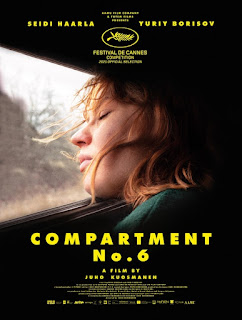
COMPARTMENT NO. 6

Seidi Haarla     Yurty Borisov     Dinarva Drukarova

            Laura (Haarla) is an introverted young Finnish woman who has aspirations of being an anthropologist.  Currently, she is in Moscow to learn the Russian language and staying with generous Irena (Drukarova), a professor of literature at a university, where she feels a bit out of place with the intellectuals at a party.  Laura and Irina had planned to go to Murmansk in northern Russia together to look at its famous petroglyphs (prehistoric rock paintings), but at the last minute Irina is unable to go, so Laura heads out on her own. 

            The long trip is the substance of the story, which has her in the same compartment as Ljoha (Borisov), a hard-drinking boorish Russian whom she avoids as much as possible, even getting off the train at one point, considering aborting her journey.  But she gets back on before the train leaves, and she makes some effort to be civil to Ljoha, who is full of questions about her.  They strike what appears to be an amicable place where she seems to be letting him in.

            What will happen in their time together?  We will see, but, unfortunately, it won’t be very understandable.  The biggest fault in this movie is the lack of backstory for any of the characters to make their actions make sense.  Laura’s and Ljoha’s relationship is off and on, but the reasons for their shifts (first one, then the other) are unknown, partly because the script offers no explanation, but also because we don’t have any information about their backgrounds.  They’re all a little like the paper dolls that young girls used to play with; they might have a complete wardrobe, but the child must provide the drama.  

            None of the characters are admirable (or even likeable), and the train ride soon makes the viewer claustrophobic.  It looks like Laura never bathes (at one point on the train she tries to brush her teeth, but there is no water from the tap) or washes her hair.  She resists others, then goes along, often passively; we are given no idea of what she really cares about.  Irena, her apparent lover in Moscow, suddenly becomes distant on the phone the day after Laura leaves and apparently hasn’t followed through in making trip plans, which Laura thinks she had made.  Ljoha is especially vague and contradictory, seeming to have no sense of boundaries initially, yet in the end is impenetrable.  He appears to be a dimwit at first, but suddenly he seems to be able to make anything happen.

            This seems to me like a non-story devoid of characterization or much of a plot.  And if you think you might get a glimpse of the Murmansk Petroglyphs, sorry.


Imagine a long journey into the arctic north with a roommate from hell in your compartment and no way to turn around and go back to where you came from.


Grade:  D                              By Donna R. Copeland 

Thursday, February 10, 2022

MARRY ME

 Jennifer Lopez     Owen Wilson     John Bradley     Sarah Silverman     Maluma

            Marry Me is the sweet kind of comedy many are drawn to.  Unlikely events transpire with a few worrisome moments, the main characters are likeable, and the plot gradually thickens to bring the show to an end.  Jennifer Lopez as Kat Valdez, a wildly popular singer plays the role beautifully and convincingly throughout.  It’s fun for the average viewer to get to go behind the scenes and get a peek at the life of a celebrity—the perks, as well as the insufferable publicity.  I imagine that the character Kat may be based on the actress herself, at least as she is currently regarded.  Earlier, she had a reputation for being a diva, but she may have been forced in that direction in order to achieve what she has as a Latina woman.

            The same might be said for Lopez’ costar, Owen Wilson, who is usually seen to be a laid-back guy with a somewhat wry bent to his personality and the characters he plays.  They’ve both acted in a number of rom-coms, so are experienced in the genre’s comic timing, mixture of sadness and goofiness, and pulling of the heartstrings.  I wouldn’t have expected there to be much “chemistry” in their attachment, but that does begin to surface as the characters get better acquainted.

            John Bradley does a great job in being Kat’s manager, showing expertise in negotiations, going with the flow, and riding out the abrupt changes in plans.  This character is always Johnny-on-the-spot, providing instant cash, reservations, or whatever practical items are needed.  Bradley is skillful in having his facial expression show exactly what he is feeling inside.

            Marry Me is successful in achieving what I presume was intended, an entertaining show with dashes of insight and soulfulness.  Directed by Kat Coiro, it holds the viewer’s interest and amusement.


When a celebrated pop singer is found to be betrayed right before her planned on-air wedding, she comes up with a spur-of-the moment solution to her problem.


Grade:  C                              By Donna R. Copeland

Thursday, December 30, 2021

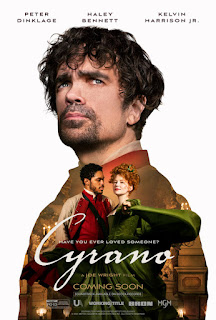
CYRANO

 Peter Dinklage     Helen Bennett     Kelvin Harrison, Jr.     Ben Mendelsohn


            Cyrano is a musical in which a princess, Roxanne (Bennett), is pining for love, to which her lady in waiting argues that “Love doesn’t last; what lasts is compromise and sacrifice.”  (She means that Roxanne should be looking out for her economic welfare over love considerations), which goes right over the beautiful young woman’s head.  Roxanne (Bennett) sings back that she never wants to marry unless she can find someone to love.  Her current suitor, the Duke De Guiche (Mendelsohn) could indeed be her future, but Roxanne loathes him, and only sees him for what she can get from him (e.g., theater tickets).

            What Roxanne doesn’t know is that her friend since childhood, Cyrano (Dinklage), has always loved her, but thinks that she will simply laugh at him for thinking she could fall in love with such a short man.  The story develops from there, such that the man Roxanne is attracted to (from just a glance) is Christian (Harrison), a handsome guard under Cyrano’s command.  The two exchange one glance from afar and both literally fall in love at first sight (or so it seems).

            When Roxanne confesses to her friend Cyrano her love for Christian, who has just been recruited into the guard, she begs Cyrano to mentor and protect her love.  Since he cannot deny Roxanne anything, he promises to do so, which puts him into a serious bind between his own interest and what he has promised.  This bind leads to his writing love letters for Christian to send as his own to Roxanne.

            It was serendipity that scheduled Houston critics to see Spielberg’s West Side Story the night before Cyrano, giving us the opportunity to contrast the two love stories.  And what a difference; where West Side Story, despite its performance value (and my usual admiration for Spielberg), seemed to me to be a tiresome, dated, story of machismo, Joe Wright’s Cyrano makes an elegiac tribute to a man in an older period piece (17th Century), for whom compromise and sacrifice become very real to him, despite his acclaimed swordsmanship.

            Sprinkled throughout the drama are bits of humor (Cyrano’s claim that “Halloween is my favorite holiday” after he has been called a freak, statements like “Her imperfections are perfect”), insightful observations (a narcissistic young woman singing, “I need more”), the non-glorification of fighting—even in the case of war), and demonstrations of true love (seen in Cyrano’s letters, soldiers’ letters home, and the final scene).

            Screenwriter Erica Schmidt is the one who took a different view of Cyrano the character by focusing not on his nose, but making him a dwarf mocked for his stature, and one who believes no woman could love him as he is.  (There is tenderness in this concept in that Schmidt is married to Dinklage, and she wrote the part specifically for him.)

            Peter Dinklage has long been one of my favorite actors, and it is high time he gets an Academy award for his performance as lead in a major motion picture.  He has numerous other awards to count, but I think it’s time his nominations and awards for “Most Promising Actor” in The Station Agent (2004) and supporting actor for Game of Thrones and Three Billboards Outside Ebbing, Missouri  be followed up with more than a nod from the Academy—for his acting.  Admittedly, singing is not his strong suit, but his resonant bass still pleases.

            Joe Wright’s previous films (e.g., Pride and Prejudice, Atonement, Darkest Hour) are testament to his talent in the art and craft of filmmaking.  Elements contributing to his success in Cyrano include Aaron and Bryce Dessner’s music, Seamus McGarvey’s cinematography, and Sarah Greenwood’s production design, some of whom have collaborated with Wright on other projects.


Cyrano, with the swagger and expert swordplay of Tyrion (Dinklage) in Game of Thrones has a much bigger heart and compassion to go with his more macho qualities.  He is a truly admirable soldier in this production, but as skilled in the art of language as he is in wielding a sword.


Grade:  A                              By Donna R. Copeland

Thursday, December 23, 2021

LICORICE PIZZA

 Bradley Cooper     Alana Haim     Maya Rudolph     Skyler Gisondo     Sean Penn

John C. Reilly     Tom Waits     Bennie Safdie     Cooper Hossman


          This is a really fine production from script to actors, music, cinematography, and production design.  The dialog is entertaining and smartly—but not too smartly—crafted.  Everyone converses in ways people normally talk to one another without artifice, which sometimes happens with clever scriptwriters.  This was penned by its director Paul Thomas Anderson and reflects his usual number of characters’ insights while still being entertaining and funny.  

            Two quirky characters meet when Gary (Hoffman) is still in high school.  She is 25 year-old Alana (Haim), who deflects his flirtatious advances in no uncertain terms.  She points out that it would be illegal for her to accept them.  But finally being convinced that Gary has already made his mark as a known actor and businessman she finally gives in to his persistence and agrees to be friends.  Gary’s ace in the hole—a sense for and success in finding business opportunities—is not usually a come-on for young women, but Alana has enough untapped talent in the art it is attractive to her.  She can’t resist joining in on his impromptu endeavors, making a contribution that shows, to everyone’s surprise, acumen.  She is the youngest of three sisters in a Jewish family that also looks upon her with bemusement.

            So the film does the wacky back-and-forth switches common in first love, the back-and-forth usually being stimulated by sparks of jealousy on one side or the other.  Entertaining bits that get into numerous sub-plots are their business ventures: “Soggy Bottom Waterbeds” morphing into “Bernie’s Waterbeds”, “Pacific Waterbeds”, “Fat Bernie’s Pinball Palace”, and even “Fat Bernie’s Environmental Living.”  Throughout, Alana frequently calls Gary a dumb d…….it, thinking he will go away…but not with somebody else, of course, we realize, before she does.

          Other enjoyable/fun moments in Licorice Pizza are the name-dropping (Barbra Streisand), the cameos (Bradley Cooper, Sean Penn, Tom Waits, Maya Rudolph, Skyler Gisondo), the playful camera action through windows and super-imposed reflections, and musical accompaniments to particular scenes.  Bradley Cooper’s Jon Peters as an over-the-top self-entitled film star competes with Jared Leto’s Paolo Gucci in House of Gucciin conveying a completely different persona then those we’ve come to associate with them.  

        Cooper Hoffman brings the star quality of his father, the late Philip Seymour Hoffman, into his character as a charismatic figure able to charm and convince others of his abilities.  Alana Haim winningly demonstrates her talent in inhabiting a character and bringing it to life.  I especially like the way Alana is portrayed; her attraction to men is primarily about her maturity and business sense, rather than her physical attractiveness. In fact, she has few of the qualities usually given to “beautiful”, but more than one man is grateful to her for her good sense.  (How long will it be before filmmakers highlight that aspect of women over their physical appearance?)

            Much could/will be made of Gary’s age (15 going on 16) in this film, but because of the way the characters are presented (he much more “worldly” than she, and his pursuing her rather than the other way around) justifies it from my point of view.  So many relationships with the male much older than the female don’t seem to give people much pause. 

A new kind of “first love”, where the characters are quirky and don’t fit the usual mold.  A superb production.

Grade:  A                              By Donna R. Copeland


Thursday, December 2, 2021

THE POWER OF THE DOG

 Benedict Cumberbatch     Kirsten Dunst     Jesse Plemons

Kodi Smit-McPhee     Thomasin McKenzie     Keith Carradine


            This well-conceived and crafted film is so evocative, you are likely to be talking about it and figuring it out with others after you see it.  That means, it’s necessary to watch and listen closely—even at the very beginning when there is a monolog spoken by Peter (Smit-McPhee).  

            The setting is a cattle ranch in 1925, but this won’t be like a typical American western.  The ranch is owned by two brothers who couldn’t be more different from one another.  Phil the older (in a stunning performance by Cumberbatch) is macho, glib, and sarcastic, lording over everyone—even to the point that in the local saloon when he thinks the party at the next table is too loud, he shuts them and the piano player up.  Everyone seems to kowtow to him.  His brother George (Plemons also at his personal finest) is his opposite—diffident, unexpressive, and self-effacing.  He clearly feels antagonistic and disapproving of his brother, but quakes in his boots when he feels forced to confront him.

            But George is man enough (and this film is clearly about manhood and how it’s achieved.  George manages to woo childhood friend Rose (Dunst) who is a widow now with a son, Peter, and marry her on the sly outside of Phil’s presence and control.  Of course, this does not sit well with Phil, and he disparages her and her son loudly and clearly.

            He is especially dismissive of Peter, who is artistic and studying to be a doctor like his deceased father.  Modeling themselves after Phil, the ranch hands yell out “faggot!” when Peter walks by, and when Phil takes it upon himself to teach Peter manly things like riding a horse, everyone is surprised.  Not Rose—she is horrified.  The antagonism between her and Phil is palpable.  

            The film is expert in bringing the viewer along with little puzzles to think and hypothesize about along the way.  It’s a study in personality types and how they might function within a family.  It’s an incredibly thoughtful movie with subtle references and signs.  Writer-director Jane Campion based it on Thomas Savage’s novel of the same title, The Power of the Dog, a biblical reference to Psalms 22:20, “But be not thou far from me, O LORD…haste thee to help me.  Deliver my soul from the sword; my darling from the power of the dog…”  [power of the dog as a symbol of gluttony, a scavenger, something evil].

            The actors are so well cast, and Cumberbatch put himself through all kinds of training exercises to learn ranching, an American western accent, and so on.  I would think he is at the top of award lists for best actor, even though he is a bit of a villain.  Plemons is in more and more films these days, and in the past seemed rather unremarkable; but in this film, he pulls off being a sympathetic character with authenticity.  Dunst herself disappears into a complex, troubled—yet vengeful—woman who lacks self-confidence except in the case of her son, whom she will defend to the end.

            As in her previous major work, The Piano, Jane Campion brings to life real people and real struggles to create a psychological drama in which the ending remains ambiguous, at least as far as the main characters are concerned.  We get attached to Peter, Rose, George and others, wondering what happened to them.


A psychological study of personality types and how they might function in a family.


Grade:  A                              By Donna R. Copeland

Thursday, November 4, 2021

SPENCER

Kristen Stewart     Timothy Spall     Sally Hawkins     Jack Nielen     Freddy Spry

Jack Farthing     Sean Harris     Stella Gomet     Richard Sommel


            The film begins by noting that it is “a fable”, and that does describe it as what I take to be a diatribe against the tradition of royalty.  It is not a bio-pic about Diana;  many/most scenes are made up by writer Steven Knight and presumably Director Larrain.  Not only does Spencer portray Diana as a spoiled, pouty diva-like person, it doesn’t show royal family members in a much better light.  (They’re shown as unempathetic.)  Diana’s costumes are beautiful (one of her marks in real life), but go over the top, seemingly to show the ridiculousness of royal dress in general.  The same goes for highlighting the elegant dining—I think it’s meant to be a criticism of a lavish lifestyle.

            Setting the film in the Christmas weekend Diana is deciding to part with Prince Charles is known as a stressful time, and one can imagine a very difficult one for Diana.  It’s hard for me to believe, though, that Diana’s behavior was so off-kilter that she was hallucinating.  It’s plausible that she was suspicious of the family’s motives toward her, but I find it hard to believe that she was as paranoid as shown.  One chilly scene that is supposed to capture the mood of the family and that weekend is Christmas dinner with almost no conversation and family members eyeing one another.  I find that hard to believe as well.

            Spencer implies that Diana was obsessed with her childhood home which, incidentally, is where she was born, but she only lived there a short time.  Much is made of her attachment to a scarecrow on the property and her taking its jacket and instructing her maid to clean it.  In the end, the scarecrow is dressed in a brilliant yellow outfit that Diana is shown to have worn at one time, a caricature of a royal family’s indulgences, I assume.

            The only part of Spencer I really enjoyed is the acting, particularly that of Kristen Stewart and Sally Hawkins, Diana’s waiting maid and confidante.  Stewart, who apparently has a positive attitude toward Diana researched the woman’s life and stated that her intention was to portray her as realistically and sympathetically as she could.  She achieves that, and the viewer can easily see her as Diana.  I haven’t been able to discern exactly what she thought of the script, but I wonder what she really thought about it, given its portrayal of a narcissistic, oppositional wounded woman.  Hawkins comes across as a servant devoted to her charge, always with kind and sensible responses to Diana’s upsets.  And their conversations are the only ones that seem to have a ring of truth to them.

            I adored Pablo Larrain’s portrait of Jackie (Kennedy), but this portrait of Diana simply doesn’t ring true—not that I knew her personally, as I’m going by my reading of news reports.  It must be that Larrain’s liberal political beliefs as in No, along with perhaps those of his writer Steven Wright (Dirty Pretty Things, Eastern Promises) brought out sentiments against a privileged class, which I appreciate, and can say spoke truth to me.  But I’m at a loss to understand the presentation of Diana Spencer as such a losing kind of woman.

            In sum, it seems unfair to concoct such a picture as this one of one weekend in a well-known, complex, multi-layered person’s life.


A princess new to royalty and deceived by her prince is portrayed as an oppositional, resentful woman, despite her being generally known as a real, caring person.


Grade:  C                              By Donna R. Copeland


Thursday, October 14, 2021

WHEEL OF FORTUNE AND FANTASY

Kotone Furukawa     Aumu Nakajima     Kiyohika Shibukawa     Katsuki Mori     Aoba Kawai

 Fusako Urabe     Hyunri     Shouma Kai 


            The wheels of fortune and fantasy do spin around in this finely executed Japanese film.  Adding to the mysteriousness for English speakers will be the challenge of keeping track of the characters matched to the actors, especially since some of characters’ names may change during the segments.  There are three stories: “Magic (Or Something Less Assuring)”; “Door Wide Open,” and “Once Again”—all cleverly acted out—with the cleverness becoming more apparent after one sees the whole movie.

            “Magic” – After a successful commercial photoshoot, Meiko (Furukawa) is seen in a café chatting with a girlfriend (who may have been her make-up artist), Tsugumi (Hyunri).  “Gumi” is elaborating on an encounter she has just had with someone she met online.  They seem to have really hit it off, calling one another pet names, and she is hoping for another meeting.  The women talk about first dates and what they will/will not dare to do.  After they part, Meiko recognizes the man as someone from her past.  What will she do with this information?

            “Door Wide Open” – We see Professor Segawa ((Shibukawa) sit stoicly as a student kneels down with his head on the floor before him, begging not to be given a failing grade in a class.  The class is taking place just across the hall, and the instructor there tries to get the student up and to close the door, but the professor insists it remain open.  It turns out that one of the other students in the class, Nao (Mori), is having an affair with the begging student Sasaki (Kai) and the two get together soon afterward when they see that Segawa has won an award for his book.  Sasaki wants to use Nao to his advantage after she admires Segawa’s book, and he manipulates her into a ruse to discredit Segawa.  We get to see how this turns out.

            “Once again” – Two women pass one another on escalator in a train station.  One seems to recognize the other, and Nana (Kawai), after going down, goes right back up again to catch up with the woman who looks like her high school friend.  Nana who had just come from her high school reunion, where she looked for Moka (Urabe) and didn’t find her there, thinks she has now run across her.  After talking a bit, Moka invites Nana back to her house for tea.  In the course of their conversation, real information is revealed, and Nana seems to be content as she returns for home.

            You will not guess the contents of each of these stories but will be intrigued as you listen to them and discover the realities behind so many obfuscations.  I actually prefer the literal translation of the title, which is Coincidences and Imagination.  The film is more than simply entertainment; responses from all sides will resemble what one might see in a therapy room, both in terms of insight and solutions to problems (my tribute to the writer/director Ryusuke Hamaguchi for his insights and apparent knowledge of what people so often seek from others but fail to receive).  The overall theme could be seen as people trying to find out who the people they meet really are, showing how avoidant behaviors might obscure the very things people want to know which would be helpful all around.  

            My parting question is how much Hamaguchi intentionally mixes up names to make us continually search to figure things out, or whether he is making a point about individual names being less important than observations about human nature.


Puzzlers will find this film intriguing as will those of us who are interested in human motivations and how we go about solving problems.


Grade:  A                              By Donna R. Copeland


Thursday, August 12, 2021

EMA

 Mariana Di Girolamo     Gael Garcia Bernal     Santiago Cabrera     Paola Giannini     Christian Saurez


            This is a completely different movie from Chilean Director Pablo Larrain as compared to his earlier success most Americans are familiar with—Jackie—about Jacqueline Kennedy.  But he is an award-nominated/winning filmmaker for films with wide-ranging subjects, most with a Chilean political subject (No, El Club, Neruda).  He is even directing eight episodes of the current running TV series of “Lisey’s Story”, a thriller based on Stephen King’s work.  I have always admired his work, but do not know quite what to make of this his latest film.

            Ema is primarily a story about a dancer (captivatingly played by De Girolamo) who is married to the choreographer of her company, Gaston (Bernal).  They adopt a child after finding that Gaston is infertile.  Although it’s not shown to any great extent in the movie, the child does something horrible that makes the couple decide to send him back to the adoption agency.  

            Thereafter, come the typical recriminations and accusations of the would-be parents toward each other.  It looks like they are going to split up because of it, and Ema proceeds to make her own way in the world, although she still dances in the company.  The story shows the varying ways people cope with tragedy, using others to guide and help them adjust.  The two characters sleep around—he a little—she, a lot.  She has a mesmerizing quality that attracts both men and women.  

            How she decides ultimately to resolve her problems will likely be a shocker to most.  Larrain and the other writers make her solution seem plausible by virtue of her appeal and her consistently kind actions toward others, which is directly the opposite of how she is initially portrayed—and hated—as a rejecting mother. 

            My conclusion about what the film is attempting—very artistically—to get across is an observation about the sense of “ownership” people develop toward those close to them, especially their children and spouses.  Ema presents another point of view, that we all belong to one another, and much peace and harmony could result if we could readjust the nature of our attachments.

            Mariana Di Girolamo delightfully holds her own in being the main attraction of the film.  She has a mystique about her that captures your attention, and her dances intensify the enchantment.  Gael Garcia Bernal is a perfect somewhat older mate for Ema, one whose ego is strong enough to tolerate the jabs about his fertility but still vital enough to stay in command of his work.

It’s unusual when behaviors that initially seem risky and foolhardy turn out to be caring and loving, as is shown here.  That is, if you buy the story; I’m sure there are many who would be vociferously offended by the film’s premises.  I found it to be intriguing, although must admit that I doubt most people, as I, are not yet ready to embrace its principles.  It is likely only someone as attractive as Di Girolamo as she is portrayed could “sell” the idea, but we’ll see in future years.  Time will tell.


Take a look at a different way of looking at human connections where, maybe, everyone is a winner.


Grade:  B                              By Donna R. Copeland

Thursday, August 5, 2021

ANNETTE

 Adam Driver     Marion Cotilliard     Simon Helberg


            Unless they’ve already heard a significant amount about it, Annette is likely to take viewers by surprise.  It’s surreal in its drama and characterization; audiences interact  in unison and sometimes in song with the comedian; music by the pop and rock duo, the Sparks brothers (who are the writers as well) is quirky in their well-known style; and the whole production is unlike almost any of the American musicals.  

            Henry (Driver) and Ann (Cotilliard) fall madly in love shortly after meeting.  It’s an unlikely pairing in that he is a stand-up comedian called “Ape God” and she is an opera singer.  His routines are odd with a mixture of subjects that are meant to shock the audience, although there are always some who laugh.  One of the first signs of the significance of his feelings are his many references to Ann’s popularity and that in her roles she often dies in the end.  Very soon after their meeting, Ann is pregnant, and it looks like they will be happily making their way into a conventional family.  The birth of the child is remarkable and funny, in a way, in that it is accompanied by the singing of the doctor and nurses…and Henry.

            But things happen.  Unusual things.  And then more unusual things.  We wonder if this romantic unit will manage to survive.  

            The actors are well cast, and Cotilliard has a beautiful, pure voice that is soothing when the action is rough.  She is also a fine actor.  Adam Driver portrays his character in his usual convincing way; he is also a fine actor, and although it is clear he is not a trained singer, his voice is acceptable, using mostly a recitative style effectively.

            The Sparks’ music is sometimes lyrical—especially when the chorus is commenting on the drama—pointed in its references, and droll at other times.  Ron and Russell Mael have done a remarkable job in designing a plot with music that is full of surprises and suspense, along with the entertaining quirkiness.  By the end, references made in the beginning make sense in retrospect, with life lessons learned.

            Leos Carax (best known for Holy Motors) has taken the Sparks’ material and directed the production with sensitivity and an eye for timing and successfully producing an unconventional movie that, in the end, has substance.  It is slow at times, and some editing and shortening would have improved it.

            Annette is not a film for everyone, but for those of us appreciating the quirky and unusual, it quite satisfies.


An unlikely pairing of an opera singer with a droll comedian that somehow works.


Grade:  B                              By Donna R. Copeland


Thursday, May 13, 2021

FINDING YOU

 Rose Reid     Jedidiah Goodacre     Katherine McNamara   

Tom Everett Scott     Vanessa Redgrave     Patrick Bergin


           Finding You.  I was turned off by the title right away; what does that even mean?  Another rom com?  Then I saw the movie.  Wow!  The number of connotations of the phrase is so artfully blended into the story, I was incredulous by the end.

            Finley Sinclair (Reid) is a high school graduate who, after failing a violin audition, decides she wants to spend a year abroad in Ireland, just as her brother did.  (Her brother is part of the story.)  By happenstance, on the airplane over to Ireland, she meets a famous movie star, Beckett (Goodacre), who tries to charm her with his usual skills, but she is completely turned off and mistrusting.  She had picked up a film rag on the trip and seen his picture plastered all over with all his hysterical fans and adoring leading lady (McNamara).  

            It turns out that her host family in Ireland—the same one that had hosted her brother—has inherited an inn.  And who should Finley meet on her first day there?  Beckett—you guessed it.  All their initial meetings are prickly and verbally combative, so of course you figure they will be entangled.  

            But not in the usual ways, and that is the charm and essence of a story that goes beyond light and cute and instead reflects the real challenges encountered in our modern world, i.e., the power of money and the responsibility it brings for some people, the burdens of fame, the double binds encountered by a parent’s control over his child, and, finally, whom to trust in life.

            Writer-director Brian Baugh, who started out as a cinematographer, but quickly transformed into a writer-director-producer with a commitment to stories that are inspiring and relevant, has created a film that weaves in these concepts into his work that will elate and inspire, as well as produce a chuckle.  “Things are not always as they seem” is one of those adages that stand out loud and clear when a young woman is not sure of a new suitor, a volunteer at an old folk’s home meets a crusty grouchy old woman, (Redgrave)  and a sleeping drunk (Bergin) is being routed off a village bench in the daytime.

            So, Finding You is about Finley finding herself and finding her love, Beckett finding himself and finding his love, Finley’s finding her brother, and an old woman and her estranged sister finding each other.  That’s a tall order for a movie, but it has succeeded here with all the elements necessary.  The acting is superb, especially by Rose Reid, Jeddiah Goodacre, Tom Everett Scott as Beckett’s father/manager, and Vanessa Redgrave (what a thrill to see her again!).


One of those good-for-the-soul movies that will still inspire you and make you chuckle.


Grade:  A                              By Donna R. Copeland