Showing posts with label Tim Roth. Show all posts

Thursday, January 27, 2022

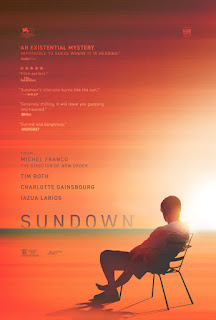
SUNDOWN

Tim Roth     Charlotte Gainsbourg     Lazua Larios     Henry Goodman

            This intriguing narrative teases you along doling out bits of information in a slow stream (background, identities, and thought processes), prompting your hypotheses and predictions, but guiding you somewhere unexpected all the time until perhaps the very end.  It’s exquisitely written and directed by Michel Franco who must know something about detective novels—although here, he’s written it so that you are the detective.

            We first meet Neil (Roth), Alice (Gainsbourg), and two teenagers at a swanky resort in Acapulco.  Alice lets Neil know how glad she is that he came on the trip (“Of course!” he replies) and a number of times they refer to “the children.”  Relationships are not spelled out at this point.  It’s apparent that Alice is the warmer of the two personalities and much more demanding of others, although she warmly tries to accommodate everyone.  We learn that she is a successful businesswoman, very committed to her work.

            Gainsbourg is famous for her acting in over 75 films, particularly in Nymphomaniac, Melancholia, and Antichrist, award-winning films, and for her performance particularly.  She brings her art to bear in Sundown, where she is the main focus of the family group enjoying a relaxed vacation in which she is wheedled into playing dominoes and staying away from her phone.  Curiously (for the naïve viewer), Neil does not play a dominant role in a situation where the man often does.  He is agreeable, but noncommittal.  

            Tim Roth is perfectly cast as the character Neil—often in the background—who offers little information as to who he is or what he might be thinking.  Yet, he remains the star of this drama, someone who often just looks silently at the person asking him a question who must use his/her judgment as to how to respond.  We observe him making leading moves and doing surprising—even outrageous—things.  Who is he?

            You will know very well by the end of the movie, one that is well crafted to make you think, observe your stereotypical thinking along the way, and leave you with questions to ponder as to the characters and the drama that you’ve just watched.

            This is not an “enjoyable” film, but it held my interest throughout with its eloquence in depicting human beings and the endless ways in which they present themselves and find solutions to the situations they encounter.  A big omission in assessing the movie is in not letting us know just how much one character (Alice) knows about another’s (Neil’s) current status.


This is a mystery well worth your time in its depictions of real people facing daunting situations and in its revelations about us, the viewers, as we make our assumptions about what we see.


Grade:  A


Thursday, October 14, 2021

BERGMAN ISLAND

 Vicky Krieps     Tim Roth     Mia Wasikowska     Grace Delrue     Anders Anderson Lie


            We meet Tony (Roth) and Chris (Krieps) as they are getting on a ferry to Fårö Island, home for 40 years of the renowned writer/director of Swedish films, Ingmar Bergman.  And you can see why he lived there so long; it is lush and evocative of special island places.  But place is not the issue or main point in this production.  Both Tony and Chris are Bergman fans.  He is older, a filmmaker considered as one of the experts on Bergman, and he has been invited to screen his latest production, hence his excitement about visiting the island.  Chris is younger and earlier in her career as a screenwriter.  She has had some success but is currently suffering from writer’s block.  Right away one senses the two are in different places in their minds.  And the story is primarily about their relationship.

            Krieps is the lead actor in this production written and directed by Mia Hansen-Løve (All is Forgiven, The Father of My Children), who was acclaimed for her last film (Things to Come).  Having read that she was a close collaborator and partner of the filmmaker Olivier Assayas and her penchant for semi-autobiographical films, I got the impression she identified with Chris, the character in this film.  She is quoted as saying, “the film really came together when I thought of the island of Fårö as a possible setting for the story”, and this line is uttered by the character Chris during the film when she is summarizing her thoughts to Tony about the script she is writing.

            In Bergman Island, Chris and Tony seem like a mismatched couple.  He is well established in his career, confident and decisive, but withholding in talking about his work with Chris.  (Although he did say he was writing about “how invisible things circulate within a couple”, which could easily be referring to the two of them, but of course he doesn’t elaborate.)  On the other hand, she is fearful (even of flying), lacks confidence in her abilities, and is frequently asking Tony for help.  When she goes into detail about her ideas for a plot, he interrupts her twice to answer his phone.  That is, there is a fundamental mismatch between them.  Although he denies his lack of interest, it seems obvious from his behavior that he gets bored.  And that’s not surprising, given the plot.

            Chris introduces her script plan to Tony by saying, “It’s a series of failure, betrayals, dramas…of impossible mourning and suffering overshadowed by a few memories” and I thought, “Who would want to see that?”  And indeed, one gets the impression her story  (told in film-within-a-film) is about a frustrated love interest of the woman Amy (wonderfully captured by Wasikowska) versus the much more thoughtful, planful first-love Joseph (Lie) who has enough insight to have a conscience.   He points out her ambivalences in relationships by saying, “You want to have two children by two different men.”  (And this is a reference to Chris’ earlier negative reaction when she was told that Ingmar Bergman had 9 children with five wives.)  Joseph’s condescension mirrors Chris’ earlier “harumph!”

            As a fan of Bergman films, I was all set to relish Bergman Island; and indeed there are many references to him and to his films (Through a Glass Darkly, Cries and Whispers, Persona), but none seem to relate to Mia Hansen-Løve’s plot.  Rather, it seems to be something of an autobiographical account of her relationship with Olivier Assayas, her partner for a number of years, and more generally with questions about a (female) writer claiming her own voice, particularly alongside a man of with a proven reputation.  There are mostly plusses for this film, but it could have been more explicit and decisive in its plot.


Not an ode to Ingmar Bergman, but a contrast between his career and that of a female screenwriter of today.


Grade:  B-                                         By Donna R. Copeland


Wednesday, January 8, 2020

THE SONG OF NAMES

Clive Owen     Tim Roth     Catherine McCormack     Jonah Hauer-King     Eddie Izzard


     The title—which is the same as the novel by Norman Lebrecht—is puzzling, but its origins will be revealed in the movie, along with its cultural associations. Fundamentally, the story is about brotherly attachment between two boys across many years.  Martin’s father, Gilbert, out of his love of music decides on the spot to take a young Jewish violinist with promise into his home in London during the build-up of WWII when the Nazis were apparently going to invade Poland, the boy’s country.  Davidl’s father returns to Poland to protect the rest of his family, promising the child that he will return for him.  
     Gilbert also thinks the arrangement will be good because his son Martin is about the same age as Davidl, and they can room together.  It turns out that the two boys are decidedly different in character and values, but after initial conflicts, arguments, and competitions, they become fast friends, though always with an edge.  An underlying sibling rivalry develops immediately, especially when Martin sees that his father clearly favors Davidl and indulges him much more than he does his own son.
     The complexity brought out in this relationship fraught with ambivalences is one of the strengths of the story because it carries a wealth of information about families and individuals that rings true to life and to the people we know from our own experience.  It’s made even more complicated by Davidl’s chameleon-like personality—intelligent, self-possessed, witty, cynical—very much his own person whose behaviors and points of views are often surprising.  He’s charismatic, along with being a gifted violinist. This is very different from Martin, a protestant well brought up to show respect, follow the rules, and think of others.  He is bright, though, and is also a musician (piano). 
     In adult years, Davidl has achieved fame, and is considered one of the best. Gilbert has booked him for concerts, which are well attended.  Then, one night, inexplicably, Davidl does not appear for a performance, and the waiting audience is sent home.  Davidl had been greatly affected by news out of Poland and unknowns about his family.  It is perhaps after getting some very distressing news about where they have been sent that tips him over the edge.  Davidl has abruptly disappeared before, but this time, he cannot be found.
     The plot then takes a turn into a detective story, with Martin obsessed with finding Davidl and getting an explanation.  This extends over 30 years, with his wife Helen becoming thoroughly exasperated with his doggedness.  We question what this is about, but can only speculate from a number of possibilities.  This detective story aspect of the film appealed to me, as Martin goes on one lead after another trying to trace the enigmatic Davidl.  Through these efforts, more of Davidl’s life and his experiences are revealed, along with the people he has met along the way.
     The real star of the movie is Tim Roth, who plays Martin with all of the acting skills he has.  It is probably his best performance to date.  Photography by David Franco is exquisite, particularly when he superimposes two scenes from earlier and later in the story as a graphic to illuminate the significance of “The Song of Names” for the characters.  Howard Shore’s music is likewise a major asset in classical works as well as the background score.  The three actors who play Davidl (Luke Doyl, Jonah Hauer-King, Clive Owen) convincingly and expertly play the violin.  How much is their own playing versus special effects, I don’t know; I couldn’t tell.  Either way, it was beautiful music to my ears.

A period film set in the world of music that combines pure drama with cross-cultural exchanges, wartime trauma, and sleuthing to extraordinary effect.

Grade:  A                                    By Donna R. Copeland

Monday, August 19, 2019

LUCE

Naomi Watts     Tim Roth     Kelvin Harrison, Jr.    Octavia Spencer
Norbert Leo Butz     Andrea Bang     Astro     Noah Gaynor


     Complexity is an understatement in this film about weighty topics ranging from race, privacy, security, trust, secrets, and communications that are misread because of listeners’ presumptions and conscious or unconscious wishes.  Luce’s strength is in illustrating how much anxiety and pain come to bear when there are no easy answers.  It’s a story that is worthy of much discussion after the movie among those genuinely moved by the events depicted.
     Initially, the Edgar family seems so admirably ideal.  Amy (Watts) and Peter (Roth) adopted a 10 year-old survivor of abuse and former child soldier in African Eretrea, and seem to have brought up a black-skinned child with all the privileges typical of privileged white children.  Named ‘Luce” (meaning “light”), the child is so gifted, personable, and emotionally balanced, he arouses expectations of fame, not only from his parents, but teachers and even other students—which, ironically, becomes a burden to him when he sees how favorably he is treated compared to fellow classmates. 
     In high school, Luce has a diverse group of friends and easily recognizes the bias with which some are treated, while he is excused.  He has a highly ambivalent relationship with his favorite teacher, Miss Wilson (Spencer), who is one of those who, he feels, expect him to be perfect.  He and the history teacher have sparring sessions fraught with a mixture of respect, overt politeness, and outright barbs.  It’s hard for the viewer to sort out the truths in this relationship, just as it is for the protagonists.  In a clever bit of script writing, the two people at different times make the statement, “Unfair doesn’t make it untrue.”
     During the course of the drama, we learn more about the Edgars’ conflicts with each other and between them and Luce.  It’s clear that husband and wife differ in their relationships with Luce.  As best as she tries to keep her private life confidential, Miss Wilson’s family history is exposed in a most unsettling way.  Luce’s diverse group of friends provides further intrigue and muddying of the waters.
     This production, directed by Julius Onah and co-written with J. C. Lee is fascinating in its grasp of contemporary issues that are not easily sorted out, all while being engrossing and entertaining.  Kelvin Harrison, Jr., as Luce performs expertly, portraying a character a bit too facile in his explanations and studied politeness.  However, at 25, he just can’t be convincing as a high school teenager.  (My ongoing gripe is the casting of young adults to play teenagers when there is an abundance of qualified younger actors in that age range.  Age discrepancy is highly disconcerting to those of us well acquainted with teenagers.  All of the “teens” in this film are in their mid-twenties, and one is 30 years old.)
     Octavia Spence is one actor continually worthy of praise.  She has recently branched out into roles where the character is a mix-up of good and bad qualities (e.g., Ma), all captivating, and highlighting her ability to portray conflicting personality characteristics.  Naomi Watts and Tim Roth also have nuanced performances that are convincing as real people going through major self-exploration and adaptation.  
     Julius Onah is early in his career as director and producer (this is only his second full feature film), and with Luce, he shows promise as a sensitive filmmaker knowledgeable about human frailties and strengths, and expert in storytelling.  Contributing to the quality of Luce are writer J. C. Lee, musicians Geoff Barrow and Ben Salisbury, and cinematographer Larkin Seiple.  

Combining mystery, intrigue, and entertainment with topical issues of race and privilege, Luce challenges viewers to question what is truth in the story and ways in which our own biases may come into play.

Grade:  B+                                    By Donna R. Copeland

Sunday, December 20, 2015

THE HATEFUL EIGHT

Samuel L. Jackson   Kurt Russell   Jennifer Jason Leigh   Walton Goggins   Tim Roth   Bruce Dern   Demian Bichir   Channing Tatum


          The Hateful Eight is divided into chapters.  Chapter 1 is entitled, “A Last Stage to Red Rock”, the full meanings of which are not immediately clear.  On the stagecoach is John Rich (Russell), a hangman and bounty hunter (“When The Hangman catches you, you don’t die by no bullet; you hang”) with his prey Daisy Domergue (Leigh) handcuffed to his wrist so she can’t escape.  They’re racing to Red Rock trying to beat the blizzard fast approaching behind them, and come upon Major Marquis Warren (Jackson) needing a ride because his horse perished on the trail.  As usual for him, Rich grills him like he does anyone, and if they succeed in convincing him, he turns out to be rather folksy with them.  Despite a brutal exterior (he continually batters Daisy), he is a soft touch if someone hits a certain button, but his mood can change on a dime.
          In Chapter 2, “Son of a gun”, we meet another potential rider, Chris Mannix (Goggins), soon to be the sheriff of Red Rock if he can just get there.  He manages to get a ride as well, and the group continues until they have to stop at Minnie’s Haberdashery to wait for the blizzard to pass.  This is the site of most of the action in the picture, with skirmishes between different parties.  An air of suspicion rules since this is just after the Civil War (in Wyoming) and some are southern Confederates, and some Union sympathizers.  Racial tension is high in the presence of blacks, Mexicans, and whites.  And finally, the two bounty hunters, Rich and Warren (who’s bringing in dead bodies for his reward) must always be alert to protect their bounty.
        Writer/Director Quentin Tarantino is a master of plot twists and thrills, and here he keeps us guessing and thinking a resolution is imminent through six chapters, continually springing plot twists that give new meaning to a situation.  Additional characters include an old Confederate General (Dern), a British gentleman (Roth); Bob, the caretaker of Minnie’s place (Bichir); and the Brit’s driver (Michael Madsen).  When suddenly, death visits unexpectedly, the plot turns to a mystery and deducing who the killer is. 
        Characteristic of a Tarantino movie, violence is so rampant, the viewer becomes inured to it, and after a while, someone like me stops reacting so much, especially since he often blends a bit of humor into the violence.  Or he has made you hate a character so much you get satisfaction in seeing that one get his/her due. 
        Tarantino likes to work with people from his previous films, such as Samuel L. Jackson, musician Ennio Morricone, and cinematographer Robert Richardson, editor Fred Raskin, casting director Victoria Thomas, and costume designer Courtney Hoffman.  Their excellent contributions help make his films masters of art.  Particularly notable here is Morricone’s haunting musical score and Richardson’s sweeping snow-laden landscapes and the menacingly colorful interiors that capture the drama of suspicion and violence.  Remarkably, the film was shot with the old Panavision lenses in 70MM, which is purported to be spectacular; however, unfortunately, my screening was in the current digital projection.
    Kurt Russell, Jennifer Jason Leigh, Bruce Dern, Demian Bichir, Tim Roth, Walton Goggins, and Channing Tatum are Tarantino first-timers, but they are all superb in their roles.  Russell and Leigh constitute a unique pair that plays perfectly into sado-masochistic roles.  No matter how many times she gets battered, the Leigh character yells out whatever truth comes to mind, only to get immediately knocked in the teeth—and she never learns to keep her mouth shut; nevertheless she always comes out smiling and feisty.
        I must say I did have reservations about seeing a female so despised by almost all the males (there are notable exceptions), who seemed to be acting out deep-seated hatred.  Perhaps Tarantino is aware of this in our culture and means to highlight it.  Or is this coming from something deep inside him?  I obviously don’t know.

Another significant work of the artist Quentin Tarantino, master of plot twists and thrills, always with injections of humor.

Grade:  A-                                    By Donna R. Copeland