Showing posts with label Brendan Gleeson. Show all posts

Thursday, December 23, 2021

THE TRAGEDY OF MACBETH

 Denzel Washington     Frances McDormand     Corey Hawkins     
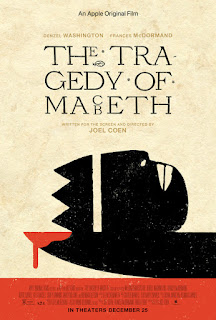
Brendan Gleeson     Bertie Carvel     Harry Melling     Kathryn Hunter


            It’s somewhat curious to me that the famed director Joel Coen (usually with his brother Ethan, but not this time) would choose to film a Shakespeare play.  We don’t seem to be in the right climate for that now, but I read that his wife Frances McDormand had for some time wanted him to direct the Macbeth play.  When he finally decided to do it, it was to make a film of it, although it was important to him to maintain a sense of the play.

            The two lead actors McDormand (Macbeth’s wife) and Denzel Washington (Macbeth) have both had experience acting in Shakespearean plays, and their renditions of the cadence and verse of the familiar lines appear natural and authentic.  Their performances here are award-worthy.  Roles played by the supporting actors (Corey Hawkins, Brendan Gleeson Harry Melling, and Bertie Carvel) are strong as well.  The cast and the special effects are the most appealing aspects of the film, a testament to Joel Coen’s direction and production abilities.

            The film is black and white, contributing to the intended qualities of starkness and eeriness.  When the witches—especially Hecate (Kathryn Hunter)—foretell the future, special effects add emphasis most effectively.  Hunter is such a wonder in contorting her body into seemingly impossible positions, it almost distracts from her prophesies.  But clearly Macbeth remains captivated and convinced that she is telling the truth, that he will one day be king of Scotland.  When he is in doubt, he evokes these spirits to reassure him, although of course he does not fully comprehend what the prophecies actually say.

Essential to the production was Stefan Dechant’s production design.  He and cinematographer Bruno Delbonnel created dark, foggy scenes outside and indoors that reflected the required mysteriousness and drama in the plot.  Likewise, Carter Burwell’s musical score with a mix of medieval and modern music sounds fit with all the different moods and auras of the film.

I was not excited to see a Shakespearean drama, but as I started watching and getting into TheTragedy of Macbeth, I began to be engrossed.  Surprising were the little thrills I got when some familiar quote appeared, and I realized that although I recognized them as Shakespeare, I had forgotten they came from this particular play.  Seeing them in context was especially pleasing.  I was also charmed by the language at times, such as “Let us not be dainty of leave taking” when two actors realize they need to disappear post-haste.


Shakespeare is not to everyone’s taste, but for those who still relish it, this impressive production of The Tragedy of Macbeth will surely please.


Grade:  A                              By Donna R. Copeland

Thursday, November 7, 2019

FRANKIE

Isabelle Huppert     Brendan Gleeson     Marisa Tomei     Greg Kinnear     Jeremie Renier


     This is a sad story in many ways—not agonizingly so—but sorrowful and melancholic.  Frankie, or rather Francoise Cremant, is a successful film star with many admirers (played by the inimitable Huppert).  She has an occasion to invite her complex family group for a vacation in the resort town of Sentra, Portugal, with striking views of the sea, the sky, hillsides, and the village—everywhere the eye turns.  But this is in sharp contrast with the lack of intimacy and veiled feelings of disquiet that permeate the group, some wrestling with relationships, some with illness, some with other kinds of dissatisfaction. 
     Frankie is there with her second husband Jimmie (Gleeson) who clearly adores her, but she is somewhat ephemeral and drifts off from time to time for solo walks. They never seem to have a conversation of substance.  Her current primary aim is to find a mate for her son Paul (Renier), who is moving to New York.  So she has the not so subtle idea of inviting her good friend Ilene (Tomei) to come as well.  She lives in New York (she has been Frankie’s hairdresser for a number of movies, and they’ve become good friends), and she thinks she is helping Paul by introducing him to Ilene. Paul is not pleased, and has the only outburst in this mostly agonizingly quiet gathering.  Unbeknownst to Frankie beforehand, Ilene has brought her friend Gary (Kinnear) with her.  
     In addition to these guests, Jimmie’s daughter has also arrived with her husband and daughter.  And Frankie’s first husband Michel (Paul’s father) is present as well.
     The whole entourage is a bit like a tour bus of travelers passing through, exchanging pleasantries, meeting and chatting on street corners or joining in walks together.  There are occasional arguments between a couple in their room, but at no time do we see the whole family all together enjoying a meal or sharing experiences.  There are only little groups of two or three, in which a conversation of depth or of personal importance might get started, but then trails off.
     Frankie has hopes that this reunion—which could be their last—will be congenial and close.  But it’s clear to the observer that their connections have never been freewheeling and intimate, where significant events are discussed and worked through.  So we get the impression the family’s typical ways of coping with major life events will be repeated here  Interestingly, the structure and dynamics of the film seem to be derived from the kind of family director Ira Sachs and his co-writer Mauricio Zacharias have created.  As a consequence, we never learn enough about the characters to really know them and care about them. Each vignette about a couple/family/individual is just a snippet so short we can’t possibly get an idea of who they are.  Similarly, drama and deep emotional concerns are never allowed to surface.  

Visually, this is a gorgeous film, but it lacks real human warmth and understanding.  The icon Huppert cannot compensate for a limpid script.

Grade:  C-                                    By Donna R. Copeland

Wednesday, November 21, 2018

THE BALLAD OF BUSTER SCRUGGS

Liam Neeson     James Franco     Tim Blake Nelson     Tom Waits     Zoe Kazan     Grainger Hines
Harry Melling     Brendan Gleeson     Jonjo O’Neill     Chelcie Ross     Tyne Daly     Saul Rubinek


      Ethan and Joel Coen have chosen to produce a western anthology containing six stories for their latest film.  Most of the main characters in each are loners, and there is at least one death in every story, but there are surprises in every one, particularly for the victims.  Characteristic of the Coens as well, humor—even if it’s sick—pops up from time to time. The music by Carter Burwell and cinematography by Bruno Delbonnel increase the artistic quality of the western stories significantly.
     In the first story titled “The Ballad of Buster Scruggs”, Tim Blake Nelson is Scruggs, a singing cowboy, who receives a dare everywhere he goes.  He’s a sharp shooter who can even hit his target looking backward through a handheld mirror—which doesn’t exactly jive with his crooning talents.
     In “Near Algodones”, Cowboy (Franco) looks up to see an isolated bank in Tucumcari, New Mexico, thinking it will be an easy target, especially with only one old man as a single teller.
     In “Meal Ticket”, Impresario (Neeson) carries a paraplegic “Thespian orator” (Melling) through western towns to deliver poems and addresses based on the Bible and Abraham Lincoln’s speeches to the local townspeople.  The two support themselves by taking up collections at the end of each performance.  Then, the impresario discovers that a chicken might be just as entertaining.
     The next two stories are the best.  In “All Gold Canyon”, Tom Waits is a prospector panning for gold.  He mumbles constantly—either to his horse or to a deity, or someone else, not sure which—but after panning doggedly for gold, he finds a mother lode.  But…someone has been following him all this time and sees what he has discovered.
      In “The Gal Who Got Rattled”, Alice (Kazan) and her brother are in a wagon train headed for Oregon, where he has a business opportunity and the hope that his partner will want to marry Alice.  Unexpected events occur, which means that Alice is on her own and must make decisions for herself.
     Finally, in “The Mortal Remains” five travelers are in a stagecoach headed for Ft. Morgan.  It’s a motley group: Two bounty hunters, a French gambler, the wife of a minister, and a trapper.  They have rather tedious arguments about humankind (“There are two types, hale and frail”, “No, there are the upright and the sinners”). The trapper says he has only one kind, the dead, “but they’re different…” he allows.  The fears of death among three in the group are readily apparent when it’s time to stop, and the “bounty” of the bounty hunters is carried out in a bag and inside and up the stairs.  They have to force themselves to go inside.   
     The “surprised by death” theme is one thing that connects all the stories, except for the last one in which we’re left with not being sure whether or not the three passengers have something to fear.  At any rate, death is on their minds.  And, by the way, the Coen meanings/points/connections between the stories are not obvious in the least.  

More quirky, thoughtful, humorous tales from the Coen brothers.

Grade:  B                                    By Donna R. Copeland

Thursday, January 11, 2018

PADDINGTON 2

Voice of:  Ben Wishaw      Sally Hawkins     Hugh Bonneville     Hugh Grant
Julie Walters     Jim Broadbent     Brendan Gleeson     Michael Gambon     Imelda Staunton


     This adventure centers around an antique book about London which Paddington (Wishaw) discovers in Mr. Gruber’s (Broadbent) shop, and wants to send to his Aunt Lucy, who has always longed to see London.  When Paddington learns that it is valuable, and he’s going to need lots of money to buy it, he immediately looks for work.  The barbershop doesn’t work out so well after the electric shears get the best of him, but he discovers he is an excellent window cleaner and works diligently with amazing acumen cleaning the windows of multi-story buildings.  And he gets close to being able to buy the book for his aunt.  Wherever Paddington goes, as we know from the earlier book and film, he charms everyone with his Aunt Lucy-isms (e.g., “If you look for the good in people, you’ll find it”) and helpfulness.  But this is a substantive kind of charm, illustrating so well how politeness, diligence, and seeing the good in others changes them.
     The story is not just about “nice” things, however; there is a villain named Phoenix Buchanan (knavishly played by Grant) who exploits what he hears from the innocent Paddington.  Putting that information together with what he already knows (that there is a valuable pop-up book that has been missing for years), he concludes that it could solve all his financial and professional problems.  (His magic acts have been failing and he is drowning in debts).  We get to hear about the history of the book and how it came to be, which is an interest heightening segue).
     From here, the story transforms into more of a thriller, with Paddington being accused of a crime, tried, and put in prison.  This takes all the resources of his beloved Brown family (Sally Hawkins, Hugh Bonneville as parents), as well as friends he has made in prison, such as the grumpy cook Knuckles (Gleeson). (Paddington won him—and the other prisoners—over with his marmalade sandwiches.)  Along with his family, these newly made friends promise to exonerate him.  After seeing how well Paddington navigates the prison system, things take a turn, after which, we have some nail-biting scenes involving a prison break-out, trains, and near-drowning that make the film into a thriller.
     Paul King, director, and writer with Simon Faraday, based on Michael Bond’s story, has scored again with a Paddington story that interests and thrills viewers, along with providing thoughtful observations about humans and how we function.  They are optimally aided by musician Dario Marianelli and cinematographer Erik Wilson, along with a plethora of artists in production design, sets, costumes, and special effects.  The actors (Sally Hawkins, Hugh Bonneville, Hugh Grant, Julie Walters, Jim Broadbent, Brendan Gleeson, et al) bring it all to life in a way that is entertaining and thought-provoking for children and adults. 
     It’s so rewarding to see a film with so much humane, visual, aural, and technological artistry.  Would that all so-called “children’s” films were of such high quality.

Before the intense adventure, there is warmth and loving connections.  What could go wrong?

Grade:  A                                    By Donna R. Copeland

Thursday, January 12, 2017

LIVE BY NIGHT

Ben Affleck     Elle Fanning     Brenda Gleeson     Sienna Miller     Zoe Saldana     Chris Cooper
Remo Girone     Robert Glenister     Chris Messina     Miguel Pimentel


         Does crime pay?  Live by Night seems to be addressing this issue, but the reasoning and events used to talk about it are complicated.  Joe (Affleck) is rebellious toward his father (Gleeson), a Boston police captain, and a bit jaded after a stint in the Marines during WWI, saying that he is no longer going to take orders from anyone.  As a reaction to these situations, he chooses a life of crime to support himself, much against his father’s advice, of course.  But the irony is in what he finds when he is caught between two warring crime bosses; father figures ordering him around—in spades.  And he also finds that now the stakes are much higher, and his vow not to kill anyone else becomes increasingly impossible.
      Joe is extremely naïve in the beginning of the story, and easily becomes fatefully involved with the girlfriend of the first big boss, Albert White (Glenister).   Emma (Miller) is coquettish and he is easily entangled in her web.  He just about loses his life as a result, but is rescued at the last minute, although he does have to do some time in prison.
        Just why he again makes a bad choice when he gets out is not explained—a fault of the writing.  That is, a boy who seemed to come from a “good” family with basic values is somehow attracted to a life of crime?  There is nothing in the script about the character that accounts for this.  But say it’s simply money; he doesn’t know how to make lots of money without participating in the alcohol trade during Prohibition.  Let’s just go with that.
         Competing drug lords Albert White (Glenister) and Maso Pescatore (Girone) recognize his skills, and recruit him; first, White, then Pescatore.  He is able to keep from killing when he is with White, but with Pescatore, that option is not open.  Not only must he deal with competition in business, but he eventually has to deal with the Ku Klux Klan in Florida.  The ante keeps increasing for this unfortunate character until he thinks he has finally reached a solution.
           Another complication Joe encounters in Florida comes in the form of a sexy Cuban, Graciela (Soldana), who supports pro-Cuba revolutionary causes.  She will be his redemption both emotionally and legally.  At last, he finds through her a path that will free him from his baser instincts.  But there are major twists in the story on up to the end.
         Affleck co-wrote, produced, and directed Live by Night, and after his success with Argo and winning numerous awards, this film is something of a disappointment, which has to do with a host of problems.  The main characters are not well fleshed out; the sound quality makes it difficult to understand the dialog sometimes, and the logic of going from Point A to Point B in events as well as the characters is weak or absent.  Affleck’s own performance is thin, not nearly as powerful as much of his earlier work in Gone Girl, Argo, and The Town, for instance.  Perhaps it’s just a matter of time and attention; he has numerous projects in development and in production.
          Turning in good performances are Elle Fanning, Brendan Gleeson, Zoe Saldana, Chris Cooper, Ramo Girone, Robert Glenister, and Chris Messina.  Robert Richardson (Hateful Eight World War Z, Django Unchained, Hugo) is a wizard with the camera, and the music of Harry Gregson captures the period.

A gangsta movie for gangsta fans.

Grade:  C                                    By Donna R. Copeland

Tuesday, December 20, 2016

ASSASSIN'S CREED

Michael Fassbender     Marion Cottiard     Jeremy Irons   
 Brendan Gleeson     Charlotte Rampling     Michael K. Williams     Ariane Labed   Michelle Lin 


         The original idea of the film came from the video game of the same name, but Director Justin Kurzel wanted writers to come up with a new story that would be less “game-ish” and more suited to cinema.  For this, he engaged writers Michael Lesslie, Adam Cooper, and Bill Collage.  To see that action and game fans would not be disappointed in the visuals and special effects, he secured the help of Production Designer Andy Nicholson, Cinematographer Adam Arkapaw, Musician Jed Kurzel, and a talented cast, as shown above.  In my view, he certainly succeeded in the visual and special effects and in the cast.
         The drawback of the production is a rather confusing story that jerks us around in time and space with a host of characters difficult to keep track of.  The first scenes are in 1492 in Andalucia, Spain, in which Aguilar de Nerha (Fassbender) is taking the oath of the Assassin’s Creed to protect an apple even unto death against the Templars, who had taken over Spain.  Switch to 1986 in Baja, California, where a young boy Cal is told by his father (Gleeson) to run and “keep in the shadows”, hiding from assassins out to kill him like they did his mother.  Thirty years later, we see the grown-up Cal (Fassbender) in prison for murder, being visited by a priest, and subsequently being executed and declared dead—when suddenly he is in Spain at Abstergo Industries associated with the Knights Templar Order. 
       He awakens to Dr. Sofia Rikkin (Cottiard) telling him that he will be participating in research with the aim of getting rid of his DNA associated with violence that passes through generations.  Yes, he is a descendant of Aguilar.  His charge is to go into “Animus” with virtual reality equipment designed to take him back in time (15th Century) and space (Spain) to wrest the apple from the Templars, who now possess it.  The apple’s seeds will then be used to rid the world of violence.  We watch this happen, and it is truly amazing to see Cal/Aguilar with his partner Maria (Labed) miraculously fighting off hordes of people standing in their way.  (I understand Fassbender and Labed did 95% of the fights themselves).  And Cal takes more than one trip into Animus trying to retrieve the apple.
         Of course, dark forces are at work.  It seems that Sofia’s father Alan, CEO of Abstergo has his own plans, and we see him talking with Templar Ellen Kaye (Rampling).  The plot thickens as the differences in aims between father and daughter become more apparent.  This adds an unnecessary layer to the drama that I think would have been better off omitting. 
        The strength of this film is actually the video game aspects (and I’m not a video game fan), and less so with the story that becomes weighed down with too many layers and complications.  And I’m not even mentioning the layer of current prisoners at the Abstergo Company who play a role in insurrection.
        Fassbender, Cottiard, Irons, Gleeson, and Rampling give the film a haunting, mythical quality that keeps the viewer engaged.  It’s too bad the story becomes so convoluted they are hung out to dry.

Action and intrigue, but with substance minimized.

Grade:  C+                        By Donna R. Copeland