Showing posts with label thriller. Show all posts

Wednesday, July 27, 2022

PARADISE HIGHWAY

 Morgan Freeman     Juliette Binoche     Cameron Monaghan     Hala Finley     Frank Grillo


            This is a crime drama as thrilling as any you would want to see, with the best of writing and directing by Anna Gutto and a cast containing the illustrious Juliette Binoche in a completely divergent role from her past and the inimitable Morgan Freeman being in his quintessential role of the quiet, irritating upsetter.  Close behind them is young Hala Finley who is already a master at showing how children can portray depth of character and artistry while still maintaining childhood innocence.  

            This is not your ordinary crime drama—no screaming car chases, no grossly bloody scenes, no mano-a-mano male combat for a finale—it shows ordinary people confronting life dilemmas and careful, committed FBI work that would do our country proud.  One might think this was not “exciting” enough, but in actuality, it was so intense at times I needed to take a break from my home screening.

            The story begins with a novel characterization of a female truck driver Sally (Binoche) talking to her friends on the road—other female truck drivers—indicating her dubious ties to her brother Dennis (Grillo).  He is in prison, and after a lifetime of protecting her from an abusive father, he is able to get her to help him in alleviating some of the abuse he is experiencing in prison.  This involves her transporting “packages” for him from one place to another.  

            When one of these “packages” turns out to be a young girl (Finley), the plot heats up.  This is especially since the writer of the drama is giving credit to how smart and streetwise young girls from her background are today.  We the audience learn something about the knowledge and understanding victims of poverty and trafficking acquire in their brief lives.

            Now, Sally has to deal with situations in her life for which she is completely unprepared.  For the first time, she must take into account someone other than herself and her devotion to her brother.  That journey will be much more difficult than anything she’s had to face before.

            I contrast this production with male-dominated stories of daring-do in which “action” scenes predominate.  Here, you find two unlikely females developing a tentative bond, an unlikely FBI pair trying to work together, and the unexpected disruptions of a child.  The bottom line is that it becomes interesting—even engrossing—while revealing much about human relationships, trafficking of children, the prison system, and intelligent police work.


A thriller well worth your time and interest, Paradise Highway shows us important considerations in life.


Grade:  A                              By Donna R. Copeland

Thursday, July 14, 2022

THE GRAY MAN

 Ryan Gosling     Chris Evans     Ana de Armas     Rege-Jean Page     Billy Bob Thornton


           How to get the attending audience not to see your movie.  Make scenes so dark viewers can’t tell what’s going on or who the characters are, especially in the fight scenes.  Make it so loud that dialog can’t be heard above the din of sound effects.  Include characters that are so sadistic it’s unbearable to watch (e.g., pulling out fingernails one by one) and forces you to look away.  Write the plot so it contains implausible situations, such as the wounded continuing to fight long after they would most likely have succumbed, have a character with a heart condition be terrified time and again without having a heart attack.  And finally, mixing up the time frames by going backward and forward.

            The CIA must be grumbling about how it’s portrayed in The Gray Man (largely written, directed, and produced by Russo brothers Anthony and Joe), showing two leaders in the upper echelons of the CIA who are completely illegal and immoral.  Movies are notorious among professionals for portraying their disciplines unrealistically, and (at least I hope) this is another instance.  Of course, we know of real situations where the CIA used bad judgment, but I hate to see even those instances glorified in media.

            The star of this production is one of my favorites, Ryan Gosling, as an unfairly discredited agent being recruited to perform special jobs that are top-secret by their nature of bordering on the illegal.  Six, as he is called, does not even have a file.  Gosling is up to his usual fine performance of being extraordinarily gifted/trained in combat, and still gentle with a heart of gold.  Chris Evans is good as well as a fiendish, sadistic evil man, and it’s hard for me to believe that “Captain America” would take on such a role, but he is believably bad here.  Ana de Armas likewise plays a strong role demonstrating her fighting skills against much stronger men.  She is certainly convincing as a very bold driver.

            On the whole, the cast and its skills are the best feature of this production that looks and feels like a video game, more intent on the craft of special effects than the art of story and character.  The Russo brothers have become famous perhaps primarily for their success in the Marvel world of film, which I have enjoyed from time to time.  Here, I think they go over the top in so many ways, with no recognizable artistry.  The craft as they see it takes over the film.  The erratic editing simply provides more evidence of the film’s lack.


I can’t think of any reason anyone would want to see this film.


Grade:  D                              By Donna R. Copeland


Wednesday, April 27, 2022

MEMORY

 Liam Neeson     Monaca Bellucci     Guy Pearce

            No justice?  Well…maybe…  That’s the subject of this thriller starring Liam Neeson in the role of a paid assassin; that is, is justice ever served, really?

            The extra twist in this movie based on an earlier Belgium movie entitled The Memory of a Killer is that the paid assassin is suffering from progressing Alzheimer’s Disease.  In this case, Alex Lewis (Neeson) is in his later years and planning to retire.  No more “jobs.”  But as a favor to an old friend, he agrees to take on one more.  “Famous last words” and all that.

            The beginning of the intrigue is a bit confusing at first, with six different people in different places introduced right away.  Keep track because you’ll encounter all of them later.  The upshot is that Alex has been persuaded to take on another job.  We quickly move from Guadalajara to El Paso to Mexico City and back to El Paso.  Essentially, the plot addresses the fundamental issue of whether justice can ever be served.  There are different kinds of justice, of course—what happens to those caught up in something in which they have no control—and true justice in which perpetrators of cruelty are given their comeuppance.  Those who are complicit in injustice are likewise addressed.

            Vincent Serra (Pearce) is a committed FBI agent who takes an interest in a child, Beatriz (Mia Sanchez in a top performance), caught up in something she cannot possibly understand.  She’s the daughter of a trafficker snared by Serra and his team.  He recognizes her innocence (an emotion we later learn is possibly based on his own experience) and tries to see that she is protected by U.S. child protective agencies.  Here, the issue of the treatment of undocumented people is touched upon.  (A strength of this film is its ability to layer related social issues.)

            The history of the plot itself is based on first a book by Jef Geeraerts, a film, “De zaak Alzheimer” by Carl Joos and Erik Van Looy and a screenplay by Dario Scardapane.  Director Martin Campbell with his collaborators cinematographer David Tattersall, musician Photek, and the actors Liam Neeson, Guy Pearce and the rest of the cast deliver a thoughtful action film that is worthy of the genre.  

            Memory is a thriller through and through where we see a paid assassin acting on personal limits (which are explained in the end) creating such an uproar he ends up being on the side of the FBI agent he deems to be moral and committed.  I liked that in the end justice can be served.


An unlikely thriller in which moral limits are tested and found to be among those least admired.


Grade:  A                              By Donna R. Copeland

Thursday, March 24, 2022

INFINITE STORM

 Naomi Watts     Billie Howle     Denis O’Hare

            You will get chilled and exhausted as you watch this 127 Hours (Danny Boyle) type of thriller about a rescue in the White Mountains of New Hampshire.  Pam Bales (Watts) heads out for a day of hiking carefree.  Her friend notes that a storm is coming, and shouldn’t she stay home?  No, she treasures her time in the mountain wilderness for the healing she experiences after the heartbreaking losses in her life.  It’s a time when she can feel free.

            Pam notices when it starts thundering and snowing, but she keeps going undeterred until she realizes a blizzard is mounting, and she heads back down.  She has to pause from time to time, and experiences real terror when she falls into a deep hole.  Now and then she thinks she hears voices and even blows her whistle but gets no response. Then, she spots sneaker prints in the snow and soon comes upon a figure sitting on the edge of a mountain.  He is mostly unresponsive, so she says she will call him ‘John’ and assures him she is from Search and Rescue.  It’s clear from watching her that she knows what she is doing, and fortunately she had packed extra supplies in her backpack.  How the man is dressed is puzzling; he is wearing sneakers and casual clothes.

            Pam is able to rouse him and warm up his body; but there is something besides his clothing that is strange to behold.  He is very uncooperative, and on their descent when times get tough, he tells her, “I can’t do it!”  This is perhaps the most surprising aspect of the movie—someone who does not want to be rescued and consequently puts both him and his rescuer in danger.

            At times, the viewer will get disgusted when he behaves so childishly as a grown man.  Come to think of it, most children would put him to shame.  You wonder at her persistence in continually goading him when he clearly wants to sit and die.  He can’t inch his way on a log over a stream without falling in the water below.

            Naomi Watts is at her best in going about her business with determination.  (Kudos to her and the filmmakers for realistically showing the aging, stresses and strains in her face when she is normally seen as a beauty.)  We learn at the end of the film what is behind her determination, and where it might not have made sense before, it does now.  Watts is a treasured actor (King Kong, Mulholland Drive, 21 Grams, Birdmen) generally admired for her skills, and she shows “true grit” in this particular role where she must act as a therapist out in the brutal elements.  Billie Howle does a commendable job, albeit in an unadmirable role.

            Lorne Balfe’s music provides needed relief during the numerous tense moments of Infinite Storm, and Javier Aguirresarobe’s cinematography captures the brilliant snowy mountain landscape in a way that enhances the emotionality.  Polish female director, Malgorzata Szumowska (Never Gonna Snow Again), has won numerous awards in Europe, but is relatively new to the U.S. scene.  Screenwriter Joshua Rollins based the plot on the real-life experience of Pam Bales, a nurse whose story was recounted in a Reader’s Digestarticle by Ty Gagne.  


Dramatization of a heroic rescue in the White Mountains of New Hampshire by a mother/nurse/mountain guide.


Grade:  B+                            By Donna R. Copeland

Thursday, January 6, 2022

THE 355

 Jessica Chastain, Diane Kruger, Penelope Cruz     Lupita Nyong’o 

Edgar Ramirez, Sebastian Stan, Bingbing Fan


            Girl power.  It’s front and center in this spy thriller that spans agencies in the U.S., the U.K., Germany, and China, with stops in Marrakesh, Morocco and Shanghai—but it begins in Bogota, Colombia.  Someone there has come up with the ultimate in hacking—a tool that can tap into any digital system, public or private.  And, of course, hackers around the world are out to get their hands on it.

            Much is made about gender politics in the film, as well as geopolitical forces, and to back up the former we get a very cheeky crew:  Jessica Chastain as Mace, Lupita Nyong’o as Khaddijah, Diane Kruger as Maria, and Penelope Cruz—a psychologist(!)—as Graciela, a reluctant player who gets pulled into the drama after she is sent to intervene with a friend who is an agent (Rodriguez).

            All these actresses are top-notch, and convey the characters’ personalities expertly, showing intuitive skills and emotional strength along with physical prowess.  Individually as well as a group, they are a highlight in the film.  As a surprise standout—not only for her sheer presence as a character, but also as a surprise element in the plot—is Bingbing Fan.  She is a mysterious figure who appears at a critical time.

            As is the predilection of current filmmakers in the action genre, there are far too many hand-to-hand combat scenes in The 355 for my taste—scenes that are usually shot in dim light so that it’s hard to follow the moves exactly.  Although these are generally presented as the means to highlight the hero’s/heroine’s strength and caginess, too many such scenes cause the viewer to distance from the story with dialog that sounds contrived rather than real.

            The film can be praised for making a valiant effort to show women who are initially dubious toward one another becoming emotionally close, with some moving from utter lack of feeling to having some semblance of empathy, but the turns are a little too pat to come across as being realistic.  An example is Kruger’s character Maria from Germany being shown as rather cold in the beginning; then, as a presumed result of her interaction with the other female characters, she becomes more personable…almost. 

            In thinking about the audience for this movie, I imagine that males will see it as a “chick-flick” because of the brutal blows that many male characters take in the hands of female characters.  But it’s not rom-com by any means.  The relationship between the Chastain and Stan characters—however contrived it may be—is not romantic at all, even though I think it is meant to be by the writers.  This is probably because it comes across as so implausible.  

            Maybe the only audience for this movie are female fans of action movies regardless, or perhaps for females who get some satisfaction from their own “giving it to the man.”


Cyber crime is shown realistically as a threat of world-wide proportions that can affect most of us; but the enactment of fighting against it in this film is less impactful.


Grade:  C+                            By Donna R. Copeland

Thursday, December 23, 2021

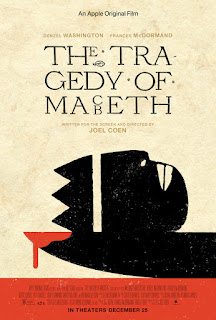
THE TRAGEDY OF MACBETH

 Denzel Washington     Frances McDormand     Corey Hawkins     

Brendan Gleeson     Bertie Carvel     Harry Melling     Kathryn Hunter


            It’s somewhat curious to me that the famed director Joel Coen (usually with his brother Ethan, but not this time) would choose to film a Shakespeare play.  We don’t seem to be in the right climate for that now, but I read that his wife Frances McDormand had for some time wanted him to direct the Macbeth play.  When he finally decided to do it, it was to make a film of it, although it was important to him to maintain a sense of the play.

            The two lead actors McDormand (Macbeth’s wife) and Denzel Washington (Macbeth) have both had experience acting in Shakespearean plays, and their renditions of the cadence and verse of the familiar lines appear natural and authentic.  Their performances here are award-worthy.  Roles played by the supporting actors (Corey Hawkins, Brendan Gleeson Harry Melling, and Bertie Carvel) are strong as well.  The cast and the special effects are the most appealing aspects of the film, a testament to Joel Coen’s direction and production abilities.

            The film is black and white, contributing to the intended qualities of starkness and eeriness.  When the witches—especially Hecate (Kathryn Hunter)—foretell the future, special effects add emphasis most effectively.  Hunter is such a wonder in contorting her body into seemingly impossible positions, it almost distracts from her prophesies.  But clearly Macbeth remains captivated and convinced that she is telling the truth, that he will one day be king of Scotland.  When he is in doubt, he evokes these spirits to reassure him, although of course he does not fully comprehend what the prophecies actually say.

Essential to the production was Stefan Dechant’s production design.  He and cinematographer Bruno Delbonnel created dark, foggy scenes outside and indoors that reflected the required mysteriousness and drama in the plot.  Likewise, Carter Burwell’s musical score with a mix of medieval and modern music sounds fit with all the different moods and auras of the film.

I was not excited to see a Shakespearean drama, but as I started watching and getting into TheTragedy of Macbeth, I began to be engrossed.  Surprising were the little thrills I got when some familiar quote appeared, and I realized that although I recognized them as Shakespeare, I had forgotten they came from this particular play.  Seeing them in context was especially pleasing.  I was also charmed by the language at times, such as “Let us not be dainty of leave taking” when two actors realize they need to disappear post-haste.


Shakespeare is not to everyone’s taste, but for those who still relish it, this impressive production of The Tragedy of Macbeth will surely please.


Grade:  A                              By Donna R. Copeland

Tuesday, December 7, 2021

WOLF

 George MacKay     Lily Rose Depp     Paddy Considine     Marten McCann     Terry Notary


            Wolf implies that “species identification disorder” is common, when in fact “species dysphoria” is a very rare condition.  I found this movie misleading and distasteful in so many ways.  First of all, the “hospital” staff treat the humans like animals, expecting them to become human, e.g., shaming them into compliance.  The filmmakers appear to know nothing about proven behavioral principles and therapy.  Progressive approximation is a common technique used by certified psychologists, whereas shame used by The Zookeeper (Considine) gets one nowhere or into something worse.  When the “patients” began to rebel at one point, my thought was that if you treat humans like animals, they will begin to show animalistic behavior.

            That is also shown in individuals, such as Jacob (MacKay) who is demonstrably tender-hearted, but when The Zookeeper in particular treats him more and more like an animal, he becomes ferocious.

            Jacob’s and the other residents’ parents have brought them for therapy, and have high hopes that they will get better.  But we don’t see any of them getting better, only worse, which shows the staffs’ techniques are wrong.  It may be that the filmmaker’s (writer/director Nathalie Biancheri) intention is to show the abuse and ill intentions for all to see, but there is no indication of that in the film.  Appropriate ways of treating people with mental disorders is never apparent.

            In contrast with the staff, when Jacob and his new-found friend “Wildcat” (Depp) confide in one another, they become more human in their sympathy, empathy, and attitude toward their peers.  Mackay’s performance is noteworthy, especially when we see him moving in the forest; he must have studied the movement of wolves enough so that his form looks convincingly feral.

            One comment made by an inmate suggests that the staff uses technology (like an iPad game) to connect them with their human side.  (Staff apparently don’t read today’s claims about technology possibly turning us into automatons.)  Other ludicrous interventions include a hopping dance with forced smiles (not emotionally based), shocks delivered to the abdomen, and placing disobedients gagged and chained into a cage.


There is nothing to redeem this psychological disaster of a movie.


Grade:  F                              By Donna R. Copeland 

Friday, December 3, 2021

ENCOUNTER

 Riz Ahmed     Lucian-River Chauhan     Aditya Seaton

Octavia Spencer     Rory Cochrane     Janina Gavanker


            Viewers’ expectations are set up immediately by opening scenes of comets flashing across the sky and close-ups of microorganisms that look like aliens.  But then we’re introduced to a typical American family—mom, stepdad, and two young boys.  The older child Jay (Chauhan) shows resentment toward the “new” dad and sits at the dinner table drawing pictures for his own father Malik (Ahmed).  He’s had frequent correspondence with him, in which Malik indicates that he has an important job fighting for the country.  And it is true he has been in the Marines, but that is only part of the story.  

            It’s best not to know much more than that before seeing the movie because it is packed with ambiguities, tension, and fear.  Suffice it to say that the dad appears suddenly to take his boys on a road trip, which he calls a “secret mission.”  His imagination charms them and they look forward to a big adventure. 

            This is a well-conceived movie directed by Michael Pierce and co-writer Joe Barton.  It leads you along from the set-up to something much more frightening, in a way, and to something that will prompt your thinking about some relevant and important truths.  As you see it, you ask questions, consider hypotheses, and do a bit of nail-biting when the action gets hairy.  But afterwards, you ponder the fundamental ideas the filmmakers want you to think about.

            The acting is superb; Riz Ahmed again proves his talent as he did in Sound of Metal playing a musician confronting deafness.  Here, he plays a devoted father—albeit one who lacks some parenting skills—whose intention is to rescue his children from an impending threat.  The young actors (Lucian-River Chauhan and Aditya Seaton) playing his children are also uncanny in their portrayals of real children put in threatening, sometimes traumatic, situations.  One is an eight-year old, the other a four-year old, and the scripting for them is outstanding in its accurate depiction of the way children those ages think.  It’s clear the two actors grasped what they needed to do, and they did it admirably with apparent precociousness.  

            Enter Octavia Spencer as the parole officer who lends common sense, genuineness, and perspicuity to all situations.  These are the attributes Spencer is so gifted in portraying, as seen in The Help, Hidden Figures,and The Shape of Water.  She shows that she is the only one in government who truly understands Malik, and appropriately asserts her presence in helping to resolve an incredibly tense situation.

            This is a movie about so many important subjects—parenting, children, guns, mental health, and governmental approaches to enforcement.  It dramatizes all of these in a suspenseful high-tension script that engages your value system as you assess the drama.  

            Director and co-writer with Joe Barton, Michael Pearce has been recognized for his 2017 movie Beast, as a promising filmmaker.  He lends credence to that accolade in his portrayal of a family drama that informs about parenting, mental health, and law enforcement in a manner that is realistic and compassionate.


Encounter thrills and chills, but also makes you think about important considerations in looking at families and human behavior.


Grade:  B                              By Donna R. Copeland

Wednesday, November 24, 2021

HOUSE OF GUCCI

 Salma Hayek     Jared Leto     Adam Driver     Lady Gaga

Al Pacino     Madalina Ghenea     Jeremy Irona     Jack Huston


            This is a colorful film with a complex plot that begins light-heartedly romantic and interesting.  Mauricio Gucci (Driver) is a reserved young man without much of a social life and still living in his family home with his father Rodolfo Gucci (Irons).  Patrizia (Lady Gaga) is an ambitious, sexy woman who, when he tells her his name at a party, flirtaciously picks him up, in a way, and he is instantly attracted to her.  They seem to mesh well together; she draws him out and he offers her stability and dependability.

            After a short time, when Mauricio introduces Patrizia to his father, although the older man is charmed by her, he is suspicious as well and warns his son not to get involved.  This creates such harsh disagreement, Mauricio moves out of the home and shows up at Patrizia’s, where he is taken in and begins working at her father’s trucking company (which Patrizia affectedly refers to as “land transportation”).  

            Mauricio is modest, belying his wealthy background, and thoroughly enjoys the physical labor.  Their love continues to grow, resulting in marriage and a child.  Many events transpire after that, with the couple remaining very much in love.

            Although skirmishes had always been a part of the family’s existence, major trouble begins to brew around running the business and financial disagreements brought on partly by the introduction of Rodolfo’s brother Aldo (Pacino) in New York City, to Patrizia and her not being able—or willing—to resist getting involved in the business and pressuring her husband to take certain actions.

            What transpires is heightened intrigue and shifting loyalties and how far people in families will go when bonds weaken and their circumstances begin to change.  

             Ridley Scott directed the film based on a book by Sara Gay Forden, with screenplay by Becky Johnston and Roberto Bentivegna.  The pace goes along nicely, giving the viewer time to absorb who all the players are and mete out the twists and turns as in a good crime story.  Scott is better known for his scripts than for his direction.  And it is probably the case in this film that his reputation is borne out.  For those who are not familiar with the story, there are major surprises as all the different elements unfold, a positive of the script.  Direction, however, may be lacking in the cohesiveness of the cast in the story.  

            That being said, along with the script, the cast is one of the film’s strongest points, beginning with the two leads, Adam Driver and Lady Gaga.  Driver is on a roll this year, with three of his movies on wide-ranging subjects being released.  Here, he is his most laid back, slow to burn character until he is pushed too far.  Lady Gaga is good at playing an ambitious woman who uses her sexiness to her advantage.  Her performance may be a bit “over the top”, but I enjoyed her young enthusiasm and craftiness in the beginning.  Later on, as the plot thickens, she is showing more of her naivete, and she relies more and more on her fortune teller (Hayak—who doesn’t quite fit the role), one’s sympathy for the character (and perhaps for the house of Gucci and The House of Gucci the movie) wanes.  

            In the mix is the uncanny performance of Jared Leto as Paolo Gucci, the “idiot son, but he’s my son” son of Aldo.  Leto shows the man as one with questionable talent who is a bit of a changeling, trying to adapt himself to whatever he thinks is expected.  

            Some may think this film is more about the fashion industry, but it is actually a chronicle of an international company whose direction failed in the face of conflicts within its leadership, a family.


Go and see this as a film about a family business rather than about fashion.


Grade:  B                              By Donna R. Copeland

Friday, November 5, 2021

THE BETA TEST

 Jim Cummings     PJ McCabe     Virginia Newcomb


The Beta Test will appeal to those who are sure that the internet is going to be the downfall of individual lives, and I’m not sure who else.  The movie focuses on two men trying to make their Hollywood talent agency a BIG success, but it’s rather muddled in its explanation as to why that might not happen.  There are so many ways…

Jordan (Cummings), one of the partners in the agency, is engaged to be married and is working hard with PJ (McCabe) to make their company hugely successful—that is world-class—perhaps at any cost.  However, Jordan becomes distracted by an invitation to a one-time no-strings sexual encounter that he can’t resist—not a good plan for someone who is naturally suspicious and is so self-focused he doesn’t really seethose he engages with, not even his fiancé, who will eventually complain about such.  

Jordan takes the invitation bait, and the rest of the story tells what effect it has on him.  He becomes testy, but this is only part of it.  In his anxiety, he mixes up real information with his fantasies about who is who and what is what.  After he confesses what he has done to his partner, PJ fills him in on how personal information is collected on the internet and how it can be used—all news to him.  It also presents a dilemma for their company, in that their tactic is DATVO (Deflect, Attack, Replace Victim with Offender).  In other words, they are willing to use underhanded techniques to win customers.

The film endeavors to keep the viewer in suspense, but Jordan’s behavior is so juvenile and risky (e.g., posing as a policeman and a federal agent), the viewer is hard pressed to maintain an interest in the story.

Other problems include the quality of acting.  Cummings and McCabe are not only writers and producers, but primary actors in the film.  This is unfortunate because the dialog and the way the two actors deliver it sounds artificial—not realistic in the least.  Not only that, but the basic premise is that an untrained individual can become a good detective.  In trying to ferret out who has betrayed him, Jordan’s emotional investment in his decisions are obviously risky to him both legally and physically.

Cummings is also the editor of the film, something else that detracts from the quality of the production.  There are so many cuts—often between scenes that have no connection—the movie becomes so disjointed it’s hard to make sense of it.

The only possible meaning I derived from Beta Test has to do with the damaging effects of guilt, how it distorts reality and how damaging it is in relationships.  Otherwise, the meaning of the film is a mystery to me.


This is a film that needed help in writing, directing, casting, and editing, so its existence is puzzling.


Grade:  F                              By Donna R. Copeland

Thursday, October 28, 2021

LAST NIGHT IN SOHO

 Thomasina McKenzie     Anya Taylor-Joy     Matt Smith     Diana Rigg

Synnove Karlsen     Rita Tushingham     Terence Stamp


             The most charming and fortuitous part of this film is the opening when Eloise (McKenzie) is dancing with abandon in her bedroom anticipating her dreams coming true in becoming a fashion designer in London.  She has been accepted into a design school there and has high hopes of being a success.  Her grandmother (Nolan) whom she lives with expresses her concern about Eloise keeping herself together in the big city, but Eloise brushes aside her concerns and rushes off.

            Her first encounters with her new roommate (Karlsen) and her friends are stressful, and Ellie (now) wisely finds her own place to live with Miss Collins (Rigg) who has strict but not unreasonable rules.  She lives near a French bistro and a pub—all set-ups for a ripe imagination.

            An interesting twist is director Edgar Wright (cowriter with Krysty Wilson-Cairns) introducing an alter-ego for Ellie, “Sandie” (Taylor-Joy), one who is more an expression of Ellie’s imagination than Ellie herself. Sandie is bold, daring, seductive, and assertively puts herself forward in getting what she wants.  This creates problems for Ellie who must clamp down on Sandie when she is getting too wild.  Sandie haunts Ellie in her dreams, only to disappear when Ellie’s morning alarm goes off.  This back-and-forth creates many dramatic and interesting moments in the film.

            All this was fascinating for me, expecting that the denouement would be as clever as it is in Wright’s earlier film, Baby Driver.   But no, my wish was not fulfilled.  The ending resembles more Wright’s World’s End.   Last Night in Soho ends up being far-fetched, turning into a fiasco, with a demented mind dissembling into absurdity.  Worse, it slides into the belief in ghosts and their power to continue to haunt the living.  

            The performances of the actors redeem this movie to some extent.  Thomasina McKenzie and Anya Taylor-Joy are two of my favorite actresses and casting (Nina Gold, Martin Ware) them as two aspects of Eloise is truly clever.  The filmmakers (Chung-hoon Chung, cinematographer) are admirably clever in making their faces appear so much the same.  McKenzie and Taylor-Joy swerving back and forth into each other is a hallmark of expertise on the part of the actors as well as the crafts people.

            Classified as a drama/horror/mystery/thriller, Last Night in Soho meets these criteria, but it goes over the top into something completely unbelievable, I detached from it eventually.  The two-hour run time is part of the problem; after ninety minutes, I was ready for it to be over.  It was like the filmmakers were just spattering us with horrors stacked upon one another just for the sake of extending the time.  Not necessary.


Last Night in Soho sets us up for expecting knowledge and cleverness but lets us down by ending in the usual horror movie absurdity.


Grade:  C-                             By Donna R. Copeland


Thursday, October 7, 2021

NO TIME TO DIE

Daniel Craig     Ana de Armas     Rami Malek     Lea Seydoux     Ralph Fiennes

Christopher Waltz     Jeffrey Wright     Lashana Lynch     Ben Wishaw     Naomie Harris 

            Quintessential Bond with the complex plot, hair-raising chases, pretty women, and lots of booze and gadgets.  Bond (Craig)—who has “disappeared” after seeing that arch-enemy Blofeld (Waltz) is incarcerated—is found in Jamaica by his old friend, CIA officer Felix Leiter (Wright), after Bond has just unceremoniously put his girlfriend Madeleine (Seydoux) on the train because of his suspicions about her.  She is heartbroken, proclaiming her innocence, and walks down the aisle seeing him in passing windows as the train leaves the station—an eloquent graphic image—thanks to Linus Sandgren (La La Land, The Hundred-Foot Journey, American Hustle), whose photography in the film is impressive throughout.

            Leiter points out that an important scientist, Valdo Obruchev (David Dencik) (has been abducted and needs to be found to prevent a scheme that could result in the death of millions.  The plot thickens from there, with Bond having to confront forces of which he was previously unaware.  It brings him into contact with his old boss at British Secret Intelligence Service, M (Fiennes) and staff, and tensions he now encounters and must manage between the U.S. CIA and British Intelligence.  Most touchy is the fact that M has assigned another agent, female Nomi (Lynch), to be 007.  This awkward situation must be dealt with because the old 007 wants to be involved in the case because it still seems to be connected with Spectre’s Ernest Blofeld (Waltz), whom Bond had put in prison.

            The most alarming danger comes from an evil man, Llyutsifer Safin (Malek), who has a poison plan that threatens millions across the world.  Getting to him is of course a tall order, and will require cooperation among all the parties involved, including international interests.

            The film is overly long with too many implausible chases and fights—as are found in most/all action films.  But it is successful in gripping intrigues and nail-biting dilemmas.  Daniel Craig is at his best in portraying for his last time the brave strategist Bond is known to be, with the additional acquisition of personal commitment and less womanizing.  He comes across as actually gallant at times.  

            A bright spot in the deluges of combat is shown by Ana de Armas as Paloma.  She kicks a.. impressively and with a little bit of humor, giving the viewer frequent “so there!” satisfactions.  Bad guys like Blofeld and Safir send plenty of chills up the spine, both because of their physical appearances and their evil nature.  Seydoux lacks some of the glamour and keenness of mind that Bond women usually have, but Lashana Lynch, the new 007, is appealing in her level-headedness and combat skills.  Lynch attributes part of her character’s success to the contributions of Phoebe Waller-Bridge to the script.  Hans Zimmer’s music for his first Bond film adds color to the action, and has just the right number of references to music in previous Bond films, most notably, the recognizable “suspense” motif.  Billie Eilish singing the title track co-written by her and her brother Finneas O’Connell provides additional inspiration.


No Time to Die will reward fans of the Bond films with plenty of intrigue and spine-chilling tension.  


Grade:  B+                            By Donna R. Copeland


Thursday, September 30, 2021

AMERICAN NIGHT

Emile Hirsch     Jonathan Rhys Meyers     Paz Vega     Michael Madsen     Jeremy Piven 

            What a disappointment.  Writer-director Alissio Della Valle has whipped up something that is supposed to be an art intrigue, but the production from writing through editing leaves much to be desired.  If I hadn’t been going to review it, I would have exited before the end.  The script is so mundane it’s close to being hilarious in scenes that aren’t supposed to be funny.

The story goes like this:  The heir-apparent of Andy Warhol’s Pink Marilyn Monroe, Michael Rubino (Hirsch), the self-entitled son of a Mafia boss and aspiring painter no less, has gotten into the cross hairs of forger-turned-art-dealer John Kaplan (Meyers).  They’re both after the Warhol, which has gone missing.  A cheap addition to the plot is putting the two also in competition for the same woman, beautiful museum conservator Sarah (Vega).  To add to the confusing mix is stuntman Vincent (Piven), who finds the painting, brings it to John, and asks for a cut of the profits.

For me, the movie was doomed the minute I saw Emile Hirsch as the son of a mafia boss who is about to succeed his father.  Hirsch has none of the characteristics we usually think of in those who have grown up in a crime family.  He just doesn’t look nor act the part.  I’m usually a fan of Jonathan Rhys Meyers, but again, he failed to convince me of his (reformed) mercenary nature.  His trysts with Sarah have some chemistry, but not enough to convince me of his passion in the end.

            I had hopes for this movie when I saw the cast who have been great in previous films but miscasting and the script—along with direction by Alessio Delle Valle--pretty much doomed it.  


Save your precious time and miss this movie with a good cast but a “wha?...” kind of plot.


Grade:  F                              By Donna R. Copeland


Thursday, September 9, 2021

THE CARD COUNTER

 Oscar Isaac     Willem Dafoe     Tye Sheridan     Tiffany Haddish


            I have heard that counting and keeping track of cards in games can help you win; and William Tell (Isaac) demonstrates this both in a simple card trick and in a fascinating story with themes of punishment and expiation—and their limits.  Writer/director Paul Schrader is a master of nuance and suspense, with engaging characters, richly metaphorical settings (Ashley Fenton), music complementary to the script (Robert Levon Been, Giancarlo Vulcano), and provocative cinematography (Alexander Dynan).

            Tell is a card shark who likes to keep a low profile after stints in the military and prison.  He has developed a systematic lifestyle that reflects his approach to cards—astute observation, discipline, the compulsive need to hide, and a solitary existence.  He meets a woman who calls herself La Linda (Hadish) and once she learns how good he is, wants to “back” him (finding wealthy clients interested in betting on him).  She appears to be the sole lightness in his life, but he still holds her at bay.

            After one of his games, he is passed a note from a bystander wanting him to give him a call, which he does.  This is Cirk (Sheridan), the son of an old acquaintance in the military.  Cirk has a proposal that seems not to interest Tell as much as the young man’s life story, which relates to the theme of punishment/expiation.  Tell has some ideas about how he can expiate himself of some of his past for which he was punished, but for which he has not forgiven himself.

            As with his previous film, First Reformed, in which a pastor is trying to work through PTSD after a war experience, Schrader poses circumstances that force the viewer to contemplate psychological stressors, current issues like war, and—above all—personal responsibility for actions in the past.  That is, it’s about war and about its after-effects and how those involved deal with them.  First Reformed deals with one person’s struggle; The Card Counter deals with the second generation’s struggle as well.

            The lead actors are supremely fitted to their roles.  Isaac’s ability to convince us of the depth of Tell’s story is key to the well written plot.  Tiffany Hadish provides (needed) respite from the gruesome details of Tell’s and Cirk’s accounts.  And she once again proves her acting abilities.  Tye Sheridan pulls off the hard-to-engage teenager with a singular passion and not much ambition.  Tiffany Hadish has evolved from her comedy roots in Like a Boss and Girls Trip to being a serious pivotal character in this film.  Willem Dafoe expertly shows us a jaded, exploitative figure who has no qualms about exploiting others under his control in the most weaseled of ways, even to the end.

            The psychological authenticity of Paul Schrader’s films always amazes me.  He is clearly attuned to personal transformations with myriad motivations that are not always clear, even to the person, much less those observing him/her.  The arc of transformation is similar in this film to that in First Reformed.   It involves something like “original” to something that is an outgrowth of itself after encountering real-life experiences.

            There are small wry touches of inspiration and humor that might go unnoticed, such as William (Bill) saying to Cirk, “You live like this?” (a messy room) and Cirk saying to Bill, “You live like this?” (a compulsively neat room).  Or La Linda taking Bill out  to a “city on fire”, which means walking through a labyrinth of bright lights, possibly as a metaphor for the potential of card winnings—dreams—and then, reality.


An intricately “wired” account of the psychological transformation of individuals as a consequence of their experiences.


Grade:  A                  By Donna R. Copeland