Showing posts with label James McAvoy. Show all posts

Thursday, September 5, 2019

IT CHAPTER TWO

Jessica Chastain     James McAvoy     Bill Hader     Bill Skarsgard
Isiah Mustafa     Jay Ryan     James Ransone     Andy Bean
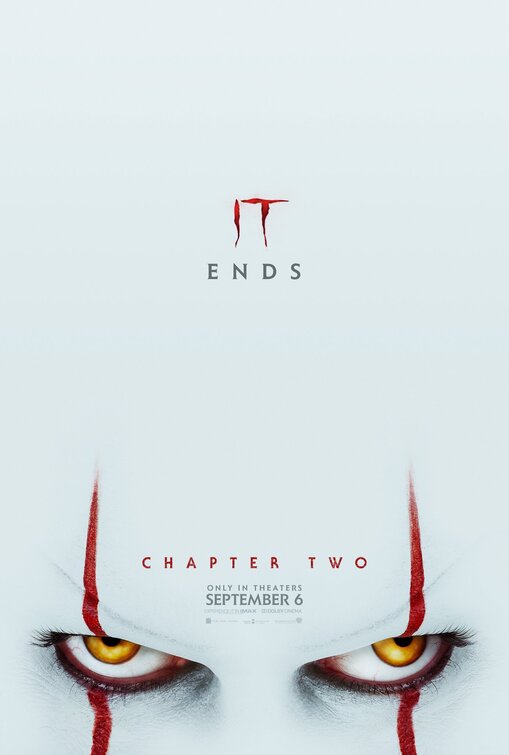


     This reunion of childhood friends after 27 years isn’t going to be typical; for one thing, a fat kid is now trim and fit—rather than everyone being more portly—the usual reunion preoccupation.  But of course it will be out of the ordinary in so many other, more important, ways.  It’s important to know that this group of reunion members are from the “Losers Club”, and “losers they will always be”, BUT they have pledged as a group to defend against a dark force.
     These friends are called together based on a promise (sealed in blood) made at a time when they thought they had done away with Pennywise (Skarsgard) the wicked clown who preys on young children.  Now Mike (Mustafa) is sending them all urgent messages to come to Derry, Maine, at once.  This will be no easy feat, because they’ve all (except for Mike) left Derry to establish careers and, sometimes, families.  We see each of them attempt to disengage from their commitments to honor the childhood pledge.
     Only one (Stanley, played by Bean) chooses not to go, but the rest brave all kinds of obstacles to return to Mike in Derry, Maine.  He has brought them all together, of course, to tell them that Pennywise has resurfaced and is killing children.  He has done enough research to learn that an ancient Native Indian tribal ritual is called for.  Each of them must find his/her own distinctive “artifact” (from childhood) and bring it to resolution in a ritual.  It’s a bit Jungian in that each must discover his/her shadow and resolve the conflict, one of the stronger assets of the film.
     Beverly (Chastain) has issues with her father, Richie (Hader) has unresolved sexual identity issues, Bill (McAvoy) is carrying the weight of his brother Georgie’s death on his conscience, Ben (Ryan) is still suffering from his “fatness” and the rejection of his childhood flame, Eddie (Ransone) has Mommie issues, and Mike has to come to terms with prejudice against his race.
     Much of the movie covers each person’s struggle with the psychological issue significant for him/her, emphasizing the “losers” aspect (“and we will always be losers”) and the group sticking together to accomplish a noble goal.  I enjoyed these parts of the movie, directed by Andy Muschietti and written by Gary Dauberman based on a Stephen King novel. 
     Unfortunately, the film degenerates into a showcase for special effects, making it insufferable in its length (almost three hours), and completely unbelievable in plot.      Additional nonessential sequences were in the beginning about brutality against gays and toward the end in gay references, neither of which fit in with the main story. The filmmakers seem to be making a side point—which I sympathize with—but find the sequences “stuck into” the plot.
     It Chapter Two has A-list actors in the major roles, and they are superb in what they are given by the script, but their roles are limited.  Jessica Chastain has little to do other than react to the male actors. With her talent, she is wasted in this film.  James McAvoy’s character is a little more filled out, but fails to make him the forceful presence he should be.  Probably the standout is Bill Hader as Richie whose ambivalence and neurotic characteristics gives him more of a platform to exploit his range and ability.
     Most of all, Director Muschietti can be faulted for getting so caught up in special effects, he lost sight of the “meat” of Stephen King’s works having to do with friends sticking together, the drama in the growing-up years, and the influence of early traumas on adult life.  He addressed these, but then covered them up with showy special effects and extended final scenes with Pennywise to an almost unbearable length.

Pennywise and pound-foolish seems to fit this rendition of a Stephen King novel.

Grade:  C+                                    By Donna R. Copeland

Wednesday, June 5, 2019

DARK PHOENIX

Sophie Turner     Jennifer Lawrence     James McAvoy     Michael Fassbender
Nicholas Hoult     Tye Sheridan     Kodie Smit-McPhee    Jessica Chastain


     Enter the world of super powers where the X-Men need only concentrate—perhaps with furrowed brows and taut faces—and the most formidable foe or metal structure can be violently repelled or disintegrated into a puff of smoke.  When you get a whole cast with these powers it can be dizzying, but that doesn’t keep you from being engaged in the story.
Jean is a child in the back seat of her parents’ car tooling down the highway, complaining about the music they’re listening to.  Suddenly she’s in a hospital asking where her parents are. Dr. Charles Xavier (McAvoy) appears and gently verifies her fears that her parents are dead.  It will be OK; Dr. Xavier has a school that might be just right for her, since she is “special” (which she scoffs at). But seriously, he says, it’s a place where children are taught to take pride in their differentness.  It’s clear from this short introduction that Jean has realized that she is different, and can harm others, so despite her misgivings—which voices later on—she agrees to enroll in the school.
     That’s Jean’s childhood; now she is almost grown up (played by Sophie Turner) and has joined the Xavier’s X-Men, albeit still in training.  She’s chosen to go with the group to rescue the NASA space flight of Endeavor, which has run into trouble.  During this mission, she is asked to do a heroic save in the last few seconds, and it’s apparent when she barely escapes with her life that she is changed.  That is, her powers are much stronger.   
     How this happened is a puzzle, although another character later on explains that “it” was given to her for a specific purpose.  The rest of the story is about these powers and the havoc they create for Jean, along with anyone around her.  The story hearkens back to Dr. Xavier’s when he first met Jean; that is, that such “gifts” to someone can be used for good or ill.  The person receiving them can make the decision as to how to exert them.  Although Dr. Xavier will be discredited from time to time, many of his principles will come back to Jean when she is in dire turmoil and pulled in two directions.
     Directed and co-written by Simon Kinberg, who was a producer on previous X-men films (X-Men:  Apocalypse, X-Men:  Days of Future Past, X-Men:  First Class), the film moves along at a fast clip, doesn’t overstay its welcome (less than two hours long), and incorporates substantive moral/ethical issues and emotional truths into an engaging story.  That is, it depicts remorse for mistakes, tensions around the use of power, the importance of “family”—however constituted—and the construction of an identity that “fits.”  
     Following her “Game of Thrones” success as a girl/woman undergoing numerous transformations, Sophie Turner proves she is ready for big-time movies and a starring role.  Aided by creative special effects, as Jean she is transformed into a “phoenix” (mythologically, a bird that regenerates) with powers that overwhelm her at first until she can figure them out.  Here, her upbringing—such as it was—will guide her in making decisions about who she wants to be.  Turner personifies these subtleties in good and evil to a tee.
     An unnamed character, a deliciously evil being without a soul and preoccupied with a quest for power, then appears to try to swing the odds.  She has in mind to use Jean to resurrect the power of a race in decline.  Jean has been a surprise all along, so we wonder what she will do…
     Fine casting strengthens this film’s success in storytelling.  James McAvoy embodies the person who has achieved acclaim but has to come to terms with mistakes he’s made.  The remorse shown is palpable.  Michael Fassbender’s initial befuddlement and subsequent resolve helps keep the tension at an optimum level, and supporting actors, Nicholas Hoult, Tye Sheridan, and Kodie-Smit-McPhee contribute significantly to the drama.
     Although knowledge of previous X-Men films will help in making sense of this rendition, it’s not a strict necessity, except perhaps in identifying the characters.

An exciting journey into the X-Men universe, with women holding their own—even starring.

Grade:  A                                    By Donna R. Copeland

Thursday, January 17, 2019

GLASS

James McAvoy     Sarah Paulson     Bruce Willis     Samuel L. Jackson
Anya Taylor-Joy     Spencer Treat Clark     Charlayne Woodard


     M. Night Shyamalan has written and directed a number of films (The Sixth Sense, Unbreakable, Signs, The Village, Lady in the Water) that seem to have a hit or miss quality about them, at least from film critics’ points of view.  Glass is intended to be the third in a trilogy with Unbreakable and Split, neither of which was up to his first success, Sixth Sense.  It is a sequel with promise, but falls short, partly because of a complicated story that contains multiple back stories, but mostly because of the editing, which forces the viewer to spend too much time wondering what is being portrayed in many scenes.  Perhaps devotees of M. Night Shyamalan’s previous two films, Unbreakable and Split, the first two parts of a trilogy, of which Glass is the third, will be able to establish precedence and context to certain scenes, but the general public will be frustrated in trying to figure out what is going on, particularly in the beginning scenes. 
     The main players are:  1) Kevin Crumb (McAvoy), an established master at portraying dissociative identity disorder (DID), who has multiple personalities, one of which is a superhuman hunk capable of, say, overturning cars, another of which is a nine year-old with a lisp.  An abusive mother is the cause of his problems.  2) David Dunn (Willis) has a security business with his son Joseph (Clark), who believes his father has superhuman powers, but knows he is to keep quiet about it.  David is committed to preventing crimes from happening through his tactile sensitivity, whereby he can sense when someone is doing something wrong and goes about trying to stop it.  3) Elijah Price (Jackson) having grown up with a bone disease that makes his bones extremely fragile, decides, based upon his expertise in comics, that there must be the opposite of weaknesses such as his—superheroes, who have extraordinary strengths.  The movie does have a clever way of showing how each of these characters confronts his weakness and develops a superpower, but logic about their existence soon falls away. In a grandiose turn showing his supreme confidence in his belief, Elijah goes about convincing Kevin and David that they are indeed superheroes. 
     Once again in this last of a loosely connected trilogy, James McAvoy is the most interesting aspect of a film about disturbed individuals.  I don’t know if he necessarily captures the actual DID disorder, but he is entertaining in his ability to be so many personalities.  Bruce      Willis and Samuel L. Jackson have roles that they could easily “phone in”, but certainly provide more interest than would be there otherwise.  The addition of a psychiatrist (Paulson) and her staff at the mental hospital once again implies that the care in such places is self-serving rather than to help patients.  Paulson is a fine actress, but she is wasted here.
     In short, Glass is overly ambitious and too reliant on sketchy scenes to provide necessary information to follow the convoluted story, so many times it comes across as a jumbled mess.  Although it has been shown that many people can turn weaknesses into strengths, a man becoming a super-hero as a result is hardly a possibility.

This Glass is less than half full.

Grade:  D                                    By Donna R. Copeland

Wednesday, January 18, 2017

SPLIT

James McAvoy     Betty Buckley     Anya Taylor-Joy     Jessica Sula     Haley Lu Richardson


       About as creepy as it can get in portraying a mentally ill person’s delusions.  James McAvoy is at the height of his performances in the depiction of someone with multiple personalities.  Here, he can be tough, mean, simple minded, and artsy, depending on which identity is “up.”  He does this mostly with facial expressions and body language, which makes his performance more impressive.  The psychiatrist treating him is pretty well portrayed and very well acted by Buckley as Dr. Fletcher.  How factual the representation of dissociative identity disorder is, I can’t really judge because I don’t have experience with that diagnosis, but it “rang true” from what I know.
        My issue with this and other horror movies is that they linger a bit too long on moments of tension and tend to drag them out long after they’re plausible.  Most notable is the ending—which is not really an ending—in which a character has a chance to do just that (end things) and doesn’t. Another issue is that every scene with the women shows them to be fragile, easily rattled, and unable to take action.  The two girls abducted with Casey (Taylor-Joy), Marcia (Sula) and Claire (Richardson), really got on my nerves with the panicky breathing and hysterical behavior.  And although Dr. Fletcher is portrayed as a very competent therapist in most of the story, her portrayal toward the end is inconsistent with how she is portrayed professionally in the beginning.
          The story begins with a father urging his daughter and her friend to be compassionate toward an odd, retiring classmate, Casey, and offer her a ride home.  But just as they are getting in the car, the father acknowledges someone approaching, and suddenly we see the stranger driving the car rather than the father.  This stranger is abducting the three girls.  He is “Kevin” (McAvoy) who will rain terror on them in the coming days.
          Shyamalan has had an uneven career, with some of his work praised (Sixth Sense and perhaps Signs) and much of it criticized (Lady in the Water).  He is good at weaving a story that keeps the viewer mesmerized and interested in the esoteric, but at times he gets too caught up in the supernatural.  Here, he is good at introducing the main character with 23 personalities slowly, so the viewer’s reaction may be, “Is that the same person we just saw?”  And then the disorder we’re seeing becomes clear.
          Another plus is Shyamalan fleshing out Casey’s character so that her current behavior and deportment are well accounted for by events in her childhood.

A mostly well crafted thriller that will make your skin crawl while you admire the star.

Grade:  C+                                    By Donna R. Copeland