Showing posts with label Ansel Elgort. Show all posts

Wednesday, December 8, 2021

WEST SIDE STORY

 Ansel Elgort     Rachel Zegler     Corey Stoll     Rita Moreno     
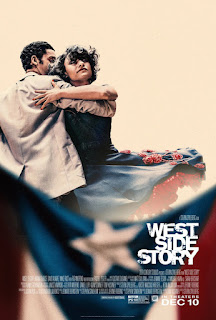
Ariana DeBose     David Alvarez     Mike Faist


            West Side Story (1961) is beloved among American cinephiles, but I was surprised that Steven Spielberg would pick it up for a 2021 remake.  It has been highly praised as a Broadway show and 1961 movie (Robert Wiseman, director), so a remake is rather puzzling.  Beyond that factor, with as much racial unrest and frank hatred going on in our country now, I have some doubts about a major film production—even though one I think is meant to make a statement about the inadvisability of violence—spending so much of the movie on machismo and racism before the “lesson” comes through at the very end.

Spielberg and his screenwriter Tony Kushner have kept the original story itself pretty much intact, except for some tweaking of the plot (e.g., inserting a clearly mixed gender character as opposed to a tomboy) and casting actors (except for Rachel Zegler) way beyond the teenage years.  I understand Spielberg was committed to cast Latin actors as much as possible for those roles, so perhaps he can be excused for not attending so well to the age factor.  But mismatching the ages of the actors and their characters is unnecessarily common in movies today, because age is so influential in defining who someone is; and beyond that, there are scores of talented young actors who could be in those roles.  Movies like West Side Story would be much more plausible to me if I looked up and saw teenagers; whereas, seeing late 20’s-30’s year-old actors behaving the same way seems a bit ludicrous.

Having stated what I see as drawbacks, I can say the production in terms of design (Adam Stockhausen), music (Leonard Bernstein, Stephen Sondheim), choreography (Jerome Robbins), and cinematography (Janusz Kaminski) are well done and entertaining.  The acting is laudable for the most part, especially Rachel Zegler as Maria and the iconic Rita Moreno as Valentina (of interest is that she was in both the Broadway show and the 1961 film production of West Side Story).  The quality of Ansel Elgort’s singing as Tony was a pleasant surprise to me, but, somehow, he seemed out of place.  It could be that he was miscast or perhaps the chemistry between him and Zegler didn’t quite come through.  

Overall, the extended macho scenes in Spielberg’s 2021 West Side Story are so off-putting, by the end of the overly long movie (over 2½ hours) the viewer is eager to leave, which makes short shrift of the truly heart-rending scenes at the end.


West Side Story 2021 is nostalgic for those enamored of the 1961 version, but considering current tensions about race and immigration, it gives us a sense of its being dated.


Grade:  C                              By Donna R. Copeland

Thursday, September 12, 2019

THE GOLDFINCH

Nicole Kidman     Ansel Elgort     Oakes Fegley     Jeffrey Wright 
Luke Wilson     Sarah Paulson    Finn Wolfhard     Aneurin Barnard


     This movie is full of surprises, most of which I loved.  Above all, the characters fascinate the viewer while the rest of the cast seem to take them all in stride, a kind of lesson in acceptance.  Storytelling hits that sweet spot in which information comes through gradually, punctuated by significant details, but giving one time to savor the plot.  The central character, Theodore (beautifully rendered by Oakes Fegley playing the younger and Ansel Elgort the older Theo), reminds of “Baby” in Baby Driver (also played by Elgort), actors able to convey mystery as they become endearing and grow on their acquaintances.
     The story begins with tragedy, when Theo’s mother is missing after an explosion in New York’s Metropolitan Museum of Art.   His alcoholic father disappeared long ago, so he needs someone to take him in.  When he names the mother of a classmate whom he has befriended, as at least a temporary solution, Mrs. Barbour (Kidman) steps up to the plate and brings him to her family, which is both wealthy and dysfunctional.  She ends up really caring about him, and it looks like he may be with them for a long time.  
     But… (This story is filled with twists and turns, continually bringing up questions about coincidences versus fate/predetermination).  That juxtaposition is one of the themes of the film, coupled with questions about what is fake and what is real, both in relation to art as well as in human relationships as portrayed.  
     The movie Goldfinch is mesmerizing during Theo’s growing-up years when we observe him to be so well balanced and well behaved, managing his losses and compensating for them in healthy ways.  It gives us a realistic picture of trauma (in other characters as well as Theo), its after-effects, and how people manage it.  The characters introduced make the story come alive, such as different family members in the Barbour family, Hobie (Wright) who takes Theo under his wing and educates him about artistic furniture and reproductions, and the reappearing father (Wilson) and his girlfriend (Paulson) who whisk him off to sandy, bleak Las Vegas.  
     Unfortunately, the film loses its way and tries to become a thriller toward the end, with drug dealing, mobsters, and other unsavory characters introduced into the mix.  This is where it lost me, although I did appreciate attempts to show all the characters to be a mixture of good and bad qualities, most of which with good intentions; but the ending was just too fantastical for me to go along with it.
     For the most part, director John Crowley, the actors, cinematographer Roger Deakins and composer Trevor Gureckis have created a beautiful work of art, capturing the qualities of the Goldfinch painting and its history, while prompting us to consider different philosophies of life.

A captivating story with meaningful characters, derailed by superfluous drama seemingly “tacked on” toward the end.

Grade:  B                                    By Donna R. Copeland


Sunday, March 12, 2017

BABY DRIVER

Ansel Elgort     Kevin Spacey     Jon Hamm     Jamie Foxx     Eiza Gonzalez     Lily James


     The opening car chase is spectacular—and this is from someone who hates such things, along with interminable gunfire.  But Edgar Wright’s wit and sensibility make those scenes in this movie entertaining.  To see the driver Baby (Elgort) maneuvering through all kinds of tight spots tailed by dozens of police cars with red lights and sirens in full blast, and then later see his body “dance” in similar ways preparing a sandwich in the kitchen at home is truly a work of art. 
     But the most delightful—and true—aspect of the film are the characterizations of the most motley crew you’ve ever seen.  Baby is beholden to a criminal boss called Doc (Spacey) who forces him to drive get-away cars to pay off a debt for a teenage transgression.  Baby is something of a savant (maybe Asperger’s Syndrome) who has an affinity for driving cars and a phenomenal memory, even while listening to music with ear buds always attached and on.  Oh, and he likes to record all conversations, which he puts to music in his spare time. He has a back-story that supports his idiosyncrasies and talents, which accounts for his personality and tastes.  He has a deaf foster father, Joseph (C. J. Jones), whom he clearly adores and guides him in ethical behavior.  Joseph is successful as a parent, because Baby has unassailable values and a conscience.
     Ahem.  Baby Driver reminds us that events in our lives are not always under our control, often because of the good/bad side of things.  Doc is good in one sense and bad in another.  He’s good with a kind of honesty—he honors his promises—but bad in—oh, let me count the ways.  You will see if you go to this film.  Doc’s criminal flunkies are colorful, really bad, guys.  One (Doc never puts the same team together twice) is Bats (who really is) (Foxx).  He cannot fathom someone like Baby and rudely taunts him, is always quick on the draw, and challenging of everyone.  Buddy (Hamm) and Darling (Gonzalez) are kissy-face lovers who are only a little more sane.  At least Buddy has some appreciation for Baby’s music, but that bond is fragile.  There are others just as colorful.
     Wright’s dialog and the synchronization of music and action with it is truly impressive in every detail.  Jobs are planned and carried out with precision, while Baby waits in the car, pantomiming comically to his music.  Seldom can a film be so entertaining, violent, funny, and smartly mapped out, while maintaining entertainment value and some degree of plausibility and heart.  Elgort will likely be put on the map of fame and glory with his portrayal of this unusual, complex, and lovable character.  He becomes smitten with a waitress (James), which makes him even more endearing. 
     Jamie Foxx is another standout, whose character is meant to drive everyone crazy, but is sharp as a tack.  Loyalty is foreign to him, and he tests limits with one and all as a matter of course.  Yet, he is funny as well.  These are only some of the many loony tunes Doc recruits for his jobs.
     Music (Steven Price) and cinematography (Bill Pope) support and enhance the script and are enjoyable in their own right. 

One of the very best films of the 2017 South by Southwest Film Festival in Austin, Texas.

Grade:  A                                    By Donna R. Copeland