Showing posts with label Chiwetel Ejiofor. Show all posts

Wednesday, May 4, 2022

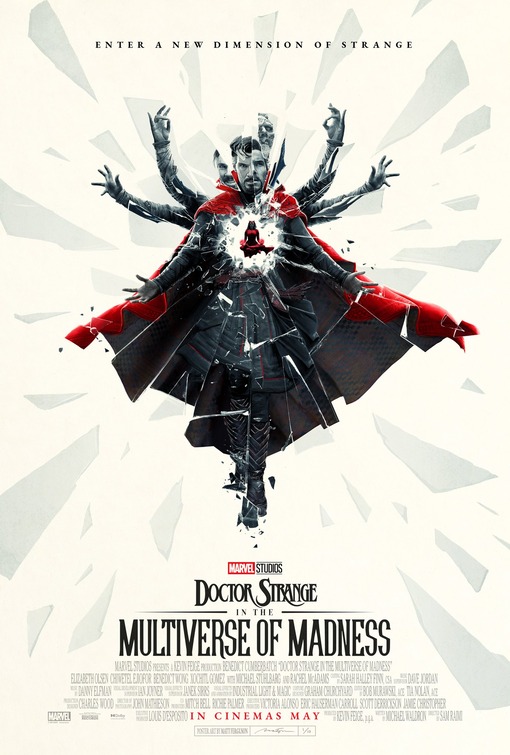
DOCTOR STRANGE IN THE MULTIVERSE OF MADNESS

 Benedict Cumberbatch     Elizabeth Olsen     Chiwetel Ejiofor     Benedict Wong
Xochitl Gomez     Michael Stuhlberg     Rachel McAdams     Patrick Stewart


            The strange wonders shown in this continuing saga of the Marvel universe(s) are a testament to the talent in filmmaking we’ve come to expect from Marvel, with a fine blending of story (Michael Waldron, Stan Lee, Steve Ditko), cast (Benedict Cumberbatch, Elizabeth Olsen, Benedict Wong, Xochitl Gomez, et al.), music (Danny Elfman), stunning  special effects and cinematography (John Mathieson).  All of these efforts are woven together into a spell-binding whole by director Sam Raimi.  Visually and emotionally, its powers draw the viewer into another colorful, fascinating, and sometimes terrifying world.

            One must carefully attend to the plot because of all the complexities involved in multiple universes with characters appearing in more than one, often with subtle differences among their different manifestations.  

            The hubris of Doctor Strange Cumberbatch), so evident in the previous (2018) story, is short-lived in this one.  Although starting out with his usual confidence in trying to incapacitate a huge octopus-like monster creating havoc on city streets and intent on capturing one small girl, Strange finds himself in need of assistance. He gets no small number of come-uppances from Wanda/Scarlet Witch (Olsen), a girl named America Chavez who is able to transverse universes at will, and others including the Doctor Strange in another universe.  Eventually, he is brought before the Illuminati summoned by Karl Mordo (Ejiofor) to sit in judgment of him.

            But throughout, there are major struggles with Scarlet Witch who appears to be power hungry, wanting to maintain her control in all the universes using Darkhold forces.  To do that, she is after America to steal the girl’s powers against the wishes and efforts of Dr. Strange who feels duty bound to protect America, who first appeared to him in a dream, although later she informs him that he was actually in another universe.

            As in the previous Doctor Strange, human conflicts are dramatically brought into the drama.  Significant here are the pull of motherhood on a woman, humans’ need for power and control, the duty of the strong to protect the weak, the wisdom of cooperation vs. going it alone, and the challenge of maintaining human relationships and managing grief and loss.

            Marvel movies are noteworthy for their broad-based appeal to young and old, fans of variable genres, and for their many historical, mythological, and literary references.  That they are based on comic books—usually considered light reading—must bring a smile to many.  Those who grew up on and have loved comic books might well say, “I could have told you so.”

            For those who love fantasy/action/adventure films that keep you on the edge of your seat, this is very likely to appeal.  In addition to the high drama and glittering visual display, it has human themes and moral conundrums worthy of post-theater discussion.


A mind-blowing experience traveling across multiple universes all of which have humans, some of whom appear in more than one, albeit with differing characteristics.


Grade:  A                              By Donna R. Copeland


Thursday, October 17, 2019

MALEFICENT: MISTRESS OF EVIL

Angelina Jolie     Elle Fanning     Michelle Pfeiffer     Harris Dickinson    Chiwetel Ejiofor
Lesley Manville     Imelda Staunton     Juno Temple     Sam Riley


     Fairy tale land—one never knows what to expect as to what will come up.  In this version following on the previous Maleficent (2014) (both starring by Angelina Jolie in the title role), her goddaughter Aurora (Fanning) is grown up and falling in love with Prince Philip (Dickinson).  As expected, he has fallen in love with the son of the King and Queen of Ulstead, a human tribe with a history of conflict with the Moors, Maleficent’s land of the fairies.  An awkward dinner takes place initiated by Philip’s mother, Queen Ingrith.
     Maleficent is reluctant to go, but for the sake of Aurora, she agrees, and they all come together; but tensions abound, as happens when two very different cultures eat together.  Major conflicts ensue, with misunderstandings and subterfuge aplenty, and suddenly Maleficent disappears.  Where she goes propels the story forward and gives us insight into her origins and an explanation for what is to appear in the rest of the film.
     As before, Jolie embodies her character in all its dimensions and power, and Fanning provides balance in her tenderness and rationality.  Although she is a good actress, Michelle Pfeiffer as Queen Ingrith seems miscast in that she simply doesn’t come across strongly enough with the qualities called for by her character.  I can’t say any more so as not to spoil the plot.  Harris Dickinson as Prince Philip didn’t wow me as someone heroic, but I assume that is a function of the script, and the same goes for Robert Lindsay as King John.  Ed Skrein as Borra (one of Maleficent’s newly discovered tribe) is the only male who is a counterpart to Jolie’s and Pfeiffer’s female characters in strength.
     To me, the problems arising during this tale are related primarily to the unsuccessful attempt to insert actions that are clearly contemporary into a fairy tale. One example is Aurora coaching her mother on social manners.  Now, sophisticated Maleficent has been around the whole world and is familiar with such things as social graces, so having it seem as if she is being coached on what to do at a dinner party seems laughable.  I had the same impression when Aurora’s simple “woodsy” dress at one point is magically changed by Maleficent to one that looks like a contemporary Neiman Marcus creation.  Just as in the earlier film, the viewer is yanked back and forth between the fairy world and our reality-based one.
     As before in the 2014 version, the opening scenes in this sequel are so dark it’s impossible to know what is going on.  There is a battle, but who is who cannot be distinguished.  I still don’t know who the warring parties are.
     Finally, there is a disconnect between the ending of the earlier film and the beginning of this one in which Maleficent seems to have reverted to her previous maliciousness.  No explanation is given for this, or perhaps the viewers are just being led down a garden path. (More jerking around.)
     This second Maleficent doesn’t measure up to the first one, which is too bad, since there was an opportunity here to tell a story like a fairy tale that speaks to contemporary concerns (e.g., war vs. peace). But the way war and peace are dealt with here is no different from…how many movies and actual events?
     In the end, it’s not clear whom this film was made for other than the pockets of those invested in it monetarily.  Much of the story as presented will go over the heads of most children; and it is likely to be simplistic (meaningless?) to many adults.

If you love a good fairy tale, stay away from this one.

Grade:  D                                    By Donna R. Copeland


Thursday, July 18, 2019

THE LION KING

Voices of:  Keegan-Michael Key     Seth Rogen     Donald Glover     Chiwetel Ejiofor     James Earl Jones
John Kani     Billy Eichner     Alfre Woodard     Beyonce     Amy Sedaris     John Oliver     JD McCreary


     What hard lessons for a cub to learn, especially when malevolence is involved! Simba (McCreary as the young Simba) is so proud to be next in line for king, but is so young he doesn’t understand the responsibilities that are part of such an honor.  He sees it initially as more freedoms for him, without regard for others.  He’s impatient, and easily led astray by Uncle Scar (Ejiofor), going where he shouldn’t go and being susceptible to outright lies.  Fortunately, the pride looks out for him, the best they can, especially the hilarious mother hen, Zazu (Oliver), but sometimes, Simba is too much for him, even.  The story contains high risks and tragedies, and although adults are likely to be entertained, it may be a little too heavy for young children.  
     The filming is spectacular (VFX by Rob Legato, cinematography by Caleb Deschanel, production design by James Chinlund), and the varied pace gives the viewer times to simply soak up being in the wild with exotic animals.  Hans Zimmer’s score made up of mixed genres is a definite highlight, sometimes being background and sometimes center stage.
     The story (screenplay by Jeff Nathanson) is mostly captivatingly suspenseful, but has interludes showing community solidarity, loving family life, and Simba’s coming of age experiences and his relationship with his father Mufasa (Jones).  There is plenty of humor too, such as the warthog Pumbaa (Rogen) and his sidekick Timon (Eichner) providing funny “stand-up” routines while being protective of Simba (with an ulterior motive, of course).  
     Romance is supplied by Mufasa and Sarabi (Woodard) in their continuing loving relationship, and the preadolescent/young adult attraction between Simba (Glover) and Nala (Beyonce) when they’re teenager/young adults.  The latter has its humor in the preadolescent phase, when the two friends cannot fathom being married (Ewww!), but then later on clearly being attracted to one another.  
     The Lion King has good modeling for kids, as well, showing them what it means to have community solidarity, nurturance by the older for the younger, and the importance of truthfulness.  I also appreciated their illustrating to children that adults do lie sometimes, so all of them cannot be trusted.  

Hard lessons learned in the transition from cub to king.

Grade:  A                                    By Donna R. Copeland

Sunday, March 3, 2019

THE BOY WHO HARNESSED THE WIND

Chiwetel Ejiofor     Maxwell Simba     Aissa Maiga     Lily Bande


     Take a trip to Africa to revel in the scenery, the music, the costumes, and the culture. Talented actor Chiwetel Ejiofor’s first venture in directing a feature film should assure him of a promising future in this aspect of moviemaking.  His selection of story, timing of plot progression, and, in partnership with the producers, assembling a team for casting, music, cinematography, and other artistic components are optimal.  
     With Ejiofor’s own script based on William Kamkwamba’s memoir with the same title, Dick Pope’s cinematography, Antonio Pinto’s music, Bia Salgado’s costumes, and Alexa L. Fogel’s casting, the viewer is able to experience what it was like in 2001 Malawi when young William was struggling to introduce the windmill to his village.  It was in the middle of a drought when his family and the villagers were suffering in a famine after poor decisions  were made by governments at all levels and by the world economic slump following the 9-1-1 terrorist attack.  And these aren’t the only tragedies in the family story; others involve beatings, stealing, and a runaway teen.  
     On a lighter note, it’s fun seeing William and his friends rummaging through the scrap yard looking for wires, pipes, wood, and metal without our knowing exactly how he’s going to put it all together.  The hardest to come by are bicycle wheels and other parts, and some of the saddest scenes are when William asks his father if he can have his bicycle, the family’s only transportation.  The father is so incredulous, it’s clear he thinks his son has lost his senses.
     I had seen and enjoyed Ben Nabors’ and Tom Rielly’s very fine 2013 documentary, William and the Windmill, but this feature gave me the opportunity to experience William’s discoveries emotionally and learn more about his family and where he grew up.  At least for me, it’s a real tearjerker—in a good way.  One is inspired as much by the child’s fortitude and his family’s struggles as touched by the sadness and tension of his story.
     In his first major acting role, Maxwell Simba captures well the child William’s excitement, self-confidence, and ups and downs in trying to cling to his school studies and inveigle ways to carry on independent research in the tiny local library for his project.  His acting skill—likely honed by the director—is especially notable in scenes with the experienced Ejiofor, who plays his father.  The father initially has no faith in his son’s capabilities, calling earlier versions of the windmill model “toys”, and insisting on William’s helping him more in the farm fields.  
     The film ends on a high note that emphasizes the family’s solidarity and William’s vindication, support from their friends and the townspeople, and a glimpse of William’s life thereafter.
     As a follow-up, it’s satisfying to learn that as a result of his invention, William was able to graduate from college, receive funding from venture capitalists, and achieve no small amount of fame.  He has spoken at T.E.D. conferences and appeared on television, and in 2013 was named by Time Magazine as one of 30 People under 30 Changing the World.  He continues his community service by consulting worldwide on projects that explore renewable energy sources, and agricultural, water, and sanitation improvements, along with being involved in providing educational help and resources for students. Most of all, he exemplifies a young man who retains the commitment to community service and assistance for everyone around the world.  

The Boy Who Harnessed the Wind will surprise and inspire you, pull on your emotions, and astonish you in witnessing the confident, creative genius of a child.  On Netflix.

Grade:  A                                    By Donna R. Copeland

Thursday, March 22, 2018

SHERLOCK GNOMES

Voices of:  James McAvoy     Emily Blunt     Johnny Depp     Chiwetel Ejiofor     Jamie Demetriou
Mary J. Blige     Ashley Jensen     Maggie Smith     Michael Caine     Julie Walters


     With all the adult themes (such as the complexities in relationships, literary references, and details in the plot), it’s hard to see how Sherlock Gnomes is a film for children, despite its being animated.  Following Sherlock’s (Depp) reasoning through problems and clues is way over the kids’ heads; observing the intricacies of relationships between Sherlock and Watson (Ejiofor), Gnomeo (McAvoy) and Juliet (Blunt), and others would not interest them, if they “got it” at all; and Watson’s counseling Gnomeo about his conflicts with Juliet seems ludicrous in this context.  After the screening, I asked a family in the elevator if they understood it, and all three of them shook their heads and looked disappointed.
     It may be another case (now common in children’s films) of the Director John Stevenson and his writers and producers making the common mistake of trying so hard to appeal to adults, they overlook the children seeing their films—or maybe they just simply don’t know very much about children.  The literary references, such as “Gnomeo, Gnomeo, wherefore art thou?” and the “Hound of the Baskervilles” are purely for adults, as are the songs by Mary J. Blige complaining about an ex-lover and “Love Machine.”
     The filmmakers also make the mistake of modeling bad behavior and then having the characters getting insight and apologizing afterwards.  Here, Juliet is rude and overbearing toward Gnomeo, and Sherlock is the same with Watson.  If you want children to learn something, you model good, respectful relationships, not bad ones where apologies are called for later.  And I detest the artificial romantic sequences shown between couples, particularly Nanette (Jensen), a frog, trying to seduce one of the gnomes.
     An odd thing about the film is that it seems to be over-compensating for the past slighting of women, because here, Juliet, Irene, and Lady Bluebury (Smith) seem to have the upper hand with their men.  For instance, Juliet is shown to be much stronger and smarter than Gnomeo; Irene gives Sherlock h--- for his behavior in their past relationship, and Lady Bluebury’s husband hardly says a word.  Juliet is absolutely irritating with her constant questions and know-it-all attitude.  I can say it was encouraging, though, to see the interactions between Juliet and Irene, which showed solidarity between two women.
     About the only other positive thing I can say about this film is that the slate of actors do a very fine job.  Although the script is woeful, the actors came through with the best they could do.

This appears to be an animated film for adults; however, I don’t think many adults would want to see it.  Children are likely to be mystified.


Grade:  D                                         By Donna R. Copeland

Wednesday, November 2, 2016

DOCTOR STRANGE

Benedict Cumberbatch   Chiwetel Ejiofor   Rachel McAdams   Benedict Wong   Mads Mikkelsen   Tilda Swinton   Benjamin Bratt


     Spectacular special effects makes this comic book story come alive in a special way, perhaps because it captures a child’s imagination and puts it on the screen.  We see it as a child with a vivid imagination may in reading a comic book.  Its exciting and mystically fascinating tale conjures up mythology and the spirit world with heroes and villains, and throws out paradoxes for us to consider.  (Must we sometimes commune with the dark side in order to achieve good?  Must we have death in order to have life?) 
     The film has numerous comical lines and jokes (e.g., a mystical reference that is actually a wi-fi password), but perhaps the biggest one is its riff on doctors who have a reputation for their arrogance, ambition, and stubbornness.  The star, Dr. Stephen Strange (Cumberbatch), is certainly supposed to shed this in his pursuit of shamanic knowledge, but part of the spoof is its tenacity on the heroic doctor. 
     Dr. Strange is at the height of his career as an esteemed neurosurgeon in New York; he can choose his patients (accepting only those that will pad his reputation), be dismissive and over-rule the staff, and is essentially the king of his realm.  His residence is fashionable with a stunning view of the city, and his car the most expensive and sportiest.  But lo, he roars out one evening to attend a lecture honoring him, when…Don’t text and drive folks! 
     Yes, he is pulled out of a ravine, but has lost the use of his golden hands, which throws him into an existential crisis and angry depression, for he is empty inside without his career.  He brushes off his one friend Christine (McAdams), a colleague trying to help him, and in desperation heads for Kamar-Taj, a healing place in Kathmandu, Nepal, where he hopes for a miracle.  His physical therapist had told him about a “hopeless” patient who had regained his physical abilities after its help.  “It will be costly”, the healed man (Bratt) informs him, but of course this was not a monetary reference. 
     Once he finds the place, Strange blusters in, completely unaware of a different universe and way of being.  While there, he will make discoveries he had never imagined in his empirically anchored life, and it will change him forever in no way that he ever anticipated.  He certainly becomes a nicer person, but that is only part of it.  He will strive to become a real hero with dimensions far beyond his previous accomplishments.
     Scott Derrickson, writer (with others) and director and his filmmaking team (Ben Davis, cinematography; Michael Giacchino, music; Charles Wood, production design; Ray Chan, art; and all the special effects group) have crafted an entertaining film with visual, musical, and literary qualities that should appeal to children and adults alike, one that contains rich material for thought and discussion after viewing. 
   Casting is perfect, with Cumberbatch as one who is equally skilled in portraying narcissism, extraordinary intelligence, and charity all in the same character.  Mikkelsen seems equally talented in portraying all different types of characters, with the one here being the epitome of evil.  A real coup with this film is casting Tilda Swinton as the “Ancient One”—we’re as surprised as Strange is that “he” is a “she.”  Swinton can play any exotic character a writer can come up with, elevating it with her own imagination.
      I was a little sorry at the end of this film to see that it was extended for 15-20 minutes too long, and that there was the now popular teaser for a sequel.  If only the filmmakers/investors could learn from their main characters!

This is a finely crafted action film with artistic merit.

Grade:  A-                                By Donna R. Copeland


Wednesday, November 18, 2015

SECRET IN THEIR EYES

Chiwetel Ejiofor   Julia Roberts   Nicole Kidman   Michael Kelly   Dean Norris   Alfred Molina


          Secret in their eyes is a real thriller and horror story marked by obsessions, compulsions, and over-reactions.  It opens in the present, but now and then goes back 12 years to a time when Ray (Ejiofor), Jess (Roberts), Claire (Kidman), Siefert (Kelly), Bumpy (Norris) and D.A. Morales (Molina) all worked in the Los Angeles District Attorney’s office.  At that time, the daughter of Jess was brutally murdered, and although much effort was put into finding the killer, they were unsuccessful.
              Ray and Jeff and her daughter were good friends, and unbeknownst to anyone else, he spent the 12 years looking at police mug shots in hopes of finding the perp.  He is convinced that the man was a guest at one of their office picnics where a group picture was taken, but no one in the office admits to knowing him much less inviting him.  Ray’s persistence and intimidation eventually yields a name, Marzin (Joe Cole) and although Ray has only come back as an FBI contractor to seek out terrorists, he talks the present #2 person in the office, Claire, into allowing him to do police work on the case on the QT. 
            Nevertheless he runs into major resistance by Kelly and Morales who are using Marzin as an informer.  The time is shortly after the 9/1/1 terrorist attack, and they are convinced that Marzin has a major lead into a second planned attack. 
              Obsessed, Ray continues to pursue Marzin and convinces Claire and Jess that he is the one.  An interrogation of Marzin by Ray and Claire (a horrific and hilarious interchange) seems to yield a confession.  But the plot is just heating up.  Morales gets word of their undercover work and in no uncertain terms makes them let Marzin go free.
             After that, there are still fits and starts in the case, but major revelations will ensue that will be shocking.  In this respect, Secret in their Eyes is well conceived and it certainly is exciting and interesting.  It’s too bad Director Billy Ray and his team did not give more thought to how they portray police work; poor judgment and repeated breaching of professional boundaries on the part of the main characters detracts from the quality of the work.  I regarded a couple of items as cheap tricks; namely, lurching back and forth between two time periods rather than proceeding chronologically, making the plot more confusing; and divulging information clearly intended to lead the viewer to a false conclusion. 
        Moreover, I found the implicit approval of ignoring proper channels for justice objectionable.  Those channels and boundaries are based on good judgment and portraying characters as heroic when they go beyond them seems unwise on the part of filmmakers simply for thrills. 
             Despite the weaknesses in plot, the actors do a superb job in their roles.  Roberts’ portrayal of a grieving mother who shows ambivalence in bringing up the case again and her role, if any, in it is finely done.  Ejiofor and Kidman are likewise fine individually, but the chemistry between them is so diluted, it’s impossible to see them as having a torch for one another.  That part seemed like an add-in because someone thought they needed a romantic touch somewhere.  Molina is appropriately terrifying in his portrayal of a man obsessed in preventing any more terrorist attacks, and Kelly and Norris lend major support in their roles.

We could call this a thriller with fine actors; you just need to overlook some flaws in the plot.

Grade:  C                                        By Donna R. Copeland


Saturday, October 3, 2015

THE MARTIAN

Matt Damon   Jessica Chastain   Jeff Daniels   Chiwetel Ejiofor   Kate Mara   Donald Glover   Sean Bean
          The Martian is so exciting, the 2 ½ hours fly by as the viewer is transfixed on the screen, first watching Mark Watney (Damon) using his considerable skills to survive all alone on Mars by producing water, setting up a farm for food, and making electronic equipment work for him; and second, watching as NASA and other scientists and the crew on a returning spaceship, the Hermes, make difficult decisions and work together to try to bring the abandoned astronaut home. 
        The crew of Hermes, led by Commander Lewis (Chastain) are busily collecting data on Mars when a fierce storm comes and blows Watney away.  Lewis risks her life in going out to try to find him, but can’t, and logically concludes he is dead.  In order to survive, the team needs to leave and head back to earth and they blast off.  However, Watney is not dead, and when he regains consciousness, he has a major wound he must treat and finds that he is on his own.  Oh, f---!
      For a good part of the film after that, we observe this very proud botanist problem-solving ways to get food and water, get battery power for the Rover, and attempt to reconnect communication lines with NASA.  Then we get good glimpses into organizational politics and see hypotheses formed, and policies made with insufficient information.  When astute observers see evidence that Mark is indeed alive, agreements have to be made about what to do with the situation and how wide the net of information to others should be spread, including the returning spaceship crew.  There are major setbacks along the way, and finally, the U.S. must rely on a foreign power for assistance. 
        I understand that the book on which the film is based is laden with technical information difficult for the average reader to wade through, so director Ridley Scott and writer Drew Goddard are to be congratulated on making the film just technical enough to heighten the drama of the plot.  Damon fits the role perfectly, with its blend of male-type analyses, wry humor, and drive for adventure.  He is the only one on screen for a significant amount of time and is entirely watchable throughout.  He deserves nominations at awards time. 
       The supporting cast members hold their own as well.  Jessica Chastain gives a solid performance as a female commander, Jeff Daniels as the bad-guy administrative head of NASA, Chiwetel Ejiofor as a scientist willing to take risks, Sean Bean as an advocate for major players lower on the hierarchy, Kate Mara as an astronaut with electronic know-how, and Michael Pena as an astronautic navigator and friendly competitor with Mark.  Kristen Wiig steps out of her usual comedy routine to be an able assistant to the head of NASA, Teddy Sanders.  Donald Glover is a stand out as Rich Purnell, a nerdy astrophysicist who stumbles out of bed after a late night of work and steps up with plans for rescue that make the higher-ups take notice. 
       Throughout, we get glimpses of the players’ personal lives, but the most entertaining and valuable aspects of the film have to be the ingenuity involved in survival and the ethical-moral-practical decisions that people in charge must make on an everyday basis and at critical times.  The point is well made that these are gut-wrenching decisions and that the best ones are those made by all involved, not just the people at the top.

An exciting, nerve-wracking, informative picture about what it takes to be a successful astronaut.

Grade:  A                                    By Donna R. Copeland

Monday, August 10, 2015

Z FOR ZACHARIAH

Margot Robbie     Chiwetel Ejiofor     Chris Pine

           This is a thriller that starts out rather slowly and peacefully with rolling hills in a lush green valley (filming was in New Zealand and West Virginia) where Ann (Margot) has been abandoned on her family’s farm after some kind of nuclear holocaust.  By some kind of accident of weather, the valley has been shielded from radiation that is rumored to be everywhere else.  Ann has her dog for company and is self-sufficient in getting food and other necessities, at least temporarily.  She wonders if she is the last person on earth, and then comes upon a man in a safe suit out on the road.  They’re both wary of one another and pull out guns immediately until they can determine the trustworthiness of the other. 
           Ann seems much less suspicious than the civil engineer Loomis (Ejiofor) who has radiation sickness, and takes him up to her house where she nurses him back to health, injecting into him some type of medicine he has that serves as an antidote.  He has been traumatized by recent events, and her tender, loving touch is like a balm for him. 
          The two start becoming close, and he begins to use his engineering skills in rebuilding efforts.  It’s clear they are from different cultures, he from the north and educated; she, the daughter of a southern farmer/minister who sees Loomis as someone God has sent to help her.  There is the budding of a romance, but he advises her that they should proceed slowly because of the effect it will have on both their lives.
           One day, Ann sees another man when she is out with her dog, and gets enough nerve to approach him with her gun in her hand.  Turns out, Caleb (Pine) is from a nearby mining town and shares many of Ann’s religious beliefs.  When she takes him to the house, Loomis is aghast that she immediately invites him to stay with them and fixes dinner for him.  But Caleb plans to stay only for a day or so because he is headed farther south. 
           Triangles are the most difficult of relationships, and when Caleb energetically helps out with chores and rebuilding—even helping to get a water wheel constructed to generate electricity—his stay is extended.  And this is when the story heats up with some of the expected twists and a rather ambiguous conclusion.
           I wondered how the title relates to the drama, and it seems that in the Robert C. O’Brien novel on which the screenplay is based, Ann has a childhood book called A to Z, and she concluded that if A is for Adam the first man, Z is for Zachariah, the last man—the situation she finds herself in before Loomis appears.  There is a reference to the book in the film when Loomis pulls it off the shelf in Ann’s library, and looks at it briefly.
           Zachariah explores the tension that exists in times of disaster between fear and charity.  Not only do Ann and Loomis embody these emotional reactions, all three characters relate their experiences with desperation and with other human beings dealing with the aftermath of the tragedy.  All convey the difficulty/necessity of maintaining hope during the bleakest times.  We are reminded of how critical survival skills are, sometimes making the difference between life and death.  It was also interesting—and imminently plausible—that people would venture out, not grasping the dangers of radiation.
           Craig Zobel shows his skills as a director (he also directed Compliance) of films that bring home points about human relationship, ethics, and fairness.  Zachariah is well paced, topical, and beautifully filmed (Tim Orr, cinematographer, and also for Manglehorn, Joe, and Prince Avalanche).  The actress Margot Robbie is not as well known as the other two, but she clearly carries her part forcefully here.  Ejiofor is one of my favorite actors, and he and Robbie convey as much in nonverbal signs as in what they say.  Pine manages to walk the fine line that he as a kind of intruder must in relationship to the other two who have become very close, but with each of whom he has much in common.

A film that prompts questions; how might you be in similar circumstances?

Grade:  B+                        By Donna R. Copeland