Showing posts with label Jessie Buckley. Show all posts

Thursday, May 19, 2022

MEN

 Jessie Buckley     Rory Kinnear     Paapa Essiedu     Zac Rothera-Oxley     Gayle Rankin

         Alex Garland (Ex Machina, Annihilation) is a master at mixing up reality and fantasy/symbolism, making viewers think one way, then another about the characters and the story.  One must do a bit of work to make sense of his films; otherwise, they would seem to be meaningless.  

         Choral music (Geoff Burrow, Ben Salisbury) and lush cinematography (Rob Hardy) pave the way for a delightful time in a beautiful old house for Harper (Buckley) to get away and heal from the recent messy break-up with her husband James (Essiedu).

         When she arrives at the house and meets the landlord Geoffrey (Kinnear), she is taken aback with his wry humor and teasing, but he is gracious after playfully chiding her for picking an apple in the yard and eating it.  He points out that television and wi-fi are a bit iffy, gives her the one house key (“you don’t really need to lock the door”), and he’s off.

         The horror only really begins when she ventures out for a walk in the forest, delights herself playing with echoes at the entrance to a cave, but then realizes she is lost, with it starting to rain.  And was that a naked man standing in front of an abandoned building?

         There is plenty of horror after that, with the naked man, a smart-alecky kid, the vicar, an unsympathetic policeman, and so on.  Intentionally, Garland has made it appear that Harper must be psychotic, and much of what seems to happen is only in her mind.  (How many times have women been told that?)

         But stepping back and with some thought, we realize that Garland is making a statement about the relationships between men and women and the way in which women are generally regarded.  (Hasn’t Eve always been held responsible for all the ills that followed from her eating the forbidden fruit?)  All the male characters in Men (and I think Garland’s use of the plural is meaningful, in that it guides us toward the general statement he is making) end up scorning Harper and even dying (“because of her”).  

         More of the symbolism could be discussed (e.g., references to death, birth, the barely audible “Papa says so” repeated several times, the appearance of blood on hands and on the naked man), but the viewer should go to see the picture with an open mind and give free rein to one’s personal associations to the images and references.

         Men is not likely to appeal to the general audience, but for those who like to see and appreciate films considered to be “artistic”, it’s well worth seeing.  My fault of the film is that its promised intrigue in the beginning falls into something that is so heavy-handed it becomes almost meaningless in the end.  A little bit of horror is good, but too much makes me just tired.


A well-crafted drama with elements of horror that make it intriguing, but maybe there is too much of a good thing.


Grade:  B                    By Donna R. Copeland

Thursday, December 30, 2021

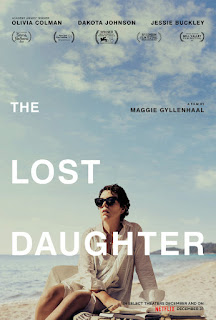
THE LOST DAUGHTER

 Olivia Colman     Dakota Johnson     Peter Skarsgaard     Jessie Buckley

Paul Mescal     Ed Harris


            We meet Leda (Colman) as she is arriving in a small coastal town in southern Italy for a vacation.  We find out later that her two daughters have gone to live with their father, and as a writer and English professor, she is looking forward to some quiet time to write.  But she does not anticipate getting involved with other people on holiday and her own festering conflicts long unresolved.

            On the noisy beach, Leda begins to observe families.  Although a number of people approach her with friendliness—Will (Mescal) the resort attendant, Lyle (Harris), and various others—she responds warmly but seems to keep them at a distance.  She becomes intrigued in observing a mother (Nina, played by Johnson) and her daughter Bianca, being reminded of her own ambivalence in mothering her children.  And Bianca seems to be annoying to Leda at first, but when the child goes missing, it is Leda who finds her and returns her to her parents.

            There are many flashbacks to Leda’s younger years when she was married and a young mother.  A proven actress Jessie Buckley captures the personality of the younger Leda, and we see her in sometimes playful and always creative, sometimes trying, interludes where her ambivalence about the responsibilities of motherhood is obvious.  But these seemingly trifling moments become significant factors later on when she acts on her impulses to develop a relationship with a Professor Hardy (Skarsgaard) who praises her work in glowing terms.

            This is Maggie Gyllenhaal’s debut in directing a feature film, and she is likely to receive commendations for her work.  The story line is finely modulated, the cast well chosen, and the subject of the film in terms of women managing family and career is topical.   But the emphasis on the ambivalence of motherhood is rather unusual in films, especially one done with a sympathetic attitude.  As we come to know Leda and develop some understanding of why she does what she does, her actions become more understandable.

            The pairing of the younger Leda actress Jessie Buckley with the older Leda, Olivia Colman, is one of the strong points of the film.  Buckley shows herself able to be paired with the experienced and renowned actress Colman.  Also, the film touches on many issues affecting women—and specifically actresses—today. 


A slightly disturbing take on an outwardly successful woman’s past and present experiences that may or may not make her understandable in today’s light.


Grade:  B                              By Donna R. Copeland

Thursday, March 18, 2021

THE COURIER

Benedict Cumberbatch     Merab Ninidze     Rachel Brosnahan     Jessie Buckley

Anton Lesser     Angus Wright     Vladimir Chuprikov


            Those of us who remember the Cuban Missile Crisis in the 1960’s will relate to the tension and intrigue that transpires in The Courier.  That was a particularly apprehensive time, and as I think about the White House administration just previous to the present, I wipe my brow, wondering what would have happened had we faced a similar crisis in the last four years.  Interestingly, the Russian spy in The Courier reflects on why he is warning the U.S. about their leader.  He describes Krushchev as impulsive, chaotic—“a man like him should have no clear command.”  The spy wants to save the world from a nuclear holocaust.  This film is based on the events that happened behind the scenes during that period.

            Greville Wynne (Cumberbatch) is a British businessman who has done well with his company, so seems to MI-6 and the CIA to be a perfect courier for these agencies to exchange information between them and their Russian contact, Penkovsky (Ninidze), a member of the GRU, who has cleverly sent a message to them about his concerns.  

            Recruiting Wynne to be the courier is no easy task; he has an ideal life and wants no part of anything that will endanger it.  He emphatically says no at first, but the CIA agent Donovan (Brosnahan), who has done background checks on him, knows how to appeal to his sense of responsibility and loyalty.

            Wynne flies to Russia and meets Penkovsky, and as it turns out, they’re from similar backgrounds and become friends, developing a sense of loyalty to one another.  The operation is successful for some time, until…  This is a spy story, so the less the viewer knows about it beforehand, the better.  And a good spy story it is, with plenty of suspense and intrigue, and a group of characters that are interesting and likeable.  We’re given enough information about them to care what happens to them.

            Director Dominic Cooke’s production and writer Tom O’Connor’s script (both producers as well) supply the elements that make this an interesting, engaging thriller.  The well-chosen cast makes it even stronger.  Cumberbatch—no stranger to spy-thrillers and action movies—portrays all aspects of the complicated Wynne to make him believable and compelling.  He is matched with Ninidze, who wins our confidence in his portrayal of an “enemy” to trust immediately.  I got a special thrill from seeing Rachel Brosnahan and Jessie Buckley ace roles that are way different from their recent work (“Mrs. Maisel” for the former, and “I’m thinking of Ending Things” for the latter).  And finally, seeing the erstwhile Game of Thrones’ Qyburn, Anton Lesser, in a minor role was a treat.

            Although there isn’t any really new material here, the pace and the performances of the actors make the film worth seeing.


This intrigue set during the Cuban Missile Crisis in the 1960’s is also a model of loyalty and trust.


Grade:  B                              By Donna R. Copeland


Thursday, August 27, 2020

I'M THINKING OF ENDING THINGS

Jessie Buckley     Toni Collette     Jesse Plemons     David Thewlis


     Few could imagine this film; only someone like Charlie Kaufman, who is able to dream in the surreal and then apply it to real life.  The film starts out with an unnamed young woman who is wondering about her boyfriend while considering suicide at the same time, i.e., I’m thinking of ending things.  “I’m thinking of ending things” is ambiguous; is it about life, or simply the relationship?  
    Traveling in a snowstorm to meet the parents of her boyfriend, “the young woman” is reflecting on her relationship with him and musings about life itself.  She ponders his assets—being understanding of her and her career and knowledgeable about scientific facts in general.  She is clearly weighing in on the relationship and whether it is worthwhile.  And they have good discussions about various topics on their way to visit his parents, whom she has never met.  But there are morbid times, such as her poem, and you begin to realize that this is not to be an upbeat story.
     They arrive at Jake’s parents’ home, and sure enough, his mother is waving from an upstairs window.  But despite the welcome, it will be some time before they enter the house.  Jake (Plemons) wants to show her around the farm first, pointing out the dead lambs and pigs in the barn.    Did you think this would be normal?  Think again.
     They enter the house, and despite the welcoming wave, it will be some time before the parents finally appear.  A bountiful feast is set before them—even though Jake has been careful to point out that his mother had been ill, so not to expect too much—and then proceeds some crazy sequences that show not only the pathology of the family, but how Jake and even the woman herself begin to sound deranged.  
     Layer upon layer, the film delves into the psyches of the players.  Identities shift around, with the oft-repeated theme of the woman needing to get back home “by tonight.”  But Jake detours, even to a visit at his old high school, where a janitor is patiently mopping the hall floors.  (We have seen him before in scenes unexplained.)  The film continues in a surreal vein, requiring a metaphorical interpretation of everything that has gone before.
     The actress Jessie Buckley who plays the part of the young woman brings charisma to a story in which it is not always clear what is going on.  We’re in her mind the whole time, trying to figure out what is transpiring before our eyes.  She has the ability to convey so much in her facial expressions and verbal outpourings it’s easy for the viewer to identify with her and fully comprehend what she is going through.  Jesse Plemons is a good counterpart, but his character is not as appealing or sympathetic, and there are major shifts in his personality, especially toward the end of the story.  At first, he appears to be empathic, accommodating and agreeable, but in the end he is passive-aggressive and ineffectual.  Unfortunately, that works against an actor.  
     This is another one of Toni Collette’s (long overdue for an Oscar) superb acting feats (Muriel’s Wedding, Hereditary, Little Miss Sunshine and a host of others), in which she is able to look charming one minute and seriously deranged the next.  In this feature, as an older mother who is struggling with various ailments, her peals of laughter at unexpected times demonstrates her perfect sense of timing and effect.  
     If you like metaphorical puzzles that delve into the human psyche, this is a film for you.  It deals with the meaning of life, the vagaries of relationships, and the psychosocial phenomenon of aging.  If not, you may want to skip it and find something less disturbing to watch.

 Mind warps and existential worries typify this intriguing presentation.

Grade:  B                                    By Donna R. Copeland

Wednesday, September 25, 2019

JUDY

Renee Zellweger     Jessie Buckley     Rufus Sewall     Michael Gambon     Finn Wittrock


     Judy Garland’s reputation for the heights of talent and performance and the depths of despair and catastrophe are all keenly represented in this docudrama, with Renee Zellweger ably capturing the starring role.  The film is strengthened by giving snapshots of the young Judy’s life being dictated by the MGM movie studio, pre-child labor laws (e.g., 18-hour days, no lunch breaks, strict diet, caps on her teeth and discs to reshape her nose), and Louis B. Mayer’s depiction of her as being unattractive, all of which affected her self-image for life.
     But she was clearly talented and had become a star by the time she was 18, earning the Academy Juvenile Award.  During the height of her career, she won Academy and Golden Globe awards for acting and Grammy awards for singing.  Behind the scenes, however, her personal and professional life seemed to pivot from one catastrophe to another, some of the studio’s and, later her own making, as the direct result of drugs and alcohol. But on top of that there was an accumulation of stresses and strains extending from childhood to the end of her life.
The movie Judy mostly focuses on the later years of when Garland was separated from her children and living in London.  It shows her being out of control much of the time with a patient “handler” (Rosalyn Wilder, played by Buckley) using every strategy she can think of to get Judy on stage.  Grieving from the separation from her children, who are with ex-husband Sidney Luft in the U.S. (custody rulings forbid their being taken out of the country), Judy throws herself into another marriage—to Mickey Deans (Wittrock).  However, that relationship is short-lived because of her disappointment in his not coming through with a promised business deal that would relieve her of concert touring and allow her to return to the U.S.
     Zellweger’s performance is noteworthy, and may signal a rousing comeback after her Oscar win in Cold Mountain (2003), which was followed by a series of insignificant roles in minor films. Here, she captures the star’s high emotionality, charm, and voice in the later years of the star’s life. Jessie Buckley as the assistant who often gets Garland on stage is the exemplar of a dogged pusher who uses a world of patience and clever strategies to manager her charge—and still show that she actually cares.  Likewise, Finn Wittrock portrays a young husband desperately trying to be a support for Judy, but ending up mystified in dealing with her dependency and rapidly fluctuating moods.  Rufus Sewell is effective as the fifth of Judy’s husbands, Sid Luft, as is Michael Gambon as the British theatrical impresario responsible for her London appearances.
     I imagine that the experience of seeing this film resembles what it must have been like for the people surrounding Judy Garland during her adult life, particularly the later years, when it is obvious how trying, even exasperating, she could be, while still showing beguiling charm.  Its strength is in Zellweger capturing so well the full range of Judy Garland’s personality and emotionality, and, above all, a voice that entertained millions all during her 45-year career.

A moving chronicle of the later years in the life of a beloved but damaged star, Judy Garland.

Grade:  A-                                    By Donna R. Copeland


Wednesday, July 3, 2019

WILD ROSE

Jessie Buckley     Julie Walters     Sophie Okonedo


     Ah, the struggle of making it in life after having two kids before age 18 and serving a jail sentence, but also nursing a burning desire to make it big in country music when you live in Scotland.  A tall order!  Rose (Buckley) is just such a girl who seems not to have much, but is richly blessed with a mother (Walters) who is far from indulgent but provides a loving home for Rose’s children when she is away.  Upon returning home, Rose finds her children distant—another challenge—and no means of supporting herself, much less her children as well.
     She gets a job cleaning for a local woman of means, Susannah (Okonado), who comes home unexpectedly to find Rose vacuuming and singing at the top of her lungs. She immediately recognizes that Rose has talent, and begins to help her in pursuing her dreams.
     But psychologically Rose is not ready.  And this is the sobering part of her story.  She has come upon adulthood without much education, training, or even coaching on practical matters.  Furthermore, she has a serious issue with self-esteem.  We sympathize with Marion, Rose’s mother, in wishing and waiting for Rose to connect with her children.  When she doesn’t right away, Marion takes a “tough love” approach and exits the home, with the hope that Rose will figure out and accept her most important responsibility of being a mother.  But this is exactly when Rose is pursuing a singing career, so things get pretty hairy.
     Will Rose step up to the plate with her children?  Will she fulfill her dream of getting to Nashville and become a famous country singer?  The beauty of the film is in its treatment of these apparently conflicting issues, demonstrating that choices have to be made by individuals, which have long-term consequences.  What it works out in this case seems to me a sensible resolution that takes into account both dreams and responsibilities.
     Director Tom Harper and writer Nicole Taylor have a good grasp of the psychosocial parameters in such a human story and treat them with a sensitive touch. However, I wish they had provided more of a back-story to Rose’s and Marion’s lives, to enrich and make more understandable their current circumstances.  
     Jessie Buckley is likely to be a rising star in entertainment with both musical and acting talent.  She makes her character be appealing, spunky, vulnerable, or aggressive, depending on the circumstances.  Julie Walters is her usual lovely, attractive maternal figure whose assertiveness waits for the right moment to arise before lowering the boom.  Sophie Okonedo exemplifies culture with elegance and soul, and I was grateful the filmmakers remained loyal to that persona.

An inspiring look at a music star in the making with significant hurdles to overcome.

Grade:  B                                    By Donna R. Copeland


Thursday, May 24, 2018

BEAST

Jessie Buckley     Johnny Flynn     Geraldine James     Charley Palmer Rothwell     Trystan Graville


     Beast is a nifty thriller that sneaks up on you, leading you to think it’s about a maladjusted young adult woman who is rebellious because of how her family treats her.  Moll (Buckley) is clearly a misfit at home as she was earlier at school.  At school because of a murky incident in her past, at home because she has been labeled as “all bad” and her sister as “all good.”  Her sister is beautiful and living what seems to be a charmed life, which makes it easy for her to be charming.  On the other hand, Moll has more depth, is difficult to understand, and always looks as if she is hiding something—all of which combined makes her an easy target for others’ projections.
     For Moll’s birthday, her mother (James) has organized a big party, which Moll is enjoying, until her sister preempts it with the announcement that she and her husband are expecting twins.  The spotlight pivots in that direction (apparently something that has happened all too often in the family history), and Moll shrinks away.  She leaves the party, walks on the beach, and goes dancing at a bar until morning.  When she is walking toward home, she is waylaid by a man she was dancing with earlier, who pressures her to continue partying.  She is having trouble getting away from him when suddenly another man with a gun appears and chases him away.
     This is Pascal (Flynn), who immediately gives her the kind of attention she has craved all her life.  He seems to understand her without knowing much about her, boosts her self-esteem, and is funny and charming.  The problem is, he’s not in the same social class as Moll, and when he meets her family, her mother is disdainful.  But Moll and Pascal seem to have a special empathic connection with one another, perhaps because he is a current suspect in local murders, and Moll was once charged with threatening a fellow student.
     The beauty of this picture, written and directed by Michael Pearce, is the way in which this empathy between the two plays out over time.  The filmmakers keep the viewer in suspense until the very, very end of the story.  Buckley gives an artful performance in portraying a resentful, troubled woman, and Flynn is the embodiment of a male protector with the ability to sense whatever is needed and provide it with charm and sincerity, in an oily kind of way.  
Beast offers an entertaining, suspenseful ride that will keep you engaged while it touches on deeper psychological yearnings that make a person vulnerable to influences which may lead down a garden path…or may prompt surprising, decisive action.

Beast is a thriller with intelligence and creativity behind it.

Grade:  A-                                    By Donna R. Copeland