Showing posts with label Olivia Colman. Show all posts

Thursday, April 14, 2022

MOTHERING SUNDAY

 Odessa Young     Josh O’Connor     Colin Firth     Olivia Colman

Some Dirisu     Glenda Jackson


         A romantic tryst in a mansion on a sunny day between lovers who have been seeing each other for seven years seems like it will be a lovely story, except that it’s bittersweet; this will be their last time together because Paul (O’Connor) is getting married the next day to someone else.  Jane (Young) seems to be taking it seriously and calmly, and one wonders what is going through her mind.

    The movie is set in 1924 in Britain when class boundaries are clearly defined.  Jane is a housemaid for the Nevins, a family close to Paul’s, and it is in his parents’ manor that the two have met.  Paul is upper-class, and he is engaged to marry a childhood friend.  He and his parents, she and her parents, and the Nevins (played by Firth and Colman) are scheduled for a lunch the day before the wedding.

     The story can only be understood in the context of a time and place when class divisions were strictly maintained; for instance in today’s world it is likely that Paul would rebel against the social order, refuse to marry his betrothed, and run off with Jane, with whom he is in love.  But not then; it’s apparent even in the conversations between Jane and both of the Nevins that a prescribed social distance is maintained, and that Paul is well socialized to conform to expected social norms.

      It is clear that the story, based on a novel by Graham Swift, is about class relationships, although, unfortunately, that is not addressed specifically.  All the characters—except for the snippy bride-to-be, whom we meet only briefly—seem to accept the social order and are not inclined to question it.  I wish the film had addressed this more specifically, along with more about the background of the main characters.  Jane’s history is spelled out, but only a brief reference to the importance of picnics in Paul’s family is mentioned.  Three of the close-knit families had lost sons in the war, and it is obvious they are still grieving, but we only learn that incidentally.  There are only brief spurts of bitterness expressed by the Olivia Colman character, and it is only after some time we learn why she behaves as she does.

     Odessa Young, who carries most of the film, is beautiful to watch, both physically and observe her acting talent and skill, which has drawn much praise from her native Australia.  I hope I will be seeing her in future productions.  Josh O’Connor is in a less appealing role but lives up to his fame in portraying Prince Charles in television’s “The Crown.”  As always, I enjoyed Firth’s performance; his acting is so eloquent, he enriches every scene he’s in, conveying underlying turmoil while maintaining outward aplomb.  Olivia Colman epitomizes the bitter (as in The Lost Daughter) and grieving mother who has lost her son on the battlefield.  

      Cinematography by Jamie Ramsay is artistic in portraying love scenes with novel sequences and in certain reflections, such as a blood stain reflected on a wallpaper pattern.  Music by Morgan Kibby is exquisite in capturing the period with lovely piano music and then with more modern-age dissonance during distressing scenes.  Director Eva Husson has put all the elements together for a moving, engaging story.

        I have to complain about two characteristics which are unfortunately not unique to this film.  One is the constant scenes of cigarettes that make it obvious they’ve paid for a good part of the picture.  The other is the mixing up of times so one must figure out the time frame.  Why can’t filmmakers film their stories in chronological order?  I don’t mind a bit of reckoning back but jumbling up time frames is getting to be so annoying. 

Mothering Sunday is about an unusual Mother’s Day in 1924 when WWI is still fresh in the minds of British people and the social order still influences people’s behaviors and relationships.


Grade:  C+                                        By Donna R. Copeland


Thursday, December 30, 2021

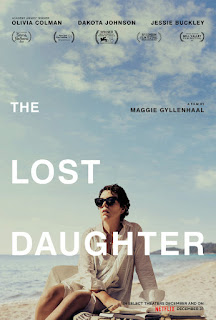
THE LOST DAUGHTER

 Olivia Colman     Dakota Johnson     Peter Skarsgaard     Jessie Buckley

Paul Mescal     Ed Harris


            We meet Leda (Colman) as she is arriving in a small coastal town in southern Italy for a vacation.  We find out later that her two daughters have gone to live with their father, and as a writer and English professor, she is looking forward to some quiet time to write.  But she does not anticipate getting involved with other people on holiday and her own festering conflicts long unresolved.

            On the noisy beach, Leda begins to observe families.  Although a number of people approach her with friendliness—Will (Mescal) the resort attendant, Lyle (Harris), and various others—she responds warmly but seems to keep them at a distance.  She becomes intrigued in observing a mother (Nina, played by Johnson) and her daughter Bianca, being reminded of her own ambivalence in mothering her children.  And Bianca seems to be annoying to Leda at first, but when the child goes missing, it is Leda who finds her and returns her to her parents.

            There are many flashbacks to Leda’s younger years when she was married and a young mother.  A proven actress Jessie Buckley captures the personality of the younger Leda, and we see her in sometimes playful and always creative, sometimes trying, interludes where her ambivalence about the responsibilities of motherhood is obvious.  But these seemingly trifling moments become significant factors later on when she acts on her impulses to develop a relationship with a Professor Hardy (Skarsgaard) who praises her work in glowing terms.

            This is Maggie Gyllenhaal’s debut in directing a feature film, and she is likely to receive commendations for her work.  The story line is finely modulated, the cast well chosen, and the subject of the film in terms of women managing family and career is topical.   But the emphasis on the ambivalence of motherhood is rather unusual in films, especially one done with a sympathetic attitude.  As we come to know Leda and develop some understanding of why she does what she does, her actions become more understandable.

            The pairing of the younger Leda actress Jessie Buckley with the older Leda, Olivia Colman, is one of the strong points of the film.  Buckley shows herself able to be paired with the experienced and renowned actress Colman.  Also, the film touches on many issues affecting women—and specifically actresses—today. 


A slightly disturbing take on an outwardly successful woman’s past and present experiences that may or may not make her understandable in today’s light.


Grade:  B                              By Donna R. Copeland

Thursday, November 4, 2021

THE ELECTRICAL LIFE OF LOUIS WAIN

Benedict Cumberbatch     Claire Foy     Andrea Riseborough

Adeel Akhtar     Olivia Colman     Tory Jones     Taika Waititi


Based on a true story of an exceedingly eccentric man, The Electrical Life of Louis Wain is about a British man living in the late nineteenth century who made a remarkable living out of his cat pictures.  The electrical part is what he feels when he is around cats—inspiration, perhaps?—which he conceptualizes as electricity.  He does talk in the beginning about patents for electrical inventions, but when he strokes a cat and talks about electricity, he senses something of importance, which he attributes to “electricity.”  Who could have predicted that his drawings would promote the habit of having cats as pets—something not done in the 1800’s in Britain.

For most of his life, Louis lives with his overbearing sister Caroline (Riseborough), four other sisters, and his mother.  He seems to have his head in the clouds most of the time—even though he becomes the family breadwinner at age 20—but is stabilized by meeting and eventually marrying his sisters’ governess Emily (Foy).  Their eccentricities fit together well, and she has an uncommon understanding of him; however, their happiness will be short-lived, but his story goes on.  He earns enough money from his drawings, and his art becoming so popular, he is able to support his family—until he discovers a significant mistake and his own mental health deteriorates.

Benedict Cumberbatch and Claire form an appealing and most interesting pair in telling this story.  There is clearly chemistry coming through that I presume reflects the real couple’s attraction.  Cumberbatch is excellent in portraying a befuddled character, and Foy easily slips into a supportive, bolstering role, which is just what Wain needs to ground himself.  As Wain’s sister, Riseborough’s constant yelling in reaction to threats to her control are grating, but most likely realistic.  Much more endearing is Tory Jones’ Sir William, consistently recognizing Wain’s talent and providing him with the kind of support that not only boosted his ego, but helped him (saved him at one point) financially.

The subject is one of fascination for me, so I thoroughly enjoyed learning about Louis Wain’s life, sad as it was.  The movie is illustrated by sepia-toned cinematography that one would see at the time (Cinematographer Erik Wilson and production designer Suzie Davies in their element), which reflects old photographs and art from that period.  It’s a film for those who lean toward the quirky and artistic, who can appreciate its refreshing creativity and appreciating the foresight in director Will Sharpe’s and his co-writer Simon Stephenson’s recounting of the story of a beautiful soul, showing how genius may be compromised by the practicalities and demands of life.  

None of the reviews of the film seems to appreciate the lovely conversations between Emily and Louis in their efforts to talk about and consider his life after her death.  Those scenes are ones that—while disturbing at an unconscious level for some—provide something extraordinary in the beauty of this film—and could serve as a model for those anticipating an untimely death.


An account of the life of a beautiful soul, appreciated by some, reviled by others, but one with a clever eye for making drawings of cats that expressed volumes.


Grade:  B                          By Donna R. Copeland


Thursday, March 11, 2021

THE FATHER

Olivia Colman     Anthony Hopkins     Mark Gattis     Imogen Poots     Rufus Sewell     Olivia Williams


            Old Age is always scary, and when dementia is a part of it, it’s horrifying.  This movie captures so many of the moments in an aging person’s life when it becomes crystal clear that things are not like they used to be.  Mystification is probably the worst of it, the swirl of people floating in and out and all around, so that one hardly remembers his/her own name.  We see one such person in Anthony Hopkins’ character, Anthony, whose psyche is portrayed in The Father.  That is, we see the world from his point of view, an impressive accomplishment of Florian Zeller (director of the original play and the movie), and Christopher Hampton (writer of the screenplay).

            Their work is clever in that we’re presented with scenarios that seem quite plausible, then as figures keep switching, we realize that we’re seeing the world through the aging Anthony’s eyes.  We get confused, just like he does.  Welcome to old age!

            Anthony Hopkins as Anthony and Olivia Colman as Anne give us stellar performances, capturing the dilemmas of aging father and concerned daughter.  Colman is adept in assuming a kind of role in which she has earned her performance awards.  Hopkins has a bit more of a challenge in portraying dementia, although the variety of his previous roles has shown his flair for all kinds of characters, from the upstanding doctor (Elephant Man) to the uptight and proper British butler (Howard’s End, Remains of the Day), to the stroke victim (Legends of the Fall) to the flawed U.S. President (Nixon) and revered U.S. President (Amistad) to the swashbuckling pirate Zorro (Mask of Zorro)—all seemingly cakewalks for him.  On a sympathetic note, I appreciated seeing the interactions of Anne and her husband Paul (Sewell), trying to work out what to do about the aging father—within the earshot of Anthony—unbeknownst to them.  As the story proceeds, one assumes that their marriage does not survive the stress, and that Anne does move on, realizing—or deciding—that her life must go beyond her father.  

            The film is thus also strong in showing the tolls old age takes on the families of the elderly, particularly at certain decision points, such as whether to keep the elderly at home, in the home of a child, or in assisted care.  These may be wrenching for the children, perhaps more so than for the elderly, but disorienting for him/her as well.

            Toward the end of the film, we get to see a highlight in the tender scene of the hapless Anthony and his current nurse (Williams) (who has previously been mistaken by Anthony to be Anne) in the elder home, assuming  the identity of his mother as he weeps for her loss in a moment of anguish.  Shout-out to health care providers who are committed to being whatever their patients need of them whenever.


Realistic and moving, The Father allows a glimpse into what most of us dread, end of life decisions.


Grade:  A                              By Donna R. Copeland


Thursday, December 6, 2018

THE FAVOURITE

Olivia Colman     Rachel Weisz     Emma Stone
James Smith     Mark Gatiss     Nicholas Hoult     Joe Alwyn


     I must confess, I did not love The Favourite.  It is easy to discern why others are entertained, but I tired of the portrayal of a moody, whimsical queen so easily led on by her ladies in waiting.  Most refreshing in the story are her sudden flashes of insight on occasion that take her subjects—particularly these very ladies—by surprise.  But I tired of their duplicitous fawning while concealing their own driving ambitions for power. It reminds me too much of the typical perception of women in power being easily duped, often by close [female] associates.
     The production, directed by Yorgos Lanthimos based on a screenplay by Deborah Davis and Tony McNamara, is a farce about the royal court in 18thCentury British aristocracy when Queen Anne (Colman) reigned, at first with the private counsel of her “lady of the bedchamber”, Sarah Churchill (Weisz), Duchess of Marlborough.  In this story, the Duchess wields considerable political power, along with her husband, the Duke of Marlborough charged with directing the army. 
     Enter a relative of the Duchess, Abigail (Stone), who has fallen upon hard times, and being intelligent, educated, and ambitious, she begins to maneuver her way into court.  Sarah is well schooled in handling intruders, and immediately puts her in her place. What she doesn’t anticipate is an equal capable of challenging her and winning over the queen.  What follows is a battle of wits between the two women and the unpredictability of the Queen’s favor.  
     Right off the bat, the three actresses, Colman, Weisz, and Stone, prove their considerable talents and carry the film.  Colman perfectly captures a person in charge who only sporadically wields her power, while being susceptible to flattery, attention, and physical comfort.  She can whine with the best of them and then turn on a dime and exert autocratic power.  Weisz plays the most interesting character in her blending of political knowledge, skill in the art of manipulation, and an apparent genuine caring.  Stone does a great portrayal of an interloper who knowingly scans the territory, assesses where different powers lie, and can convey sincerity without warmth.  These actresses are already being slated for nominations and have actually received awards for their performances.
     Clearly The Favourite will be a 2018 favorite, maybe even more so than Lanthimos’ previous films that were hits, The Lobster and The Killing of a Sacred Deer, both of which I loved. My problem with this film is as I stated above, is that it is a little too pat in portraying women’s records of power and their relationships with one another.  It turns out that whereas earlier accounts of Queen Mary’s reign emphasized her illnesses and other weaknesses, subsequent historians have given her more credibility.  She attended more cabinet meetings than those who came before or after her; more artistic literary, economic, and political advancements were made during her reign; and she supported the union of England and Scotland, which became Europe’s largest free trade area at the time.  No weak willed Nellie she.  It’s something of a pity that she is portrayed so weak in a 20thCentury film.

For a romp in an 18th Century royal court where intrigue is rampant and women compete for power, go see The Favourite.

Grade:  B                                    By Donna R. Copeland

Thursday, November 9, 2017

MURDER ON THE ORIENT EXPRESS

Kenneth Branagh     Penelope Cruz     Willem Dafoe     Judi Dench     Johnny Depp     Michelle Pfeiffer
Daisy Ridley     Leslie Odom, Jr.     Josh Gad     Derek Jacobi     Olivia Colman


            Murder on the Orient Express should be an exciting, engaging, production of a beloved author’s work (Agatha Christie).  Kenneth Branagh, more acclaimed as an actor than a director, fills both roles here, but is not exemplary in either, and perhaps the script (Michael Green) bears some of the responsibility.  A good detective story subtly plants clues, explicates the detective’s reasoning process, and guides the reader along in the story.  But the story here comes across as too convoluted to make sense.  I found a number of problems in this production, foremost being Branagh as Poirot, a role stamped in my mind as a David Suchet character.  Although Branagh attempts to convey the preciseness and impressive deductive abilities of Poirot, these simply do not come across clearly; they’re too English (rather than Belgian), and rather than a neat mustache, Branagh sports what looks like a gray rag across his upper lip. 
            Many of the first scenes on the inside of the train are hazy, dark and difficult to discern what is taking place, despite the work of talented production designer, Jim Clay, and cinematographer, Haris Zambarloukos. 
            The fault cannot be in the stars; the cast for this film being a large group of highly accomplished actors, including Branagh, along with Penelope Cruz, Michelle Pfeiffer, Judi Dench, Derek Jacobi, Willem Dafoe, Leslie Odom, Jr., Josh Gad, Daisy Ridley, and Olivia Colman.  Johnny Depp is on the screen only briefly, but plays his role well.
            The plot adheres loosely to the novel, in which a group of passengers board the Orient Express in Istanbul bound for numerous European stations along the way; but the train derails in a storm, and the passengers are stranded until repairs can be made.  During this time, a murder is committed, and with Poirot on board, he is called upon to solve the case, despite his being on holiday.  Earlier, he had been approached by the victim, asking for his protection, because the man was convinced that someone was out to kill him.  The man wants to prevent a murder (his) before it happens.  Poirot refuses for reasons he states very clearly.  When the murder does take place, Poirot must solve the crime, which is the only intriguing part of this film, but delivered in a way that is hard to follow with the flurry of names and historical events.

This film seems to be a big miss for an Agatha Christie story.

Grade:  D+                                    By Donna R. Copeland