Showing posts with label Biography. Show all posts

Thursday, June 2, 2022

BENEDICTION

 Peter Capaldi     Tom Blyth     Jack Lowden

Simon Russell Beale     Ben Daniels     Gemma Jones


         This is not your usual war story.  It starts out in London in 1914 with a poem about war written by Siegfried Sassoon (played by Jack Lowden as the younger and Peter Capaldi as the older), the protagonist whose life is chronicled beginning with his years as a young man when he and his brother are going off to WWI.  We see him three years later after his brother was killed and he has become at the same time a decorated British soldier and an anti-war activist, based on his “Soldier’s Declaration.” He is refusing to return to the battlefield on the basis that the conditions for peace have not been stipulated by government and the powers that be are guilty of “political errors and insincerities.”  

         He is fortunate (or unfortunate, depending on your point of view) in that a mentor with influence, Robbie Ross (Beale) sees that he is referred to a hospital for traumatized soldiers in lieu of being court martialed.  He is outraged by this “help” because he had wanted to publicize his protest.  Nevertheless, he concedes, and uses his time in a military hospital to develop more insight into himself with the help of therapist Dr. Rivers (well characterized by the script and performed by Daniels).  

         The plot takes a turn after Sassoon is discharged from the army and focuses on his life thereafter when he has acknowledged his attraction to men and becomes involved in ambivalent relationships with a number of them when, after a particularly painful period, he decides to marry a woman, Hester Gatty (Jones).

         Writer/Director Terence Davies has created a moving and interesting work on the life of the poet Siegfried Sassoon, although he has chosen not to adhere strictly to historical accuracy.  Presumably his interest was more in the direction of illustrating the lives of homosexual men during that period of time not only in the military but in everyday social life as well.  And perhaps just as much to validate anti-war sentiments. His depiction captures the passion against war and the advocacy for freedom of identity, which could be seen as related causes.

         Jack Lowden seems perfectly cast in the starring role, showing the interiority of the main character with subtle charm on the outside and depth of feeling on the inside, most particularly captured in the last scene.  Peter Capaldi as the older Sassoon with obvious bitterness and closed off emotions is aptly personified.  All the cast members are well chosen and help to give us a poignant impression of the people in Sassoon’s life.


An unusual war story that depicts international struggles mirroring internal conflicts.


Grade:  B                    By Donna R. Copeland

Thursday, May 5, 2022

THE DUKE

 Jim Broadbent     Dame Helen Mirren     Fionn Whitehead

Heather Craney     Matthew Goode     Aimee Kelly     Craig Conway

            This is a strangely seductive movie, showing a British family with a rather daft though good-hearted Kempton Bunton (Broadbent), his wife Dorothy Bunton (Mirren), and younger son Jackie (Whitehead) not communicating very well with one another.  Dorothy is extremely critical of Kempton (for some good reasons), which makes him more secretive at times, and Jackie torn between taking sides with one then the other.  An older son appears about midway through, but doesn’t appear to have much in common with the rest of his rather straitlaced family.  Dorothy is especially offended by his frequent swearing.

            Much about the family is a dramatization, but the story is loosely based on an actual theft of the Goya painting entitled “The Duke of Welllington” from the National Gallery of London.  Reference is made to it in a number of plays and movies ever since.

            In the movie, Kempton is currently protesting paying the government a television license (which everyone was required to pay) since he cannot get the BBC and he feels strongly that everyone should be able to watch television as a public service.  After serving some time, he thinks he has solved the problem by taking the BBC tube out of his set.  He is not only against paying the license himself but feels strongly that everyone should receive television as a public service.  

            When the theft of the  Goya painting is in all the news, it suddenly appears in the Bunton household, with Kempton and Jackie making sure it is hidden even from the ever-cleaning Dorothy.  

            Much intrigue occurs around the painting, around Kempton’s temporary jobs, and the death of Jackie’s sister.  Towards the end, after the viewer has become more and more sympathetic to and interested in the family, there is a surprising shift, which makes the Roger Michell’s direction and screenplay by Richard Bean and Oliver Coleman impressive in its subtlety and its shift from an account of a zany man to a heart-warming story of community and care for others. 

            Jim Broadbent’s acting skills have made him a famous and favorite British actor.  Here, he makes his character so convincing one surmises that he is one with the kindly Kempton Bunton.  The same for Helen Mirren who after we so often see her now so elegantly dressed and coifed nowadays in the media we can see how easily she pulls off playing a frumpy housewife with firm opinions.  Fionn Whitehead and Matthew Goode as Kempton’s solicitor contribute to the appeal and quality of The Duke.


This is an engaging British production that pulls you in, makes you think, and have good thoughts about humankind.


Grade:  A                              By Donna R. Copeland

Thursday, December 9, 2021

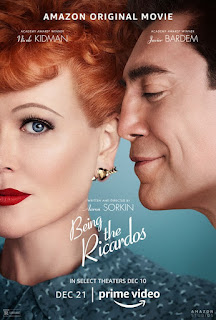
BEING THE RICARDOS

 Nicole Kidman     Javier Bardem     J. K. Simmons     Jake Lacey

Nina Arianda     Alia Shawkat     Tony Hale


            I was not a big fan of the Lucy/Desi shows, so I didn’t see Being the Ricardos with much nostalgia.  But for those who did love them, the film is likely to be a big hit.  A few viewers in the screening audience laughed out loud on cue with the radio audience, suggesting they were having fond looks down memory lane.

            I will say that the film is informative in that I was not aware of the significant roles Lucille Ball and Desi Arnaz had had in their productions, from the script to the sets to the executive decisions.  I had read about Arnaz’ revolutionary role in the creation of television as it’s seen today, but the film shows the painstaking efforts of the couple—each with different ideas—in executive decisions.  The stunned looks on the named executives’ faces foretell the significance and revolutionary nature of Desi’s and Lucy’s contributions.

            It’s also educational for the viewer to be given a peek behind the scenes and witness the haggling and sometimes brutal struggles that take place among writers, producers, actors, and sponsors in putting on a show.  When we see the finished product, usually little of the blood, sweat, and tears that went into the project are apparent.

            Something is puzzling to me, though.  It’s not uncommon for actors to disappear into their characters so much so that the viewer becomes unaware of the actor.  Recent case in point is Jared Leto as a Gucci son in House of Gucci and Benedict Cumberbatch as an American rancher in The Power of the Dog.   And there are countless examples of such through time, with Meryl Streep being one of the paragons of this kind of shape shifting.  However, I did not see that convincing transformation in Nicole Kidman as Lucy and Javier Bardem as Desi.  I was always aware of the actors and had difficulty putting the characters in their place.  The reason this is puzzling is that both Kidman and Bardem are top-notch actors.  It wasn’t as if they weren’t portraying their characters accurately, it was that that “something” that makes the actor disappear was not evident.

            One explanation could lie at the writer/director Aaron Sorkin’s feet.  This is his “creation” in a sense, so perhaps he was not as attuned to subtleties and nuances that he could have exploited.  His scripts can sometimes border on the glib, where the writing is more about the craft than about human drama, especially when it is delivered rapid-fire like stand-up comedy.  Other times, I wondered why some dialog was even inserted, such as when writer Frawley (Simmons) asks Desi whether he was scared when the Cuban militia came for his family, which constitutes a “Duh!” moment.

            Another somewhat minor—although annoying--issue with the film is sound production.  So often, music and sound effects drown out the dialog, even when sound effects are not necessarily needed (for example, the rain at one point).  Javier Bardem’s English is excellent, and I have never had difficulty understanding him in a movie, but apparently here, he was advised to affect a stronger Spanish accent than even Desi actually had, resulting in my not comprehending all of what he said.  (I never had trouble understanding Desi in sound clips.)

            Being the Ricardos will be primarily for die-hard fans who are nostalgic and for those who like to watch behind-the-scenes filmmakers hash out the fine points of scenes, plots, and characters. 


Being the Ricardos is for the fans of Lucy and Desi primarily and for a look at the influence two actors had on television production.  


Grade:  C+                            By Donna R. Copeland


Thursday, November 18, 2021

KING RICHARD

 Will Smith     Jon Bernthal     Dylan McDermott     Aunjanue Ellis

Saniyya Sidney     Demi Singleton     Tony Goldwyn

            This is a fascinating account about how to make a champion.  Richard Williams, the father of the famous tennis stars Venus and Serena Williams, knew the value of positive reinforcement, despite his tendency to be overbearing, and temperamental.  And let’s not forget the decisive role of his wife Brandi.  She knew him like a book and could read him in such a way she helped him understand himself when he otherwise couldn’t.  And she was a real force in their girls’ training.

            The gist of the story is known by most people, that the black family from Compton, California, took the tennis world by storm in the early 2,000’s when Venus began winning tournaments at an early age.  The proud father always responded to reporters and coaches when they praised him for one daughter by reminding them he had two girls who would be stars.

            As oppositional and pompous as he often was, Richard had rules he lived by and taught his children, such as “Fail to plan, plan to fail.”  Humility is another principal he at least wanted his children to retain, always remembering where they came from no matter how many prizes they won.  No matter the win, he forbade them to “brag.”  Clear from the film is that much of the success of the girls depended on his salesmanship.  He seemed not to be intimated by anyone; he successfully convinced almost (not all) all of them to at least look at his daughters’ prowess on the court.

            I am not a tennis player or big fan, but the film comes across as an authentic representation of what it takes to become a tennis star, the role a parent so inclined could play in a child’s success, and in this case the tremendous support provided by a family that not only stood together but talked through and hashed out problems that arose.   I appreciated the background information about the father that led to the fierceness and perseverance he shows in situations where he is challenged.  Valuable as well is the occasional focus on the marriage and the way the couple solves their issues.  

            Will Smith seems tailor made for the role of Richard Williams.  He embodies it so well one can imagine that aspects of Williams’ personality are ones Smith knows very well.  As Mrs. Williams, Aunjanue Ellis is an inspiration for all women who need to stand up for themselves.  Ellis shows the full dimensionality of a bright, creative, and loving woman who knows how to be a partner to a strong man, and I hope both actors will be recognized come awards season.

            The movie is entitled “King Richard” apparently because of the way Williams conducted himself in coaching and advocating for his daughters.  It seems an apt title to me.  The film does not go into the marriages and divorces of the parents or other types of conflicts in the women’s careers—which is a bit of sugar-coating perhaps—but wisely concentrates primarily on the family during the time Venus is just getting established as a pro tennis player.


This account of the background of two record-breaking female tennis players will keep you entertained and cognizant of the importance of family support.


Grade:  A                              By Donna R. Copeland

Friday, November 12, 2021

TICK, TICK...BOOM!

Andrew Garfield     Alexandra Shipp     Robin de Jesus     Vanessa Hudgens

Joshua Henry     Bradley Whitford     Jonathan Mark Sherman


Jonathan Larson, the creator of the hit musical “Rent” (which earned Pulitzer and Tony awards) is the subject of this film as he was writing one of its predecessors.  He is young—not yet 30—but wants to set the Broadway world on fire with his musicals.  He captures the interest of one who turned out to be his long-time mentor Stephen Sondheim (here played on note by Bradley Whitford), and one of the humorous segments of the film is Sondheim and a colleague critiquing one of Larson’s first musicals.  It’s funny because the colleague seems to want to trash it, but after Sondheim gives his opinion, the man agrees with him in a roundabout way.  (A wonderful rendition of doublespeak.)

Tick, Tick…Boom! canvasses a wide range of subjects—writer’s block, homophobia and the AIDS epidemic, the tension between art and corporate concerns, and on a more personal level the tension and pulls between professional life and human connections—all of which were highlights in Larson’s life. These subjects are the “meat” of the production.

I found the story more engaging than the music, especially in the beginning, which is frenetic and hyper in the partying mode.  At the middle point of the drama and towards the end, music and story become more inspirational.  The duet of Susan (Shipp), Larson’s neglected girlfriend and Karessa (Hudgens), one of Larson’s main characters/singers, sing about Jon’s struggle in writing the most important song in the work; it’s a stand-out, especially touching and beautiful.  I also found the songs of Larson and de Jesus at the end singing about AIDs just as beautiful and moving.

Andrew Garfield may not be the most appealing star of a musical, but his performance here proves his talent.  Shipps’ and Hudgens’ voices complement each other and express well the emotions their characters are experiencing.  The entire ensemble of musicians makes this musical vibrate.

Another strength of Tick, Tick…Boom! Is the cinematography of Alice Brooks.  She inserts a number of shots that are humorous and inspiring, such as that of Jon at his lowest encountering the “30” at the bottom of the pool (reminding him of his impending age) and swiping it into a treble clef, just what he needed for inspiration to write the most important song in his current production.  There are numerous creatively rendered shots that enhance this production 

Tick, Tick in the title refers to the ticking of time, that it is always there to remind us of the finiteness of life and relationships.  I think the film did a great job of reminding us of that and encouraging us to ponder it a bit.  And to emphasize the point, Jon’s agent tells him after the success of the Tick, Tick...Boom! workshop that his next job is to start writing his next show immediately.  No rest for the weary!

Tragically, that tick tick of the clock was a knell for Jonathan Larson.  He had an aortic aneurysm that killed him suddenly at age 35.  Our loss for sure.


Tick, Tick…and may there be a Boom...if you're lucky!


Grade:  B                                                      By Donna R. Copeland


Thursday, November 4, 2021

THE ELECTRICAL LIFE OF LOUIS WAIN

Benedict Cumberbatch     Claire Foy     Andrea Riseborough

Adeel Akhtar     Olivia Colman     Tory Jones     Taika Waititi


Based on a true story of an exceedingly eccentric man, The Electrical Life of Louis Wain is about a British man living in the late nineteenth century who made a remarkable living out of his cat pictures.  The electrical part is what he feels when he is around cats—inspiration, perhaps?—which he conceptualizes as electricity.  He does talk in the beginning about patents for electrical inventions, but when he strokes a cat and talks about electricity, he senses something of importance, which he attributes to “electricity.”  Who could have predicted that his drawings would promote the habit of having cats as pets—something not done in the 1800’s in Britain.

For most of his life, Louis lives with his overbearing sister Caroline (Riseborough), four other sisters, and his mother.  He seems to have his head in the clouds most of the time—even though he becomes the family breadwinner at age 20—but is stabilized by meeting and eventually marrying his sisters’ governess Emily (Foy).  Their eccentricities fit together well, and she has an uncommon understanding of him; however, their happiness will be short-lived, but his story goes on.  He earns enough money from his drawings, and his art becoming so popular, he is able to support his family—until he discovers a significant mistake and his own mental health deteriorates.

Benedict Cumberbatch and Claire form an appealing and most interesting pair in telling this story.  There is clearly chemistry coming through that I presume reflects the real couple’s attraction.  Cumberbatch is excellent in portraying a befuddled character, and Foy easily slips into a supportive, bolstering role, which is just what Wain needs to ground himself.  As Wain’s sister, Riseborough’s constant yelling in reaction to threats to her control are grating, but most likely realistic.  Much more endearing is Tory Jones’ Sir William, consistently recognizing Wain’s talent and providing him with the kind of support that not only boosted his ego, but helped him (saved him at one point) financially.

The subject is one of fascination for me, so I thoroughly enjoyed learning about Louis Wain’s life, sad as it was.  The movie is illustrated by sepia-toned cinematography that one would see at the time (Cinematographer Erik Wilson and production designer Suzie Davies in their element), which reflects old photographs and art from that period.  It’s a film for those who lean toward the quirky and artistic, who can appreciate its refreshing creativity and appreciating the foresight in director Will Sharpe’s and his co-writer Simon Stephenson’s recounting of the story of a beautiful soul, showing how genius may be compromised by the practicalities and demands of life.  

None of the reviews of the film seems to appreciate the lovely conversations between Emily and Louis in their efforts to talk about and consider his life after her death.  Those scenes are ones that—while disturbing at an unconscious level for some—provide something extraordinary in the beauty of this film—and could serve as a model for those anticipating an untimely death.


An account of the life of a beautiful soul, appreciated by some, reviled by others, but one with a clever eye for making drawings of cats that expressed volumes.


Grade:  B                          By Donna R. Copeland


SPENCER

Kristen Stewart     Timothy Spall     Sally Hawkins     Jack Nielen     Freddy Spry

Jack Farthing     Sean Harris     Stella Gomet     Richard Sommel


            The film begins by noting that it is “a fable”, and that does describe it as what I take to be a diatribe against the tradition of royalty.  It is not a bio-pic about Diana;  many/most scenes are made up by writer Steven Knight and presumably Director Larrain.  Not only does Spencer portray Diana as a spoiled, pouty diva-like person, it doesn’t show royal family members in a much better light.  (They’re shown as unempathetic.)  Diana’s costumes are beautiful (one of her marks in real life), but go over the top, seemingly to show the ridiculousness of royal dress in general.  The same goes for highlighting the elegant dining—I think it’s meant to be a criticism of a lavish lifestyle.

            Setting the film in the Christmas weekend Diana is deciding to part with Prince Charles is known as a stressful time, and one can imagine a very difficult one for Diana.  It’s hard for me to believe, though, that Diana’s behavior was so off-kilter that she was hallucinating.  It’s plausible that she was suspicious of the family’s motives toward her, but I find it hard to believe that she was as paranoid as shown.  One chilly scene that is supposed to capture the mood of the family and that weekend is Christmas dinner with almost no conversation and family members eyeing one another.  I find that hard to believe as well.

            Spencer implies that Diana was obsessed with her childhood home which, incidentally, is where she was born, but she only lived there a short time.  Much is made of her attachment to a scarecrow on the property and her taking its jacket and instructing her maid to clean it.  In the end, the scarecrow is dressed in a brilliant yellow outfit that Diana is shown to have worn at one time, a caricature of a royal family’s indulgences, I assume.

            The only part of Spencer I really enjoyed is the acting, particularly that of Kristen Stewart and Sally Hawkins, Diana’s waiting maid and confidante.  Stewart, who apparently has a positive attitude toward Diana researched the woman’s life and stated that her intention was to portray her as realistically and sympathetically as she could.  She achieves that, and the viewer can easily see her as Diana.  I haven’t been able to discern exactly what she thought of the script, but I wonder what she really thought about it, given its portrayal of a narcissistic, oppositional wounded woman.  Hawkins comes across as a servant devoted to her charge, always with kind and sensible responses to Diana’s upsets.  And their conversations are the only ones that seem to have a ring of truth to them.

            I adored Pablo Larrain’s portrait of Jackie (Kennedy), but this portrait of Diana simply doesn’t ring true—not that I knew her personally, as I’m going by my reading of news reports.  It must be that Larrain’s liberal political beliefs as in No, along with perhaps those of his writer Steven Wright (Dirty Pretty Things, Eastern Promises) brought out sentiments against a privileged class, which I appreciate, and can say spoke truth to me.  But I’m at a loss to understand the presentation of Diana Spencer as such a losing kind of woman.

            In sum, it seems unfair to concoct such a picture as this one of one weekend in a well-known, complex, multi-layered person’s life.


A princess new to royalty and deceived by her prince is portrayed as an oppositional, resentful woman, despite her being generally known as a real, caring person.


Grade:  C                              By Donna R. Copeland


Thursday, September 16, 2021

THE EYES OF TAMMY FAYE

Jessica Chastain     Andrew Garfield     Cherry Jones     Vincent D’Onofrio

 Fredric Lehne     Louis Cancelmi     Sam Jaeger 


             A little girl with a rejecting mother finds redemption for herself at a Second Adventist Church when she bursts in on a service (against her mother’s wishes) and the preacher accepts her testament of faith.  She is so overjoyed she begins speaking in tongues, whereupon the congregation is convinced she is from God.

            A young man driving his father’s car gets distracted and hits a young boy, seriously injuring him.  The teenager is so distraught he prays for the child, promising God that if the child lives, he will devote himself to preaching the Gospel.

            Tammy Faye (Chastain) and Jim Bakker (Garfield) meet, fall in love and elope before Tammy’s mother knows what is going on.  He aspires to become a television evangelist a la Pat Robertson, and Tammy Faye fits herself right in with a singing voice and creativity in appealing to anyone—adults or children—who listens.  They’re both talented, and building on childhood dreams, manage to develop a following among evangelical Christians.  Of course, this provokes the interest of Pat Robertson and Jerry Falwell who aren’t quite ready for the competition.

            Those of us of a certain age remember the Bakkers and their making religion more entertaining with playful puppets and delivering messages like “God doesn’t want us to be poor” on their PTL (Praise the Lord) network.  They even recruit Gary Paxton, a Grammy winning songwriter who comes up with something like “Don’t Give Up; You’re on the brink of a miracle” for Tammy Faye to sing.  For her, God is a loving god with tolerance for everything he has made.  When Falwell is condemning homosexuality and claiming that AIDS is God’s punishment for it, her approach is that we should love all God’s creatures, because “God don’t make no junk.”

            This starts to be a fairy tale story, as the Bakkers’ messages—and confessions—strike a chord in the hearts of Christians and the donations coming in go over the top.  Jim’s plans and dreams grow in kind, as in elaborate water parks and vacation lands on the PTL property, along with Tammy Faye’s social programs (e.g., homes for unwed mothers and children with special needs).  Unfortunately, the Bakkers are susceptible to human enticements, and no one in their organization has learned money management, which ends up being a major problem.

            Certainly, the outstanding part of this production is Jessica Chastain’s performance as Tammy Faye.  She so encapsulates the character, the viewer ceases to see Chastain at all—only Tammy Faye.  Chastain captures Tammy’s chameleon personality flawlessly, and we get seduced just as all the characters are by her enticing charm.  There is a genuineness in Tammy Faye that Chastain has picked up on that makes her a sympathetic character rather than one usually disdained.  Andrew Garfield is likewise perfectly cast as one who, though mostly sincere, is naïve, easily influenced, and devoid of a sense of practicalities. 

            There are a couple of problems with an otherwise well produced movie.  One for me is that the two characters become wearing over time, with their inability to grow and change and their persistent denial of reality, even though I realize this is probably how people experienced them at the time.  But the filmmakers could have used more judicious editing and omitted some of the scenes--especially toward the end—when the movie seems to drag on and on.

            I did appreciate the honesty of both of these characters when they are confronted by each other; ultimately, they were truthful—at least with one another.  Whether or not that holds for the real people, I couldn’t say.


Tammy Faye shows how even those with good intentions and caring hearts can be seduced by fame and fortune to their detriment.  Nevertheless, the voyage in getting there may make it all seem worthwhile.  Didn’t the characters say in the end that they didn’t regret anything?  I was left with that impression.

Grade:  B                              By Donna R. Copeland


Thursday, August 12, 2021

RESPECT

 Jennifer Hudson     Forest Whitaker     Audra McDonald     Saycon Sengbloh

Tituss Burgess     Marlon Wayans     Mark Maron     Albert Jones 


Respect shows a cross-section of Aretha Franklin’s life from her childhood up through the first several of her many successes (1972 album Amazing Grace).  It makes good use of flashbacks to fill out the early stories, showing the kind of background from which Aretha came and the strong influence of her father throughout her life.  His influence even extends to her standing up to him and forging a life and career unbeknownst to him.  That he did not approve didn’t seem to lessen their continued deep love for one another even through rocky times.

And there would be many rocky times as a function of the first man Aretha chose to marry, the rigors of a music idol’s life, a certain degree of rebelliousness, and her own susceptibility to alcoholism.  The story is well told, and although beginning sections of the 2½ hour film could have been shortened, the rest of the production is gripping.  The processes by which Aretha and her fellow musicians are composing and recording songs is highly entertaining, both for their explication of the process and the discord/accord that rises and falls.  When a song hits that special note, the audience breathes a sigh of relief and has a joyful moment along with the musicians.

Young director Liesl Tommy, whose previous work has been in television, shows great sensitivity in the types of experiences she has chosen to feature, in the aptness of the flashbacks, and in the overall picture of the times during these periods of Franklin’s life.  She has shown good judgment as well in showing almost complete renditions of many of Aretha’s most popular songs.  Credit is likewise due to the primary writer, a close friend of Liesl, Tracey Scott Wilson (TV’s “Fosse/Verdon” and “The Americans”), who was thrilled to work on the project after being a fan.  She says, “It’s one of those things where you want to get it right. She’s just so important. There’s not many musical biopics about Black women in general. It was really important to us to represent her as she was, with a lot of love and care.”

As Aretha, Jennifer Hudson (chosen by Aretha before her death), captures the music and the complex/complexing personality that was Aretha—her early sense of herself as someone who knows her own mind and has clear opinions and one with a rebellious streak who may show flashes of temper.  At the same time, one who could be meek and at sometimes be sensitive to another person’s point of view.  

Forest Whitaker, with so many credentials in portraying complex characters, is a perfect choice to stand in as a powerful man with obvious weaknesses and contradictory positions.  All the actors chosen are strong:  Audra McDonald cameos of Aretha’s mother; Marlon Wayans as an abusive, controlling husband; Tituss Burgess as a mentor to the child Aretha through her adulthood; and the music producers played by Mark Maron and Tate Donovan.

As a biopic, Respect is likely to please the fans of Aretha Franklin.


“How does the woman with the greatest voice of all time find her own voice?"    

 Director Liesl Tommy


Grade:  A                              By Donna R. Copeland

Thursday, May 20, 2021

DREAM HORSE

 Toni Collette     Damian Lewis     Owen Teale          Joanna Page


            This film is just what you hope it will be; an inspiring story of a horse and its owners coming into their own through a bit—or perhaps a considerable amount—of trauma.  Additionally, it’s based on a true story.  I like the way the movie opens with Jan (Collette), a middle-class woman in Wales, working several low-level jobs, trying to get her older husband Brian (Teale) out of the TV chair at home, and taking care of her parents. When suddenly she gets inspired.  It seems there are a number of citizens who could use more zest in their lives.

            Jan had won awards as an animal trainer in her earlier days, and when she came across an advertisement for a mare, something inspired her to look ahead and realize her vision of a racehorse.  She works in a grocery store as well as in the local bar, so she is well acquainted with the townspeople.  When a new person shows up, a certain Howard Davies (Lewis), the owner of the bar fills her in on his shady past (including considerable debt in betting on horse races), she makes note.  As she takes his order, they have a cryptic conversation, but something clicks between them, and when he hears later of her purchase of the mare, he engages her.

            That encounter leads to their formation of a syndicate of townspeople to buy stakes in the offspring of the mare who is expected to breed with a sire of racehorse pedigree.  The filmmakers present us with colorful townspeople who buy into the project, as well as vignettes about Jan and her husband and Howard and his wife.  I could, however, have done without the scenes of an older man having trouble getting his clothes on and keeping them straight—an attempt at some comedy, I suppose, that just didn’t succeed.

            Eric Wilson’s cinematography and Jamie Pearson’s editing work together with the story to present a thrilling tale of tight horseraces being held in vista-like settings with windmills often a part of the picture.  Toni Collette is inevitably a fine actress showing all kinds of emotions with her face and her body and stepping up to be assertive when need be.  Damian Lewis strays from his usual fare of British dramas and political thrillers to play an upper-class stock trader comfortably hobnobbing with the small-town group.  


Townspeople banding together in a heartwarming tale of a shrewd woman’s keen eye in looking for a winner.


Grade:  B                              By Donna R. Copeland

Wednesday, April 21, 2021

PERCY VS GOLIATH

Christopher Walken     Roberta Maxwell     Zach Braff     Christina Ricci     Adam Beach     Luke Kirby


Percy is an irascible old farmer who’s had minor disappointments with his son who chose teaching rather than farming (which Percy’s ancestors from the old country had perpetuated), but he’s come to terms with that, and although he rarely expresses any emotions, he clearly loves his wife, son, and their community in Saskatchewan, Canada.

Award-winning Christopher Walken fills the order perfectly to play the part of Percy.  He is leading a relatively happy life in his early 70’s, has just invested in some new farming equipment, and his supportive wife Louise (Maxwell) and he are close to the townspeople in their small community.  They have no idea what’s ahead.

What’s ahead is giant corporation Monsanto suing Percy for some of his canola seeds resembling their patented ones.  It claims that every product harvested by Percy is actually theirs because he didn’t pay for their seeds, even though the seeds were (presumably) blown by the wind into his crop.  What becomes a matter of contention is how Monsanto’s seeds got mixed up with his.  He had followed instructions from his ancestors to save the best seeds from one year to plant the next year.  As far as he knew, these seeds were separate from any others.

Enter an environmental group wanting to make Percy’s case known to the world.  Rebecca (Ricci) is a young, passionate advocate for the cause against Monsanto for its GMO, and she encourages him to fight for his case.  His lawyer (Braff) tries to persuade him to settle with Monsanto to save horrendous legal fees involved in contesting the case.  

Percy is a practical man who relies on logic in making his decisions.  He is clearly torn about what to do.  Rebecca sees the issue on a global scale; so many farmers are being done in by Monsanto, and she urges him to fight, offering some incentives for getting financial help.  

            Unfortunately, the film is not clear about exactly how much help Percy actually receives from the environmental group.  He continues to fight his case all the way up to the Canadian Supreme Court.  But the film is timely and worthwhile in pointing out the encroachment of corporations like Monsanto on innocent people.  For example, “each GM seed is patented and sold under exclusive rights.  Therefore, farmers must purchase the GM seeds anew each year, because saving seeds is considered to be patent infringement. Anyone who does save GM seeds must pay a license fee to actually re-sow them.”

            The film directed by Clark Johnson is engaging, and highlights the current issue of multinational corporations having so much power over the common people.  It makes its point very well, and instead of delivering ultimate satisfaction, shows what efforts it takes to defend against large corporations bent on making a profit despite its repercussions.


Taking on a big corporation these days is an almost insurmountable problem for an individual.


Grade:  B                              By Donna R. Copeland


Wednesday, February 24, 2021

BILLIE EILISH: THE WORLD'S A LITTLE BLURRY


     In the beginning of this film, I was impressed with seeing how a music video was made.  Then, I was impressed with how many people were fawning over the star, noting that she puts herself down and harshly criticizes her performances.  But it’s not clear whether she does this intentionally (to get praise and reassurance) or whether she is simply talking about how she feels.  As the film progresses, I’m drawn in, first of all by her appeal, but also by seeing a strong family unit working together.  Both parents are amateur musicians and have fostered the careers of their son Finneas and daughter Billie.

As much as I admired the star, there are all kinds of appealing features to this documentary, which Director R. J. Cutler and the other filmmakers have so competently produced.  There is the appeal of seeing all the facets of Billie Eilish’s personality, seeing them expressed in her outfits and her appearance overall, the presentation of her family—almost unique nowadays for the family staying together--and most of all, a teenager hit artist thanking her parents for their help, not only in helping with careers, but also in the way they brought the children up.  Eilish possesses an unusual combination of authenticity and playfulness.

     The film does a great job in showing the stress of constant hordes of people pressing against celebrities.  We can see Billie reveling in this at first, then realizing how much it affects all of them.  We see a child star trying to cope with fandom and the inclusion of her Justin Bieber idolization brings that point home—even though it certainly surpasses most fans’ experiences.

Most of all, the documentary highlights the process of idolization from humble beginnings, ways of coping, and its effects on all involved—family and friends.  To see what a child at 17 years old goes through is enlightening.

     The documentarians of Billie Eilish are to be congratulated on giving us a realistic picture of stardom achieved by a teenager.  It was moving to hear Billie’s mother expressing herself about how necessary a responsible parent is to help navigate the waters of fame.  She is keenly aware of the danger drugs and alcohol pose for such “lucky” performers.  

     Finally, it’s awesome to hear about all the Grammy awards Billie earned in 2020—including Record of the Year, Album of the Year, Song of the Year, Best new Artist, and Best Pop Vocal Album—with her brother Finneas sharing in those awards, along with his own Producer of the year Award. 

     For someone who did not really know who Billie Eilish was, I enjoyed the film a great deal for the way it covered a star, not only in concerts and acclaim, but as well in illustrating the background and values of a singer/songwriter star from an intact family.


An inspiring look at a new artist with a history different from the usual story of instant fame.


Grade: A                                                By Donna R. Copeland 


Wednesday, February 10, 2021

JUDAS AND THE BLACK MESSIAH

Daniel Kaluuya     LaKeith Stanfield     Jesse Plemons    Dominique Fishback


     Betrayal of one’s own can be considered one of the most egregious of sins, and this film about the Black Panthers in the 1960’s does an excellent job in charting the beginnings of such a compromise, the experience of the betrayer, and some of the after-effects for the perpetrator.  The story is told from William O’Neal’s (Stanfield) point of view, and puts the listener in a bit of a dilemma, at least during the first part.  You see he is a hustler, but he has wits and charm, so unless you already know who he is, you might be drawn to him.

     Fred Hampton (Kaluuya), the deputy chairman of the Black Panthers from 1966 to 1969, has a different kind of charm, one built on honesty, sincerity, and commitment to a cause for other people.  It’s easy to see why he might be a threat to the FBI at the time, being truly a black messianic figure who was winning over thousands of followers. He became the chairman of the Black Panthers in Chicago in the 1960s primarily because he was a skillful orator, an alliance builder, and recognized the needs and frustrations of Black people.  He was an earlier Black Lives Matter leader at a time much less receptive to such causes.  

     Director Shaka King and his team have created a very fine production that shines a light on a very dark time in U.S. history, outlining events and giving shape to the characters involved and what they were about in terms of their personal lives as well as the aims and workings of the Black Panthers.  It allows those of us who heard about them primarily in the news to fill in the gaps and see their human-ness beyond the revolutionary rhetoric.  

     Daniel Kaluuya has already achieved a reputation for his previous roles in Get Out and Black Panther, and he is winning accolades again for his performance here.  Those eyes! They tell so much of what he is intending to convey, that with his soft voice and purposeful carriage, he can deliver stunning performances.  In this film, my eyes were drawn more to the Judas character because it is much more complicated.  Stanfield portrays the divided loyalties and ultimate survival instincts of a traitor skillfully, showing the pangs of guilt and ability to deny facing up to possible repercussions of his actions.  Jesse Plemons—not an admirable character here, as in his other films—shows well the man who speaks the party line, ignoring his personal opinions. 

     Judas and the Black Messiah is of historical significance and instructive to those wanting to be informed about politics in the 1960’s, specifically in regard to the Black Panther group.


Judas and the Black Messiah is an account of the Black Panther group in the 1960’s, which highlights what it was up against with the FBI.


GRADE:  A                                                By Donna R. Copeland


Thursday, February 4, 2021

SON OF THE SOUTH

Lucas Till     Lex Scott Davis     Lucy Hale     Julia Ormond

Brian Dennehy     Cedrick the Entertainer    Shamier Anderson


     This is a movie like many we’ve seen before about the blatant racism of the Deep South during the time of the early civil rights movement in the early 1960’s. It’s based on the memoir (The Wrong Side of Murder Creek:  A White Southerner in the Freedom Movement) of Bob Zellner a young man at the time who lived in Alabama and was bound for college in the north, but kept being drawn into the movement by activists and circumstances.  He’s an older man by the time of movie preparation, but was consulted on the script by Barry Alexander Brown and Constance Curry (co-author of the book).

     Bob Zellner (played by Lucas Till in a fine performance) simply wants to visit a local Methodist Church for information for his high school essay, and ropes in a few of his friends to go with him.  He seems very neutral, having been brought up by a father who left the KuKluxKlan after a sojourn in Russia where he became acquainted with Negroes and a grandfather (Dennehy) still wholly committed to the Klan, and Bob is now ready to make up his own mind.  

   But in the Sixties, it was almost impossible to remain neutral; either one was for or against negroes, and it’s chilling to listen to the hatred toward black people spewed out by southerners in the film.  We see some of Bob’s friends gradually fade away as he makes new friendships that are more meaningful for him.

     As a result, in his openness to new ideas and people, Bob is transformed, although not without some pain and suffering.  The movie does a good job in illustrating the divisions among family and friends when race becomes such an urgent issue.  It’s odd for our ears to hear “you can’t kill him because he’s [white and] from Alabama!” and to see the division among life-long southerners when confronted with this dilemma.

     Son of the South is not quite successful in at least a couple of ways.  One is that it is more of a revisiting of an issue rather than something new that we’ve never seen before in so many films (Just Mercy, Selma, Loving, Get Out, Fruitvale Station, e.g.).  (Not that I’m saying we shouldn’t be reminded; it’s still moving to see the film.)  The other is related to the script and to the actors not sounding like real people.  At times, it’s like listening to actors reading a script in the first round. The experienced actors have no problem, but others clearly sound like they are reading for an audition.  


A film to remind us of the struggles and heartbreaks activists endured in the Civil Rights Movement.


Grade:  C+                                    By Donna R. Copeland