Showing posts with label Naomie Harris. Show all posts

Thursday, December 16, 2021

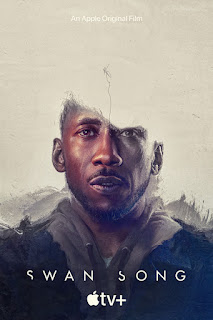
SWAN SONG

 Mahershala Ali     Naomie Harris     Glenn Close     
Awkwafina     Adam Beach     Lee Shorten


            This bit of sci-fi poses some interesting moral and ethical questions about the extent to which one could/should make a valiant attempt to spare his family grief and suffering.  Cameron’s (Ali) wife Poppy (Harris)—normally a vivacious, perky kind of woman—had undergone a severe reaction when her twin brother was killed, and if he could protect her from the potential for that to happen a second time, he is seriously considering participating in a medical experiment as a solution.

            Cameron, a commercial artist given to presenting his spontaneous drawings of those he meets to them, has been experiencing the effects of a brain disorder for some time, but hasn’t had the courage to tell Poppy.  They have a young son and another child on the way, comprising a most happy family.  When his disease worsens, Cameron is presented with a most unusual option.

            Arralabs is experimenting in making molecular copies of terminally ill patients—not just their bodies and physical appearance but all their memories from the time they were born, as well as their unconscious mind—as a way of preserving family relationships and avoiding grief after a major loss.  It boggles the mind to think about, and as you see how the process works there is definitely an eeriness about it.  You see the clone being developed in the lab, and indeed he looks exactly like Cameron.  

            The process goes on for a number of weeks for a full transition to be completed, so Cameron has some time to prepare—and even back out—although after a certain point dropping out won’t be possible.  The clone’s memories of the transformation will be erased, after which, he will be Cameron.  Cameron must then bear his own fate alone, albeit on Arralabs’ extensive well-kept, scenic grounds in the Pacific northwest.  

            Dr. Scott (Close, embodying the ideal doctor—warm, direct, sympathetic, informative) has given Cameron a detailed description of what to expect and the terms of the contract.   Whenever he has doubts, she informs him of his options, and although she makes it clear all of this is his own choice, she encourages him to stick with the plan for the sake of his family.

            Swan Song, written and directed by Benjamin Cleary, skillfully and realistically portrays the kinds of dilemmas and considerations that one would encounter in considering such a proposal at this.  He depicts research hospitals and staff as caring and informative—just as one would hope to—and does—find in good research centers.  And he shows (thoughtfully enacted by Ali) the degree of ambivalence the research subject will undergo in making such a momentous decision.  The Lab has arranged for Cameron to see his clone interacting with his family at home, so he must deal with all the emotions that brings up for him.

            As a futuristic solution to the problem of loss and grief, I appreciate this slant on how things could be at some point in the future.  The world is changing at a rapid pace, so it is within the realm of possibilities that such a system could be an option.  (I’m avoiding, of course, how much it would cost and who would pay for it.)


This adventure into the sci-fi world of human replication offers an intriguing new idea for managing loss and grief.


Grade:  B                              By Donna R. Copeland

Thursday, October 7, 2021

NO TIME TO DIE

Daniel Craig     Ana de Armas     Rami Malek     Lea Seydoux     Ralph Fiennes

Christopher Waltz     Jeffrey Wright     Lashana Lynch     Ben Wishaw     Naomie Harris 

            Quintessential Bond with the complex plot, hair-raising chases, pretty women, and lots of booze and gadgets.  Bond (Craig)—who has “disappeared” after seeing that arch-enemy Blofeld (Waltz) is incarcerated—is found in Jamaica by his old friend, CIA officer Felix Leiter (Wright), after Bond has just unceremoniously put his girlfriend Madeleine (Seydoux) on the train because of his suspicions about her.  She is heartbroken, proclaiming her innocence, and walks down the aisle seeing him in passing windows as the train leaves the station—an eloquent graphic image—thanks to Linus Sandgren (La La Land, The Hundred-Foot Journey, American Hustle), whose photography in the film is impressive throughout.

            Leiter points out that an important scientist, Valdo Obruchev (David Dencik) (has been abducted and needs to be found to prevent a scheme that could result in the death of millions.  The plot thickens from there, with Bond having to confront forces of which he was previously unaware.  It brings him into contact with his old boss at British Secret Intelligence Service, M (Fiennes) and staff, and tensions he now encounters and must manage between the U.S. CIA and British Intelligence.  Most touchy is the fact that M has assigned another agent, female Nomi (Lynch), to be 007.  This awkward situation must be dealt with because the old 007 wants to be involved in the case because it still seems to be connected with Spectre’s Ernest Blofeld (Waltz), whom Bond had put in prison.

            The most alarming danger comes from an evil man, Llyutsifer Safin (Malek), who has a poison plan that threatens millions across the world.  Getting to him is of course a tall order, and will require cooperation among all the parties involved, including international interests.

            The film is overly long with too many implausible chases and fights—as are found in most/all action films.  But it is successful in gripping intrigues and nail-biting dilemmas.  Daniel Craig is at his best in portraying for his last time the brave strategist Bond is known to be, with the additional acquisition of personal commitment and less womanizing.  He comes across as actually gallant at times.  

            A bright spot in the deluges of combat is shown by Ana de Armas as Paloma.  She kicks a.. impressively and with a little bit of humor, giving the viewer frequent “so there!” satisfactions.  Bad guys like Blofeld and Safir send plenty of chills up the spine, both because of their physical appearances and their evil nature.  Seydoux lacks some of the glamour and keenness of mind that Bond women usually have, but Lashana Lynch, the new 007, is appealing in her level-headedness and combat skills.  Lynch attributes part of her character’s success to the contributions of Phoebe Waller-Bridge to the script.  Hans Zimmer’s music for his first Bond film adds color to the action, and has just the right number of references to music in previous Bond films, most notably, the recognizable “suspense” motif.  Billie Eilish singing the title track co-written by her and her brother Finneas O’Connell provides additional inspiration.


No Time to Die will reward fans of the Bond films with plenty of intrigue and spine-chilling tension.  


Grade:  B+                            By Donna R. Copeland


Thursday, November 3, 2016

MOONLIGHT

Mahershala Ali     Alex Hibbert     Ashton Sanders     Trevante Rhodes     Naomie Harris     Janelle Monae     Andre Holland


           This is an artfully rendered film in which the viewer participates by filling in details that are omitted from the storyline, which proceeds from the main character’s childhood to adulthood.  Little/Black/Chiron is the character named differently, depending on his age and the section of the movie.  (The three very fine actors are Alex Hibbert, Ashton Sanders, and Trevante Rhodes.)  Little is picked on as a child because he’s not “hard”; he gets bullied and teased for being a “faggot”, and rarely stands up for himself.  His only friend Kevin (Jadon Piner, Andre Holland, Jharrel Jerome) tries to help him by telling him to fight back, but even in high school, he remains passive.  He’s a boy/man of few words, although the considerable turbulence inside shows on his face to an astute observer.
            When a kind-hearted drug dealer Juan (Ali) finds Little in a “drug hole”, he makes an effort to befriend him, find out where he lives, and who his parents are.  But Little is mostly mute, and it takes Juan’s girlfriend Teresa (Monae) to draw him out enough to find out where he lives.  When Juan takes him home, much is gradually revealed, and we begin to sort out the relationships in the community and why Little’s life is so hard.  We see Juan taking him under his wing, realizing he needs a father figure (which shows up later when Chiron adopts the appearance and occupation of this most important man in his life).
            The switching of actors (three for Chiron and three for Kevin) makes following the story a bit difficult, especially since Chiron says so little, but the actors are so skilled it doesn’t take long to sort it out.  The pace of the film and Chiron’s reticence is skillful in eliciting our empathy, and will hopefully have the effect of helping more of us understand and have sympathy for those caught up in the drug culture in poorer neighborhoods and the trials that gay people undergo even at a young age.  This is a picture of a segment of society that few of us have seen so tenderly portrayed.
            Co-writer with Terell McCraney, director Barry Jenkins has created a portrait of a boy and his milieu that is evocative while being so quiet, eloquent while making the main character Chiron so mute, and heartwarming in its highlights of kindnesses shown toward Chiron.  Its style and form seem groundbreaking to me.
             
An Impressionist painting of a gay child growing up in a black drug culture that elicits our empathy and sympathy.


Grade:  A                                    By Donna R. Copeland

Thursday, November 5, 2015

SPECTRE

Daniel Craig   Christopher Waltz   Lea Seydoux   Monica Bellucci   Ralph Fiennes   Ben Whishaw   Andrew Scott   Naomie Harris


          Increasing surveillance across the world and across institutions becomes the theme in Spectre, the latest James Bond adventure.  It would make George Orwell turn over in his grave, observes M (Fiennes) to O (Scott) after O reveals his plan to get 13 countries to agree to share their intelligence information with one another.  And we agree when we see an attempt to extend surveillance inside Bond’s brain later on to destroy certain memories.
        Now, however, Bond (Craig) is in hot water with his chief, M, after taking it upon himself to stop a terrorist attack in Mexico City.  Granted, there was considerable damage and bad press, which Bond doesn’t deny.  It’s just that his superiors are not aware that he has prevented a terrorist plot from coming to fruition.  That is, he has gotten onto the current scheme of his old enemy, Oberhauser (Waltz), who seems to have disappeared, but maybe not.  Knowing he is up to no good, Bond is determined to find him and sabotage his plans. 
        This will involve trips through multiple countries, leaving a trail of destruction behind, including humans, buildings, cars, helicopters, and planes.  When Bond calls on a Mr. White in an isolated cabin in wintry Austria, whom he thinks can lead him to Oberhauser, he has to promise to protect the man’s daughter, Dr. Madeline Swann (Seydoux).  Her life is in danger after White began to have second thoughts about the activities of Spectre.  But he also gives Bond information about how to locate Oberhauser.
       In many ways, Spectre is like the previous films in the series with the super heroic protagonist, the electronic gadgets in labs and cars, the need to buck the bureaucracy, thrilling car/helicopter/plane chases, unbelievable hand-to-hand combat, and beautiful women.  Unfortunately, when these components are repeated over and over in films across the years without much creativity, they get a ho-hum response.  As my friend and editor Evan Zimmerman observed, “If the filmmakers would spend less money on special effects and invest more in the script, it would be a much better movie.”
      There are clever jokes and quotable quotes sprinkled throughout the story, such as, “She wouldn’t let death get in the way of her job”, spoken by Bond about M (Judi Dench), who died in the last film, but left a message to Bond to listen to after her death.  There is a toast “To death”, spoken by one terrorist to another about a planned attack just before Bond shoots and kills them.  M tries to counsel O with “The license to kill is also a license not to kill”, advice that it not heeded.
      It may be that this franchise has run its course.  Daniel Craig has voiced his thoughts about it, implying that he doesn’t want to act in the next film, even though he has signed a contract for it.  The filmmakers (director Sam Mendes, the actors, musician Thomas Newman, and cinematographer Hoyte van Hoytema) are all gifted, but unless they can bring more creativity to future productions, they run the risk of appearing dated.

Go if you are a diehard James Bond fan.

Grade:  C                                                   By Donna R. Copeland


Friday, December 6, 2013

MANDELA: LONG WALK TO FREEDOM

Idris Elba     Naomie Harris     Terry Pheto


     The recent death of the universally revered Nelson Mandela (Elba) makes this biography based on his memoir even more important when it opens in many theaters on Christmas Day.  Its purpose is to give an overview of an extraordinary man’s life from his early years and coming-of-age rites, through his disillusionment with government when he practices as a lawyer, his early days as a sometimes violent activist, his 27-year imprisonment, and finally to his release and his stance on forgiveness and pacifism in his later years and subsequently being elected president of the Republic of South Africa. 
     One of the characteristics of Mandela throughout his life was his value of family, even during the times when he could not be present in the family setting during his days of activism and imprisonment.  Throughout his life and political activities, he never lost sight of children and their future.  He and his first wife, Evelyn Mase (Pheto), became estranged after the death of their daughter and his increasing involvement in politics.  Eventually, Evelyn left Mandela and took their son to live with her brother, and they divorced.  During the divorce proceedings, he began seeing Winnie Madikizela (Harris), whom he married six months after the divorce was final.  Winnie was active in the same movement as Mandela, and was arrested herself and jailed for a time.
     Throughout his imprisonment for sabotage and violence, first at Robben Island and later at Victor Verster, he and Winnie stayed married.  After his release, however, because of her continued advocacy of violence and his increasing belief that nonviolence was a better approach, he decided they should separate and divorce, despite his abiding love for her.
     In covering Mandela’s and Winnie’s political activities across so many years, the film can only highlight some of the important events, but it does a good job in showing Mandela’s transitions among different stands at different times on the need for violence.  He begins with a nonviolent stance, then feels forced after a police massacre to advocate for more aggressive resistance, and finally, especially during his imprisonment—during which time he studied a great deal—coming to his ultimate belief in the need for reconciliation among all races.  He firmly believed that this could only be achieved through forgiveness.
     This British production directed by Justin Chadwick with a screenplay by William Nelson is concise in presenting such a long history of a rich, colorful individual.  Its 2½ hour-long presentation holds interest throughout for this fascinating historical figure.  Idris Elba is marvelous in playing the title role, and even though he does not really resemble Mandela physically, his mannerisms and tone are entirely convincing.  Similarly, Naomie Harris captures the fiery personality of Winnie, and when the two actors are together on screen they obviously convey the deep affection that held the two spouses together for so long during many separations.
     Because Mandela’s life had so many significant events, I think it would be helpful for the viewer to inform him/herself to some extent beforehand to be able to follow such a fast pace.

A comprehensive look at the long, significant life of Nelson Mandela


Grade:  A- By Donna R. Copeland