Showing posts with label Adam Beach. Show all posts

Thursday, December 16, 2021

SWAN SONG

 Mahershala Ali     Naomie Harris     Glenn Close     
Awkwafina     Adam Beach     Lee Shorten


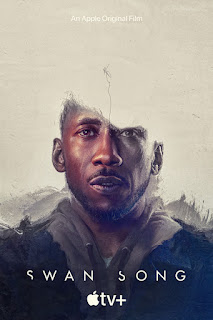
            This bit of sci-fi poses some interesting moral and ethical questions about the extent to which one could/should make a valiant attempt to spare his family grief and suffering.  Cameron’s (Ali) wife Poppy (Harris)—normally a vivacious, perky kind of woman—had undergone a severe reaction when her twin brother was killed, and if he could protect her from the potential for that to happen a second time, he is seriously considering participating in a medical experiment as a solution.

            Cameron, a commercial artist given to presenting his spontaneous drawings of those he meets to them, has been experiencing the effects of a brain disorder for some time, but hasn’t had the courage to tell Poppy.  They have a young son and another child on the way, comprising a most happy family.  When his disease worsens, Cameron is presented with a most unusual option.

            Arralabs is experimenting in making molecular copies of terminally ill patients—not just their bodies and physical appearance but all their memories from the time they were born, as well as their unconscious mind—as a way of preserving family relationships and avoiding grief after a major loss.  It boggles the mind to think about, and as you see how the process works there is definitely an eeriness about it.  You see the clone being developed in the lab, and indeed he looks exactly like Cameron.  

            The process goes on for a number of weeks for a full transition to be completed, so Cameron has some time to prepare—and even back out—although after a certain point dropping out won’t be possible.  The clone’s memories of the transformation will be erased, after which, he will be Cameron.  Cameron must then bear his own fate alone, albeit on Arralabs’ extensive well-kept, scenic grounds in the Pacific northwest.  

            Dr. Scott (Close, embodying the ideal doctor—warm, direct, sympathetic, informative) has given Cameron a detailed description of what to expect and the terms of the contract.   Whenever he has doubts, she informs him of his options, and although she makes it clear all of this is his own choice, she encourages him to stick with the plan for the sake of his family.

            Swan Song, written and directed by Benjamin Cleary, skillfully and realistically portrays the kinds of dilemmas and considerations that one would encounter in considering such a proposal at this.  He depicts research hospitals and staff as caring and informative—just as one would hope to—and does—find in good research centers.  And he shows (thoughtfully enacted by Ali) the degree of ambivalence the research subject will undergo in making such a momentous decision.  The Lab has arranged for Cameron to see his clone interacting with his family at home, so he must deal with all the emotions that brings up for him.

            As a futuristic solution to the problem of loss and grief, I appreciate this slant on how things could be at some point in the future.  The world is changing at a rapid pace, so it is within the realm of possibilities that such a system could be an option.  (I’m avoiding, of course, how much it would cost and who would pay for it.)


This adventure into the sci-fi world of human replication offers an intriguing new idea for managing loss and grief.


Grade:  B                              By Donna R. Copeland

Wednesday, April 21, 2021

PERCY VS GOLIATH

Christopher Walken     Roberta Maxwell     Zach Braff     Christina Ricci     Adam Beach     Luke Kirby


Percy is an irascible old farmer who’s had minor disappointments with his son who chose teaching rather than farming (which Percy’s ancestors from the old country had perpetuated), but he’s come to terms with that, and although he rarely expresses any emotions, he clearly loves his wife, son, and their community in Saskatchewan, Canada.

Award-winning Christopher Walken fills the order perfectly to play the part of Percy.  He is leading a relatively happy life in his early 70’s, has just invested in some new farming equipment, and his supportive wife Louise (Maxwell) and he are close to the townspeople in their small community.  They have no idea what’s ahead.

What’s ahead is giant corporation Monsanto suing Percy for some of his canola seeds resembling their patented ones.  It claims that every product harvested by Percy is actually theirs because he didn’t pay for their seeds, even though the seeds were (presumably) blown by the wind into his crop.  What becomes a matter of contention is how Monsanto’s seeds got mixed up with his.  He had followed instructions from his ancestors to save the best seeds from one year to plant the next year.  As far as he knew, these seeds were separate from any others.

Enter an environmental group wanting to make Percy’s case known to the world.  Rebecca (Ricci) is a young, passionate advocate for the cause against Monsanto for its GMO, and she encourages him to fight for his case.  His lawyer (Braff) tries to persuade him to settle with Monsanto to save horrendous legal fees involved in contesting the case.  

Percy is a practical man who relies on logic in making his decisions.  He is clearly torn about what to do.  Rebecca sees the issue on a global scale; so many farmers are being done in by Monsanto, and she urges him to fight, offering some incentives for getting financial help.  

            Unfortunately, the film is not clear about exactly how much help Percy actually receives from the environmental group.  He continues to fight his case all the way up to the Canadian Supreme Court.  But the film is timely and worthwhile in pointing out the encroachment of corporations like Monsanto on innocent people.  For example, “each GM seed is patented and sold under exclusive rights.  Therefore, farmers must purchase the GM seeds anew each year, because saving seeds is considered to be patent infringement. Anyone who does save GM seeds must pay a license fee to actually re-sow them.”

            The film directed by Clark Johnson is engaging, and highlights the current issue of multinational corporations having so much power over the common people.  It makes its point very well, and instead of delivering ultimate satisfaction, shows what efforts it takes to defend against large corporations bent on making a profit despite its repercussions.


Taking on a big corporation these days is an almost insurmountable problem for an individual.


Grade:  B                              By Donna R. Copeland


Thursday, January 4, 2018

HOSTILES

Christian Bale     Rosamund Pike     Paul Anderson     Timothee Chalamet    
Ben Foster     Wes Studi     Adam Beach     Rory Cochrane


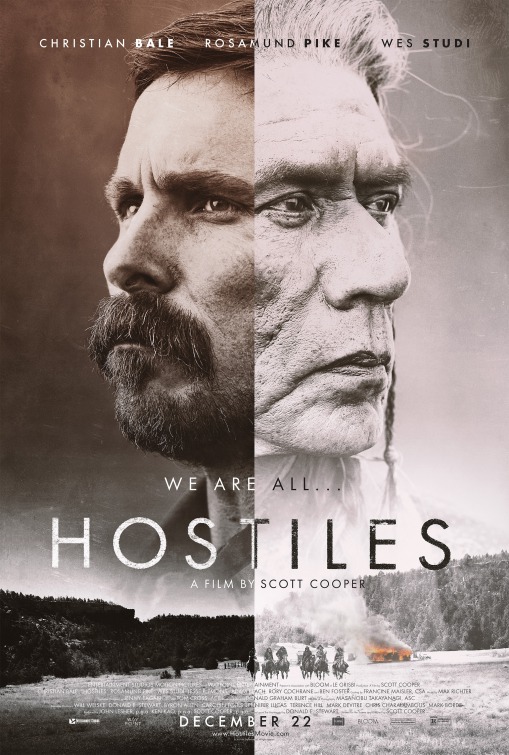
     Writer/director Scott Cooper is a master at highlighting genuine but dramatic human dilemmas, as seen in Out of the Furnace, Black Mass, Crazy Heart, and now, Hostiles.  Hostiles depicts the
US Army-Indian conflicts in the late 19th Century.  It opens with a brutal scene of the massacre of a family on an isolated farm/ranch.  American soldiers have experienced huge losses from Indian attacks, and some take great satisfaction in having retaliated in kind.  Cooper shows the varying ways in which soldiers cope with the killing.  One says, “If you kill enough people, you get used to it…but I hate losing my men.”  Another says, “I was just doing my job” [in slicing Apaches from stem to stern].  “An eye for an eye; a tooth for a tooth”, is his mantra as he reads the Bible regularly to reassure himself.
     Cooper is eloquent in showing men pushed to their limit, the ethical/moral dilemmas life presents, and—most heartening—men transformed by their experiences.  In Hostiles, we are captivated by Captain Blocker (Christian Bale in a stellar performance), who in the beginning sits patiently, but uncomfortably, when a trusted soldier under his command confesses to “Melancholia”, of which Capt. Blocker has no inkling.  That doesn’t mean he doesn’t care for this soldier—he values him—but depression?  That is not something he knows anything about. 
     Then he is assigned a task that is anathema to him—accompanying Apache chief Yellow Hawk (Studi) and his family to Montana, for burial at his birthplace.  The chief has cancer and is about to die, and the zeitgeist is turning toward being much more tolerant of the Indians.  President Harrison has ordered that the chief be accompanied by the U.S. military to Montana to assure his safe arrival.  Have you ever heard a silent scream?  That is Capt. Blocker’s response to the order, which he cannot refuse without jeopardizing his pension.
     What kind of transformation can a person like Capt. Blocker make?  It takes two warring parties traveling together (ahem...plus a woman?) to “humanize” him.  This film is about the profound emotional experiences that such a man as Capt. Blocker undergoes that go from silent listening and grunts to real, tender, sharing moments he has with those around him.  You don’t often see a cowboy/soldier self-actualized, but Cooper achieves just that.
     There are exemplary tender moments in this film, such as a simple “Thank you for your kindness” to a sympathetic laying of a hand on a person suffering in a tent, to a soulful “A part of me dies with you.”  The upshot is that Cooper understands so many aspects of men especially (not to entirely exclude women) and portrays them as few filmmakers have been able to do.
     Christian Bale brings out the character of Capt. Blocker in a way that perhaps no one else could.  His award-worthy performance (after stellar roles in The Big Short, American Hustle, and two Dark Knight films) should be recognized.  Supporting roles are well covered by Rosamund Pike, Wes Studi, and Rory Cochrane, but this is really Bale’s tours de force.

If you want to see a western with heart and substance, this is it.

Grade:  A                                    By Donna R. Copeland