Showing posts with label Rory Cochrane. Show all posts

Friday, December 3, 2021

ENCOUNTER

 Riz Ahmed     Lucian-River Chauhan     Aditya Seaton

Octavia Spencer     Rory Cochrane     Janina Gavanker


            Viewers’ expectations are set up immediately by opening scenes of comets flashing across the sky and close-ups of microorganisms that look like aliens.  But then we’re introduced to a typical American family—mom, stepdad, and two young boys.  The older child Jay (Chauhan) shows resentment toward the “new” dad and sits at the dinner table drawing pictures for his own father Malik (Ahmed).  He’s had frequent correspondence with him, in which Malik indicates that he has an important job fighting for the country.  And it is true he has been in the Marines, but that is only part of the story.  

            It’s best not to know much more than that before seeing the movie because it is packed with ambiguities, tension, and fear.  Suffice it to say that the dad appears suddenly to take his boys on a road trip, which he calls a “secret mission.”  His imagination charms them and they look forward to a big adventure. 

            This is a well-conceived movie directed by Michael Pierce and co-writer Joe Barton.  It leads you along from the set-up to something much more frightening, in a way, and to something that will prompt your thinking about some relevant and important truths.  As you see it, you ask questions, consider hypotheses, and do a bit of nail-biting when the action gets hairy.  But afterwards, you ponder the fundamental ideas the filmmakers want you to think about.

            The acting is superb; Riz Ahmed again proves his talent as he did in Sound of Metal playing a musician confronting deafness.  Here, he plays a devoted father—albeit one who lacks some parenting skills—whose intention is to rescue his children from an impending threat.  The young actors (Lucian-River Chauhan and Aditya Seaton) playing his children are also uncanny in their portrayals of real children put in threatening, sometimes traumatic, situations.  One is an eight-year old, the other a four-year old, and the scripting for them is outstanding in its accurate depiction of the way children those ages think.  It’s clear the two actors grasped what they needed to do, and they did it admirably with apparent precociousness.  

            Enter Octavia Spencer as the parole officer who lends common sense, genuineness, and perspicuity to all situations.  These are the attributes Spencer is so gifted in portraying, as seen in The Help, Hidden Figures,and The Shape of Water.  She shows that she is the only one in government who truly understands Malik, and appropriately asserts her presence in helping to resolve an incredibly tense situation.

            This is a movie about so many important subjects—parenting, children, guns, mental health, and governmental approaches to enforcement.  It dramatizes all of these in a suspenseful high-tension script that engages your value system as you assess the drama.  

            Director and co-writer with Joe Barton, Michael Pearce has been recognized for his 2017 movie Beast, as a promising filmmaker.  He lends credence to that accolade in his portrayal of a family drama that informs about parenting, mental health, and law enforcement in a manner that is realistic and compassionate.


Encounter thrills and chills, but also makes you think about important considerations in looking at families and human behavior.


Grade:  B                              By Donna R. Copeland

Thursday, September 13, 2018

WHITE BOY RICK

Matthew McConaughey    Jennifer Jason Leigh     Richie Merritt     Bel Powley
Rory Cochrane     Eddie Marsan     Bruce Dern     Piper Laurie     Brian Tyree Henry

     
     Recipe for disaster:  A lower middle class family living in Detroit in the ‘80s near a predominantly African-American section of town; FBI agents who are aware that the father is dealing guns illegally (although they’re not pursuing him) and that the son is developing friendships with the drug dealers in the black community, recruit Rick (Merritt) to become an informant for them.  
     What could go wrong?  A lot.  The trouble is, there are additional unanticipated factors and events that will complicate the picture.  The father, Richard Wershe (McConaughey), is an eternal optimist (“I’m a glass-is-half-full kind of guy”) who hasn’t done well, but sustains his dream of owning a string of video stores that will make him rich and able to take care of his kids, Rick and Dawn (Powley), and no longer need financial help from his parents.  He is good at communicating with his son about his business plan of selling guns (which he is clearly overly attached to) to get capital for his dream, but doesn’t seem to have the foggiest notion about guiding Rick or Dawn in sensible behavior and avoiding pitfalls and destructive temptations.
     So a lot goes down, with Rick getting more and more entrenched in shady dealings, Dawn making poor choices in the company she keeps, and Richard trying desperately to hold everything together.  It’s a statement about unmet needs, skimpy education, and desperate plans that have slim chances of success.  But the film also takes punches at black-white disparities in the criminal justice system, unethical practices of government agencies, and the inability of government to deal with economically ravaged cities such as Detroit in the 1980’s.  
     This is a difficult, painful film to watch from beginning to end, in its exquisite picture of flawed parenting, inadequacies in government service, seductiveness of drugs in distressed populations and the resultant crime, and the disparities in black vs. white lifestyles and communities and the criminal justice system.  The only positive element in all this mess is the example of family loyalty, which would be the primary support sustaining Rick for the rest of his life.
     White Boy Rick is a realistic picture of the 1980’s, but, unfortunately, shows that we have not made as much progress in social welfare and justice as we should have (or as I wished we would have). It could have made sharper connections between family dysfunction, social services, and the legal system, and how factors in all areas had such an impact on a young man’s life.
     The esteemed actor Matthew McConaughey clearly holds this film together in his ability to make the screen come alive when he is present, and then have this presence echo in the scenes where he is absent.  For his first film, Richie Merritt makes an impressive appearance, at home with his character and able to show a range of emotion.  Although not much more than a cameo, Bruce Dern and his brilliant blue piercing eyes gives us an extra treat.  Max Richter’s score with its doomsday tones and dramatic thrusts is a worthy accompaniment.

I realize that films like this need to be made, but they are painful to watch because of their realistic commentary about contemporary life.

Grade:  C                                By Donna R. Copeland


Thursday, January 4, 2018

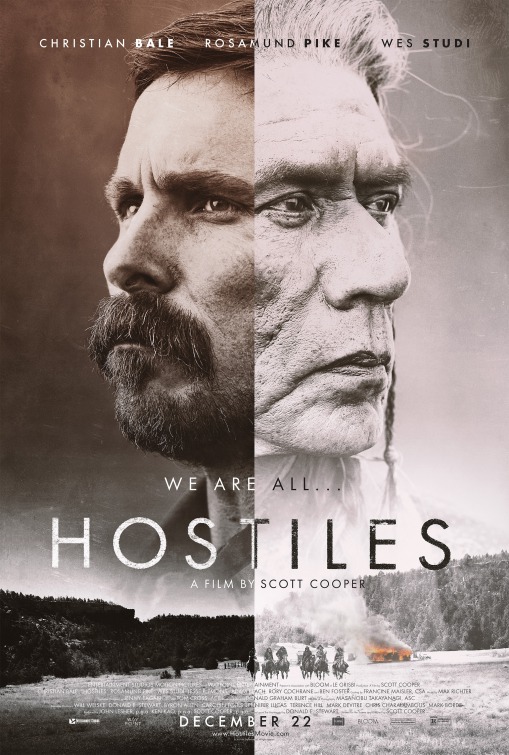
HOSTILES

Christian Bale     Rosamund Pike     Paul Anderson     Timothee Chalamet    
Ben Foster     Wes Studi     Adam Beach     Rory Cochrane


     Writer/director Scott Cooper is a master at highlighting genuine but dramatic human dilemmas, as seen in Out of the Furnace, Black Mass, Crazy Heart, and now, Hostiles.  Hostiles depicts the
US Army-Indian conflicts in the late 19th Century.  It opens with a brutal scene of the massacre of a family on an isolated farm/ranch.  American soldiers have experienced huge losses from Indian attacks, and some take great satisfaction in having retaliated in kind.  Cooper shows the varying ways in which soldiers cope with the killing.  One says, “If you kill enough people, you get used to it…but I hate losing my men.”  Another says, “I was just doing my job” [in slicing Apaches from stem to stern].  “An eye for an eye; a tooth for a tooth”, is his mantra as he reads the Bible regularly to reassure himself.
     Cooper is eloquent in showing men pushed to their limit, the ethical/moral dilemmas life presents, and—most heartening—men transformed by their experiences.  In Hostiles, we are captivated by Captain Blocker (Christian Bale in a stellar performance), who in the beginning sits patiently, but uncomfortably, when a trusted soldier under his command confesses to “Melancholia”, of which Capt. Blocker has no inkling.  That doesn’t mean he doesn’t care for this soldier—he values him—but depression?  That is not something he knows anything about. 
     Then he is assigned a task that is anathema to him—accompanying Apache chief Yellow Hawk (Studi) and his family to Montana, for burial at his birthplace.  The chief has cancer and is about to die, and the zeitgeist is turning toward being much more tolerant of the Indians.  President Harrison has ordered that the chief be accompanied by the U.S. military to Montana to assure his safe arrival.  Have you ever heard a silent scream?  That is Capt. Blocker’s response to the order, which he cannot refuse without jeopardizing his pension.
     What kind of transformation can a person like Capt. Blocker make?  It takes two warring parties traveling together (ahem...plus a woman?) to “humanize” him.  This film is about the profound emotional experiences that such a man as Capt. Blocker undergoes that go from silent listening and grunts to real, tender, sharing moments he has with those around him.  You don’t often see a cowboy/soldier self-actualized, but Cooper achieves just that.
     There are exemplary tender moments in this film, such as a simple “Thank you for your kindness” to a sympathetic laying of a hand on a person suffering in a tent, to a soulful “A part of me dies with you.”  The upshot is that Cooper understands so many aspects of men especially (not to entirely exclude women) and portrays them as few filmmakers have been able to do.
     Christian Bale brings out the character of Capt. Blocker in a way that perhaps no one else could.  His award-worthy performance (after stellar roles in The Big Short, American Hustle, and two Dark Knight films) should be recognized.  Supporting roles are well covered by Rosamund Pike, Wes Studi, and Rory Cochrane, but this is really Bale’s tours de force.

If you want to see a western with heart and substance, this is it.

Grade:  A                                    By Donna R. Copeland