Showing posts with label Scott Cooper. Show all posts

Thursday, October 28, 2021

ANTLERS

 Keri Russell     Jesse Plemons     Graham Greene     Amy Madigan     Jeremy T. Thomas     Scott Haze


            Be prepared; this is a scary shocking movie.  I was heard to yell out quietly twice.  Music by Javier Navarette, cinematography by Florian Hoffmeister, and production design by Tim Grimes set the stage, along with creepy and disturbing sounds that aren’t always identifiable.  Helmed by director Scott Cooper, the filmmakers have created a film that is successful in a number of respects, in addition to the above.

        For instance, the background of the two main characters, brother and sister Paul (Plemons) and Julia (Russell), includes child abuse, which gives them insight into the events they are discovering.  She is a dedicated teacher who picks up on signs in Lucas (Thomas), a student in her class, that everything is not all right at home.  And Frank Weaver (Haze) has a reputation and history in town that makes his current situation seem plausible.  Mix into these aspects Wendigo Indian mythology and you have the makings of a true horror show.  Producer Guillermo del Toro’s influences on production are palpable in a good way.            

        It’s great to see Keri Russell after her long stint on television in “The Americans.”  She brings some of her character, Elizabeth Jennings, from that series into this production with her inquiring mind and clarity of vision and purpose.  Even though he is a sheriff in their small town, her brother Paul has a tendency to deny what is in front of him and seek less troublesome explanations of events, but Julia goes right past him, at times doing some investigating on her own.  Plemons is to some degree effective in his role, repeating some of his others, namely Jake in I’m Thinking of Ending Things from a couple of years ago and Gary in Game Night, a 2018 movie, in which he seems a bit clueless.

            A stand-out is young Jeremy T. Thomas as Lucas, the child who is subjected to peculiar horrors on a daily basis and has come to realize that the role of parenting is on his shoulders long before he is ready.  His face and demeanor reflect all the emotional distress, fear, intimidation, and calm confidence that he is meant to display, and Thomas  appears to be a natural.

            I have a complaint in almost all the horror movies I see, that characters do things I would call foolish—even dumb.  After hearing sounds that should alert them to danger, they blunder right down into a dark cellar, out into the dark night, and in this case, opening a front door that no one has answered, behind which animal-like noises are heard from within.  These characters never ask for reinforcements before entering, often without a gun or even a flashlight.  Those scenes take my brain right out of the fantasy into a more practical mode.          

         Antlers is largely effective in achieving the aims of a horror flick that will set the viewer’s teeth on edge and tap into primordial fears common of most.

 A horror movie weaving in mythology, child abuse, and mystery into a gripping tale.


Grade:  B                              By Donna R. Copeland


Thursday, January 4, 2018

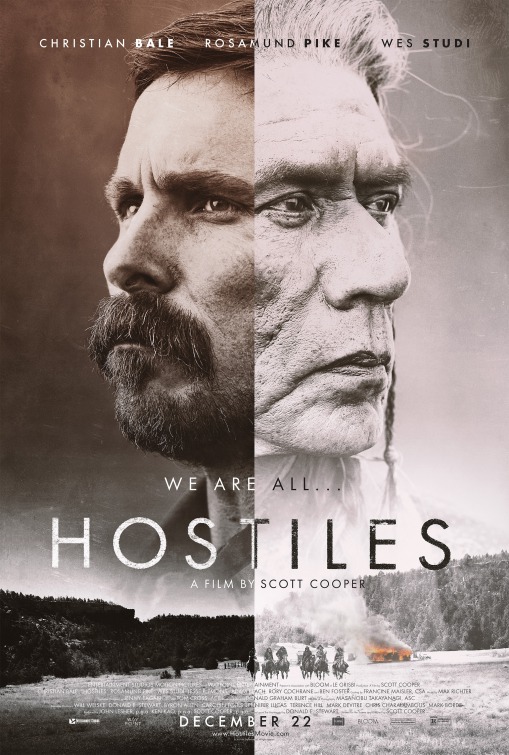
HOSTILES

Christian Bale     Rosamund Pike     Paul Anderson     Timothee Chalamet    
Ben Foster     Wes Studi     Adam Beach     Rory Cochrane


     Writer/director Scott Cooper is a master at highlighting genuine but dramatic human dilemmas, as seen in Out of the Furnace, Black Mass, Crazy Heart, and now, Hostiles.  Hostiles depicts the
US Army-Indian conflicts in the late 19th Century.  It opens with a brutal scene of the massacre of a family on an isolated farm/ranch.  American soldiers have experienced huge losses from Indian attacks, and some take great satisfaction in having retaliated in kind.  Cooper shows the varying ways in which soldiers cope with the killing.  One says, “If you kill enough people, you get used to it…but I hate losing my men.”  Another says, “I was just doing my job” [in slicing Apaches from stem to stern].  “An eye for an eye; a tooth for a tooth”, is his mantra as he reads the Bible regularly to reassure himself.
     Cooper is eloquent in showing men pushed to their limit, the ethical/moral dilemmas life presents, and—most heartening—men transformed by their experiences.  In Hostiles, we are captivated by Captain Blocker (Christian Bale in a stellar performance), who in the beginning sits patiently, but uncomfortably, when a trusted soldier under his command confesses to “Melancholia”, of which Capt. Blocker has no inkling.  That doesn’t mean he doesn’t care for this soldier—he values him—but depression?  That is not something he knows anything about. 
     Then he is assigned a task that is anathema to him—accompanying Apache chief Yellow Hawk (Studi) and his family to Montana, for burial at his birthplace.  The chief has cancer and is about to die, and the zeitgeist is turning toward being much more tolerant of the Indians.  President Harrison has ordered that the chief be accompanied by the U.S. military to Montana to assure his safe arrival.  Have you ever heard a silent scream?  That is Capt. Blocker’s response to the order, which he cannot refuse without jeopardizing his pension.
     What kind of transformation can a person like Capt. Blocker make?  It takes two warring parties traveling together (ahem...plus a woman?) to “humanize” him.  This film is about the profound emotional experiences that such a man as Capt. Blocker undergoes that go from silent listening and grunts to real, tender, sharing moments he has with those around him.  You don’t often see a cowboy/soldier self-actualized, but Cooper achieves just that.
     There are exemplary tender moments in this film, such as a simple “Thank you for your kindness” to a sympathetic laying of a hand on a person suffering in a tent, to a soulful “A part of me dies with you.”  The upshot is that Cooper understands so many aspects of men especially (not to entirely exclude women) and portrays them as few filmmakers have been able to do.
     Christian Bale brings out the character of Capt. Blocker in a way that perhaps no one else could.  His award-worthy performance (after stellar roles in The Big Short, American Hustle, and two Dark Knight films) should be recognized.  Supporting roles are well covered by Rosamund Pike, Wes Studi, and Rory Cochrane, but this is really Bale’s tours de force.

If you want to see a western with heart and substance, this is it.

Grade:  A                                    By Donna R. Copeland

Monday, September 14, 2015

BLACK MASS

Johnny Depp   Joel Edgerton   Benedict Cumberbatch   Kevin Bacon   Peter Sarsgaard   Adam Scott   Corey Stoll
          Black Mass:  an excellent film with a stunning cast that mesmerizes as the viewer witnesses one blatant crime after another.  It’s instructive in showing how a particular attachment formed in childhood renders the adult myopic in relation to someone who was his “savior” at a critical time.  I learned (from Wikipedia) that the title “Black Mass” is a metaphor for an unholy alliance, which I presume refers here to the FBI’s (particularly agent Connolly’s) alliance with a major criminal as an “informant.”
         Director Scott Cooper and the whole team deserve applause for just about every aspect of filmmaking:  The script (Mark Mallouk and Jez Butterworth, screenplay; Dick Lehr and Gerard O’Neill, book); the acting, particularly Depp, Edgerton, Cumberbatch, Bacon, Sarsgaard; makeup so well done I hardly recognized Depp; and cinematography (Masanobu Takayanagi) in artistic use of the camera.  The pacing made the film move in the best of storytelling technique.  Being unaware of the wealth of data about Jimmy “Whitey” Bulger’ criminal career, I expected much to be made of his years of escape, but the filmmakers made a wise choice in restricting most of the film to his criminal behavior and the FBI’s unwitting cooperation.  It was more than enough to fill a two-hour time slot.
            Black Mass serves as a study of personality and character; how people coming out of South Boston have developed a keen sense of loyalty, how one person goes in a criminal direction, another to political office, and still another to law enforcement.  Their background binds them together in a fascinating way.  Bulger is especially well fleshed out, so that we get a comprehensive picture of the complexities of his makeup (e.g., strict religious values in some areas, no conscience in others, and the knowledge and ability to use politeness and the concept of loyalty in evil intentions).
          The social commentary raises the question of how much one can change after coming from a humble background, at least one that makes moral compromise a part of everyday life, for which, I think, South Boston has a reputation.  This is seen in the Cumberbatch figure—Whitey Bulger’s brother—who apparently acquired a veneer of uprightness which brought him a political office and later a university presidency.  But when he had to make a compromise by communicating with his brother on the FBI’s most wanted list, he had to give up the presidency.
          I went reluctantly to the screening of Black Mass (I had seen the television documentary of Bulger’s capture), but was gratifyingly surprised by the substance of the film in terms of criminal behavior and the informed, comprehensive view of humans at their best and worst.

Go to Black Mass for its perceptive insight and understanding of human behavior.

Grade:  A                                    By Donna R. Copeland