Showing posts with label Christian Bale. Show all posts

Thursday, November 14, 2019

FORD v FERRARI

Christian Bale     Matt Damon     Caitriona Balfe     Jon Bernthal
Tracy Letts     Josh Lucas     JJ Field     Noah Jupe


     Yes, this film is about car racing, but it’s also about corporate culture and how it wields its power, showing how one major player can influence major events; and it’s about the friendship between two men, both of whom fit the emotional reticence of “macho” men, yet remain extremely close to one another. Thankfully, the wife and son of one of them provide balance to a testosterone-filled drama.
     Carroll Shelby (Damon) has a significant reputation as a racecar driver, but when his health forces him to stop, he becomes a designer of racecars, pulling in his good friend and driver, Ken Miles (Bale).  Shelby has a successful business designing and assembling sports cars, partly by virtue of his salesmanship and negotiating talent. Ken, on the other hand, is prickly, often offending others, and his car repair business is failing.
     When Lee Iacocca (Bernthal) of the Ford Motor Company begins to have aspirations of competing with Ferrari, current winner of multiple Le Mans races, he approaches Shelby, who has been the only American to have ever won the race.  He wants Shelby to partner with Ford to make a car that will give Ferrari competition.  
     What follows is the conflict between the creativity of Shelby and Miles with the Ford Corporation’s executive layers and its insistence on employees toeing whatever line it sets.  In addition, we see the struggle between middle-class “good ‘ole boy” war heroes and the upper crust of society.  We also get a glimpse of treachery that is sometimes characteristic of overly ambitious sorts and the self-entitlement of those born into wealth.
     The film tells an exciting, gripping story (more-so for those who are fascinated by cars and racing), written by Jez and John-Henry Butterworth and Jason Keller, based on Anthony Pritchard’s book (2011) about the Le Mans 1966 competition, pitting Ford versus Ferrari.  It’s well directed by James Mangold, but the jerky editing—especially in the beginning—detracts from its success.  The roar of sports cars around town accompanied by a soft “Chica Chica Boom Boom” rendition is fun, but when the races are full on, on the track, it is hard on the ears and head for those of us less enamored by the sport.
     Along with the excitement provided by a story about racing and personal conflicts, Christian Bale and Matt Damon are the hallmarks of the film.  They are the big draw, and lend their well-deserved stardom to boost the appeal.  Bale shows his range in all the different roles he has played (as a fighter in The Fighter, to an action figure in The Dark Knight films, to the Vice President of the United States in Vice, to name a few), and here as a cantankerous but brilliant race driver who keeps a cool head and is willing to take risks.  Damon’s Texas accent and persona come across as authentic, and it looks like he thoroughly enjoys savoring it the whole time. This role resembles his award-winning performance in The Martian, in its ingenuity and being able to think on his feet.  
     Lovely Caitriona Balfe as the wife of irascible Ken Miles, adds dimension to the story, and her pluckiness and daring is also one of the high points of the film. Most endearing, of course, is Noah Jupe as Peter Miles, Ken’s son.  Jupe mixes childhood reverence and joy showing keen perception on what Peter is learning, which, like the Molly Miles character, provides some levity to the male competitiveness.

Ford v Ferrari will be appealing primarily to car racing enthusiasts who will be fascinated by what went into the 1966 Le Mans race.

Grade:  B                                    By Donna R. Copeland

Monday, December 24, 2018

VICE

Christian Bale     Steve Carell     Amy Addams     Sam Rockwell     Alison Pill
Don McManus     Eddie Marsan     Tyler Perry     Jesse Plemons


     This well conceived production with incredible casting and screenplay should hold up against the sure-to-come backlash.  Its greatest value lies in bringing to life background events and personalities that changed our country forever during the period of Richard Cheney’s political career (roughly the 1970’s-2009).  The choice of having a narration, and the selection of the figure to do it, points to just one of the creative ways in which writer-director Adam McKay and his colleagues present the personal and political values and characteristics that aided Richard Cheney and his wife Lynne in attaining the power they ultimately achieved in the U.S. government.  
     The story starts out with Cheney as a wayward partier when it looked like he would simply be a neer-do-well.  Enter Lynne Cheney, who had already dealt with alcoholism in her father, and gave her husband clear messages about her expectations of him and the consequences that would ensue should he choose not to abide by her conditions. Dick Cheney shored up, and began his career in politics.
     His true character begins to emerge after he has made it to Washington as an intern and aligns himself with Donald Rumsfeld.  Rumsfeld’s mentoring meshes completely with the personality of Cheney already in place:  ambitious, crafty/secretive, uncanny perception and the ability to look ahead and plan.  In the course of his career, Cheney will undergo ups and downs, but he will always have an eye out for opportunity, with a solid backer/strategist in his corner, his wife Lynne.  
     Through significant political threats (such as significant and historically unprecedented upsets in White House administrations) to his ambitions and heart attacks, Cheney forges on, seemingly undeterred, without any apparent contemplation or self-examination about his actions.
     Vice charts these activities, showing how stable he is in his positions and machinations.  When George Bush becomes President, he sees a golden opportunity to push forward something he has learned about from his lawyer, David Addington, the “unitary executive theory”, in which the power of the executive is absolute; the President can, literally, do no wrong. Application of this idea paved the way toward eroding previously firm policies about civilian privacy, foreign policy, and wartime engagement and behavior.  “Where law ends, tyranny begins”—an idea first attributed to British philosopher John Locke (1689) and carved on the Supreme Court building, which flashes briefly during a scene in this film, a meaningful quote.
     Christian Bale is a wonder playing Dick Cheney, who he doesn’t ordinarily look or sound like.  But with the extra weight, prosthetics, and studious attention he gave to media in preparing for the role, Bale is a dead ringer.  Amy Adams as Cheney’s stalwart, tenacious, and adoring wife is likewise convincing.  This is as strong a casting I’ve ever seen for a picture, including Steve Carell as Donald Rumsfeld, Sam Rockwell as George Bush (the younger), and Alison Pill as Liz Cheney.  Bale and Adams will almost certainly be named during the award season coming up.
     Adam McKay’s writing and direction of a subject that is sure to be controversial is, probably, one of his best, even taking into account The Big Short, which won an Oscar for screenplay.  I fully expect Viceto reap accolades during the awards season.

Demonstrates the power of drama in relating some significant historical transitions in the U.S.

Grade:  A                                    By Donna R. Copeland

Thursday, December 6, 2018

MOWGLI: LEGEND OF THE JUNGLE

Voices of:  Cate Blanchett     Christian Bale     Benedict Cumberbatch     Peter Mullan 
 Andy Serkis     Tom Hollander     Naomie Harris     Freida Pinto
Rohand Chand as Mogli and Matthew Rhys as a researcher


     I’m a bit puzzled as to why this movie was made, following so closely upon the very successful 2016 film, “The Jungle Book”, a Disney production based on the Rudyard Kipling novel directed by Jon Favreau.  This version, with a screenplay by Callie Kloves and directed by Andy Serkis, pretty much follows the same story of a child being brought up by the animals when his parents are killed in the jungle by a tiger named Shere Khan (Cumberbatch).  Mowgli (played here by Rohand Chand) tries valiantly to keep up with his “pack” (tested in a race), but when he starts to come of age, it is clear that he can’t keep up and that he is becoming more and more like a human man. His two main advisors, panther Bagheera (Bale) and bear Baloo (Serkis), see to it that he joins the group of villagers who live nearby.  That’s not the end of the story; heroics will follow.
     The strongest asset of this Mowgli lies in a stellar cast.  Cate Blanchett as the initial narrator and embodied as the python Kaa delivers authoritative/threatening/protective lines in a voice that conveys the message very clearly.  Christian Bale and Andy Serkis serve as the wise overseers of the pack and of Mowgli that connotes both patriarchy and loving concern.  Benedict Cumberbatch issues ferocious, lip-smacking threats that seem even more threatening with a British accent. And finally, Rohand Chand is successful in convincing us of a feral child gradually becoming acquainted with his own tribe.  
     Aside from this version of The Jungle Book being an unnecessary, less successful remake, it does have a plot that is engaging and offers some good counsel to children in its message about the importance of social groups and cooperation to achieve goals, “specialness” not necessarily being an asset, and the value of wise counsel even when it feels uncomfortable. On the other hand, inserting the character John Lockwood (Rhys) as an alcoholic, boorish researcher having no human interest in his subjects, is offensive and disrespectful to the many anthropological/sociological scientists who have given us valuable information. I have no idea why this character was included.
     I expect that children may enjoy the color and the story about a child brought up in the jungle, but it is probably not one that will stay with them for long.  And it probably won’t engage their parents at all.  

More tales of a feral child and his adventures in the jungle.

Grade:  C                                    By Donna R. Copeland

Thursday, January 4, 2018

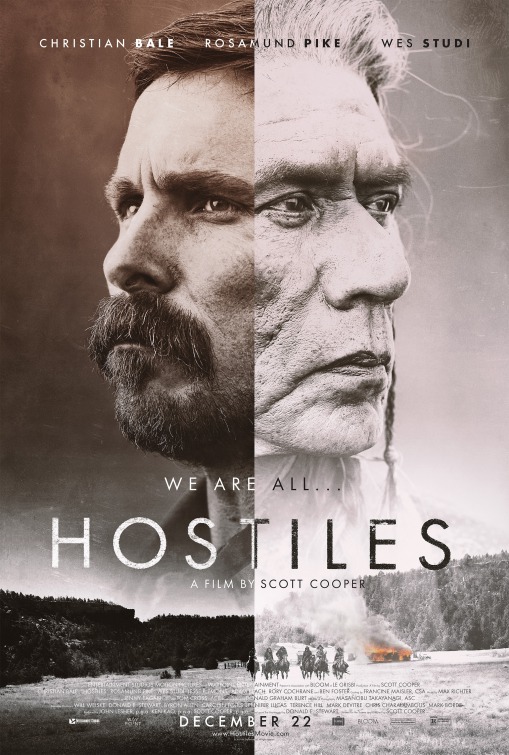
HOSTILES

Christian Bale     Rosamund Pike     Paul Anderson     Timothee Chalamet    
Ben Foster     Wes Studi     Adam Beach     Rory Cochrane


     Writer/director Scott Cooper is a master at highlighting genuine but dramatic human dilemmas, as seen in Out of the Furnace, Black Mass, Crazy Heart, and now, Hostiles.  Hostiles depicts the
US Army-Indian conflicts in the late 19th Century.  It opens with a brutal scene of the massacre of a family on an isolated farm/ranch.  American soldiers have experienced huge losses from Indian attacks, and some take great satisfaction in having retaliated in kind.  Cooper shows the varying ways in which soldiers cope with the killing.  One says, “If you kill enough people, you get used to it…but I hate losing my men.”  Another says, “I was just doing my job” [in slicing Apaches from stem to stern].  “An eye for an eye; a tooth for a tooth”, is his mantra as he reads the Bible regularly to reassure himself.
     Cooper is eloquent in showing men pushed to their limit, the ethical/moral dilemmas life presents, and—most heartening—men transformed by their experiences.  In Hostiles, we are captivated by Captain Blocker (Christian Bale in a stellar performance), who in the beginning sits patiently, but uncomfortably, when a trusted soldier under his command confesses to “Melancholia”, of which Capt. Blocker has no inkling.  That doesn’t mean he doesn’t care for this soldier—he values him—but depression?  That is not something he knows anything about. 
     Then he is assigned a task that is anathema to him—accompanying Apache chief Yellow Hawk (Studi) and his family to Montana, for burial at his birthplace.  The chief has cancer and is about to die, and the zeitgeist is turning toward being much more tolerant of the Indians.  President Harrison has ordered that the chief be accompanied by the U.S. military to Montana to assure his safe arrival.  Have you ever heard a silent scream?  That is Capt. Blocker’s response to the order, which he cannot refuse without jeopardizing his pension.
     What kind of transformation can a person like Capt. Blocker make?  It takes two warring parties traveling together (ahem...plus a woman?) to “humanize” him.  This film is about the profound emotional experiences that such a man as Capt. Blocker undergoes that go from silent listening and grunts to real, tender, sharing moments he has with those around him.  You don’t often see a cowboy/soldier self-actualized, but Cooper achieves just that.
     There are exemplary tender moments in this film, such as a simple “Thank you for your kindness” to a sympathetic laying of a hand on a person suffering in a tent, to a soulful “A part of me dies with you.”  The upshot is that Cooper understands so many aspects of men especially (not to entirely exclude women) and portrays them as few filmmakers have been able to do.
     Christian Bale brings out the character of Capt. Blocker in a way that perhaps no one else could.  His award-worthy performance (after stellar roles in The Big Short, American Hustle, and two Dark Knight films) should be recognized.  Supporting roles are well covered by Rosamund Pike, Wes Studi, and Rory Cochrane, but this is really Bale’s tours de force.

If you want to see a western with heart and substance, this is it.

Grade:  A                                    By Donna R. Copeland

Thursday, April 20, 2017

THE PROMISE

Oscar Isaac     Christian Bale     Charlotte Le Bon   Tom Hollander   James Cromwell


    The Armenian apothecary Mikael Pogosian (Isaac) has aspirations to become a doctor. With his parents’ encouragement, he is betrothed to a young woman in their village.  Her dowry will pay for him to get his medical degree in Constantinople, which he calculates will be two years, after which, he will return and marry his sweetheart.  Hence, the title, The Promise; little does he know what (individual, country, international events) will threaten that pronouncement.
     He’s doing well in his studies and makes friends with a fellow medical student who introduces him to a couple of his friends and they begin sampling the nightlife.  Chris Myers (Bale) is an American reporter writing stories about the war, and his girlfriend, Ana (Le Bon) is a tutor for the children of Mikael’s uncle.  She is Armenian like Mikael, and that serves as a bond between them.  Against their will—certainly Mikael’s, but also because Ana is unsure of Chris—the two develop an attraction for one another, and the love triangle will be interspersed into the story, which is mostly about the persecution of the Armenians.
     This juxtaposition of the triangle and the sieges against the Armenians has been criticized by critics of The Promise; but I liked having a human interest story for relief from the extremely brutal, merciless attacks that constitute most of the plot.  The interactions among the three are deftly presented, and don’t follow the usual outcome of such relationships—something else I appreciated.  Although, granted, the passion shown between characters at times is unbelievable under the circumstances.
     When the Ottoman Empire joins the Central Powers against the Allies in WWI, they simultaneously step up their attacks on the Armenians.  Religious hatred, animosities, and purges had been occurring for centuries in the region, and the Ottoman leadership is now deciding to systematically get rid of all Armenians.  (One and a half million of them were massacred during this period of time.)  Through a chain of events, Mikael’s medical student friend is conscripted into the military and Mikael is put in a slave labor force building a railroad.  After a chance accident, he escapes and heads home to his parents, realizing that they are now in danger. 
     Much horror transpires, and Mikael, his family, and his friends are drawn together in a bloody conflict against the Ottomans.  Toward the end of the film, Ana responds to Mikael’s urge for revenge with “Our revenge will be to survive.” 
     This is the Armenian story, which is well worth the retelling, although it is a brutal, bloody tale.  Director Terry George and writer with Robin Swicord, bring forth an account of the fate of the Turkish/Kurdish Armenians in history that officials in Turkey are still loath to admit occurred.  The cast of Isaac, Bale, Le Bon, and Cromwell are superb in their renditions and in their sensitivity to portray victims of state government discrimination.  The music of Gabriel Yared and cinematography of Javier Aguirresarobe greatly support and enhance the qualities of this film.

Ordinary lives caught up in the drama of history.

Grade:  B                                    By Donna R. Copeland


Friday, March 11, 2016

KNIGHT OF CUPS

Christain Bale   Cate Blanchett   Natalie Portman   Freida Pinto   Brian Dennehy   Antonio Banderas   Wes Bentley   Imogen Poots


          Beautifully filmed by Emmanuel Lubezki, Terrence Malick’s latest production falls short of his previous work, which I always enjoyed.  However, this production seems to be going over similar material as before, with even less plot to carry the viewer along.  Knight of Cups starts with a tale about a prince charged by his father with finding a pearl, but the son goes after the party life, forgetting all about the stone.  The king does not forget, and sends repeated messages to his son as reminders.  Finally, an earthquake catches his attention.
We’re then introduced to Rick (Bale), a melancholy figure who appears to be working through his tumultuous relationships with his father (Dennehy) and brother (Bentley) and tracing the paths he took with the four women in his life (Blanchett, Pinto, Portman, and Poots).  Regret is a salient emotion marking his memories of all. 
        His thoughts are marked by the rueful as well.  “Pieces of your life never come together; that’s damnation.”  “Dreams are nice, but you can’t live in them.”  “So much I was given; so much I left behind.”  “I spent 30 years not living life; I couldn’t remember the man I wanted to be.”
           The end contains short admonitions that seem to come from father to son.  “Love’s so rare that when you find it, don’t let it go.”  “Pay attention to this moment; everything is there, perfect and complete just as it is.”
        The characters don’t speak much in real conversation—we mostly hear voiced thoughts—so most of what they convey is in their movements.  The film is divided into sections that represent Tarot cards, i.e., The Hermit, The Hanged Man, The Tower, The High Priestess, Death, etc.  A closer viewing of the film might shed some light on the metaphorical meaning of each section.
       Much of the entertainment/enjoyment of the film will be derived from Lubezki’s cinematography, although Jungian scholars will no doubt understand the archetypes best, and derive more meaning from Malick’s work.

Obscure meanings, but Lubezki’s sumptuous cinematography compensates.

Grade:  C           By Donna R. Copeland