Showing posts with label Cate Blanchett. Show all posts

Wednesday, December 15, 2021

NIGHTMARE ALLEY

Rooney Mara     Bradley Cooper     Cate Blanchett     Willem Dafoe     Mary Steenburgen

Toni Collette     Ron Perlman     Tim Blake Nelson     Richard Jenkins     David Strathairn
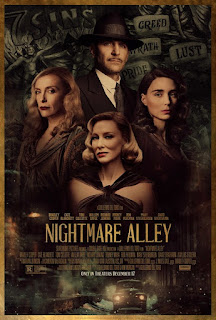
            It’s a nightmare all right.  It starts out with arson by a shady-looking character, and we follow him as he wanders around and ends up at a circus, where he manages to get hired.  Stan Carlisle (Cooper) is smart and a bit of a charmer, and quickly makes friends with the showrunner (Dafoe) and the fortune teller Pete (Strathairn) and his roommate Zeena (Collette), a reader of Tarot cards.  When he learns fast from Pete and begins to offer tips on improving Molly’s (Mara) electrical act, it becomes clear that he has worked in the circus before, and that he doesn’t mind conning people.

            But like all good sociopaths, he draws viewers into his web and we become fascinated with/question more and more of his actions.  Del Toro’s mastery in weaving stories that develop slowly across time, sustain glued-to-the-screen interest with spikes of anxiety and tension is clearly working in Nightmare Alley.  All the characters have potential to be a story unto themselves, but somehow Del Toro and his team integrate all of them into a coherent whole.  He co-wrote the screenplay with Kim Morgan and William Lindsay Graham who wrote the novel on which it is based.

            The filmmakers make the most of their cast headed up by Bradley Cooper who embodies a corrupt phoenix that keeps rising after destruction.  Conning is his game, and it is only the goons [Molly’s protector Bruno (Perlman), a wealthy stooge’s bodyguard, and a psychologist] who recognize his threat.  This role could be a high mark in his career.  Cate Blanchett as a psychologist caught up in his web is icily intriguing as a gorgeous blonde fellow schemer, and as always cinches her role, which I will take issue with below (the role; not the actress).  Rooney Mara pulls off a rather naïve ingenue who eventually picks up on the straits she is in, in an entirely convincing way.  Toni Collette, David Strathairn, and Richard Jenkins are highlights in their portrayals of quirky characters who gradually become endearing in a strange way.

            I found the production to be very entertaining and living up to the filmmakers’ reputation for making a good horror movie that gets into the psychology of human beings and all the myriad of characters that can and do emerge.  Speaking of psychology, I hope that viewers realize that the psychologist portrayed here committed any number of infractions that would revoke her license, let alone try her for crimes.  But as usual, filmmakers seldom consult with professionals in the profession they are portraying.  I got a chuckle out of Dr. Ritter’s sign:  Dr. Lilith Ritter, Psychologist, Ph.D.  It’s Dr. Ritter who earned the Ph.D., which should come with her name, not tacked on at the end.

            Crafts I especially liked about Nightmare Alley are the production design by Tamara Deverell and the cinematography by Dan Laustsen.  Both contributed so much to the mood and subject of the film.


Nightmare Alley has Guillermo del Toro’s mark of provocative storytelling that always includes observations about human nature and ethics.


Grade:  B+                            By Donna R. Copeland


Wednesday, December 8, 2021

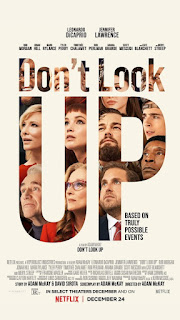
DON'T LOOK UP

 Leonardo DiCaprio     Jennifer Lawrence     Rob Morgan     Jonah Hill     Mark Rylance

Tyler Perry     Timothee Chalamet     Cate Blanchett     Meryl Streep     Ron Perlman


            In the beginning when astronomer Dr. Randall Mindy (DiCaprio) and his graduate student Kate (Lawrence) first discover a “planet destroying comet” headed for Earth they attempt to inform the proper authorities and American people that the country has only six months to get ready for it.  They’re wanting everyone to look up and see the moving light with a tail and understand it is coming our way.  The movie gets its title from those not wanting to accept that a comet is on its way and very dangerous; when it appears to the naked eye in the sky some advise others, “Don’t look up.”

         Well, the movie is a very funny parody about our political times, shining its light on climate change deniers, right-wingers, Fox News, the media’s exploitation of trivialities and current pop interests over serious news, and prominent Republicans who have their own ethics and their own interests at heart.  Topping the list is the President (Streep) with long blonde hair and a primary interest in getting re-elected [her empty-headed son Jason (Hill) serves as her Chief of Staff].  As expected, the President and her “scientific” appointees want to keep the news quiet and just “sit on it” for a while (i.e., until after the mid-terms).  DiCaprio has observed that “Adam [McKay] has woven an incredibly timely message about society, how we communicate, our current priorities, and the climate crisis into an absurdly funny yet important movie."  https://www.elle.com/culture/movies-tv/a37512771/dont-look-up-news-cast-spoilers-date/

       Upon hearing the news, the administration’s reaction and its influence spreads and influences those who similarly want to ignore science and scientists, ridicule them, and even become very nasty toward them on social media. The two scientists’ media advisors tell them to “keep it simple—no math”, to which Dr. Mindy replies, “But it is math!” Clearly, because he is a male and speaks a language many can’t/won’t understand, Dr. Mindy is made a darling; whereas Kate—younger, more articulate in plain language and more in touch with her emotions—becomes a pariah.  And gets arrested by the FBI more than once.

            Even the sexual boundary issues are brought into play, with a sensuous “Daily Rip” TV show host, Brie (Blanchett) seducing Randall and promoting him so long as he does her bidding.  (Her show with co-host, Jack Bremmer (Perry) is clearly a reference to “Fox and Friends” on Fox News.)   In Kate’s circle, the men are aware of the Me Too movement, such as one asking politely if he may touch Kate’s hair in a “nonsexual manner.”  These are anti-war anti-violence protesters who are gentle and respectful of women.  (The currently adored Chalamet plays one of them.)  

            The cast is huge and full of some of our best actors who are at the top of their game.  DiCaprio is almost unrecognizable in his slightly befuddled scientist mode.  It’s good to see Jennifer Lawrence back in action after a brief hiatus, and she plays the fiery young scientist most convincingly.  It’s too bad the writers had both scientists becoming uncharacteristically (for scientists) hysterical and verbally combative at times.  It undermined their believability in a significant way.

            A scene-stealer is Mark Rylance in his most surprising role:  that of an owner of a tech (phone) company who sees himself as a scientist because his company uses algorithms.  He comes across as an odd kind of person, but is a large donor to President Orlean’s campaign, so has her ear.  He convinces her of his alternative plan to deal with the comet, and we see how that works out.

            Entertaining is Ariana Grande’s performance as a pop star whose love life steals away the public’s attention from the impending danger to the outcome of her current romance.  It’s still another comment about the current attention span and the public’s and media’s focus on their idols.  Other actors who should be acknowledged are Rob Morgan as a Black scientist and Ron Perlman as the Administration’s willing sacrificial lamb (who didn’t have to serve when the mission he was on was aborted) but who nevertheless saw himself as a fighter and a hero.

            Adam McKay has had a significant role in movie productions including The Big Short and Vice, and the current TV series “Succession”, but Don’t Look Up seems to be a major shift into satirical parody.  He clearly has his finger on the times, and doesn’t mind at all skewering others when apt.  This is a “feel good” movie for those of us more politically liberal and concerned about the future of our democracy.  It describes so well the world we live in with all its puzzlements and outrageous people and behaviors.

            Don’t Look Up refers to the time when the deniers are the most desperate in wanting people to deny reality.


Don’t Look Up:  A must-see for everyone now living in a most perplexing age as far as people are concerned, but where science is concerned everything is quite clear.


Grade:  A-                             By Donna R. Copeland

Wednesday, August 14, 2019

WHERE'D YOU GO, BERNADETTE?

Cate Blanchett     Billy Crudup      Trojan Bellisaro     Kristen Wiig     Laurence Fishburne     James Urbaniak


     For a fun and rewarding experience, Bernadette fulfills the promise that most Richard Linklater films do. It’s about marriage, parenting, and family, but branches out further into “kookiness”, self-actualization, neighbor relations, and adventure, and with some scenes shown against the breath-taking seascapes for which Antarctica is famous.  Along with the seascapes, there are wonderful Escher-like shots that are meant to disorient the viewer, compliments of cinematographer Shane F. Kelly (A Scanner Darkly, Boyhood). 
     The first half of the story is a bit unnerving, with Bernadette (Blanchett) at her most manic, alternating between being a comedian and a complete nut job. Her husband Elgie (Crudup), a Microsoft techie, adored her initially when she had just won a “genius” award for architecture, but now seems incomprehensible of her frantic leaps in everyday living.  They have a daughter Becky (Bellisaro), who is very mature and astute at the young age of 12, and it’s clear that she has a closer relationship with her mother than her father.
     After visits with a psychiatrist (Greer) and an FBI agent (Urbaniak), Elgie tries to make things right, but he is not fast enough:  Bernadette has disappeared.  And this will not be the first and only time. Intrigued?  You should be.
     Linklater has a knack for bringing in the viewer as if he/she is a part of the family.  We identify with Bernadette and her need for privacy and alone time, with Elgie’s befuddlement/attraction to her, and the child Becky’s better understanding of the adults than they do of themselves.  All this brings the story alive for us, and we become invested in the outcome. 
     Cate Blanchett is a wonder to behold as an actress who can mesmerize while bringing home the truths of her characters.  In this case, she plays to Billy Crudup’s strengths as an actor who lives in his character to best advantage.  Kristen Wiig is perfect as a locally admired mother who, like Elgie, is mystified by women going against type.  Wiig has a way of bringing authenticity to her characters in a way that makes us laugh and cry at the same time.  This must be Trojan Bellisaro’s break-away moment playing an astute teenager who is thoughtful, loving, and perceptive to its best advantage.  I’m sure we’ll be hearing more about her in the years to come.

An award-worthy picture of contemporary personal/family drama that propels us forward.

Grade:  A                                    By Donna R. Copeland


Thursday, February 21, 2019

HOW TO TRAIN YOUR DRAGON: THE HIDDEN WORLD

Voices of:  Jay Baruchel   America Ferrera   F. Murray Abraham   Cate Blanchett   Gerard Butler
Jonah Hill   Kristen Wiig   Kit Harrington   Craig Ferguson


     The opening of this film set me up for disappointment with an extended battle in dim light in which the characters are not recognizable.  Suddenly, there looms a glorious, colorful view of the island of Berk, and things began to look up.  What follows, however, is the least interesting story of the three Dragon movies.  
     Here, the challenge for Hiccup (Baruchel) and Toothless, his dragon, is to meet the threat posed by Grimmel the Grisly (Abraham), a dragon-hunting warlord who has a nefarious plan to capture Toothless and make him the leader (alpha) of all the dragons he has captured.      He will send out his captive white Fury to beguile Toothless and bring him to Grimmel.
     In the meantime, since Berk is becoming overpopulated with dragons, Hiccup is trying to find the utopia for dragons that his father had told him about, the Hidden World.  If he could move the population there, they could live happily ever after in safety from the dragon hunters.
     Unexpected events happen in both Hiccup’s and Grimmel’s plans, the most profound being that Toothless and the white Fury stumble upon each other and it is love at first sight.  
     Writer/director Dean DeBlois has chosen different themes for this version of Dragons.  It’s partly about how true love involves dealing with loss and letting go of a loved one at the proper time.  Loyalty and heroism get woven in as guiding principles in love.  Hiccup retains his original concerns for the social good and acts upon them.  
     I did not find the story as compelling as in DeBlois’ previous two Dragon productions, but Gil Zimmerman’s cinematography and John Powell’s music are as impressive as they were in their earlier work.  

Dragon training and the search for utopia is interrupted by love.

Grade:  C+                                    By Donna R. Copeland


Thursday, December 6, 2018

MOWGLI: LEGEND OF THE JUNGLE

Voices of:  Cate Blanchett     Christian Bale     Benedict Cumberbatch     Peter Mullan 
 Andy Serkis     Tom Hollander     Naomie Harris     Freida Pinto
Rohand Chand as Mogli and Matthew Rhys as a researcher


     I’m a bit puzzled as to why this movie was made, following so closely upon the very successful 2016 film, “The Jungle Book”, a Disney production based on the Rudyard Kipling novel directed by Jon Favreau.  This version, with a screenplay by Callie Kloves and directed by Andy Serkis, pretty much follows the same story of a child being brought up by the animals when his parents are killed in the jungle by a tiger named Shere Khan (Cumberbatch).  Mowgli (played here by Rohand Chand) tries valiantly to keep up with his “pack” (tested in a race), but when he starts to come of age, it is clear that he can’t keep up and that he is becoming more and more like a human man. His two main advisors, panther Bagheera (Bale) and bear Baloo (Serkis), see to it that he joins the group of villagers who live nearby.  That’s not the end of the story; heroics will follow.
     The strongest asset of this Mowgli lies in a stellar cast.  Cate Blanchett as the initial narrator and embodied as the python Kaa delivers authoritative/threatening/protective lines in a voice that conveys the message very clearly.  Christian Bale and Andy Serkis serve as the wise overseers of the pack and of Mowgli that connotes both patriarchy and loving concern.  Benedict Cumberbatch issues ferocious, lip-smacking threats that seem even more threatening with a British accent. And finally, Rohand Chand is successful in convincing us of a feral child gradually becoming acquainted with his own tribe.  
     Aside from this version of The Jungle Book being an unnecessary, less successful remake, it does have a plot that is engaging and offers some good counsel to children in its message about the importance of social groups and cooperation to achieve goals, “specialness” not necessarily being an asset, and the value of wise counsel even when it feels uncomfortable. On the other hand, inserting the character John Lockwood (Rhys) as an alcoholic, boorish researcher having no human interest in his subjects, is offensive and disrespectful to the many anthropological/sociological scientists who have given us valuable information. I have no idea why this character was included.
     I expect that children may enjoy the color and the story about a child brought up in the jungle, but it is probably not one that will stay with them for long.  And it probably won’t engage their parents at all.  

More tales of a feral child and his adventures in the jungle.

Grade:  C                                    By Donna R. Copeland

Thursday, September 20, 2018

THE HOUSE WITH A CLOCK IN ITS WALLS

Jack Black     Cate Blanchett     Owen Vaccaro
Kyle MacLachlan     Renee Elise Goldsberry     Sunny Suljic


     In 1955, in an old mansion in New Zebedee, Michigan, strange and eerie things are going to happen.  Ten year-old Lewis (Vaccaro) is going to be moving in with his Uncle Jonathan (Black) after his parents were killed in a car accident, and he has no idea his uncle is a warlock. The house is sumptuous with a large bedroom for him—impressive!--But he will soon learn that things go bump—or something else—in the night.  He is alarmed at times, but he is a brave child, and even goes to investigate at times with his flashlight.  
     Then, Lewis is alarmed one night to see his uncle hacking into the wall with an axe, and even though his uncle’s strange neighbor Mrs. Zimmerman (Blanchett) urges Jonathan to reveal “secrets” to Lewis, that doesn’t happen.  It’s a bit strange anyway to hear Mrs. Z and Jonathan exchange insults (hilarious name-calling), but not in anger, and they immediately get back to solving problems.  Well, there is one big one that they have been wrestling with for ages.  
     Lewis is a bookish child (loves dictionaries and learning words like indomitable, which causes him to sound like an effete child) with silly goggles on his head, and even so while he comes across at school as a nerd, he is able to make a friend (at least temporarily).  But this bookishness turns out to be just what he needs to follow in his uncle’s footsteps, something he sorely wishes for after Jonathan’s demonstration of magic in the garden when it comes alive in the most delightful way.
     Reluctantly, Jonathan agrees to help Lewis become a warlock.  There is just one rule in the house, which is not to open a certain cabinet.  Lewis is an obedient child and he fully intends to comply, but neither he nor his uncle anticipate what might happen when Lewis invites his one friend, skeptical Tarby (Suljic), over to the house to impress him with what he’s learned about magic.  
     What follows is a major struggle that is exciting for children and adults to watch, and, gratifyingly for me, carrying positive messages.  They will see children and adults persisting in the face of adversity, staying on the side of good, and seeing that children need to be informed about what is going on in their lives and, moreover, including them in solutions.  Yes, children should be more respected.  
     Another positive piece of good modeling in the film is the egalitarian relationship between Jonathan and Mrs. Z.  He openly acknowledges her value to him and the impressiveness of her skills. She is portrayed as skillful, motherly, and a wise sage.  Jonathan is open both to her as a female and to Lewis as a child.  He models for men the value of listening to women and children, and then being willing to make changes.
     With the aid of screenwriter Eric Kripke, director Eli Roth has done a good job in adapting John Bellairs’ novel to the screen.  Music (Nathan Barr), cinematography (Rogier Stoffers), and production design (John Hutman) are of similar quality.  Jack Black nails every role he plays, as does Cate Blanchett, and their inclusion in any cast will elevate the film.  Young Owen Vaccara pulls for attention, although I have to confess I kept wanting to see Jacob Tremblay (Room) in that role.  Kyle MacLachlan and Renee Elise Goldsberry were wonderfully effective as villains.
     House with a Clock is a bit silly at times—which is not unusual for this type of film—but general audiences will enjoy it; there was applause for it afterwards at the screening I attended.  The special effects are good, but parents might note that it could be scary for young children who are afraid of the dark. 

A good choice for those who like a mixture of fantasy, comedy, and a bit of horror.

Grade:  C+                                    By Donna R. Copeland


Thursday, June 7, 2018

OCEANS 8

Sandra Bullock     Cate Blanchett    Rihanna    Sarah Paulson    Mindy Kaling    Awkwafina
Anne Hathaway     Helena Bonham Carter     Richard Armitage     James Corden    Dakota Fanning


     This clever, fun heist movie will engage you, intrigue you, and keep you entertained. Debbie Ocean (Bullock), sister of Danny (George Clooney) in previous Oceans movies, is just being released from prison after serving five years. She bounds out in the same outfit as when she went in—dressed for the evening in a trendy black outfit—assured that she can go anywhere and do what she wants with the $45 in her pocket. And we see how she begins to do just that with her light fingers and made-up stories as she ensconces herself into a fancy hotel and gets in touch with her seven specially talented friends and accomplices, the first being Lou (Blanchett), an Australian motorcycle enthusiast and sharp observer of human behavior  
     Debbie has used her time in prison well, figuring out detailed plans for living up to her family name, exacting a delicious revenge, and getting a ticket to the high life for life.  Debbie and Lou flesh out a strategy for a major heist of jewelry at one of THE social events of the year, the Met Gala, hosted by the iconic Vogue Magazine editor and artistic director of Conde Nast publications, Anna Wintour who appears as herself in the film.  
     Debbie and Lou assemble a motley team of thieves, smugglers, fashion and jewelry designers, forgers, and computer geniuses to play their roles in an intricately choreographed dance designed to net them all a sizeable share. What are they after? Cartier’s 150-million-dollar diamond necklace.  It will involve managing to get just the right celebrity to wear it to the ball.  
     Some of the funniest scenes include the eccentric fashion designer Rose Weil (Carter) flattering the always-aspiring celebrity Daphne Kluger (Hathaway) to go along with the plan to wear the necklace.  (Not hard at all, once she sees it.)  To watch Hathaway acting out preening and self-love in brilliant red lipstick in front of the mirror as she tries on various necklaces (the real diamond one is held out as a tease) will surely make you groan and laugh at the same time.  
     Also engaging are glimpses into the current lives of the fellow co-conspirators. Tammy (Paulson) is a contented mother who buys tens of bicycles on eBay when she has only one child.  Nine Ball (or “Baller”, if you prefer) (Rihanna) is a wizard on the computer, and most of the fun here is seeing others having to catch up with her; and like any good Asian has a relative, April (Midori Francis), to come through at a crucial time.  Mindy Kaling, as Amita, the jewelry designer, is trying to find a partner on an internet match site, but she will amuse and impress you with her rather naïve pronouncements coupled with design efficiency.  Constance (Awkafina) always shows up just in time, and even though she is simply collecting and sorting things, you smile at her dedication.  
     In Oceans 8, Director Gary Ross demonstrates his sensitivity toward women’s important issues, his delight in mixing up craftiness and comedy, and his flair in infusing excitement into a rather predictable plot.  The journey there is the point, and it will serve as a good time to relax and simply enjoy.
     This Oceans’ cast impresses with its unwavering skill and art.  The major protagonists and supporting actors deliver what we hope for and expect in a film of this kind.  Bravo to all!

This is a great movie for kicking back, relaxing, and letting the irony and truthfulness amuse you.

Grade:  B                                    By Donna R. Copeland

Thursday, November 2, 2017

THOR: RAGNAROK

Chris Hemsworth     Tom Hiddleston     Cate Blanchett     Mark Ruffalo     Tessa Thompson
Anthony Hopkins     Benedict Cumberbatch     Idris Elba     Jeff Goldblum     Karl Urban


     Thor has seen rocky times in two previous versions (Thor, 2011; Thor:  The Dark World, 2013), but in the hands of the gifted director Taika Waititi, Thor:  Ragnarok is deemed much more successful.  Additional factors contributing to quality are the writers (Eric Pearson, Craig Kyle, Christopher Yost, and original Marvel comics); the diverse, finely talented cast; the imaginative cinematography by Javier Aguirresarobe; and the special and visual effects. 
One of the distinctions of this action film is the inclusion of emotional elements (sibling rivalry, family issues, friendship, loyalties, humor) and depth of story, along with the stronger roles given to women, more so than almost any other action film, except for Wonder Woman.  Cate Blanchett as Hela and Tessa Thompson as a Valkyrie have special powers and hold their own in physical combat with the men. 
    In searching for the Infinity Stones, a holdover from the Avengers franchise, Thor (Hemsworth) is captured by the fiery demon Surtur (voice of Clancy Brown) who prophesies the end of Asgard (Odin’s realm) in an apocalypse called Ragnarok.  Thor is not about to let that happen, and escapes the demon, thinking he has prevented Ragnarok from happening.  But his father Odin (Hopkins) is missing, so he enlists the help of Dr. Strange (Cumberbatch) in locating him, which he does with a number of flashy demonstrations.  Thor talks to his father, and learns that his sister Hela (Blanchett), who has been in prison, will be released, will be claiming the crown, and will implement Ragnarock as the Goddess of Death.  It turns out that she has higher ambitions than her father, with wishes to control the whole world.  Thor decides to take her on, and goes to Asgard.
     But the black-clad Hela with a gorgeous body and an antler headdress is formidable, and not only does Thor lose his hammer, he is banished to the world of Sakaar, ruled by the weird Grand Master (Jeff Goldblum).  He finds his brother Loki (Hiddleston) already there, and sees that he has gained the confidence of the Grand Master.  The brothers are as competitive as always, and Thor winds up being made a gladiator scheduled to fight the current champion—none other than The Hulk (Ruffalo).  Thor is delighted to see him, but soon discovers that Bruce Banner is no longer present, and The Hulk fully intends to destroy him.  Eventually, Thor, Loki, the Valkyrie, and The Hulk wriggle out of the confines of Sakaar, and rally the support and arms they will need to thwart Hela’s ambitions.
     Back on Asgard, the people are unhappy with Hela’s merciless rule and destructiveness, and under the leadership of Heimdall (Elba), attempting to avoid Hela’s soldiers and escape to a safer place.  Thor and his team of “Revengers” will be fighting the battle of their lives when they arrive.
     Balancing out the action scenes are many allusions to a wry kind of humor.  Calling their team the “Revengers” is one; the Grand Master insisting on calling Thor the “Lord” of Thunder, rather than a god, rankling Thor, is another; and key people refusing to join the Revengers because they “don’t want to get into a family squabble” still another example.  Many of these jokes were sprinkled throughout the action sequences late in production, increasing the run time twenty minutes, but Waititi considers it well worth it.  I would agree.

Thor:  Ragnarok easily entertains with adventure, challenges, family fights, and humor. 

Grade:  A                                    By Donna R. Copeland

Saturday, March 11, 2017

SONG TO SONG

Ryan Gosling   Rooney Mara   Michael Fassbender   Natalie Portman
 Christian Bale   Cate Blanchett   Val Kilmer   Benecio del Toro   Holly Hunter   Iggy Pop


     This is a love story about one couple, but generalizes to a broader inclusion of people in general and the natural world.  It’s an Impressionist painting, with story, song, and photography artfully expressed.  Malick has a photographer’s eye that doesn’t follow along the usual frame of plot line, but he gives us impressionistic glimpses of people’s lives and the meanings of it they construct.  Rooney Mara as Faye narrates most of the film, tracing the “dance moves” that made her life what it became.  She starts out as a receptionist for a wealthy man (Fassbender) who is a major force in people’s lives (“people change when they’re around him”, she says).  People come to him as Faye does, hoping he can help them make more of their lives.
     But the man, who is some kind of Titan in the music industry, cannot resist exerting god-like control over people he is mentoring, even while exhorting them to “be free.”   Faye ends up having an affair with him, but after a time meets another man in his orb (Gosling).  The three play, cavorting and frolicking, hoping that it will last forever.  “We thought nothing could break us apart; we made music together.”  Ah, but we are human, and thus in this story the “song to song”, “kiss to kiss” begins, and after betrayal, disappointment, and disillusionment, it finally ends in forgiveness and mercy—at least in one case, which gives us hope.
    There are contrasts drawn between the experiences of men and women, people of privilege and those less fortunate, and individuals with varying degrees of insight and introspection.  The women here seem to be more introspective and self-critical, and searching at first for someone like the wealthy man who will complete them, like Faye the narrator.  Her successor (Portman) says to the same man, “What part of me do you want?  Take what you want from me”, unaware of the bargain she made upon first meeting him when she observed, “you have everything, everything I want.”
     The men have more of a competitive relationship, and their interests are expressed in that realm, with the mentor abrasively scolding the mentee for not achieving more, and the mentee accusing the other of stealing credit for his work, which could be the undoing of their relationship.  We get few clues or evidence of introspection on their part, except for one’s toward the end.
    We get glimpses of those who have come from more modest circumstances encountering the wealth of others, and aspiring to achieve the American dream.  Some are not willing to compromise themselves; others are.  Some learn from their experience and try to change; others are oblivious.  But all experience some kind of regret over the choices they made.
     As much as Song to Song is a portrayal of life as a series of dances and songs with varying partners, it’s also a commentary on trust, fidelity, truthfulness, openness, and honesty in human relationships.  Along with the endearing playfulness (Gosling’s character takes this to the max), we’re reminded of the anguish of betrayal and the pain of separation, but as well the possibility of a “new paradise” in forgiveness.
     The four talented main actors (Gosling, Fassbender, Mara, and Portman) show their skill in responding to Malick’s rather unique direction, and impress with their delightful athletic abilities in dancing and cavorting through all the scenes showing the blooming of new love.  Blanchett’s brief scenes show her power in conveying deep emotion, and cameo appearances of Bale, Kilmer, del Toro, Hunter, Iggy Pop, and still more, provide additional entertainment and scope.  A most impressive appearance is Patti Smith, singing of her love of the photographer Robert Mapplethorpe and through it, giving sound advice to Faye.
     Malick’s teaming with his award-winning partner in cinematography, Emmanuel Lubezki, makes Song to Song a true work of art visually, dramatically, psychologically, and philosophically.

A song of love in many of its manifestations, ending on a high note.

Grade:  A                                                By Donna R. Copeland

Friday, March 11, 2016

KNIGHT OF CUPS

Christain Bale   Cate Blanchett   Natalie Portman   Freida Pinto   Brian Dennehy   Antonio Banderas   Wes Bentley   Imogen Poots


          Beautifully filmed by Emmanuel Lubezki, Terrence Malick’s latest production falls short of his previous work, which I always enjoyed.  However, this production seems to be going over similar material as before, with even less plot to carry the viewer along.  Knight of Cups starts with a tale about a prince charged by his father with finding a pearl, but the son goes after the party life, forgetting all about the stone.  The king does not forget, and sends repeated messages to his son as reminders.  Finally, an earthquake catches his attention.
We’re then introduced to Rick (Bale), a melancholy figure who appears to be working through his tumultuous relationships with his father (Dennehy) and brother (Bentley) and tracing the paths he took with the four women in his life (Blanchett, Pinto, Portman, and Poots).  Regret is a salient emotion marking his memories of all. 
        His thoughts are marked by the rueful as well.  “Pieces of your life never come together; that’s damnation.”  “Dreams are nice, but you can’t live in them.”  “So much I was given; so much I left behind.”  “I spent 30 years not living life; I couldn’t remember the man I wanted to be.”
           The end contains short admonitions that seem to come from father to son.  “Love’s so rare that when you find it, don’t let it go.”  “Pay attention to this moment; everything is there, perfect and complete just as it is.”
        The characters don’t speak much in real conversation—we mostly hear voiced thoughts—so most of what they convey is in their movements.  The film is divided into sections that represent Tarot cards, i.e., The Hermit, The Hanged Man, The Tower, The High Priestess, Death, etc.  A closer viewing of the film might shed some light on the metaphorical meaning of each section.
       Much of the entertainment/enjoyment of the film will be derived from Lubezki’s cinematography, although Jungian scholars will no doubt understand the archetypes best, and derive more meaning from Malick’s work.

Obscure meanings, but Lubezki’s sumptuous cinematography compensates.

Grade:  C           By Donna R. Copeland


Friday, November 6, 2015

CAROL

Rooney Mara     Cate Blanchett     Sarah Paulson     Kyle Chandler


           Much has been made of the Lesbian relationship in Carol, but this award-winning film at Cannes (Best actress for Mara and Queer Palm for director Todd Haynes) contains much more in-depth exploration of women in the l950’s, and the trials and consequences in particular of these two women, Carol (Blanchett) and Therese (Mara), who simply don’t fit the mold.  They are independent thinkers, despite Therese’s complaint that “I say ‘yes’ to everything.” The two men (Chandler as Harge and Lacy as Richard) who claim they’re in love with Carol and Therese are completely taken aback and bewildered by the women’s resistance to being appendages.  The rejection is not only mystifying; it’s a painful narcissistic wound for them.
      Therese is a shop girl at a department store and when Carol comes in to buy a Christmas present in the Toy Department, they seem to have an instant awareness and attraction to one another.  Immediately, Therese shows that she’s not a typical 50’s girl when she says she didn’t care much for dolls as a child; she loved trains.  And Carol is then easily convinced to buy her daughter a train when she finds that the doll she was looking for is not in stock.
         This could have been the end of it, except Carol (unconsciously?) leaves her gloves on the counter and when Therese finds them and mails them to her along with the train set, Carol must thank her by offering to take her to lunch.
      The difference in class between the two women is noteworthy; Carol wears an expensive fur and goes to high-end restaurants.  When she orders a martini and quiche for lunch, Therese says she’ll have the same, although in her words, “I barely even know what to order for lunch.”  This difference in background becomes a significant issue throughout the drama that will take place.  The wealthier, older, more experienced Carol could be seen as “toying” with Therese for her own amusement; although this is not born out in the end when Carol shows moral/ethical strengths that are not obvious initially.
          The highly respected and admired Blanchett performs at her usual level of excellence with fine nuances and subtleties.  But Mara is equally good here in playing a younger woman unsure of herself and still in the process of finding out who she is and what she wants in life.  Director Haynes clearly understands women, and with screenwriter Phyllis Nagy has adapted Patricia Highsmith's novel for the screen with knowing grace, utilizing—along with the actors—the talents of musician Carter Burwell and cinematographer Edward Lachman.  Lachman uses light and screen shots to interesting effect, as does Burwell with music anticipating scenes and capturing mood.  The movie takes place at Christmastime, and the carol “Silver Bells” is perfectly apt as the two women embark on a hopeful journey together.
        Carol proceeds slowly and gently as the women’s relationship develops, although there are some jolting surprises that make the viewer sit up straight.  The ending is remarkable when Carol pleads her case in a custody battle with her husband at a meeting in the presence of lawyers, imploring them to keep the interests of their child foremost and arguing reasonably about hers and Harge’s joint responsibilities.  She warns that “a court battle could get ugly, and we’re not ugly people.”

Carol reminds women that even though we have a ways to go, contemporary women can be grateful for the progress that has brought us this far.

Grade:  A-                                               By Donna R. Copeland

Wednesday, October 28, 2015

TRUTH

Cate Blanchett   Robert Redford   Topher Grace   Dennis Quaid   Elizabeth Moss   Bruce Greenwood   Stacy Keach


          This Truth does need to be told to remind us of the importance of solid investigative journalism at a time when so much news has become infotainment.  The film is based on a book written by its lead character Mary Mapes (Blanchett) entitled Truth and Duty:  The Press, the President, and the Privilege of Power.  It gives Mapes’ account of a story she researched and produced on television’s “60 Minutes”, which questions President Bush’s service in the Air National Guard.  The first half of the film shows the painstaking efforts made by the CBS team to fact check their data to assure its veracity.  They sincerely think they are doing the best job they can as journalists.  Little do they realize the power of those who have competing interests in squashing such a newscast.  
          The coincidence of the story being aired during a Presidential election turns out to be meaningful.  Needless to say, it creates a firestorm of controversy.  Dan Rather (Redford), CBS’ news anchor reporting the story, is criticized, but nothing like the vitriolic attacks on Mapes, his producer.  Was it at least partly because she was a woman?  She had a reputation for aggressively going after stories, but initially CBS patted her on the back for this.  The film does a good job in showing that some of the things she is criticized for actually make her a good reporter. 
       But when CBS’ parent company, Viacom, enters the picture and begins to exert a strong arm over CBS—because of a competing interest—the writing is on the wall.  Rather sees it.  He bends to the forces and goes out gracefully.  Rather and Mapes are the best of friends/colleagues, but with very different personalities and backgrounds.  Having been abused by her father and well supported by her husband, she cannot resist a final major defense of the story (against her lawyer’s advice to mollify a committee stacked against her), which is not in her own self-interest.  But that’s a hero for you.
        Blanchett is clearly a star in this production—as she is in so many—by capturing the essence of the Mapes figure and empathically rendering it.  Her co-star Redford—while he does not physically resemble the newscaster—easily conveys the essence of Rather.  The actors’ chemistry onscreen is a valid reproduction of the deep connection between Rather and Mapes. 
        This is a film that will not receive its due primarily for political reasons, I think.  But it is well told even-handedly by writer/director James Vanderbilt (The Amazing Spiderman, 2012, 2014; Zodiac) and the actors. 

I am glad this account of Dan Rather’s undoing is being told, although it is a sad story.

Grade:  B                                    By Donna R. Copeland